Delayed Injury Symptoms After a Motorcycle Accident


Every article on this site is researched by our internal team, reviewed for legal accuracy against current Texas law, and held to State Bar of Texas advertising standards before publication. We do not publish content that overstates outcomes or makes promises about results.
Learn more about our
editorial standards .
Key Takeaways
- Adrenaline after a crash can mask serious injuries for hours or days, so feeling fine is not a medical clearance.
- Signing an insurance release before a full medical evaluation permanently ends your right to more compensation.
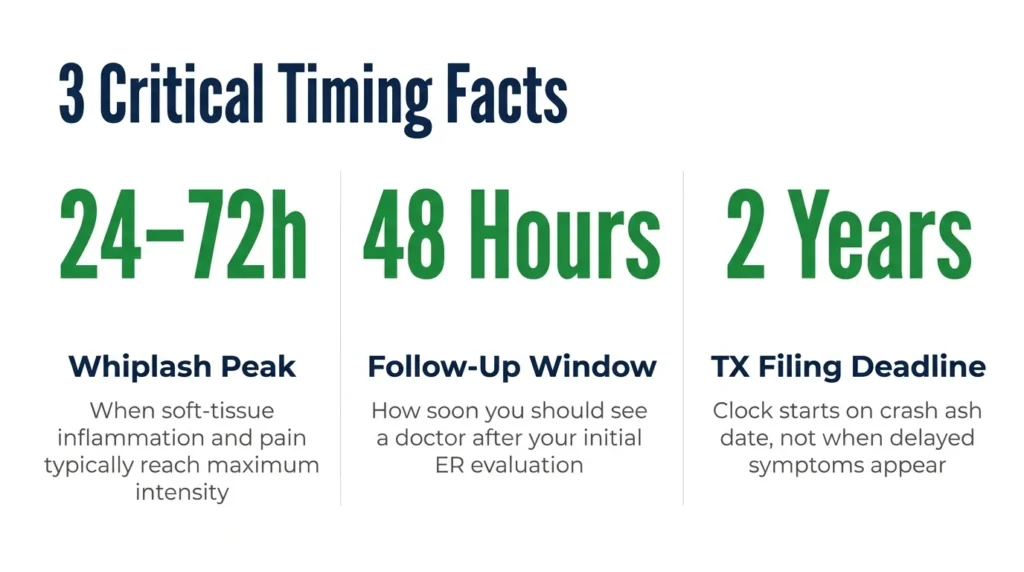
- Texas law gives you two years from the crash date to file a personal injury claim, not from when symptoms appear.
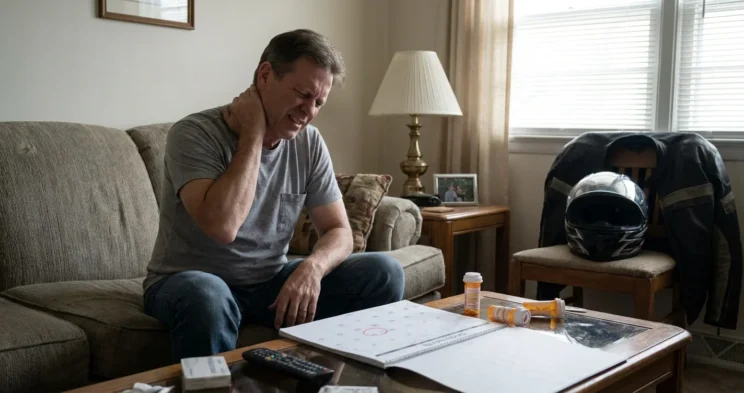
You walked away from the crash on the Westpark Tollway feeling shaken but intact. No broken bones, no bleeding, nothing that sent you to the hospital. Two days later, you wake up with a headache that will not quit and a stiffness in your neck that was not there the night before.
This is one of the most dangerous moments for a motorcycle crash victim. Not because the symptoms themselves are the crisis, but because of what is already in motion around them.
Why You May Feel Fine Right After a Crash
Feeling okay at the scene is not a medical clearance. Your body’s response to trauma is responsible for that.
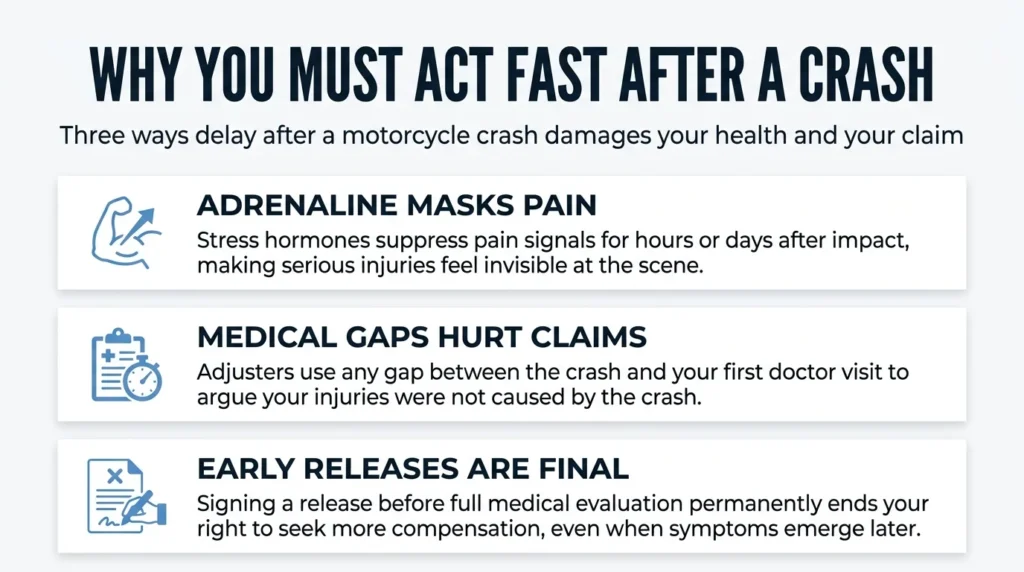
When you crash, your body floods with adrenaline and other stress hormones. These chemicals suppress pain signals, keep your heart rate up, and push you through the immediate threat. That response is what allowed people to survive physical danger for thousands of years.
In a modern crash, it creates a window of time where serious injuries go undetected, sometimes for hours, sometimes for days.
By the time the adrenaline fades and inflammation sets in, you are at home, away from a medical team. The opportunity for early documentation is gone. Riders who walk away from crashes that turn out to be serious are not being dramatic when symptoms show up later. They are experiencing exactly what the body does under trauma.
Four Injuries That Show Up Days Later
Motorcycle crashes produce four categories of injury with well-documented delayed onset. Each one can be present without symptoms at the scene.
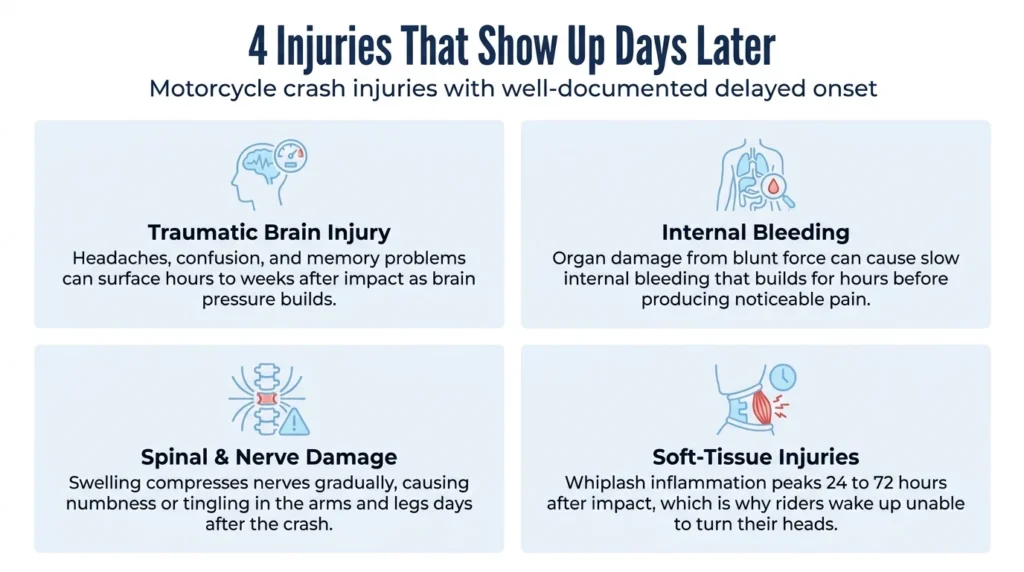
Traumatic Brain Injury
TBI does not announce itself clearly after a crash. Headaches, confusion, sensitivity to light, memory problems, and personality changes can surface hours to weeks after impact. A brain bleed, for example, may produce no noticeable symptoms while pressure builds inside the skull. Then, when it crosses a threshold, the symptoms can escalate rapidly.
Watch for worsening headaches, nausea, slurred speech, vision changes, or seizures in the days after a crash. Any of those signs is a medical emergency, not a reason to wait and see. A rider who felt mentally sharp at the scene may still be developing a serious TBI.
Internal Bleeding
The liver, spleen, and kidneys absorb significant blunt force trauma in a motorcycle crash. Slow internal bleeding from organ damage can build over hours or days before it causes noticeable pain. The NHTSA tracks motorcycle fatalities and injury outcomes for exactly this reason: what a rider feels at the scene does not reliably reflect what is happening internally.
Abdominal pain that develops after a crash, combined with dizziness, bruising around the midsection, or feeling faint, requires emergency evaluation. Internal bleeding cannot be ruled out based on how a rider feels at the scene. It requires imaging to detect.
Spinal & Nerve Damage
Spinal injuries often produce no pain immediately because swelling has not yet compressed the nerves. As inflammation develops over the following days, numbness, tingling, or weakness in the arms or legs can appear gradually. Soft tissue in the cervical (neck) spine, including muscles, ligaments, and tendons, can suffer micro-tears that do not produce significant pain until inflammation peaks, typically one to three days after impact.
The stiffness riders write off as normal soreness after a fall is sometimes the first sign of a cervical spine injury that will require significant treatment if left unaddressed.
Soft-Tissue Injuries
Whiplash is the clearest example of delayed onset: the head snaps forward and back during impact, straining the neck’s soft tissue, but pain and stiffness do not peak until 24 to 72 hours later as inflammation builds. Riders who feel fine that evening and wake up unable to turn their heads the next morning are not overreacting.
Why a Medical Gap Hurts Your Claim
A delay between your crash and your first doctor visit is not just a health risk. It is a legal liability. Insurance adjusters are trained to look for gaps in medical treatment.
When you wait three days or longer to seek care, the adjuster uses that gap to argue that your injuries were not caused by the crash, or that they are not as serious as you claim. The argument is simple: if you were really hurt, you would have gone to a doctor right away.
Without a medical record dated close to the crash, you face a documentation gap that is hard to close later. Your attorney can challenge the insurer’s position, but a strong chain of records starting from the crash date is far more powerful than one that begins a week later. Prompt care creates the documented link between the crash and your injuries that every part of the process, from insurer negotiations to any eventual legal proceeding, depends on.
The Settlement Trap: Why Signing Early Is Dangerous
Insurance companies move fast after a motorcycle crash. A quick settlement offer within the first few days of a crash is a business decision, not a goodwill gesture.
The goal is to close your claim before you know the full scope of your injuries. Once you sign a release of liability, you permanently give up the right to pursue additional compensation, no matter what symptoms or diagnoses emerge later. If your TBI was not yet diagnosed when you signed, the release does not account for that. The release does not care. The claim is closed.
Texas gives you two years from the date of the crash to file a personal injury lawsuit under Texas Civil Practice and Remedies Code (CPRC) § 16.003. Signing an early settlement forfeits that claim window voluntarily before you understand whether you need it. The clock starts on the crash date, not the day symptoms appear, and not the day a delayed diagnosis is confirmed.
Do not accept any settlement offer or sign any document from an insurer before you have received a full medical evaluation. Know the complete picture of your injuries first.
What to Do After a Motorcycle Crash
Even if you feel fine, the steps you take in the first 48 to 72 hours after a crash determine much of what is available to you legally and medically.
- Step 1: Go to the emergency room or urgent care immediately. Tell the medical team about the crash and describe every symptom, no matter how minor. This creates the first documented record connecting the crash to your condition on the crash date.
- Step 2: Follow up with your primary care physician or a specialist within 48 hours. A follow-up visit catches delayed symptoms that may not have been visible in the initial evaluation and adds another link in the documentation chain.
- Step 3: Document everything. Keep copies of every medical record, bill, prescription, and communication from the insurer. Photograph visible injuries at each stage as they develop over the days after the crash.
- Step 4: Do not speak to the insurance adjuster without an attorney. Adjusters ask questions designed to gather information that reduces your payout. Refer all adjuster calls to your attorney.
Talk to an Attorney Before It’s Too Late
If you were in a motorcycle crash and you are feeling the pressure to settle quickly, that pressure is not accidental. Angel Reyes & Associates has helped injured Texans work through exactly this situation for over 30 years.
We work on a contingency basis, which means you pay nothing unless we win, and we offer free consultations so you can understand your options without the stress of financial pressure. Our team is available 24/7 because crashes and the questions that follow them do not wait for business hours.
The cost of waiting can be permanent. Reach out for a free consultation and let us review what happened before you make any decision that cannot be undone.
Delayed Symptom FAQs
Can psychological symptoms like anxiety or PTSD show up after a motorcycle crash?
Yes. PTSD, anxiety, and depression are well-documented delayed responses to motorcycle accidents and can appear days, weeks, or even months after the crash. These conditions are compensable injuries under Texas personal injury law and should be documented by a mental health professional just like physical injuries.
What type of doctor should I see after a motorcycle accident?
Start with an emergency room or urgent care for immediate evaluation, then follow up with your primary care physician who can refer you to specialists. Depending on your symptoms, you may need a neurologist for head or brain concerns, an orthopedic specialist for spinal or bone injuries, or a physiatrist for soft-tissue rehabilitation.
Does Texas's discovery rule affect the two-year filing deadline for delayed injuries?
Texas courts have recognized a discovery rule that can delay the start of the two-year clock when an injury was not reasonably discoverable at the time of the crash. However, this exception is narrow and fact-specific, and courts apply it cautiously. The safest approach is to treat the crash date as your filing deadline and consult an attorney as soon as symptoms appear.
How long can delayed injury symptoms last after a motorcycle crash?
It depends entirely on the injury type and when treatment begins. Whiplash may resolve in weeks with proper care, while untreated soft-tissue injuries can become chronic and require months of therapy. TBI and spinal injuries can produce symptoms lasting years, and recovery timelines are difficult to predict without a proper medical evaluation.
Can I still pursue a claim if I did not go to the doctor right away?
Yes, a delayed visit to the doctor does not automatically end your claim, but it does make it harder. An attorney can help build a documented connection between the crash and your injuries even with a treatment gap, though the strength of that connection weakens the longer the delay.
About the Authors

Angel Reyes
Writer
Angel L. Reyes, III is the Founder and Managing Partner of Angel Reyes & Associates. A nationally recognized trial attorney and business leader, Angel has helped over 70,000 injury victims recover more than $1 billion since founding the firm in 1993. Named to the Texas Super Lawyers list annually since 2008, Angel brings Wall Street experience, Ivy League education, and a deep commitment to client advocacy. He is a frequent legal commentator and published author with extensive contributions to legal scholarship, trial strategy, and consumer protection.

Kyle Nicolas
Editor
Kyle Nicolas is the Web Content & SEO Manager at Angel Reyes & Associates. He has more than 10 years of experience as a marketing co...

Angel Reyes
Reviewer
Angel L. Reyes, III is the Founder and Managing Partner of Angel Reyes & Associates. A nationally recognized trial attorney and business...