Motorcycle Accident Compensation Examples in Texas


Every article on this site is researched by our internal team, reviewed for legal accuracy against current Texas law, and held to State Bar of Texas advertising standards before publication. We do not publish content that overstates outcomes or makes promises about results.
Learn more about our
editorial standards .
Key Takeaways
- Motorcycle injury values range widely, from tens of thousands to millions by injury type.
- A rider 51% or more at fault recovers nothing under Texas negligence law.
- Policy limits, fault, and documentation quality drive most of the settlement difference.
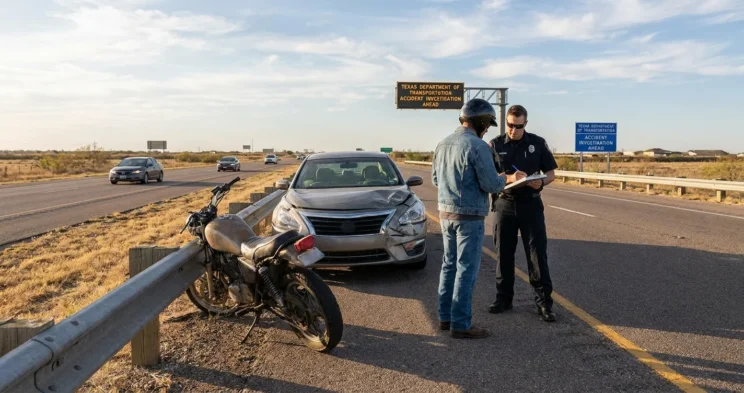
You were riding home from work on I-35 near downtown Austin when a driver turned left across your lane and put you on the pavement. Now the medical bills are stacking up, you have missed shifts, and an adjuster has floated a number that feels low.
The question keeping you up is simple. What is a crash like yours actually worth?
Compensation Ranges by Injury Type
What a motorcycle crash claim is worth depends almost entirely on the injury. The gap between a minor and a catastrophic injury is enormous. The figures below are illustrative ranges from publicly reported settlements and verdicts, not promises about your case.
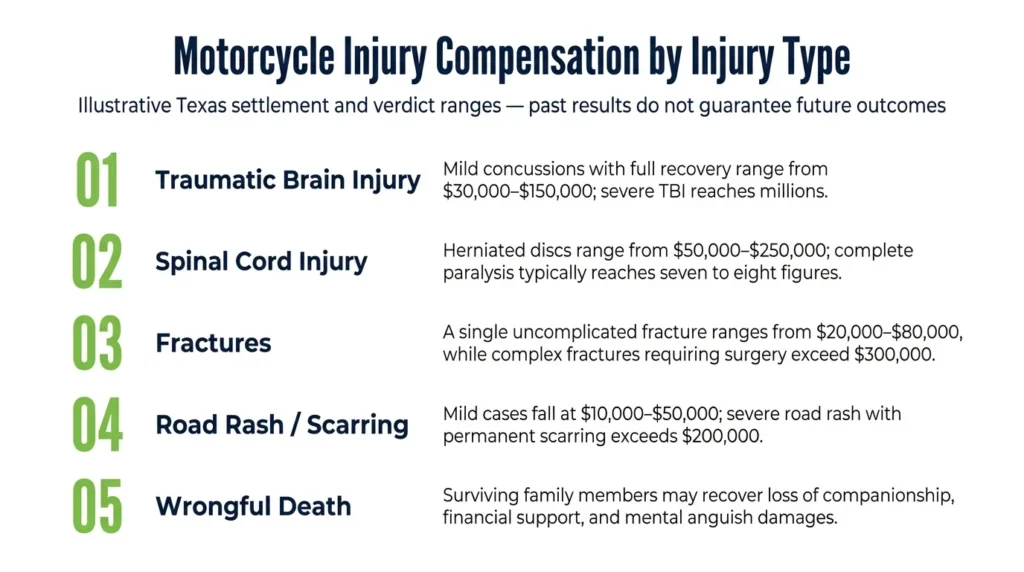
Use these motorcycle accident settlement amounts by injury type in Texas as reference points, not predictions. Two riders with the same diagnosis can recover very different amounts depending on fault, insurance, and documentation.
Traumatic Brain Injury (TBI) Settlements
A Texas motorcycle TBI settlement can span from tens of thousands of dollars to figures in the millions, because brain injuries run from a brief concussion to permanent damage. The more lasting the cognitive or physical deficit, the higher the value climbs.
Mild cases, like a concussion with a full recovery, fall in an illustrative range of roughly $30,000 to $150,000.* That figure reflects your medical costs, short-term lost wages, and pain and suffering.
Moderate TBI with extended recovery and lasting cognitive changes lands in an illustrative range of roughly $150,000 to $750,000. As the effects last longer, the non-economic damages for pain and lost quality of life become a larger share of the total.
Severe or permanent TBI extends into seven or eight figures, driven by lifelong care needs. In 2025, a San Antonio jury awarded $831 million in a case involving TBI and paralysis. That verdict is an extreme outlier, not a benchmark, and it shows how high catastrophic cases can reach.
If you want to understand how these injuries happen and what recovery looks like, our overview of the most common motorcycle accident injuries walks through each type.
Spinal Cord Injury Settlements
Spinal injuries carry some of the widest value gaps of any crash injury, from a herniated disc to complete paralysis. People often hear “back injury” and “spinal injury” as the same thing, but they are not, and the difference shows up in the numbers.
A herniated disc or soft tissue spinal injury falls in an illustrative range of roughly $50,000 to $250,000. Whether you need surgery and how long the impairment lasts move you within that band.
Partial spinal cord injuries, where some function is preserved, can climb into an illustrative range of roughly $500,000 to more than $2,000,000, a range supported by publicly reported Texas verdicts in commercial vehicle and serious crash cases.
Complete paralysis, whether paraplegia or quadriplegia, typically reaches seven to eight figures. Lifetime care costs alone often push the economic damages past $1,000,000.
Fractures & Road Rash Compensation Examples
Broken bones and road rash are the most common motorcycle injuries, and adjusters routinely undervalue both. These motorcycle crash payout examples in Texas show that even non-catastrophic injuries carry real medical costs and lost income.
Fracture Claims
A fracture claim can be worth far more than the break itself might suggest, because surgery, hardware, and months of therapy add up fast. The value tracks how complex the break is and how long it keeps you off your feet.
A single fracture to an arm, wrist, or collarbone that heals without surgery falls in an illustrative range of roughly $20,000 to $80,000. That covers your medical costs and short-term lost wages.
Complex or multi-site fractures that require surgery land in an illustrative range of roughly $75,000 to $300,000. Hardware costs, physical therapy, and a longer disability period lift the figure.
Pelvic or femur fractures with lasting impairment fall in an illustrative range of roughly $150,000 to more than $500,000. When the injury limits your mobility or your ability to work, the non-economic damages grow.
Road Rash Claims
Road rash gets dismissed as a scrape, but severe cases mean skin grafts, infection risk, and permanent scarring that drives up the non-economic damages. The injury is skin avulsion or degloving, and it can be far more serious than it sounds.
Mild to moderate road rash that needs no grafting falls in an illustrative range of roughly $10,000 to $50,000. Wound care and pain and suffering make up most of that figure.
Severe road rash requiring skin grafts, with scarring and infection, lands in an illustrative range of roughly $50,000 to more than $200,000. Disfigurement damages raise the non-economic share well above the medical bills.
Permanent scarring on visible areas like the face or neck can push an award higher than the medical bills alone would suggest. An attorney familiar with how Texas adjusters value road rash and scarring claims can help you identify non-economic damages that insurers routinely undercount.
Wrongful Death Compensation in Texas
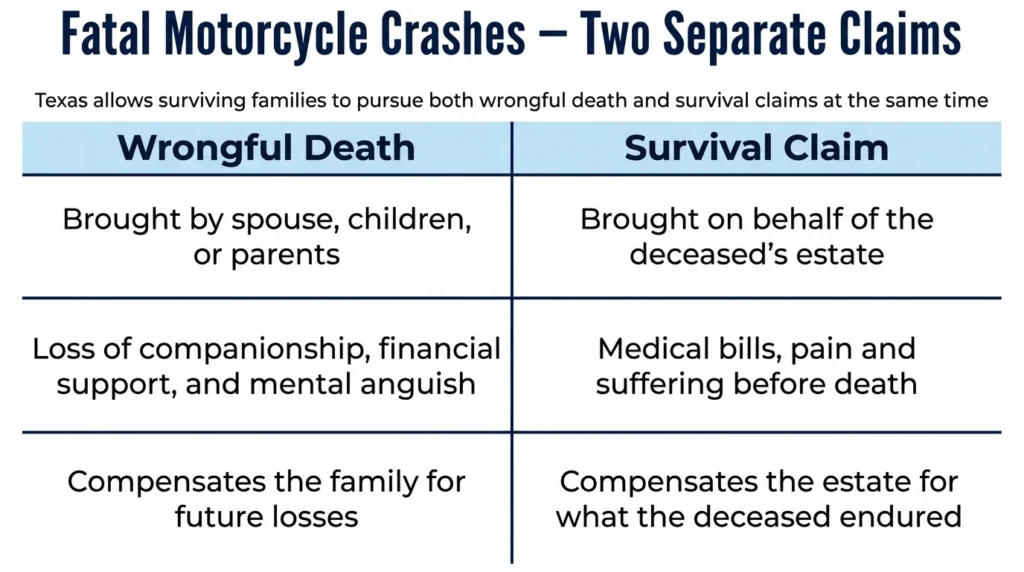
When a motorcycle crash is fatal, Texas law gives surviving family members a separate path to compensation through a wrongful death claim. This is a different framework from a personal injury claim, with its own eligible plaintiffs and damage categories. A Texas motorcycle wrongful death settlement varies widely depending on the family’s losses and the conduct that caused the crash.
Wrongful Death Claims
A wrongful death claim is brought by surviving family members and compensates them for what they lost when their loved one died. The Texas Civil Practice and Remedies Code (CPRC) section 71.004 limits these claims to the surviving spouse, children, and parents of the person who died.
Recoverable damages include loss of companionship, care, and guidance, lost financial support, the mental anguish the family suffers, and lost inheritance. Settlements and verdicts in fatal motorcycle cases vary widely. Cases involving a young breadwinner with dependents, or a defendant whose conduct was especially reckless, can reach seven figures.
Survival Claims
A survival claim is a separate case brought on behalf of the estate, not the family, and it covers what your loved one endured between the crash and their death. A family can pursue both a wrongful death claim and a survival claim at the same time.
The survival claim recovers the medical bills from the crash to the death, the pain and suffering the person experienced, and the earnings they lost during that period. This adds a layer of compensation a wrongful death claim alone does not cover, so families should know both can apply.
What Moves Compensation Higher or Lower
The same injury can settle for $40,000 in one case and $400,000 in another, and a handful of variables explain why. Fault, insurance limits, and the defendant’s conduct drive most of the spread across the motorcycle accident compensation examples in Texas above. The average motorcycle accident settlement in Texas is less useful than understanding what shifts your specific number.
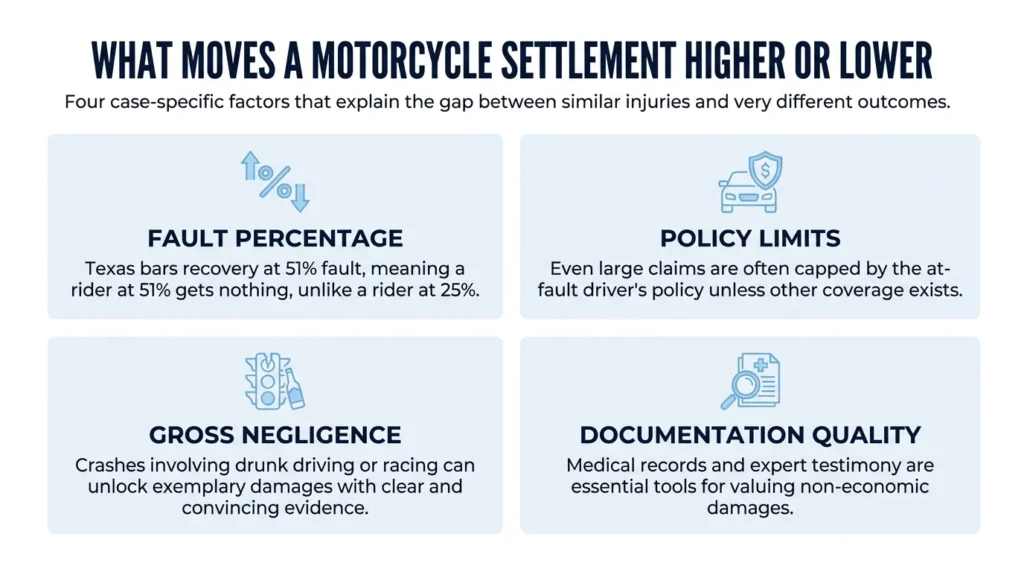
Texas follows a proportionate responsibility rule. Under the Texas Civil Practice and Remedies Code section 33.001, a rider found 51% or more at fault recovers nothing. Fault below that line reduces your recovery in proportion.
If you are 25% at fault on a $100,000 claim, you recover $75,000. Our breakdown of the Texas comparative negligence rule explains how adjusters apply it.
Insurance policy limits act as a practical ceiling. Even a valid seven-figure claim may recover only the at-fault driver’s policy limits, unless you carry underinsured motorist coverage or there are additional defendants to pursue.
Gross negligence can open the door to exemplary damages on top of your compensatory figure. Crashes involving drunk driving or street racing can qualify. CPRC section 41.003 requires clear and convincing evidence of gross negligence, malice, or fraud, and section 41.008 sets the cap on those damages.
Our explanation of how punitive damages are calculated in Texas covers the math.
Helmet use is a common pressure point. Insurers often try to cut offers by arguing a helmetless rider took on extra risk. Texas does not require helmets for riders over 21 who meet training or insurance requirements, but the tactic shows up anyway, and an attorney can push back on it in negotiation.
Documentation quality may be the variable you control most. Medical records, imaging, accident reconstruction, and expert testimony directly shape how an adjuster or jury puts a number on your non-economic damages. Riders who understand how Texas fault rules and insurance limits apply to their facts are better positioned to judge whether an offer reflects full value.
Talk to an Attorney Today
Knowing the ranges is one thing. Knowing what your specific crash is worth, and how to prove it, is where experienced guidance changes the outcome.
Angel Reyes & Associates has spent over 30 years helping injured Texans hold negligent drivers accountable. We have more than $1 billion recovered for clients across the state. We work on contingency, so there is no fee unless we win, and your first consultation is always free.
We are available 24/7 to take your call, and we serve all of Texas from more than 20 offices throughout the state.
Reach out to us for a free, no-obligation review of your options, and take a look at what past clients say about working with us. Se habla español.
*The figures and estimates given in this blog are examples and are purely illustrative for educational purposes only. Past results do not guarantee future outcomes. Every case is different, and only a licensed attorney can provide you with an accurate estimate and legal advice tailored to your specific case.
Motorcycle Accident Compensation FAQs
How long do I have to file a motorcycle accident claim in Texas?
Texas gives you two years from the date of the crash to file a personal injury claim under Texas Civil Practice and Remedies Code section 16.003. Missing that deadline generally bars you from recovering anything, so acting early to preserve evidence and document injuries directly protects your claim’s value.
Does a pre-existing injury affect my motorcycle accident claim?
A pre-existing condition does not prevent you from recovering compensation, but insurers will use it to argue that your current injuries are not crash-related. You can still recover for any worsening or aggravation the crash caused to a prior injury, and being upfront about your medical history with your doctor and attorney helps protect that recovery.
Can I recover compensation if I was a passenger on the motorcycle?
Yes. As a passenger, you can file a claim against the motorcycle operator, the driver of another vehicle involved, or both, depending on who was at fault. Passengers are rarely assigned fault in a crash, so Texas’s 51% rule typically does not reduce a passenger’s recovery.
What happens if the driver who hit me had little or no insurance?
If the at-fault driver’s policy limits are too low to cover your losses, your own underinsured motorist (UIM) coverage can make up the difference. Texas requires insurers to offer this coverage, so if you did not reject it in writing, you may have it on your policy even if you are unsure.
What is the difference between a settlement and a verdict in these examples?
A settlement is a negotiated agreement that resolves your claim before or during trial, while a verdict is a jury’s award after the case is tried. Both can produce significant compensation, but they follow different paths, and either can be reached at different stages of the legal process.
About the Authors

Angel Reyes
Writer
Angel L. Reyes, III is the Founder and Managing Partner of Angel Reyes & Associates. A nationally recognized trial attorney and business leader, Angel has helped over 70,000 injury victims recover more than $1 billion since founding the firm in 1993. Named to the Texas Super Lawyers list annually since 2008, Angel brings Wall Street experience, Ivy League education, and a deep commitment to client advocacy. He is a frequent legal commentator and published author with extensive contributions to legal scholarship, trial strategy, and consumer protection.

Kyle Nicolas
Editor
Kyle Nicolas is the Web Content & SEO Manager at Angel Reyes & Associates. He has more than 10 years of experience as a marketing co...

Angel Reyes
Reviewer
Angel L. Reyes, III is the Founder and Managing Partner of Angel Reyes & Associates. A nationally recognized trial attorney and business...