Motorcycle Accident Scarring & Disfigurement Claims in Texas


Every article on this site is researched by our internal team, reviewed for legal accuracy against current Texas law, and held to State Bar of Texas advertising standards before publication. We do not publish content that overstates outcomes or makes promises about results.
Learn more about our
editorial standards .
Key Takeaways
- Texas treats disfigurement as a separate non-economic damage from pain, suffering, and mental anguish.
- No statutory cap applies to actual disfigurement damages in standard Texas personal injury cases.
- CPRC § 16.003 gives motorcycle crash victims two years from the crash date to file a claim.
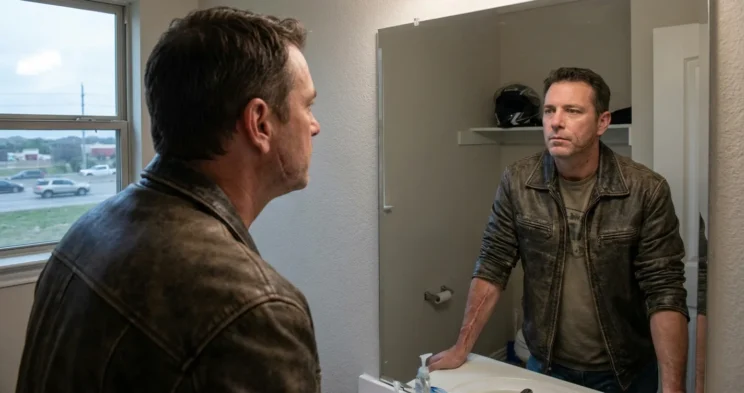
You were heading home on I-35 outside Round Rock when a driver drifted into your lane and clipped your bike. Months later, the broken bones have healed, but the scars across your forearm and jaw have not, and every mirror, every meeting, every glance from a stranger reminds you that the crash is still with you. The question now is whether Texas law treats that lasting harm as real harm.
What Disfigurement Means Under Texas Law
Texas law treats disfigurement as a separate, compensable injury, which courts define as any harm that impairs your natural appearance, symmetry, or beauty, or that produces an unsightly condition objectionable to others. It is a distinct non-economic damage element, apart from pain and suffering, mental anguish, and physical impairment. Both past and future disfigurement are recoverable.
The statutory framework for damages in Texas personal injury cases is found in Texas Civil Practice and Remedies Code (CPRC) Chapter 41. Under § 41.001, disfigurement is expressly listed as a noneconomic damage — a category that also includes physical pain and suffering, mental anguish, and physical impairment.
Because disfigurement is a recognized element of noneconomic damages under the statute, a jury may award it as part of a general damages submission without it being pleaded as a separate count.
Motorcycle crashes produce disfigurement through a few common injury patterns. Road rash strips away skin layers and often leaves discolored, uneven tissue; facial trauma includes fractures, deep lacerations, and dental injuries; and keloid and hypertrophic scarring can develop as wounds heal, sometimes growing larger or thicker over time.
Texas courts allow recovery for any scarring you have today and scarring that is reasonably likely to develop or worsen later. That second category matters when common motorcycle accident injuries require repeat surgeries or revisions years after the crash.
How Texas Juries Value Disfigurement Damages
Texas juries assign disfigurement damages as a separate line item on the verdict form, for both past and future harm, but there is no formula. The Texas Pattern Jury Charges, General Negligence volume, instructs the jury to use its collective judgment. And there is no statutory cap on actual disfigurement damages in ordinary personal injury cases.
That last point matters. The cap many people have heard about comes from Texas CPRC § 41.008, and it applies to exemplary (punitive) damages, not to actual damages like disfigurement. Medical malpractice has its own separate cap regime, but a standard motorcycle injury claim does not.
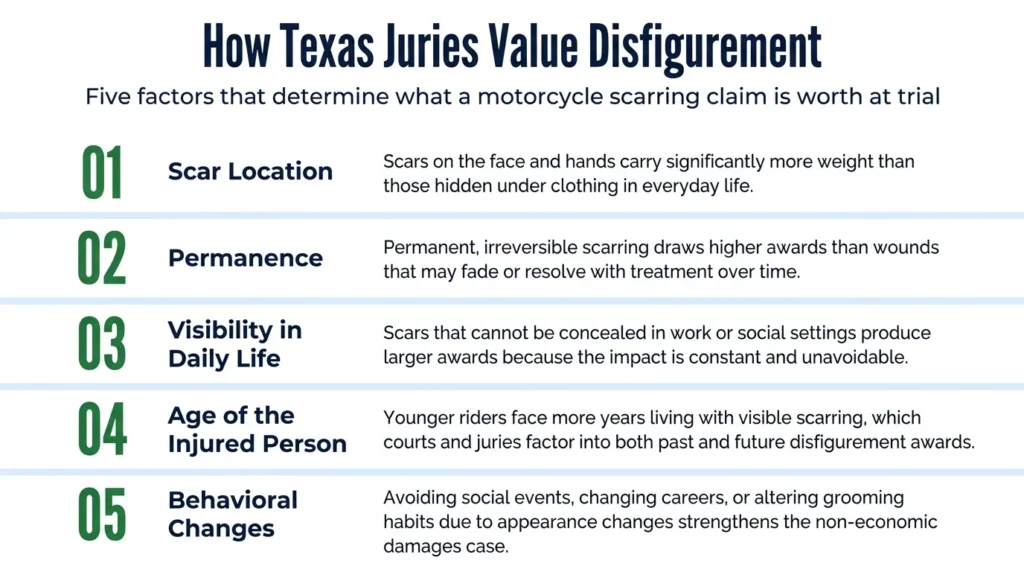
Juries weigh several factors when valuing the harm. Location matters: scars on the face and hands carry more weight than scars hidden under clothing. So does permanence, visibility in everyday settings, the age of the injured person, and whether the appearance change causes daily behavioral shifts like covering up, avoiding people, or changing jobs.
Severity sits on a spectrum. Superficial scarring tends to draw limited awards, while deep dermal or subcutaneous scarring draws moderate to significant awards. Disfigurement requiring ongoing reconstructive surgery sits at the top, with a strong future-disfigurement component built into the number.
Recent Texas appellate decisions confirm that photographs help but are not always required. Credible testimony from you and your treating physicians can support an award even when visual evidence is disputed. Reviewing how motorcycle accident settlements work in Texas can help you understand how these factors translate into real numbers.
Expert Testimony & Evidence in Disfigurement Claims
Strong disfigurement claims combine expert opinion with documentary proof. Defendants almost always argue the scarring is minor, temporary, or fixable. Evidence is what answers that argument.
Medical Expert Witnesses
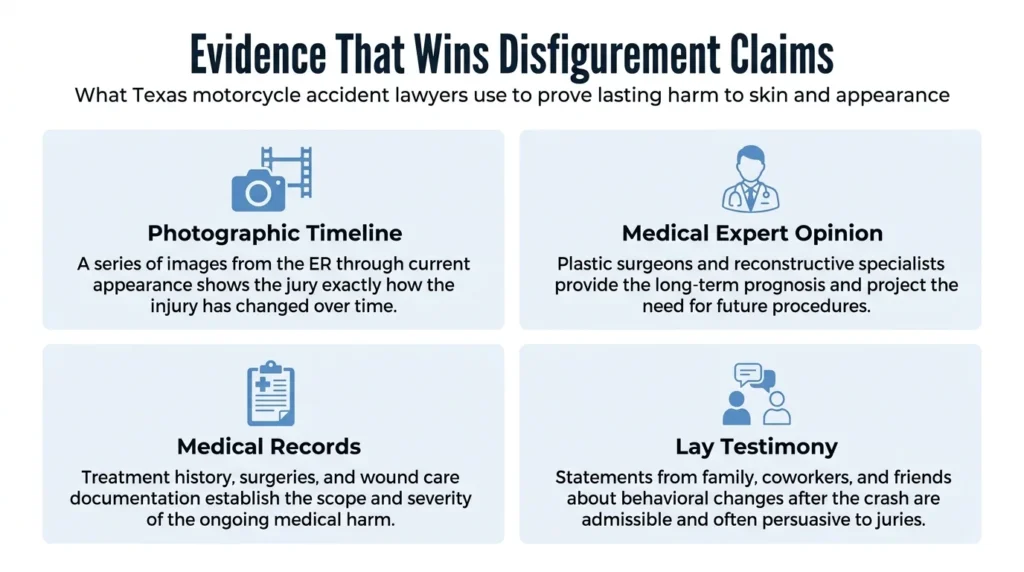
Plastic surgeons, dermatologists, and reconstructive specialists carry most of the weight in a disfigurement claim. A treating physician can describe the current condition. A retained expert is usually needed to address long-term prognosis, the likelihood of the condition worsening, and the need for future procedures.
That future-care opinion is what anchors the future-disfigurement component of the damages award. Texas courts apply the Robinson standard — adopted from the federal Daubert framework — to expert testimony, which requires that opinions be both relevant to the issues in the case and based on a reliable foundation, including sufficient facts, sound methodology, and a reliable application of that methodology to the facts.
Documentary & Demonstrative Evidence
Photographic timelines are some of the most persuasive evidence in these cases. A series of images from the emergency room through current appearance shows the jury exactly what changed.
Medical records establish the treatment history, surgeries performed, and wound care over time. Lay testimony from family, coworkers, and friends about behavioral changes (avoiding social events, changes in grooming, withdrawal at work) is admissible and often powerful.
Psychological Harm as a Recoverable Element
Texas law recognizes mental anguish as a standalone recoverable damage, separate from the disfigurement itself. When visible scarring causes anxiety, depression, loss of self-image, or social withdrawal, those conditions are compensable. You do not need a formal psychiatric diagnosis; credible testimony about the nature and duration of the suffering, supported by evidence of lifestyle changes, can be enough.
While these emotional impacts apply to any severe scarring, the psychological consequences most often tied to motorcycle crash disfigurement include post-traumatic stress responses linked to altered appearance, occupational anxiety where presentation matters, and long-term depression tied to body image. Visible locations like the face, hands, and forearms carry greater weight in this analysis because those injuries cannot be hidden in daily life.
Motorcyclists are especially vulnerable to this kind of harm because riders do not have the enclosure of a car, making visible disfigurement far more common after a motorcycle accident than after a typical fender-bender.
Understanding the full scope of recoverable harm can ultimately help you evaluate whether an insurance offer reflects what Texas law actually allows.
Filing Deadlines & Steps to Protect Your Claim
You generally have two years from the date of the crash to file. Texas CPRC § 16.003 sets the two-year deadline for personal injury claims, and missing it usually ends your right to recover any damages, including disfigurement and mental anguish.
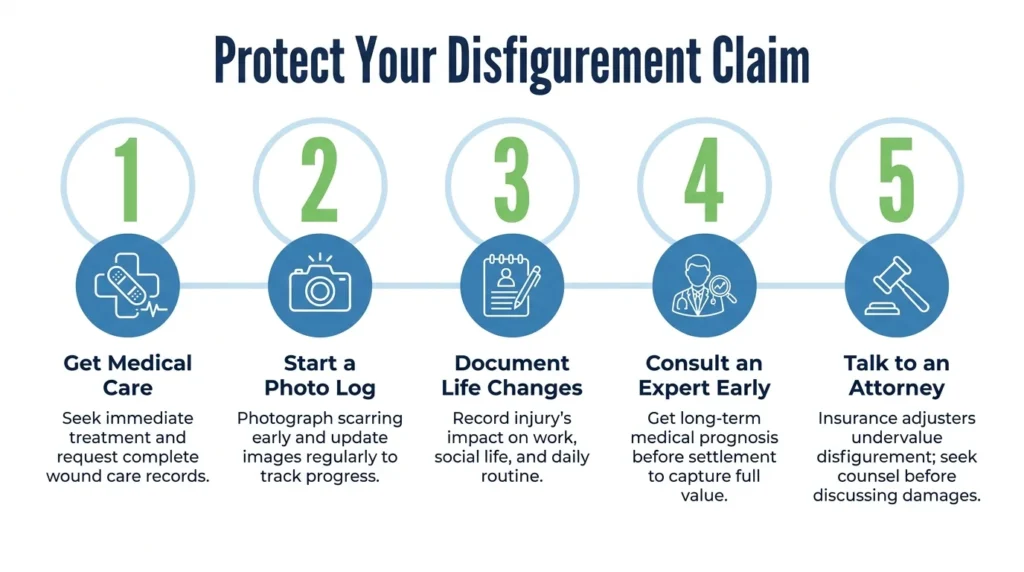
The right steps protect both the legal claim and the evidence behind it, so get medical care immediately and keep complete records of every wound care visit and procedure. Start photographing your scarring early, updating those images regularly as healing progresses, and save anything that ties the visible injury to changes in your work or social life. Talk to an attorney before discussing non-economic damages with any insurance adjuster.
Insurance adjusters routinely undervalue disfigurement and psychological harm because these are harder to quantify than medical bills. According to TxDOT crash data, 574 motorcyclists were killed on Texas roads in 2025 alone, so these claims arise often and adjusters know how to push back. Working with our injury attorneys early helps make sure the full value of the harm is on the table.
Suffered Scarring Injuries? Talk to an Attorney
Permanent scarring and disfigurement are not side notes in a personal injury claim. They are central to what Texas law allows you to recover, and they deserve the same care as medical bills and lost wages. Understanding the full scope of recoverable harm can help you evaluate whether an insurance offer reflects what Texas law actually allows.
Angel Reyes & Associates has over 30 years of experience handling serious motorcycle injury claims, including cases involving permanent disfigurement and psychological harm. We have recovered more than $1 billion recovered for clients, and we work on contingency, meaning no fee unless we win. Consultations are free. Contact us today to talk through your situation with a Texas motorcyle accident attorney during a free consultation.
Past results do not guarantee future outcomes.
Motorcycle Scarring & Disfigurement Claims FAQs
Can health insurance or MedPay cover scar revision surgery before a lawsuit settles?
Yes, health insurance and MedPay can pay for scar revision treatment before your case resolves, but those payments may create a reimbursement or subrogation obligation that reduces your net recovery. An attorney can help you track these costs so they are properly accounted for in the final settlement or verdict.
Does wearing motorcycle gear affect how much a jury awards for scarring?
Texas follows a proportionate responsibility framework, so a defendant may argue that riding without protective gear contributed to the severity of the scarring, which could reduce your damages award by your percentage of fault. This does not bar recovery entirely unless your share of fault exceeds 50 percent.
Will scar revision surgery after a settlement release my right to future disfigurement damages?
Once you sign a full and final release, you generally give up the right to seek additional compensation, even if the scarring worsens or additional procedures become necessary later. This is one reason why consulting a medical expert on long-term prognosis before settling is worth the time.
Can a minor injured in a Texas motorcycle crash still file a disfigurement claim after turning 18?
Texas tolls the two-year statute of limitations for minors, meaning the clock typically does not start running until the minor turns 18. A parent or guardian may also file on the minor’s behalf before that point.
Does the at-fault driver's liability policy have to cover disfigurement damages, or is that a separate claim?
Disfigurement is part of the overall bodily injury claim against the at-fault driver’s liability policy, not a separate claim. If that policy limit is too low to cover the full award, your own underinsured motorist coverage may provide additional compensation up to its limit.
About the Authors

Alex Ivanov
Writer
Alex Ivanov is a personal injury attorney at Angel Reyes & Associates, focused on car, truck, and motorcycle accident cases. Licensed in Texas and multiple federal districts, Alex brings international legal experience and a global education to his practice. He earned his LL.M. from Texas A&M University School of Law after graduating from Belarussian State University in 2016. Alex is fluent in Russian, English, Ukrainian, and Belarussian, and is recognized by multiple national trial lawyer associations for his results and leadership under 40.

Kyle Nicolas
Editor
Kyle Nicolas is the Web Content & SEO Manager at Angel Reyes & Associates. He has more than 10 years of experience as a marketing co...

Angel Reyes
Reviewer
Angel L. Reyes, III is the Founder and Managing Partner of Angel Reyes & Associates. A nationally recognized trial attorney and business...