When a Defective Motorcycle Part Causes Your Crash


Every article on this site is researched by our internal team, reviewed for legal accuracy against current Texas law, and held to State Bar of Texas advertising standards before publication. We do not publish content that overstates outcomes or makes promises about results.
Learn more about our
editorial standards .
Key Takeaways
- When a motorcycle part fails, liability may shift to the manufacturer, dealer, or repair shop, not another driver.
- Texas gives riders two years from the crash date to file suit; a 15-year repose period also applies.
- Allowing the failed component to be repaired or scrapped before expert review can destroy a valid claim.
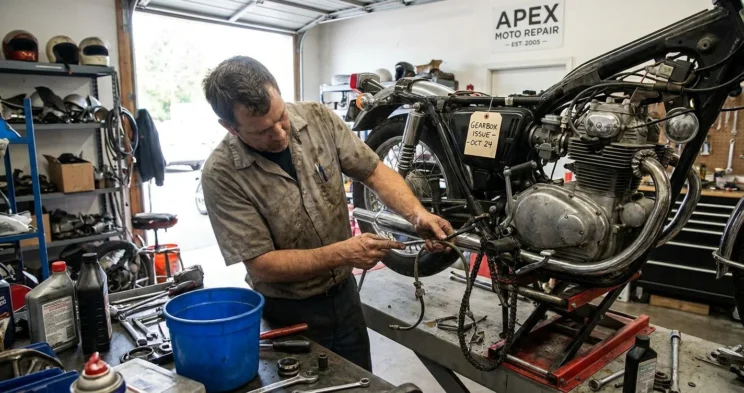
You were heading out on I-35 when something gave way. The brake lever went soft, the throttle stuck, or the front end wobbled without warning. You did everything right as a rider, and you still went down. Now you are in the hospital, your bike is at a tow yard, and someone is already calling about what to do with it.
Before you answer that call, you need to know something: when a part fails, the person responsible for your crash is probably not another driver.
How Mechanical Failure Shifts Who Is Liable
A defective motorcycle parts accident does not follow the same liability path as a crash caused by a negligent driver. When a component fails, the responsible party may be a manufacturer, a distributor, a dealer, or a repair shop, depending on why the part failed and who handled it before you did.
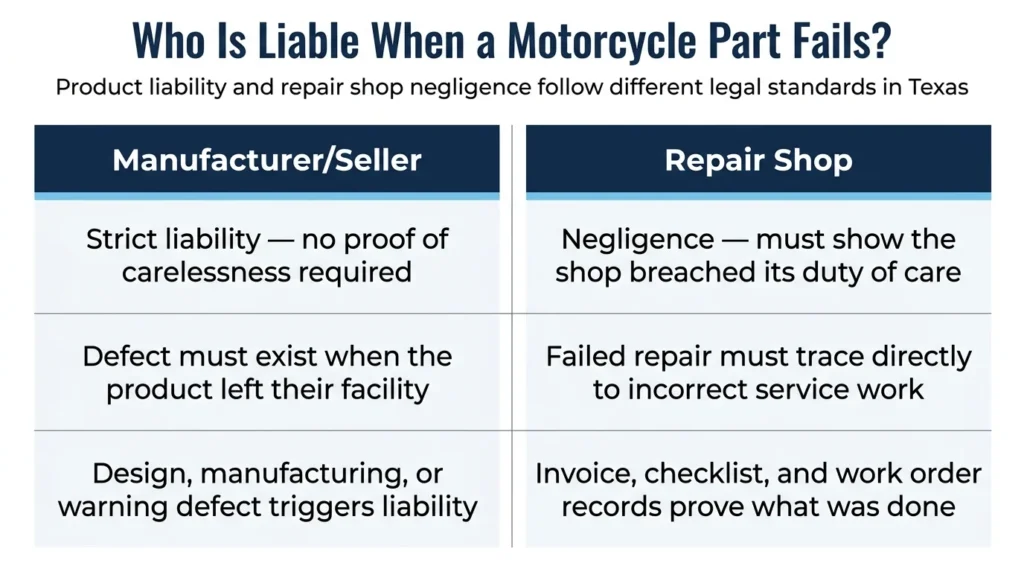
Texas law provides two separate tracks for these situations. Manufacturers and sellers face strict product liability, which means you do not need to prove they were careless. You only need to show the product was defective, the defect existed when it left their facility or shop, and the defect caused your crash.
Repair shops and mechanics operate under ordinary negligence law, which requires showing they had a duty to do the work correctly, they failed to meet that standard, and the failure caused your injury.
Riders who go down alone, without another vehicle involved, most often assume the crash was unavoidable. That assumption costs them a valid claim. If you felt the part failed before impact, a Texas motorcycle accident claim may exist against a party you have not yet considered.
Strict Liability for Defective Motorcycle Components
According to Texas law, manufacturers and nonmanufacturing sellers can be held liable for injuries caused by a defective product. The plaintiff does not need to prove the manufacturer knew about the defect or acted recklessly. The defect itself is enough.
Three types of defects create liability in Texas product liability cases.
Design Defects vs. Manufacturing Defects
A design defect and a manufacturing defect are not the same thing, and which one applies to your situation determines who you are suing and why.
A design defect means the motorcycle was built exactly as intended, but the intended design is unsafe. A braking system that overheats under normal riding conditions, a throttle design that creates sticking risk across an entire model line, or a tire compound that degrades at highway temperatures are all potential design defects.
Every unit built to that specification is equally dangerous. The claim targets the engineering decision, not a single production error.
A manufacturing defect means one specific unit veered from its intended design during production. The spec was safe, but something went wrong in the factory. A brake caliper machined out of tolerance, a tire with a bonding flaw in a single batch, or a throttle body assembled with the wrong spring are manufacturing defects.
Your bike was dangerous in a way the design did not intend.
A third theory, failure to warn, applies when a manufacturer knew of a hazard and failed to provide adequate instructions or safety warnings. This can accompany either a design or manufacturing defect, or it can stand on its own if the risk was known and undisclosed.
When a Mechanic or Repair Shop Is Responsible
Repair shops are not held to the strict liability standard that applies to manufacturers. If a motorcycle mechanical failure crash traces back to a service visit rather than a factory defect, the legal issue is ordinary negligence.
To hold a shop accountable, you must show four things: the shop owed you a duty to perform the work competently, the work was done incorrectly, the bad repair caused the component failure, and the failure caused your crash. All four elements must connect.
Common repair errors that create this kind of liability include incorrect brake fluid replacement that introduced moisture and led to brake fade, improper tire mounting that created bead instability, missed torque specifications on wheel bearings, and failure to flag a known manufacturer recall during a routine service visit.
Shop records are the evidence that makes or breaks these claims. The invoice tells you what was inspected. The mechanic’s checklist tells you what was passed. The work order tells you what was touched. If those records show the shop serviced the failed component days before the crash and signed off on it, you have strong evidence to work from.
If you believe a recent service visit contributed to your crash, speak with an attorney before the shop changes or throws out those records.
Preserve the Motorcycle. Preserve Your Case.
The failed component on your motorcycle is physical evidence. Once it is repaired, replaced, or destroyed, no expert can examine it. Letting the bike go before an engineer can inspect it is the single most common and most damaging mistake in defective motorcycle parts accident cases.
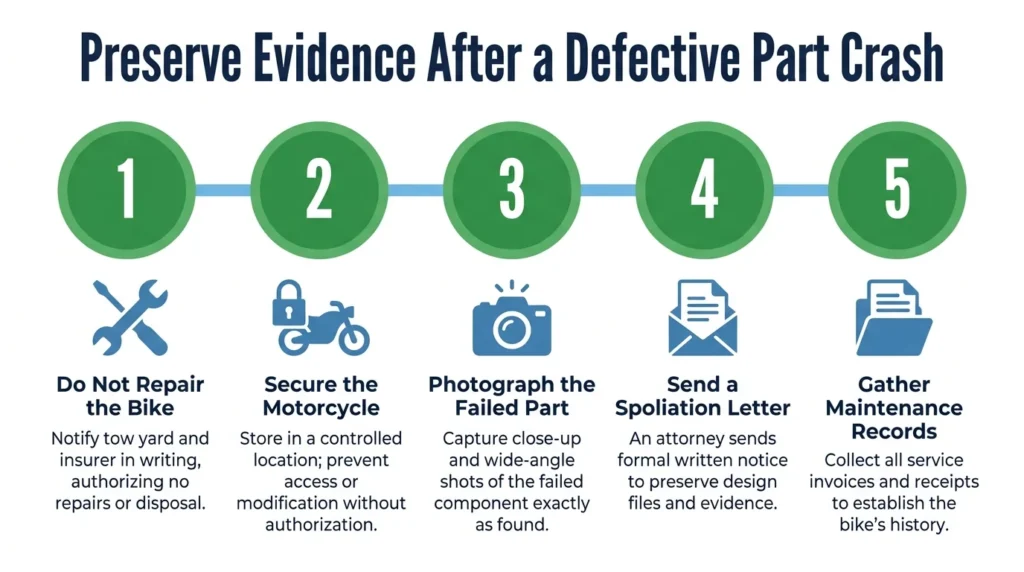
Take these steps now.
Step 1: Do not authorize any repair, sale, or disposal of the motorcycle. Tell the tow yard, your insurance company, and anyone else asking that the bike is evidence in a potential legal matter. Put that instruction in writing.
Step 2: Place the motorcycle in a controlled location, such as a personal storage unit, a facility your attorney designates, or another location where no one can access or modify the bike without authorization.
Step 3: Photograph the failed component before anything is moved. Get multiple angles, close-up and wide. Capture the component in the condition it was in immediately after the crash.
Step 4: Send written notice to the manufacturer or repair shop that evidence must be preserved. An attorney handles this step through a formal spoliation letter, which creates a legal obligation for the other party to preserve its own records, design files, and quality-control data.
Step 5: Gather all maintenance records, receipts, and service invoices for the motorcycle. These documents establish the bike’s history and help an expert separate crash damage from pre-existing component failure.
Insurers sometimes move quickly to have the motorcycle declared a total loss. Accepting that payout before an expert examines the failed component may end the physical evidence chain. Review any total loss offer carefully and talk to an attorney before you agree to anything that involves releasing the bike.
Read through the legal steps available after a Texas motorcycle crash for additional context on what your immediate priorities should be.
Texas Deadlines for Defective Part Claims
Texas sets two separate deadlines for motorcycle product liability claims, and both are important. First: the statute of limitations in Texas Civil Practice and Remedies Code Chapter 16 gives you two years from the date of your crash to file suit. Miss that deadline and your right to pursue a claim is almost certainly gone, regardless of how clear the defect is.
The second statute bars any product liability claim brought more than 15 years after the original sale of the motorcycle. Unlike the two-year limitations period, the repose deadline generally cannot be extended by any exception. Riders with older bikes need to calculate the original sale date before assuming they still have a viable product liability claim.
Both deadlines apply independently. A crash that happens in year 14 of a bike’s life gives you two years from that crash date to file, but if the sale was more than 15 years ago, the repose period may already be closed.
Understanding how Texas fault rules apply to your situation is a useful starting point, but the deadline calculations for a defective parts claim require specific analysis of your dates. An attorney can run both calculations and tell you whether your claim is still timely before you take any other step.
What to Do if You Believe a Part Failure Caused Your Crash
Defective motorcycle parts accident cases involve multiple potential defendants, strict evidence requirements, and expert engineering analysis. They are not cases you build alone.
Angel Reyes & Associates has spent over 30 years helping injured Texans pursue the right defendant after complex crashes. We investigate mechanical failure claims, send spoliation letters to protect physical evidence, and work with qualified engineers to document what failed and why. This thorough approach is part of the reason why we have recovered more than $1 billion for clients across the state.
We offer free consultations and charge no fee unless we win. Contact us to go over what happened, what evidence you have, and what your options are.
Past results do not guarantee future outcomes.
Defective Motorcycle Part Accident FAQs
Can I check whether my motorcycle has an open recall before filing a claim?
Yes. Enter your 17-character VIN at the NHTSA recall database at nhtsa.gov/recalls to see any open safety recalls, including component-specific issues with brakes, tires, and throttle systems. An open recall at the time of your crash is strong evidence the manufacturer was already aware of the defect.
Can I sue the motorcycle dealer, not just the manufacturer?
In Texas, a dealer that did not manufacture the product is generally not liable unless it participated in the design, modified the product, or made an incorrect factual representation you relied on. However, if the manufacturer cannot be served in Texas, the law may allow a claim against the domestic seller instead.
Do aftermarket parts or modifications affect my product liability claim?
A manufacturer can argue that a modification you made to the bike caused the failure rather than the original component. Keeping records of exactly what was modified, when, and by whom helps establish whether the modification was connected to the failed part at all.
What if the failed part was replaced before I could have it inspected?
If the motorcycle was repaired or the failed component was discarded before an expert could examine it, the claim becomes significantly harder to prove. Courts may allow testimony about the failure mode based on other evidence, but the absence of the physical component is a serious gap that a defendant will exploit.
Does a mechanic's failure to notice an open recall create its own liability?
A repair shop that performs a service inspection without flagging a known manufacturer recall may face a separate negligence claim. Shops have an obligation to check for open recalls during relevant service visits, and failing to do so when the recall covers the part that later failed is a documented breach of the duty of care.
About the Authors

Alex Ivanov
Writer
Alex Ivanov is a personal injury attorney at Angel Reyes & Associates, focused on car, truck, and motorcycle accident cases. Licensed in Texas and multiple federal districts, Alex brings international legal experience and a global education to his practice. He earned his LL.M. from Texas A&M University School of Law after graduating from Belarussian State University in 2016. Alex is fluent in Russian, English, Ukrainian, and Belarussian, and is recognized by multiple national trial lawyer associations for his results and leadership under 40.

Kyle Nicolas
Editor
Kyle Nicolas is the Web Content & SEO Manager at Angel Reyes & Associates. He has more than 10 years of experience as a marketing co...

Angel Reyes
Reviewer
Angel L. Reyes, III is the Founder and Managing Partner of Angel Reyes & Associates. A nationally recognized trial attorney and business...