Motorcycle Accident Burn Injury Claims in Texas


Every article on this site is researched by our internal team, reviewed for legal accuracy against current Texas law, and held to State Bar of Texas advertising standards before publication. We do not publish content that overstates outcomes or makes promises about results.
Learn more about our
editorial standards .
Key Takeaways
- Texas gives motorcycle burn victims two years from the crash date to file an injury lawsuit.
- Riders found more than 50 percent at fault under Texas proportionate responsibility cannot recover any damages at all.
- Skin grafts, future surgeries, and permanent scarring are all recoverable damages in a burn claim in Texas.
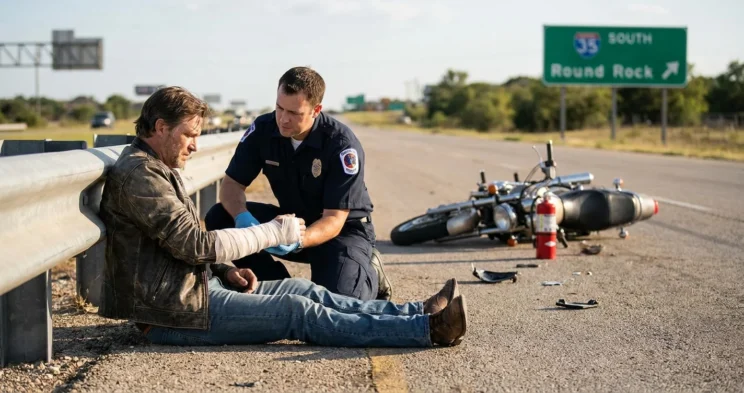
You were riding home on I-35 near Round Rock when a driver drifted into your lane and clipped your bike. You went down hard, slid across the pavement, and felt heat from the spilled fuel before help arrived. Now, you’re facing skin grafts, weeks of wound care, and bills that keep piling up while you’re out of work.
Three Types of Burns from Motorcycle Crashes
Motorcycle crashes commonly produce three burn categories:
- Thermal burns from post-crash fires or hot engine contact
- Friction burns (also known as “road rash”) from sliding across pavement
- Chemical burns from gasoline, oil, or battery acid exposure
Each is recognized under Texas personal injury law and can support a damages claim when another party’s negligence caused the crash.
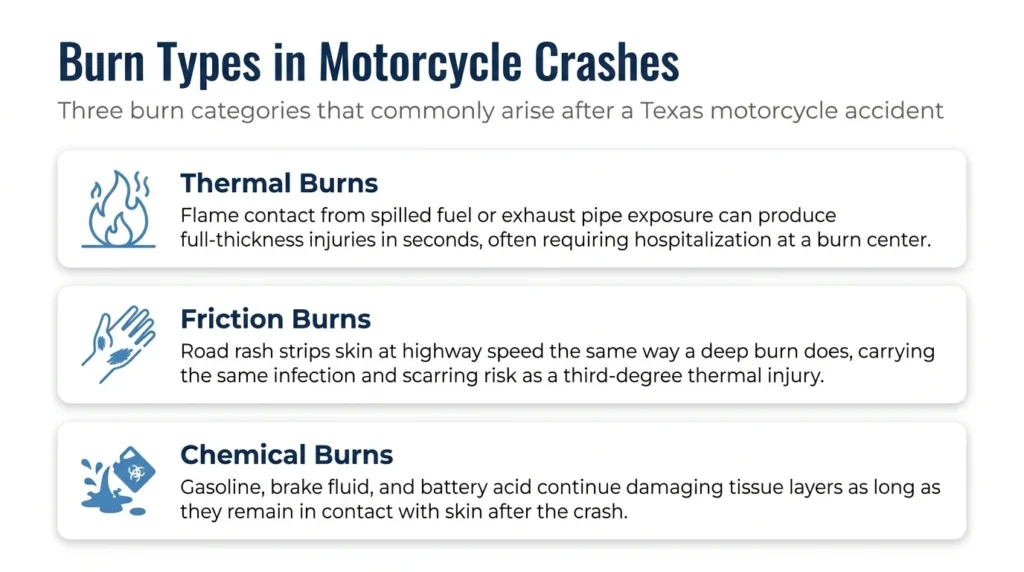
Thermal burns happen fast. Contact with burning fuel can produce severe burns in seconds, and hot exhaust pipes can leave deep wounds on contact.
Friction burns are often misunderstood. At highway speed, road rash strips skin in the same way a deep burn does, and the infection risk mirrors a third-degree burn. Riders sometimes leave the ER thinking they have a scrape when the wound is far more serious.
Chemical burns can be the most deceptive. Gasoline and brake fluid keep damaging tissue layers as long as the liquid remains in contact with your skin. A burn that looks minor at the scene of the crash can deepen over the next several hours.
Riders face higher burn exposure than people in passenger vehicles because there is no metal cage or airbags, and protective motorcycle gear rarely covers every inch of your skin. Federal crash data from the National Highway Traffic Safety Administration’s motorcycle safety research confirms that riders are much more likely than passengers in cars to suffer injuries from impact and fire exposure. For a better look at the injury patterns that these crashes produce, see common injuries in Texas motorcycle accidents.
How Burn Severity Affects Medical Treatment
Burn severity is graded by how deep the injury reaches:
- First-degree burns affect only the outer skin layer.
- Second-degree burns penetrate the layer of skin underneath (also known as the “dermis”).
- Third- and fourth-degree burns destroy all skin layers and underlying tissue, and they almost always require hospitalization at a burn center, surgery to remove damaged tissue, and one or more skin graft procedures.
Skin grafting is its own ordeal. Surgeons harvest healthy skin from another part of your body and transplant it to the burned area. Large surface area burns often require several grafting surgeries, each with its own recovery period and risk of complications.
Road rash that exposes tissue beneath the skin is treated the same way as a serious burn because the infection and scarring risks are the same, even though no heat caused the wounds.
Chemical burns demand immediate medical attention to stop ongoing tissue damage, and severe cases require surgery and grafting, just like other burns.
Rehabilitation after a severe burn is long and may include several components:
- Physical therapy works to restore range of motion.
- Occupational therapy retrains hand and limb function.
- Compression garments help manage scarring.
- Psychological support helps burn survivors handle trauma and changes in appearance.
Our blog on Texas motorcycle accident claims covers the full range of treatment costs tied to burn recovery.
Texas Liability Rules for Burn Injuries
In most motorcycle burn cases, the at-fault driver is the primary defendant. Liability is established by showing that the driver’s reckless behavior caused the crash and the burns.
When a defective fuel system, faulty fuel line, or other motorcycle component contributed to ignition, you may also be able to file a product liability claim against the manufacturer.
Texas uses proportionate responsibility to determine fault. This means that under the Texas Civil Practice and Remedies Code (CPRC) § 33.001, a rider found partially at fault can still recover compensation, as long as their share of fault does not exceed 50 percent. Recovery is reduced by the rider’s percentage of fault. A rider found 51 percent or more at fault cannot recover any compensation at all.
Punitive damages may also be on the table. When burns result from a defective product, fraud, malice, or gross negligence, CPRC § 41.003 allows exemplary damages, as long as there is clear and convincing evidence to prove it.
A rider dealing with a crash that involves both a negligent driver and a defective part may have claims against more than one defendant, and our blog on how Texas motorcycle accident settlements are calculated can help clarify what that means for total recovery.
Recoverable Damages for Burn Injuries
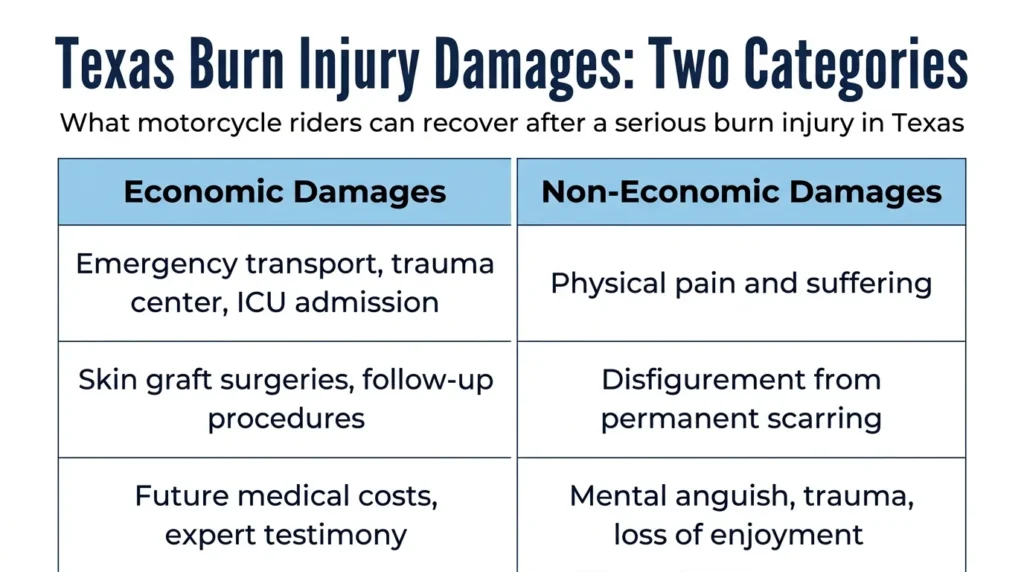
Texas burn injury claims include two damages categories:
- Economic damages, which are financial losses that can be measured (such as medical bills or lost wages)
- Non-economic damages, which compensate for harm that does not have a fixed dollar amount (such as pain and suffering or emotional distress)
Both apply in serious burn cases, but there are important differences in the evidence required to prove your claim.
Economic Damages
Economic damages cover what you can document on paper. Ambulance rides, trauma center admission, burn center hospitalization, and ICU stays are all recoverable medical expenses, and therefore they are covered under economic damages.
Skin grafting surgeries, donor-site recovery, follow-up procedures, and specialist fees are also major economic damages that can be recovered in a severe burn case. Future medical costs (such as anticipated surgeries, ongoing wound care, compression therapy, physical and occupational therapy, and psychological treatment) are also recoverable when an estimate is provided by expert medical testimony.
Lost wages during hospitalization and recovery are also recoverable as economic damages. If your burn severity causes permanent disability or reduces your future earning capacity, these projected losses are recoverable, too. So are out-of-pocket costs, like home health aides, adaptive equipment, and transportation to medical appointments.
Non-Economic Damages
Non-economic damages cover harm that doesn’t show up on a bill:
- Physical pain and suffering includes pain from your burns and chronic pain from healing, scar tissue, and repeated surgeries.
- Disfigurement from permanent scarring is a standalone damages category that often raises the value of your claim significantly, especially when your burns affect your face, hands, or other visible areas.
- Mental anguish from trauma, anxiety about future procedures, and the psychological weight of long-term disability are also recoverable as non-economic damages. These are supported by testimony from your mental health provider.
- Loss of enjoyment of life reflects how burn injuries have limited your ability to do the things you did before the crash.
Riders with multiple skin grafts or permanent scarring may be entitled to substantial non-economic damages, as evidenced by our case results. Past results do not guarantee future outcomes.
Filing Deadlines & How to Protect Your Claim
Texas gives you a two-year deadline to file a personal injury lawsuit after a motorcycle accident under Texas Civil Practice and Remedies Code § 16.003. Missing this deadline ends your right to recover damages in court, no matter how severe your burns are. The clock typically starts counting down on the date of the crash, with limited exceptions for chemical burn damage that was not apparent at the time of the crash.
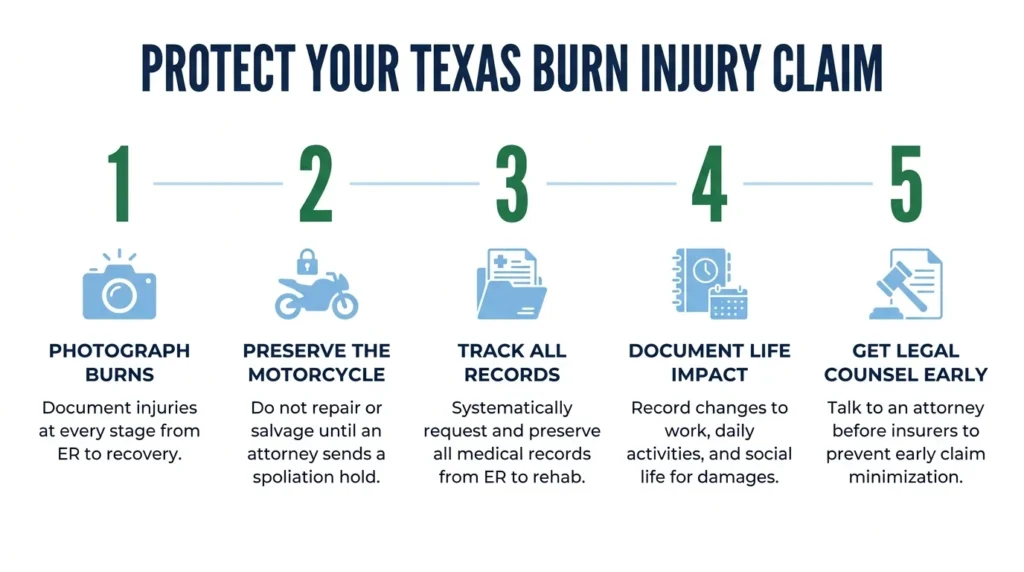
Preserving evidence early is critical. Photograph your burns at each stage of treatment, document the accident scene, save any damaged motorcycle gear, and keep records of the vehicle’s condition. When combined, these pieces of evidence show how the injury happened and how severe the damages were.
Medical records are the backbone of a burn damages claim. Request and preserve them in order, from the ER visit through every surgery and rehab session.
Product defect cases need to be investigated quickly because physical evidence on the motorcycle can deteriorate or get lost during repair or salvage. An attorney can send a legal notice (called a “spoliation hold”) to keep the bike and its components intact.
Be careful with insurance adjusters. Any statements you make before you have legal counsel can be used to reduce your claim. Remember, the at-fault driver’s insurer is not on your side.
Talk to an Attorney About Your Burn Injury Claim
Burn injuries from a motorcycle crash feature some of the longest recoveries and highest medical costs in personal injury law. Angel Reyes & Associates has over 30 years of experience helping Texas riders pursue full recovery for serious injuries, including more than $1 billion recovered for clients.
We work on contingency, which means you pay no fee unless we win, and we offer free initial consultations in English and Spanish. If a loved one died from burn injuries after a crash, talk to us about filing a wrongful death claim. Contact us today to talk through what happened and what your case may be worth.
Past results do not guarantee future outcomes.
Motorcycle Accident Burn Injury FAQs
Can burn injuries from a motorcycle crash qualify as a "serious injury" under a Texas insurance policy?
No, Texas does not use a no-fault auto insurance system, so there is no statutory “serious injury” threshold that must be crossed before you can pursue a claim against the at-fault driver. Your right to recover is based on the other driver’s negligence and the damages you can prove, not on meeting a threshold defined by your own policy.
Does Texas place a cap on the damages that a burn victim can recover in a motorcycle accident case?
No, Texas does not cap economic or non-economic damages in personal injury cases between private parties. Caps only apply in medical malpractice cases. A motorcycle crash claim against a negligent driver or product manufacturer is not subject to these limits.
How long does a severe burn injury case typically take to settle in Texas?
Cases involving significant burns often take longer than typical injury claims because the full extent of medical treatment (including future surgeries and rehabilitation) needs to be clear before final damages can be established. Settling too early can mean you will not be able to recover compensation for future medical treatment. Many serious burn cases take longer to resolve because the full scope of your injuries must be determined first.
Can a motorcyclist recover damages for scarring at the skin graft donor site, as well as the burn site?
Yes. The donor site produces its own scarring, and that harm is separate from the burn wound itself. Both the burn site and the donor site scars are considered to be recoverable disfigurement damages under Texas personal injury law.
If the at-fault driver had no insurance or minimal coverage, are there other sources of compensation for burn injuries?
Yes, a motorcycle rider may have uninsured or underinsured motorist coverage on their own policy that can provide additional compensation when the at-fault driver’s coverage falls short. Texas law requires insurers to offer this coverage, but riders can reject it in writing, so the availability depends on what the rider’s own policy includes.
About the Authors

Angel Reyes
Writer
Angel L. Reyes, III is the Founder and Managing Partner of Angel Reyes & Associates. A nationally recognized trial attorney and business leader, Angel has helped over 70,000 injury victims recover more than $1 billion since founding the firm in 1993. Named to the Texas Super Lawyers list annually since 2008, Angel brings Wall Street experience, Ivy League education, and a deep commitment to client advocacy. He is a frequent legal commentator and published author with extensive contributions to legal scholarship, trial strategy, and consumer protection.

Kyle Nicolas
Editor
Kyle Nicolas is the Web Content & SEO Manager at Angel Reyes & Associates. He has more than 10 years of experience as a marketing co...

Angel Reyes
Reviewer
Angel L. Reyes, III is the Founder and Managing Partner of Angel Reyes & Associates. A nationally recognized trial attorney and business...