How Dashcam & GoPro Footage Can Help Your Motorcycle Accident Case


Every article on this site is researched by our internal team, reviewed for legal accuracy against current Texas law, and held to State Bar of Texas advertising standards before publication. We do not publish content that overstates outcomes or makes promises about results.
Learn more about our
editorial standards .
Key Takeaways
- Dashcam footage records in a loop and can overwrite crash evidence within hours of impact.
- Losing or destroying footage can lead courts to instruct the jury that it hurt your case.
- Texas courts require authentication before admitting dashcam or GoPro footage as evidence.

You were heading home on your bike after a long shift when a driver drifted into your lane on Lamar Boulevard in Austin and clipped your front wheel. You stayed upright, but the other driver is already telling the officer a version of events that does not match what happened.
If your dashcam or GoPro was recording, you may have more on your side than you know.
What Dashcam Footage Proves in Your Case
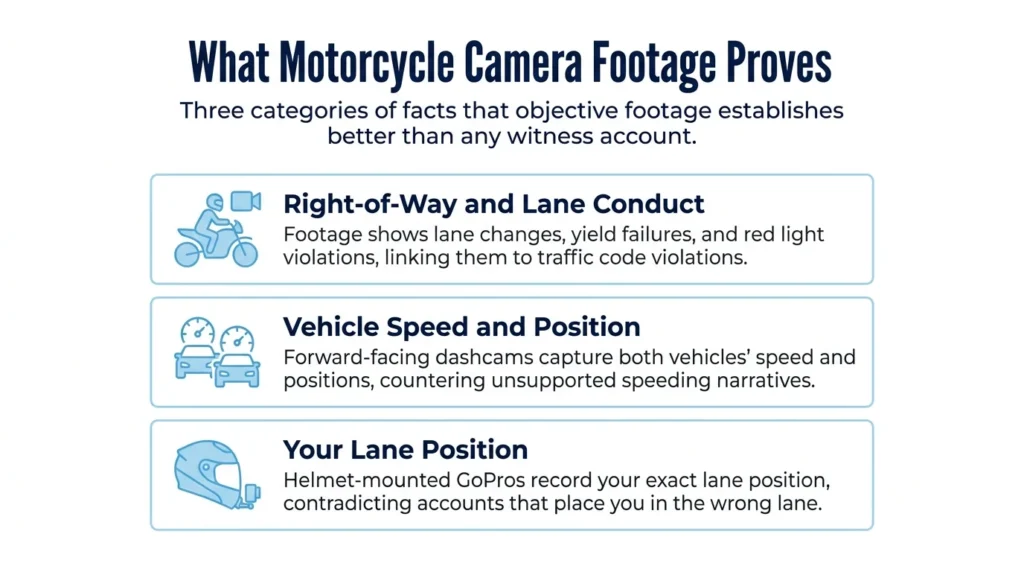
Dashcam and GoPro footage can show what eyewitness accounts often miss:
- Who had the right of way
- Whether the other driver changed lanes without signaling
- How fast each vehicle was moving before impact
The Texas Transportation Code, Chapter 545, sets the rules for speed, lane changes, following distance, and signaling. When footage shows another driver breaking those rules, you have objective evidence of fault tied directly to the law.
A helmet-mounted GoPro adds your perspective. It records your lane position, road hazards ahead, and the seconds immediately before the collision. In motorcycle accident cases, that view often directly contradicts the other driver’s account.
Footage also supports the connection between the crash and your injuries. Understanding the injuries riders most commonly sustain in crashes can put what your footage shows in context when you discuss your case with an attorney.
Preserve Your Footage Before It Overwrites
Dedicated dashcams record on a continuous loop and can overwrite crash footage within hours if you do not act. Action cameras like GoPro typically stop recording when the card is full, but footage can still be lost if the camera is damaged in the crash or your motorcycle is towed.
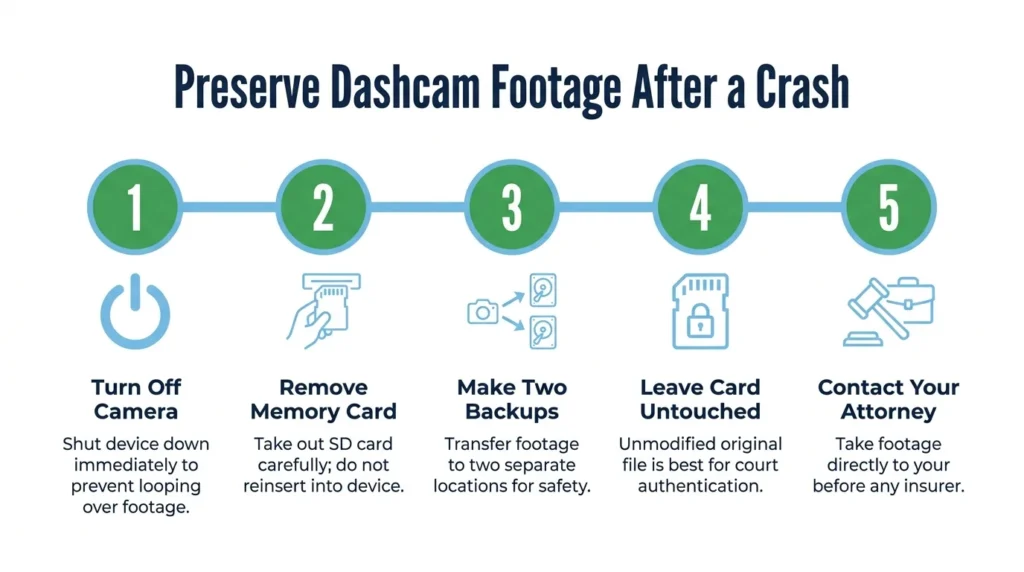
When liability is disputed, footage from your camera is often the most credible evidence available. Take these steps before anything else:
Step 1: Turn off the camera. Shut down the device as soon as you reach safety. This stops the recording loop.
Step 2: Remove the memory card. Take out the SD card carefully and do not reinsert it into any device.
Step 3: Make two backup copies on separate devices. Transfer the footage to a laptop and an external hard drive, and keep them apart.
Step 4: Leave the original card untouched. Do not format it, overwrite it, or repeatedly play the footage. The original file holds more value for authentication than any copy.
Step 5: Do not send footage to any insurer before speaking with an attorney. Insurance companies will use what you provide to shape their investigation from the start.
Consulting an attorney early helps make sure your footage is preserved in a form courts will accept as evidence in your claim.
When Footage Can Work Against You
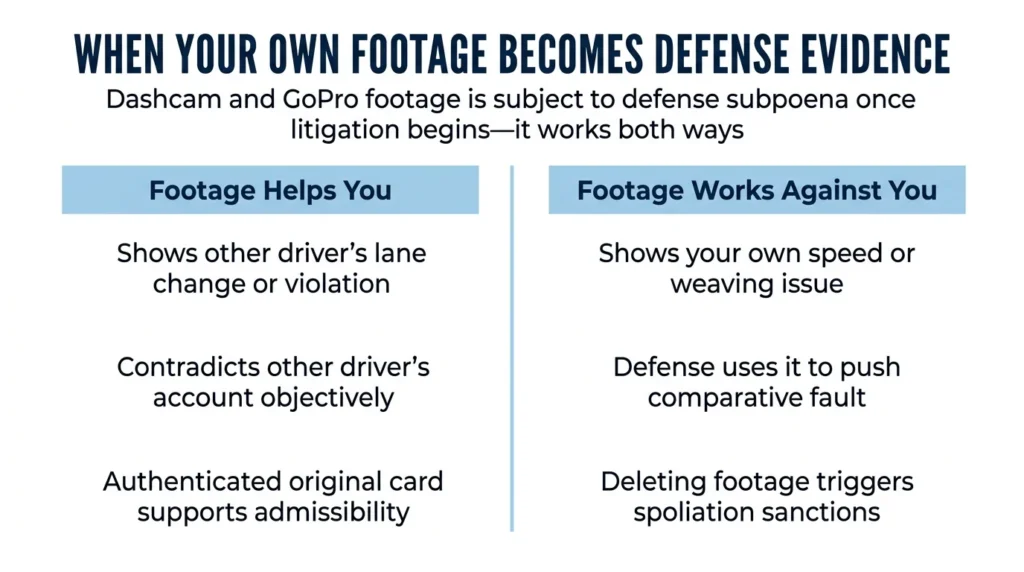
Defense attorneys can subpoena dashcam and GoPro footage you hold once litigation begins. The recording does not stay private simply because you filed the claim.
Texas courts recognize a doctrine called spoliation. If you lose or destroy footage after a lawsuit becomes reasonably foreseeable, a court can instruct the jury to assume the missing footage was harmful to your case. That inference can be as damaging as footage that showed something unfavorable.
The Texas Civil Practice and Remedies Code § 16.003 sets a two-year deadline for filing a personal injury lawsuit. The duty to preserve evidence kicks in well before that deadline. Once you know you were injured and another party may be at fault, courts treat footage you held as evidence you were obligated to keep.
Footage can also cut against you in a liability dispute. If your action camera captured speeding or weaving before the collision, a defense attorney will use it to argue you share fault. Under Texas proportionate responsibility rules, that can reduce or eliminate your recovery.
Dashcam evidence in motorcycle cases follows the same legal framework as dashcam videos in car accident cases. The motorcycle-specific difference is the dual-mounted camera setup and the additional footage risks that come with it.
What Makes Footage Admissible in Texas
Video evidence does not automatically speak for itself in court. Texas requires footage to be authenticated before it is admitted, which means showing the recording is a fair and accurate depiction of what it captures.
Timestamps and GPS metadata embedded in footage files support authentication by anchoring the recording to the time and location of the crash. Edited or re-encoded files are harder to admit. The original, unmodified SD card holds more value for authentication than any copy.
Chain of custody also plays a role. If footage passes through several hands before reaching your attorney, the defense may challenge whether the file is unchanged from the original. Transferring custody to your attorney directly addresses that problem.
The Texas Transportation Code § 545.0605 gives motorcyclists the right to full use of a traffic lane. When GoPro footage shows another driver cutting into that space, it documents the violation directly and connects the conduct to a specific legal standard.
An attorney who handles motorcycle accident cases can take custody of your original footage early and manage the authentication process. How that evidence is presented shapes your leverage in a motorcycle accident settlement and at trial.
Get Help With Your Motorcycle Accident Claim
Dashcam and GoPro footage can shift the outcome of a motorcycle accident case, but only if it is preserved correctly and presented by someone who knows how to use it. A skilled attorney can do just that.
Angel Reyes & Associates has spent over 30 years representing injured riders and other accident victims across Texas. We work on a contingency basis, which means you pay nothing in legal fees unless we win your case. We have recovered more than $1 billion for the clients we have represented.
If you were in a motorcycle accident and have dashcam or GoPro footage, reach out to us today for a free consultation. We will review your footage, walk you through your options, and help you protect your rights.
Past results do not guarantee future outcomes.
Motorcycle Accident Evidence FAQs
What if my camera did not capture the actual moment of impact?
Footage showing the other driver’s behavior in the seconds before the crash can still be strong evidence. Courts consider the full sequence of events leading up to a collision, not just the point of contact.
What if the motorcycle was towed and the camera is still attached?
Contact the tow yard as soon as possible to retrieve the camera or remove the SD card before it is lost in storage. Tow yards have no obligation to preserve electronic evidence on vehicles in their custody.
Can the other driver's insurer legally demand my footage before a lawsuit is filed?
The other driver’s insurance company has no legal authority to compel you to hand over footage before litigation begins, and you have no duty to cooperate with them.
Can dashcam footage help if the other driver had no insurance?
Yes, footage capturing the other vehicle’s license plate, make, model, or driving behavior can support a claim under your own uninsured or underinsured motorist coverage.
How long should I keep my dashcam footage after a motorcycle accident?
Keep the original footage until your claim is completely resolved, including any litigation that may extend beyond the two-year filing deadline. Closing a case can take longer than the initial deadline, so keeping footage through final settlement or verdict protects you.
About the Authors

Angel Reyes
Writer
Angel L. Reyes, III is the Founder and Managing Partner of Angel Reyes & Associates. A nationally recognized trial attorney and business leader, Angel has helped over 70,000 injury victims recover more than $1 billion since founding the firm in 1993. Named to the Texas Super Lawyers list annually since 2008, Angel brings Wall Street experience, Ivy League education, and a deep commitment to client advocacy. He is a frequent legal commentator and published author with extensive contributions to legal scholarship, trial strategy, and consumer protection.

Kyle Nicolas
Editor
Kyle Nicolas is the Web Content & SEO Manager at Angel Reyes & Associates. He has more than 10 years of experience as a marketing co...

Angel Reyes
Reviewer
Angel L. Reyes, III is the Founder and Managing Partner of Angel Reyes & Associates. A nationally recognized trial attorney and business...