Chronic Pain & Long-Term Motorcycle Injury Claims in Texas


Every article on this site is researched by our internal team, reviewed for legal accuracy against current Texas law, and held to State Bar of Texas advertising standards before publication. We do not publish content that overstates outcomes or makes promises about results.
Learn more about our
editorial standards .
Key Takeaways
- Chronic pain from a motorcycle crash is compensable under Texas's non-economic damages law.
- Future medical costs and lost earning capacity require expert testimony to recover in Texas.
- Texas gives riders two years to file, but the discovery rule may extend that deadline.

You were riding home along I-35 when a driver drifted into your lane and clipped your bike. The ER cleared you with what they called a “soft tissue strain,” and you tried to push through. Months later, the pain is worse, your back locks up on the job, and the settlement offer that seemed fair now barely covers a week of physical therapy.
If that sounds familiar, the question isn’t whether you were hurt. It’s what your injury is worth, and whether you still have time to act.
When Chronic Pain Is a Compensable Injury in Texas
Chronic pain from a motorcycle crash is a recognized injury under Texas personal injury law. It falls within non-economic damages alongside physical impairment and disfigurement. The duration and severity of the pain are factors that shape the award, not reasons to deny it.
Common long-term conditions after a motorcycle crash include:
- Nerve damage
- Herniated discs
- Spinal injuries
- Persistent soft tissue conditions
The ER often labels these common motorcycle accident injuries “acute”, and only later do they prove to be permanent or recurring injuries.
“Soft tissue” describes the type of tissue injured. It’s not a legal category that caps your recovery. If the condition limits how you sit, sleep, lift, or work, it is compensable.

How Much Are Chronic Pain Claims Worth?
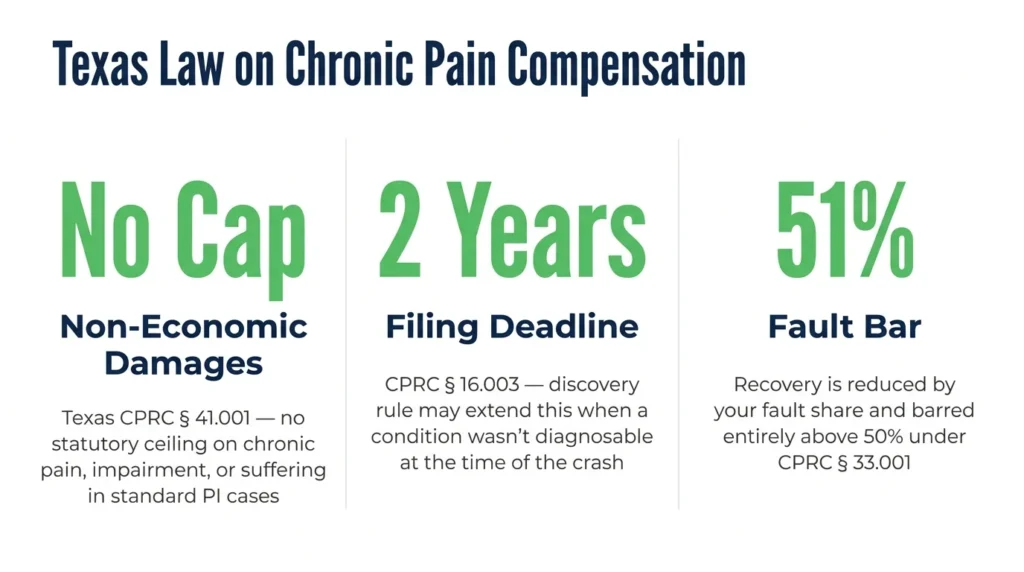
Texas doesn’t put a general statutory cap on non-economic damages, such as for chronic pain, in standard personal injury cases. The definitions that frame these damage categories appear in the Texas Civil Practice and Remedies Code (CPRC) § 41.001. The strength of your medical record, not an arbitrary ceiling, drives your claim’s value.
Consistent documentation is the backbone. Steady treatment notes, diagnostic imaging, and clear statements from your treating physician show that the pain is ongoing rather than resolved. Gaps in care give the insurer room to argue you healed.
How Future Damages Are Calculated for Long-Term Injuries
Future damages are the dollar value of harm that has not happened yet but will. Texas law treats future medical expenses and future loss of earning capacity as two separate compensable categories of economic damages. Each is built on expert testimony, not guesswork.
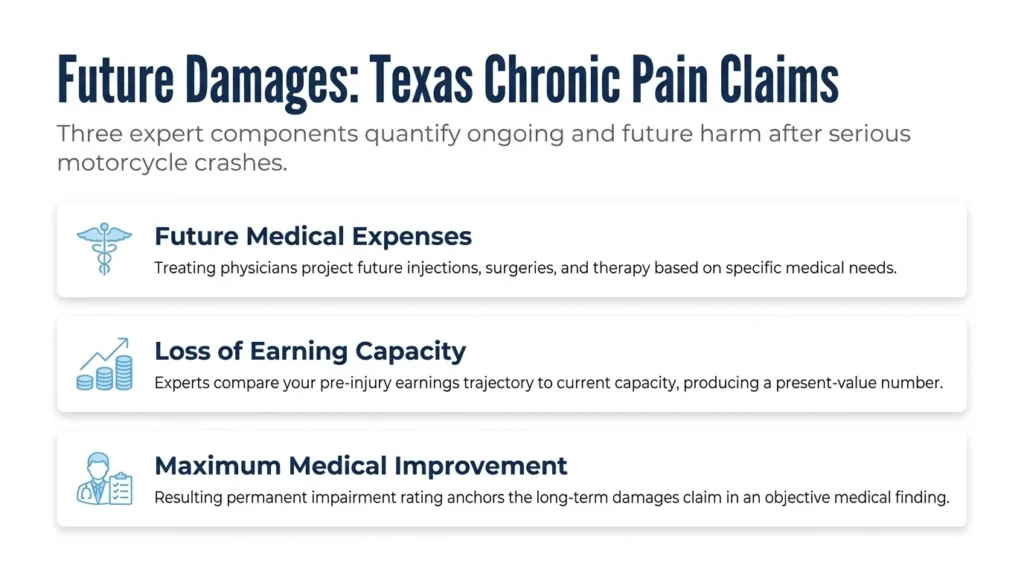
Future medical expenses are projected with help from treating physicians and, in serious cases, life care planners. They estimate the type, frequency, and cost of care you will need going forward. That can include injections, surgeries, physical therapy, medication, and assistive equipment.
Loss of earning capacity is the gap between what you could have earned without the injury and what you can earn now. Vocational and economic experts compare your pre-injury trajectory to your current capacity. The result is a number tied to your actual work history, not a guess.
Maximum medical improvement (MMI) is the point at which your doctor concludes further recovery is unlikely. A permanent impairment rating at MMI key tells the insurer and the court that your condition has stabilized in its damaged state. This anchors your long-term damages claim.
Expert testimony under Texas Rule of Evidence 702 is how the dollar amount of your damages gets into evidence. Without qualified experts, future damages do not stick.
If you’ve reached MMI or received a permanent impairment rating, you might have a stronger claim than you realize. An attorney handling spinal cord injury cases can help translate that finding into long-term value.
Long-Term Disability & Reduced Earning Capacity After a Crash
Long-term disability from a motorcycle crash can be partial or total. Texas law lets you recover for reduced earning capacity even when you can still work, as long as the injury forces you into lower-paying or less demanding work. The wage gap itself is the damage.
Riders in trades and physically demanding jobs face a sharper version of this problem. Your pre-injury earnings depended on your back, knees, or shoulders — which the crash damaged. A vocational expert can put real numbers on the difference between what you used to earn and what you can earn now.
Retraining and career transition costs are also recoverable as economic damages when your prior job is no longer realistic. That can include tuition, certification fees, and time out of the workforce while you retrain.
The calculation looks both ways. Backward at tax returns, W-2s, and employer records. Forward at projections built on your age, skill set, and the physical limits your doctor has documented.
Motorcycle injuries are common enough in this state to shape policy conversations. TxDOT reported that motorcyclist deaths in Texas climbed to nearly 600 in 2023, with thousands more serious injuries. Many of those serious injuries become the chronic conditions described above.
Texas Statute of Limitations & the Discovery Rule
Texas gives most injured riders two years from the date of the crash to file a personal injury lawsuit. That deadline is set by Texas Civil Practice and Remedies Code § 16.003. Miss it, and your ability to file a claim is usually gone for good.
There is one important exception. Texas recognizes the discovery rule, which can delay the start of the two-year clock when the full nature of an injury was not reasonably discoverable at the time of the crash. In that case, the clock may begin when you discovered your injury, or should have discovered it with reasonable diligence.
Chronic pain cases sometimes fit this pattern. A condition first written off as a strain, a disc issue that quietly worsens, or a nerve injury that takes months to diagnose can all support a discovery rule argument. A change in diagnosis or a new permanency finding from your doctor can be the evidence that anchors it.
Prior Settlements and Partial Fault
If you already settled an early claim, the analysis is different. A signed release is a separate legal barrier from the statute of limitations, and the two questions are analyzed on different tracks. Don’t assume the door is closed without having an attorney look at the paperwork.
Fault matters too. Under CPRC § 33.001, your recovery is reduced by your share of fault, and you are barred from recovery only if you are found more than 50% responsible. Partial fault does not end your motorcycle accident case.
If you’re unsure whether the discovery rule applies or whether your window is still open, review the legal strategies available after a Texas motorcycle accident before assuming time has run out.
Talk to an Attorney About Your Claim
Chronic and long-term injury claims after motorcycle accidents are more complex than standard recovery cases. They turn on medical documentation, expert testimony, and a careful read of the timeline. Getting this right matters more when your livelihood depends on the outcome.
Angel Reyes & Associates has handled serious Texas motorcycle injury cases for decades, with more than $1 billion recovered for clients. Our attorneys work on contingency, so you pay no fee unless we win, and our team answers the phone 24/7 so you can get help when you need it.
If you’re still in pain months or years after a crash, contact us for a free case review before the statute of limitations runs out.
Past results do not guarantee future outcomes.
Long-Term Motorcycle Accident Injury FAQs
Can I file a chronic pain claim if the at-fault driver had minimal insurance coverage?
You can still file a claim, but your recovery may be limited to the at-fault driver’s policy limits unless you have underinsured motorist (UIM) coverage on your own policy. In Texas, insurers must offer UIM coverage, though riders can reject it in writing.
Will a pre-existing back or spine condition hurt my chronic pain claim?
Not necessarily. Texas follows the “eggshell plaintiff” rule, which holds a defendant responsible for the full harm they cause, even if a pre-existing condition made you more vulnerable to injury. The key is showing that the crash aggravated or worsened a condition that was not causing the same level of limitation before the collision.
Can a motorcycle accident cause complex regional pain syndrome (CRPS), and is it covered under Texas law?
Yes. CRPS is a recognized chronic pain disorder that can develop after traumatic injury, including motorcycle crashes, and it qualifies as a compensable condition under Texas personal injury law. Because it often appears weeks after the initial trauma, detailed medical records connecting the diagnosis to the crash are especially important.
Does health insurance have a right to reclaim money from my motorcycle accident settlement in Texas?
It may. Texas law allows certain insurers and government health programs to assert a subrogation or reimbursement lien against your personal injury recovery for medical expenses they paid on your behalf. The rules differ depending on whether your coverage is private insurance, Medicaid, Medicare, or an ERISA-governed employer plan.
How does a permanent impairment rating differ from a disability rating assigned by the Social Security Administration?
A permanent impairment rating from a treating physician measures physical loss of function and is used to support damages in a civil personal injury claim. A Social Security disability determination is a separate federal process that evaluates whether you can perform any substantial work, and the two ratings are assigned under different standards and do not automatically mirror each other.
About the Authors

Angel Reyes
Writer
Angel L. Reyes, III is the Founder and Managing Partner of Angel Reyes & Associates. A nationally recognized trial attorney and business leader, Angel has helped over 70,000 injury victims recover more than $1 billion since founding the firm in 1993. Named to the Texas Super Lawyers list annually since 2008, Angel brings Wall Street experience, Ivy League education, and a deep commitment to client advocacy. He is a frequent legal commentator and published author with extensive contributions to legal scholarship, trial strategy, and consumer protection.

Kyle Nicolas
Editor
Kyle Nicolas is the Web Content & SEO Manager at Angel Reyes & Associates. He has more than 10 years of experience as a marketing co...

Angel Reyes
Reviewer
Angel L. Reyes, III is the Founder and Managing Partner of Angel Reyes & Associates. A nationally recognized trial attorney and business...