Rear-End Motorcycle Accidents: Causes, Injuries, and Claims


Every article on this site is researched by our internal team, reviewed for legal accuracy against current Texas law, and held to State Bar of Texas advertising standards before publication. We do not publish content that overstates outcomes or makes promises about results.
Learn more about our
editorial standards .
Key Takeaways
- Texas law presumes the following driver is at fault in rear-end motorcycle crashes.
- Riders absorb far more rear-impact force than car occupants because motorcycles have no trunk or crumple zone.
- You have two years from the crash date to file a personal injury lawsuit in Texas.
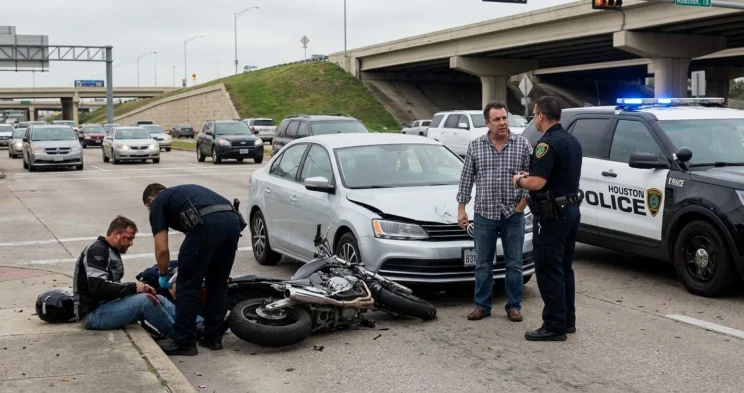
You were stopped at a red light on US-290 heading into Houston when a pickup hit you from behind. Your motorcycle flew out from under you before you could do anything. You landed hard. Now you’re dealing with neck pain, a wrecked bike, and an insurance adjuster who keeps asking whether you suddenly stopped.
Why Rear-End Collisions Hit Motorcyclists Harder
When a car gets rear-ended, the trunk, bumper, crumple zone, and headrest absorb and redirect the impact. Riders have none of that. When a vehicle strikes a motorcycle from behind, the full force transfers directly through the frame and into the rider’s body.
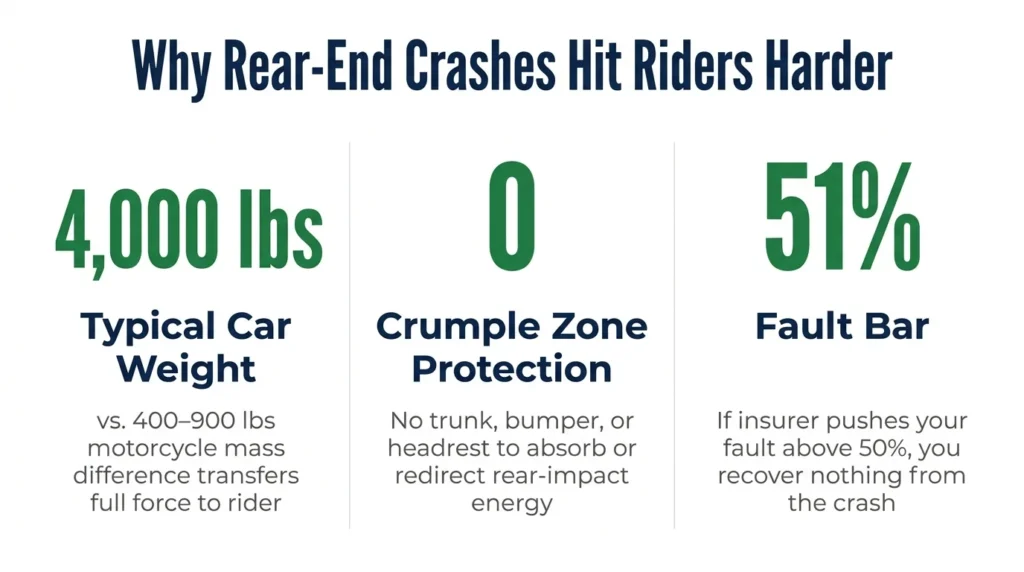
A motorcycle can weigh anywhere from 400 to over 900 pounds depending on the model. A passenger car weighs about 4,000 pounds. That weight difference means even a low-speed impact can throw a rider forward off the seat or seriously compress the spine.
There’s no structure behind you designed to manage that energy.
The rider’s upright seating position makes the problem worse. Your torso and neck are exposed to the same kind of hyperextension and compression that headrests and seatbacks are built to prevent in cars. A rear-end crash that leaves a car driver with whiplash and bruising can leave a rider with fractures, disc injuries, or spinal cord damage.
Common Causes of Rear-End Motorcycle Crashes
Distracted driving causes more rear-end motorcycle crashes than anything else. A driver watching a phone, adjusting the stereo, or looking away from traffic for a few seconds cannot react in time when a rider ahead slows or stops. By the time the driver looks up, they’ve already hit the rider.
Tailgating is the second major cause. Motorcycles can stop faster than cars because of their lighter weight and braking mechanics. A driver who maintains a normal car-following distance behind a motorcycle is already too close if the rider needs to brake hard.
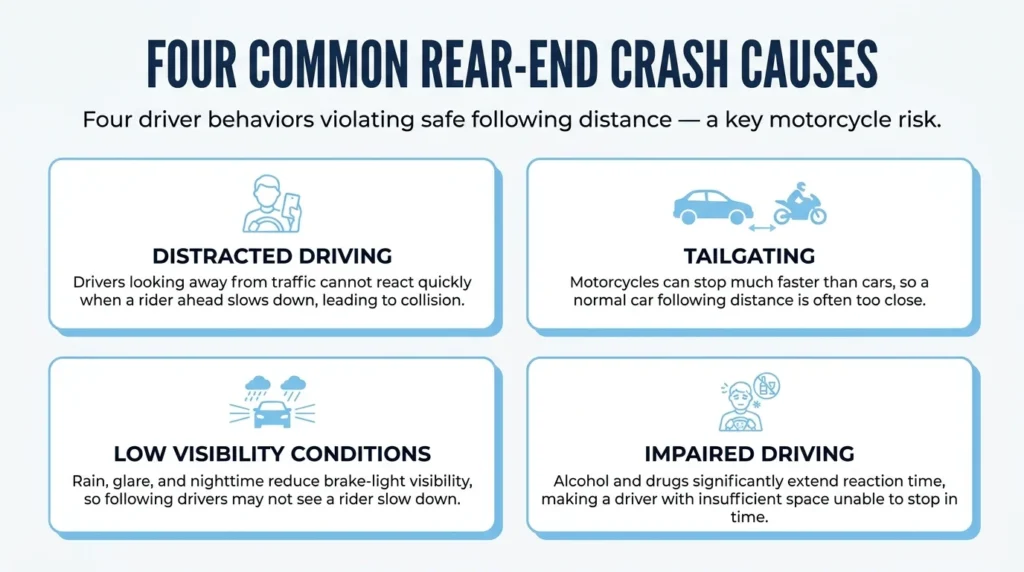
Visibility also plays a role. Rain, glare, dusk, and nighttime driving reduce how well a driver can see a motorcycle’s brake light. When a rider slows in these conditions, drivers following them may not register the decreasing speed until it’s too late.
Blind spot positioning creates a specific risk. When a rider drifts into a driver’s blind spot and then slows for traffic, the driver behind may not see the motorcycle is in the lane until contact occurs. Impaired driving adds reaction time delays to all of the above, and the outcome is almost always worse.
Every Texas driver has a legal duty to maintain a safe following distance under Texas Transportation Code section 545.062, which requires there’s an assured clear distance that accounts for speed, traffic, and road conditions. That duty is what the driver behind you violated when they hit you.
Injuries Common in Rear-End Motorcycle Crashes
Rear-end impacts cause specific injuries in riders. The injuries tend to be more severe than if the rider was in the same crash but in a car. For a broader look at injury patterns across motorcycle crash types, review common injuries in motorcycle accidents.
Whiplash and cervical strain happen when the forward pitch from the impact forces the head and neck through a rapid hyperextension sequence. Without a headrest to stop the motion, the strain on the cervical (neck) spine is unchecked. Symptoms can appear immediately or show up days later, which is one reason early medical evaluation matters.
Disc herniation is common at both the cervical and lumbar (lower spine) levels. The compressive force traveling up through the seat can collapse disc space, causing immediate radiating pain or delayed neurological symptoms in the hands, arms, or legs. Published research on spinal injury patterns in motorcycle crashes shows higher rates of thoracic (middle) spine involvement in riders compared to car occupants, reflecting the unchecked compression loads.
Spinal cord injuries occur when fractures or displacement compress or sever the cord. Complete spinal cord injuries carry permanent consequences. Even incomplete injuries can cause lasting loss of function.
These are the outcomes insurers try to lowball most aggressively, and they are exactly the situations where documented evidence from the early days after the crash carries the most weight.
Lower extremity fractures happen when the motorcycle is pushed into a stopped vehicle or barrier, or when the rider is thrown. Even with a helmet, traumatic brain injury can occur if the forward pitch causes a secondary impact against the pavement or another vehicle.
Fault & Liability in Texas Rear-End Motorcycle Cases
Texas law presumes the following driver is at fault in rear-end collisions, and that presumption is grounded in the duty to maintain a safe following distance. For most rear-end motorcycle cases, the facts will support that presumption. The problem is that insurers don’t simply accept it.
The Fault Presumption & How Insurers Challenge It
The insurance company’s job is to close your claim for as little as possible. When you’re the rider in a rear-end crash, their most common argument is that you created the collision by stopping suddenly without cause, or that you were riding in the following driver’s blind spot and gave the driver no reasonable opportunity to stop.
Neither argument automatically shifts fault. A sudden stop caused by traffic ahead, a road hazard, or debris is a legitimate reason to brake hard. Drivers are legally required to maintain enough distance to stop safely regardless of how quickly the vehicle ahead brakes.
If the driver behind you couldn’t stop in time, the question is whether they were following too closely, not whether your stop was unexpected.
The blind spot argument also has limits. Riding in a driver’s blind spot is not illegal. A driver’s failure to check their blind spot before the impact strengthens, not weakens, the case against them.
The practical answer to both arguments is evidence. Dashcam footage from the striking vehicle, traffic camera recordings, witness statements, and an accident reconstruction can all show that the following driver was too close, regardless of how quickly you stopped. You can review the rear-end collision fault framework that Texas courts apply to understand how these arguments have played out in similar cases.
Texas Comparative Fault & the 51% Bar
Texas uses proportionate responsibility under Texas Civil Practice and Remedies Code (CPRC) Chapter 33. Your recovery is reduced by your percentage of fault. If you’re found to be 20% at fault, you recover 80% of your damages.
If you’re found to be 51% or more at fault, you recover nothing.
This is why insurers push sudden-stop and blind-spot arguments so aggressively. They are not trying to prove you caused the crash. They are trying to push your fault percentage above 50%, which ends the claim entirely.
Filing a Claim After a Rear-End Motorcycle Accident
Building a strong claim starts at the scene, and the steps you take in the first 24 to 48 hours have a direct effect on what you can recover later.
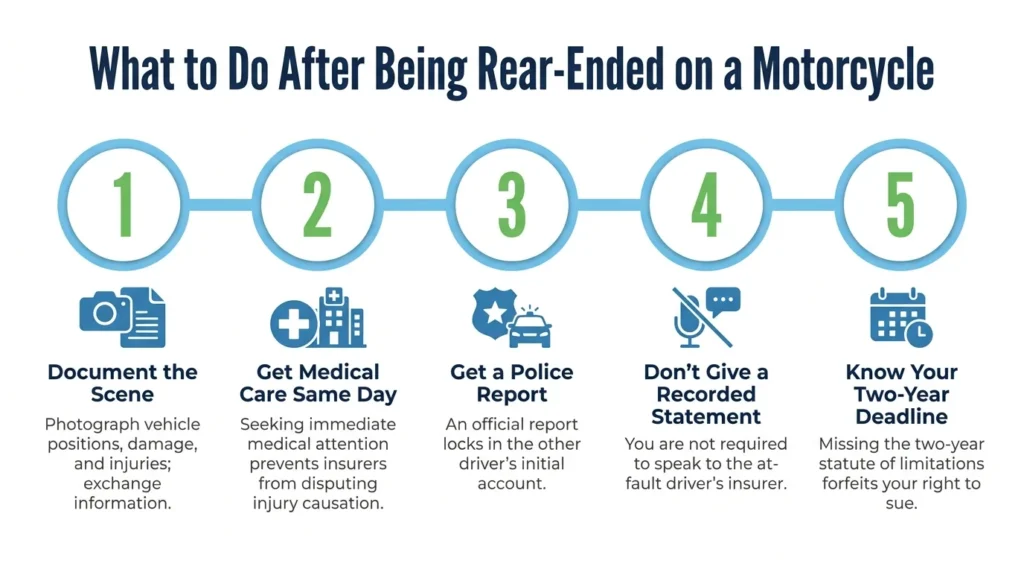
- Step 1: Document the scene before anything is moved. Photograph your motorcycle, the striking vehicle, their position on the road, skid marks, traffic controls, and any visible injuries. Get the other driver’s insurance card, license, and license plate number. Ask any bystanders for their contact information.
- Step 2: Seek medical care the same day, even if you feel fine. Rear-end spinal injuries frequently produce delayed symptoms. A gap between the crash and your first medical visit gives the insurer a basis to argue the injuries were not caused by the crash. A same-day evaluation creates a documented connection between the impact and your condition.
- Step 3: File a police report and request a copy. The responding officer’s report captures the other driver’s initial account of what happened. That account can become important if the driver’s story changes when they speak to their own insurer.
- Step 4: Notify your own insurer but limit what you say to the other driver’s carrier. You’re not required to give a recorded statement to the other driver’s insurer. Providing one without legal guidance gives the adjuster material to use against your claim.
- Step 5: Know your filing deadline. Under Texas Civil Practice and Remedies Code section 16.003, you have two years from the crash date to file a personal injury lawsuit. Missing that deadline ends your right to sue, regardless of how strong your case is.
Learn more about how motorcycle accident settlements develop in Texas before deciding whether to accept an early offer.
Talk to an Experienced Attorney
If you were rear-ended on a motorcycle, the other driver’s insurer will look for ways to reduce what they owe. They may argue that you stopped suddenly, you were in a blind spot, or your injuries were not as severe as documented. Having an attorney review the evidence before you respond to those arguments can change the outcome significantly.
Angel Reyes & Associates has spent over 30 years helping injured Texans work through situations like this. We offer free initial consultations, and our fee is contingent on your recovery. You pay nothing unless we win.
To talk through your situation, contact us for a free consultation. You can also review how we handle motorcycle injury cases across Texas to understand who would be working on your claim.
Past results do not guarantee future outcomes.
Rear-End Motorcycle Accident FAQs
What if the driver who rear-ended my motorcycle has no insurance?
You may still recover insurance through your own uninsured motorist coverage if you carry it on your motorcycle policy. In Texas, insurers are required to offer UM coverage, and if you didn’t sign a written rejection, you may be covered even if you don’t remember adding it.
Does not wearing a helmet affect my rear-end motorcycle accident claim in Texas?
Texas riders 21 and older can legally ride without a helmet if they meet state requirements, but an insurer may argue that a head injury would have been less severe with a helmet on. That argument reduces damages tied to the head injury, not your right to pursue the claim overall.
Can I file a property damage claim for my totaled motorcycle separately from my injury claim?
Yes. Property damage and bodily injury are separate claims in Texas. You can settle the motorcycle replacement or repair through the at-fault driver’s property damage liability coverage while your injury claim is still open, but you should confirm that accepting the property settlement doesn’t release any injury claims.
Does the crash still need a police report to make a claim?
A police report is not legally required to file a claim, but it documents the other driver’s initial statements and puts the crash on record. Without a report, you rely more heavily on photos, witness accounts, and your own medical records to establish what happened and who was responsible.
How long does it typically take to resolve a rear-end motorcycle accident claim in Texas?
Claims with clear liability and documented injuries often settle within a few months, but cases involving disputed fault, serious injuries, or delays in reaching maximum medical improvement can take a year or longer to resolve.
About the Authors

Angel Reyes
Writer
Angel L. Reyes, III is the Founder and Managing Partner of Angel Reyes & Associates. A nationally recognized trial attorney and business leader, Angel has helped over 70,000 injury victims recover more than $1 billion since founding the firm in 1993. Named to the Texas Super Lawyers list annually since 2008, Angel brings Wall Street experience, Ivy League education, and a deep commitment to client advocacy. He is a frequent legal commentator and published author with extensive contributions to legal scholarship, trial strategy, and consumer protection.

Kyle Nicolas
Editor
Kyle Nicolas is the Web Content & SEO Manager at Angel Reyes & Associates. He has more than 10 years of experience as a marketing co...

Angel Reyes
Reviewer
Angel L. Reyes, III is the Founder and Managing Partner of Angel Reyes & Associates. A nationally recognized trial attorney and business...