Uber Robotaxis Set to Launch in Houston in 2027


Every article on this site is researched by our internal team, reviewed for legal accuracy against current Texas law, and held to State Bar of Texas advertising standards before publication. We do not publish content that overstates outcomes or makes promises about results.
Learn more about our
editorial standards .
Key Takeaways
- Texas law treats the self-driving system's owner as the legal operator of a robotaxi.
- You have two years from a Houston robotaxi crash to file a personal injury lawsuit.
- Nuro, Lucid, and Uber can each face separate liability after a robotaxi crash.
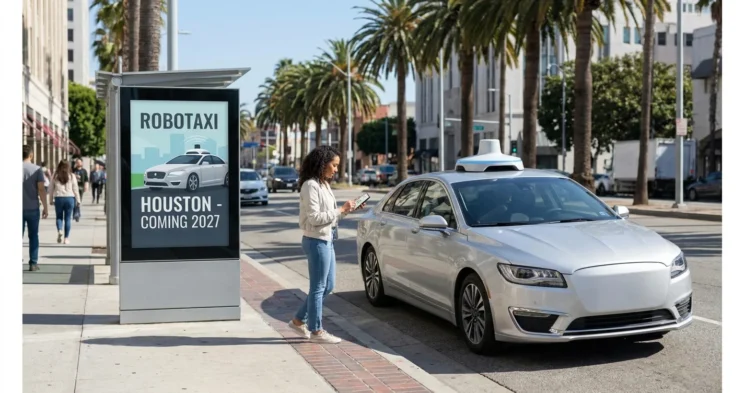
You are stopped at a light on Westheimer Road near the Galleria when a car with no one in the driver’s seat pulls up beside you. It is not a glitch, but the next wave of traffic coming to your daily commute. The question most Houston drivers are starting to ask is simple: if one of these cars hits me, who do I even hold responsible?
Uber’s Houston Robotaxi Launch: What We Know
Uber will bring a premium robotaxi service to Houston by mid-2027. The June 17, 2026 announcement confirmed the launch through a partnership with Nuro, which builds the autonomous driving system, and Lucid, which builds the vehicle on its Gravity SUV platform.
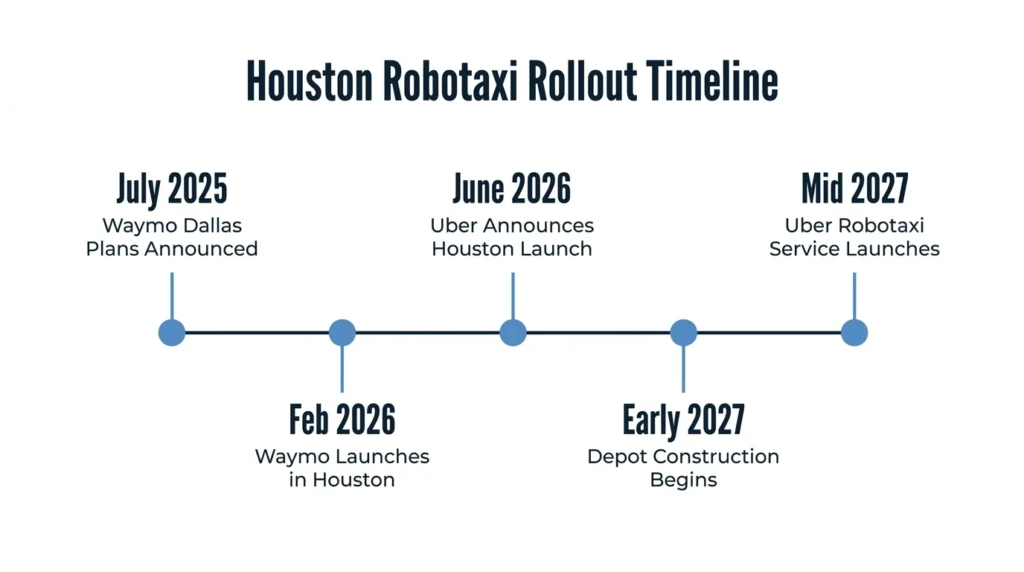
Nuro has registered its autonomous vehicles under Texas’s commercial AV authorization program and is conducting 24/7 testing with safety operators in Houston and the San Francisco Bay Area ahead of the commercial rollout.
Uber has also secured a 50,000-square-foot depot in Houston, with construction slated to begin in early 2027. Each Lucid vehicle uses cameras, solid-state lidar, and radar to sense the road around it.
The Houston launch is one piece of a larger global program targeting 35,000 vehicles across dozens of markets. The San Francisco Bay Area is scheduled to become the first commercial market later in 2026, with Houston following close behind.
Robotaxis Are Already on Houston Streets
You do not have to wait until 2027 to share the road with a self-driving car. Waymo launched a commercial robotaxi service to select Houston riders on February 24, 2026, months before Uber made its announcement.
Those fifth-generation Jaguar I-PACE vehicles already operate across roughly 25 square miles inside the I-610 loop. That coverage includes downtown, Midtown, Montrose, and Houston Heights, so you may have passed one without realizing it.
Houston is now an active robotaxi market. When the Uber-Nuro-Lucid service launches in mid-2027, your city will be one of the few in the country with multiple competing autonomous operators on the same streets.
Waymo has confirmed expansion into Dallas as well, with plans dated back in July 2025 and managed by Avis. While a driverless fleet promises convenience, it also introduces entirely new legal questions when something goes wrong on the road. If you want a closer look at how these crashes get handled, our breakdown of whether you can sue Waymo after a robotaxi crash walks through the basics.
Every operator must first obtain authorization through the TxDMV Automated Vehicles Regulatory Program under SB 2807 before carrying passengers commercially in Texas. You can learn what legal options exist after an AV crash by reviewing the legal framework Texas courts apply.
Who Controls a Robotaxi Under Texas Law?
When a self-driving car is running itself, Texas law treats the owner of the software, not a human behind the wheel, as the legal operator, a rule that reshapes who you can hold responsible after a crash. This framework is governed by distinct state and federal layers that define liability when a collision occurs:
- The Vocabulary: Texas Transportation Code § 545.451 defines automated motor vehicles and automated driving systems, setting the exact terms courts and insurers use to evaluate a robotaxi crash.
- The Operator: Texas Transportation Code § 545.453 establishes the automated driving system’s owner as the operator when that system is engaged. For a Nuro-powered Uber trip, responsibility shifts away from any human and onto the system’s owner, which changes who pays if you are hurt.
- A safety operator riding in the car during testing does not erase that rule because once the system is engaged and driving the vehicle, the statutory operator designation still applies. Our explainer on who counts as the driver in a self-driving crash covers how this plays out in practice.
- The Federal Oversight: The NHTSA Standing General Order requires AV makers to report crashes involving automated systems, adding oversight on top of the Texas authorization program.
If a Robotaxi Hurts You, Who Can Be Held Liable?
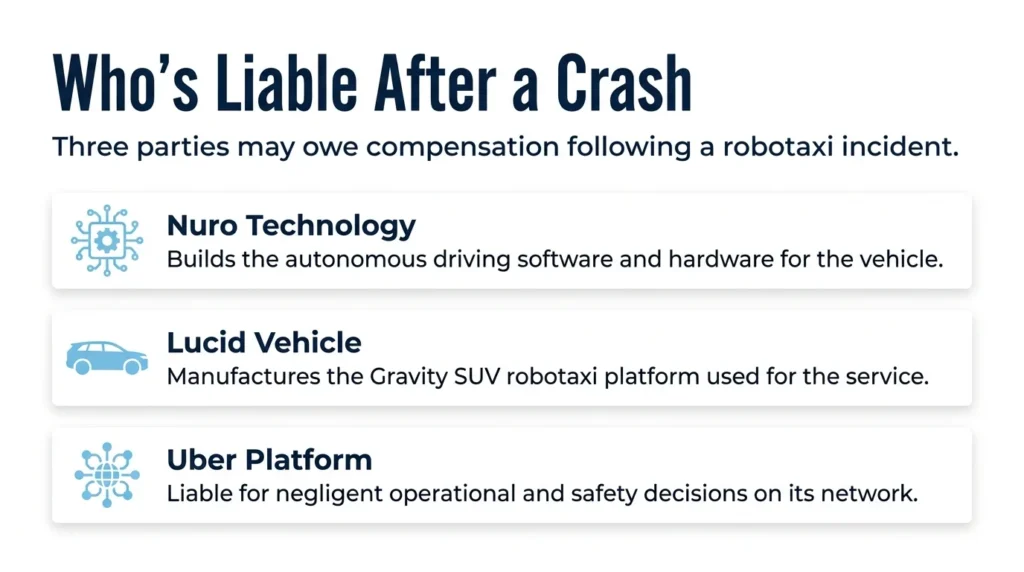
More than one company can owe you compensation after a robotaxi crash. The technology developer, the vehicle maker, and the platform operator each face different legal theories, and your claim may run against more than one of them.
Nuro & Lucid: Technology & Vehicle Liability
Nuro and Lucid can both be defendants under Texas product liability law if a defect in the autonomous system or the vehicle caused your crash. Nuro builds the software and hardware that drives the car, while Lucid builds the vehicle itself.
The Texas Civil Practice and Remedies Code (CPRC) Chapter 82 governs product liability claims against these companies. A claim can run against Nuro as the system developer and Lucid as the manufacturer at the same time.
To win a product defect claim, you must show the system or vehicle had a manufacturing, design, or marketing defect that made it unreasonably dangerous. Engineering logs, sensor data, and Nuro’s crash reports become some of your most important evidence. Our guide on filing a claim against a self-driving car company explains how these cases come together.
Uber: Platform & Fleet Operator Liability
Uber faces a separate path to liability as the company deploying the service to the public. This theory turns on Uber’s own conduct rather than a product defect.
If Uber’s operational decisions, training protocols, or safety standards contributed to your crash, you may bring a direct negligence claim against the company. That claim stands on its own, apart from any defect in the car.
Fault rarely lands on one party alone. Under CPRC § 33.001, Texas allocates fault among everyone responsible, and your recovery drops by your own share of the blame. If you are found 51% or more responsible, you recover nothing.
For the full legal framework behind these rules, our Texas self-driving vehicle accident liability guide lays out how the pieces fit together before you accept any settlement offer.
Your Rights After a Houston Robotaxi Crash
You have two years from the date of your crash to file a personal injury lawsuit. The CPRC § 16.003 sets that deadline, and missing it can bar your recovery no matter how clear the fault is.
AV crashes leave behind a kind of evidence ordinary wrecks do not. Sensor logs, camera footage, system decision records, and Nuro’s federally required crash reports all tell the story of what happened.
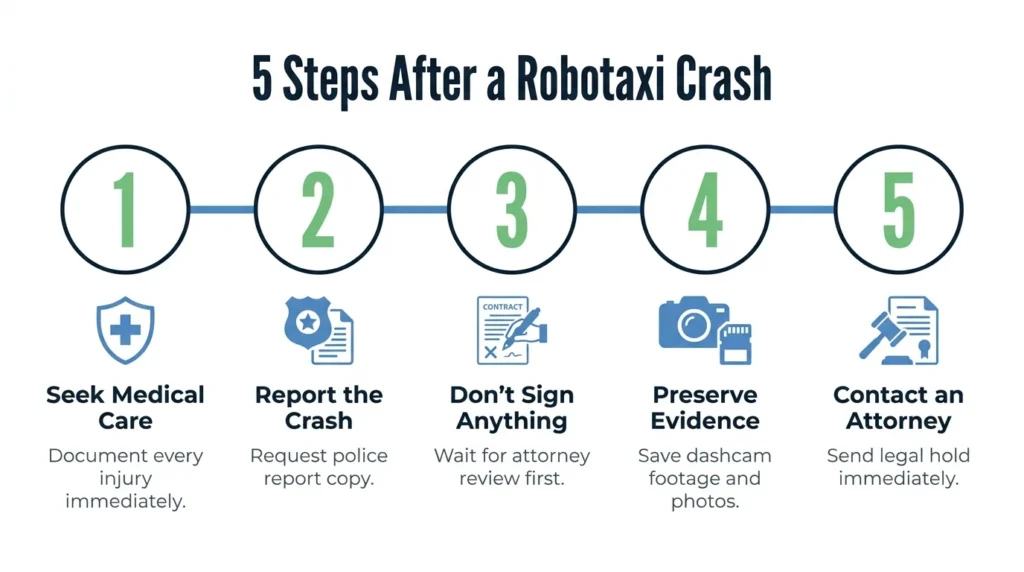
That data is often overwritten or purged on short cycles. Preserving it takes a timely legal hold, which is why the steps you take in the first days matter so much.
Step 1: Seek medical attention immediately. Get checked out and document every injury, even ones that feel minor at first.
Step 2: Report the crash to the Houston Police Department. Request a copy of the crash report once it is filed.
Step 3: Do not sign any release or accept any payment from Uber, Nuro, or Lucid. Wait until an attorney reviews the offer first.
Step 4: Preserve dashcam footage, photos, and witness contact information. This is the evidence you control, so protect it.
Step 5: Contact an attorney promptly. A timely legal hold letter can stop sensor data from being purged before anyone reviews it.
If you were hurt in any Houston crash, our Houston car accident cases page explains your options. For trips booked through an app, our Houston rideshare accident cases page covers how those claims work.
Injured by a Robotaxi? Talk to Angel Reyes & Associates
Robotaxis are arriving in Houston faster than most people expected, and the rules for holding a self-driving car company responsible are unlike anything in an ordinary crash. Angel Reyes & Associates has more than $1 billion recovered for clients across Texas, including Houston residents hurt in complex vehicle cases. Our team understands how to navigate these emerging technologies and protect your rights.
If an Uber robotaxi, a Waymo vehicle, or any autonomous vehicle injures you or a loved one, we are available 24/7 for a free consultation. When a crash takes a life, our wrongful death claims team can help your family understand the path forward. You can also see our office locations across Texas or read what our clients say about working with us.
We work on a contingency basis, so there is no fee unless we win. Schedule a free consultation so we can help you in your recovery journey.
Past results do not guarantee future outcomes.
Houston Robotaxi FAQs
Does Uber's arbitration clause prevent passengers from filing a lawsuit after a robotaxi crash?
Uber’s terms of service require passengers to resolve most injury disputes through mandatory arbitration rather than in court, but third parties who never agreed to those terms (pedestrians, cyclists, and other drivers) are not bound by that clause and can still sue in court.
Are robotaxi passengers owed a higher standard of care than pedestrians or other drivers on the road?
Texas courts have recognized that carriers transporting paying passengers for compensation owe their riders a heightened duty of care, sometimes called a high degree of care, which goes beyond the ordinary reasonable care owed to the general public. Whether that standard applies to a robotaxi operator under Texas law is a question that will likely be decided on a case-by-case basis as litigation develops.
What if the crash happens during Nuro's testing phase, before the commercial 2027 launch?
The Texas Transportation Code designates the ADS owner as the legal operator whenever the system is engaged, so the pre-launch or post-launch distinction does not shield Nuro from operator liability. Nuro already holds a Texas permit that allows driverless operation, and crashes during testing are subject to the same legal framework as commercial crashes.
Does Texas law require Uber and Nuro to keep a data recorder in their robotaxis?
Texas SB 2807 requires AV operators to certify that their vehicles are equipped with a recording device as a condition of obtaining and maintaining commercial authorization. This means the data recorder requirement is a state-mandated condition of operation, not just an internal company practice, which matters when you seek access to that data after a crash.
Can a human teleoperator or remote safety monitor be held responsible if they caused the crash?
If a remote operator took control of the vehicle and their actions caused the crash, liability may shift toward that individual and the company that deployed them, separate from any defect in the ADS itself. Real-world incidents with other AV operators have recorded crashes caused by human teleoperators taking over a stalled system, so this is a recognized fault scenario courts are beginning to address.
About the Authors

Angel Reyes
Writer
Angel L. Reyes, III is the Founder and Managing Partner of Angel Reyes & Associates. A nationally recognized trial attorney and business leader, Angel has helped over 70,000 injury victims recover more than $1 billion since founding the firm in 1993. Named to the Texas Super Lawyers list annually since 2008, Angel brings Wall Street experience, Ivy League education, and a deep commitment to client advocacy. He is a frequent legal commentator and published author with extensive contributions to legal scholarship, trial strategy, and consumer protection.

Kyle Nicolas
Editor
Kyle Nicolas is the Web Content & SEO Manager at Angel Reyes & Associates. He has more than 10 years of experience as a marketing co...

Angel Reyes
Reviewer
Angel L. Reyes, III is the Founder and Managing Partner of Angel Reyes & Associates. A nationally recognized trial attorney and business...