Texas School Bus Safety Laws


Every article on this site is researched by our internal team, reviewed for legal accuracy against current Texas law, and held to State Bar of Texas advertising standards before publication. We do not publish content that overstates outcomes or makes promises about results.
Learn more about our
editorial standards .
Key Takeaways
- Texas school bus drivers need a Class B CDL with Passenger and School Bus endorsements, plus DPS certification.
- State law requires buses to have working safety equipment, including stop arms, flashing lights, mirrors, and emergency exits.
- If school bus safety law is violated, it can be used as evidence of negligence in an injury claim.
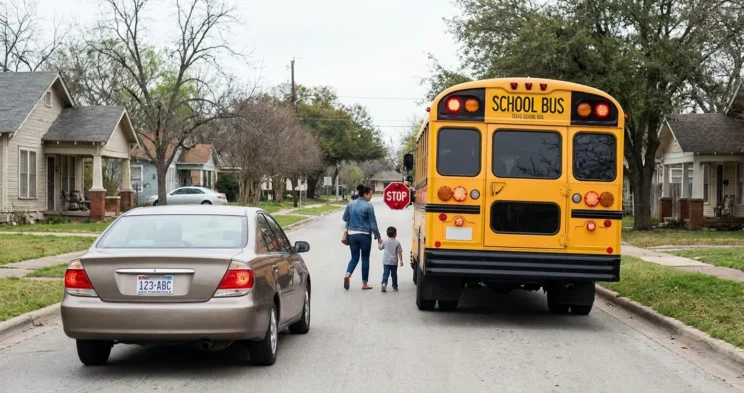
Every weekday morning, your child climbs the steps of a big yellow bus and disappears behind the closing door. You wave goodbye, trusting that someone made sure the bus is safe, and the driver is responsible. Rest assured that Texas has a layered system of school bus safety laws covering who is allowed to drive the bus, what equipment the bus must carry, how often the bus gets inspected, and how the bus must be operated on the road.
These rules protect your child every time they ride the school bus. They also come into play if your child is ever injured on a school bus, because a crash can often be traced back to a safety law that was ignored. Keep reading to learn how the Texas school bus system is built, and what your options are when it fails.
Who Can Drive a School Bus in Texas?
Not just anyone can sit behind the wheel of a school bus in Texas. The state layers federal and state requirements on top of an ordinary driver’s license, and a driver has to clear every one of them before they can get behind the wheel.
Required Licenses and Endorsements for School Bus Drivers
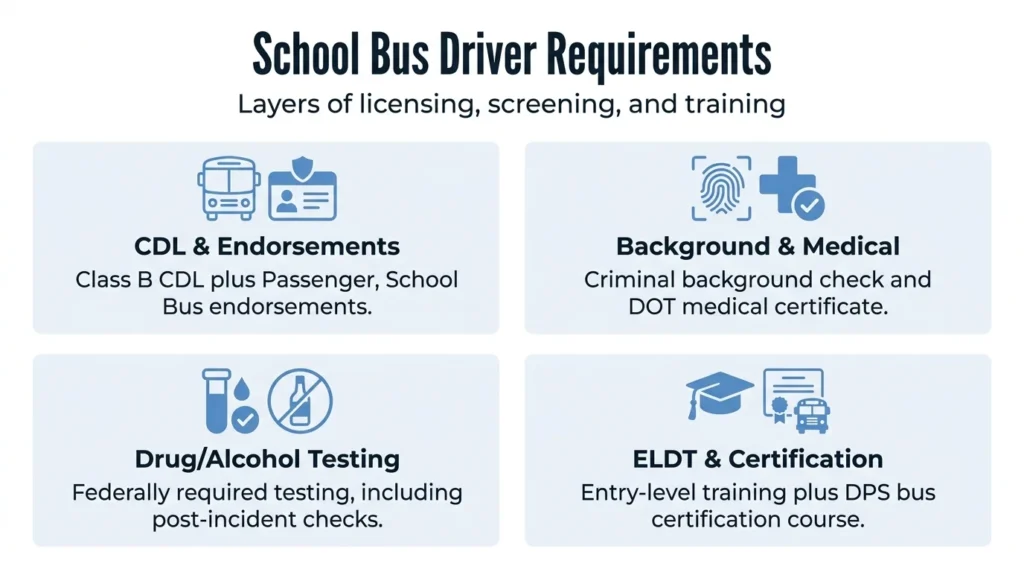
A Texas school bus driver must hold a Commercial Driver License (CDL), usually a Class B. A standard license is not enough.
On top of the CDL, the driver needs two endorsements:
- The Passenger (P) endorsement is required to operate any vehicle built to carry 16 or more people.
- The School Bus (S) endorsement is required specifically to drive a school bus. To earn it, prospective drivers must take an extra knowledge test, plus a behind-the-wheel skills test in an actual school bus. This second endorsement is the state’s way of confirming that the driver can handle the specific demands of moving children safely, from managing the danger zones around the bus to supervising the loading and unloading process.
Background Checks, Medical Certification, and Drug Testing
Qualifying to drive a school bus is about more than passing a test. A school bus driver must meet the age requirements (at least 18 years old and often older according to specific district policy) and pass a criminal background check.
The driver must also hold a valid Department of Transportation medical certificate, which means passing a physical exam that confirms they are healthy enough to operate a commercial vehicle. As a CDL holder, the driver is subject to a federally required drug and alcohol testing program, including testing after certain incidents.
These checks exist to ensure the person responsible for a busload of children is medically fit, sober, and has no disqualifying criminal or driving history.
Required Training and Certification
Getting a CDL isn’t enough in Texas. Since February 2022, anyone who wants to earn a new Class B CDL or add the Passenger or School Bus endorsement must complete federal Entry-Level Driver Training (ELDT) from an approved provider before they can take the behind-the-wheel skills test.
Texas school bus drivers must also complete a School Bus Driver Training and Certification course administered by the Texas Department of Public Safety, along with regularly scheduled refresher training. Under Texas Education Code Chapter 34, the Department of Public Safety and the Texas Education Agency are responsible for setting the safety standards for school buses, and every school district must meet or exceed these standards.
School Bus Equipment Requirements
A school bus is one of the most heavily regulated vehicles on any Texas road. Texas Transportation Code Chapter 547 requires that school districts must meet specific vehicle equipment and Texas Department of Public Safety (DPS) standards.
The Stop Arm and Flashing Warning Lights
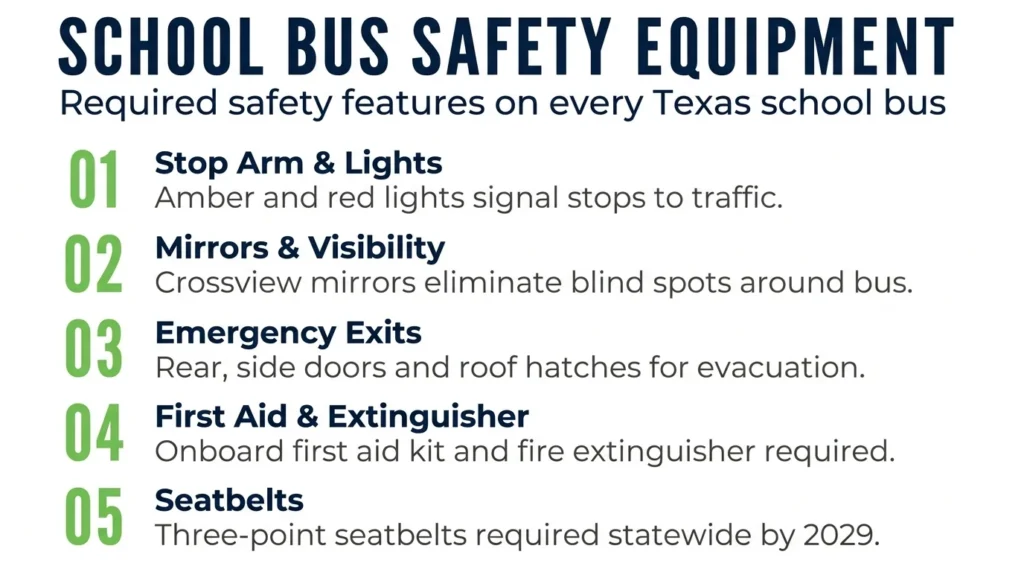
The most recognizable safety equipment on a school bus is the warning system. Under Chapter 547.701, a school bus must display alternately flashing warning lights and a stop signal when it stops to pick up or drop off children.
The amber lights warn approaching traffic that the bus is about to stop. The red lights and the extended stop arm signal that children are getting on or off the bus, and traffic must come to a halt.
That responsibility falls on the other drivers on the road. According to Texas Transportation Code Chapter 545.066, Texas law requires other motorists to stop when a school bus displays its stop sign and flashing lights, and there are serious penalties for illegally passing a stopped school bus.
Mirrors, Emergency Exits, and Onboard Safety Equipment
Safe loading depends on the driver’s ability to see. School buses must be equipped with crossview and side mirrors designed to eliminate blind spots around the vehicle, including the area directly in front of the bus, where a small child can easily disappear from view.
A bus must also have working emergency exits, including rear or side emergency doors and roof hatches built to federal safety standards, so children can get out quickly if the main door is blocked. Standard onboard equipment includes a first aid kit and a fire extinguisher, along with reflective markings and clear school bus identification on the outside of the vehicle.
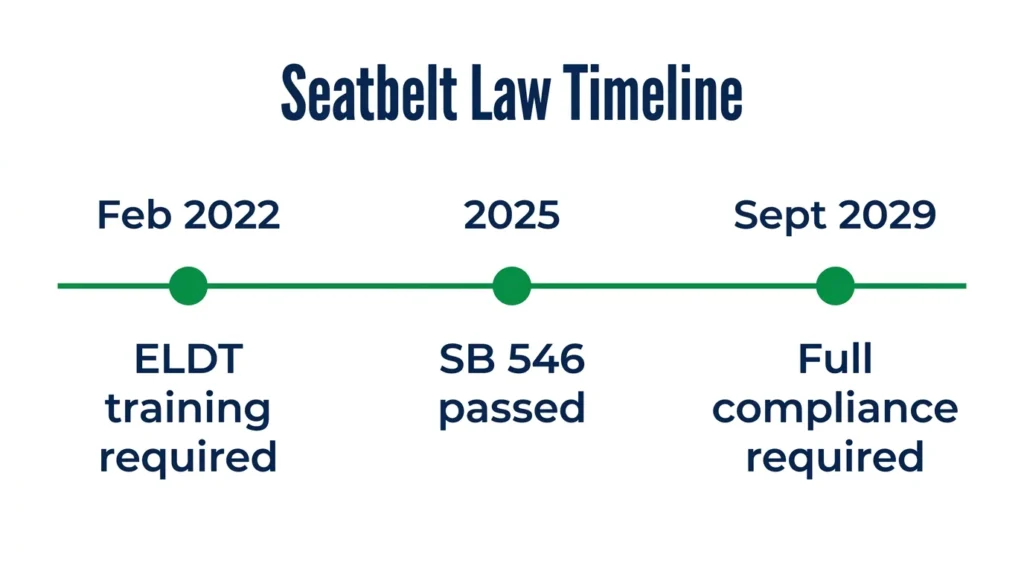
When it comes to seatbelts, most newer Texas school buses are equipped with seatbelts for every passenger. As of 2025, Senate Bill 546 mandates Texas to transition to a broader three-point seatbelt requirement for school buses, with full compliance on all school buses required by September 1, 2029.
Inspection and Maintenance Requirements
Equipment only protects children when it actually works. A stop arm that sticks, brakes that fade, or a mirror knocked out of alignment can turn a routine bus trip into a tragedy, so Texas law requires school buses to be kept in safe operating condition.
Keeping the Bus in Safe Operating Condition
School buses are commercial vehicles, and they remain subject to safety inspection requirements, even when inspection rules for ordinary passenger cars change. School districts and the bus companies they use must keep their buses maintained according to the DPS safety standards they are required to meet or exceed under Education Code Chapter 34.
This means that before a bus can be driven, it must go through documented servicing, maintenance, and repairs. A district that puts a defective bus on the road is not just cutting corners; it is breaking the law.
The Daily Pre-Trip Inspection
The law does not rely on annual checks alone. As a CDL holder, a school bus driver is trained and expected to perform a pre-trip inspection every single day before transporting students.
This daily inspection looks at the brakes, lights, tires, mirrors, stop arm, warning lights, and emergency exits. A driver who skips the inspection or drives a bus that does not pass the inspection is breaking the law.
Rules of the Road for School Bus Drivers
A qualified driver in a well-equipped bus still has to operate it safely. Texas Transportation Code Chapter 545 governs how vehicles move on Texas roads, and because bus drivers are transporting children, they have an even greater responsibility.
Speed Limits and Following Distance
Texas sets reduced speed limits in school zones, and bus drivers must obey them like everyone else. Speed affects every part of a crash, including how long it takes the bus to stop and the force of an impact.
Bus drivers also have the same responsibilities as every Texas driver, including keeping a safe following distance and maintaining enough room to stop for whatever the road throws at them. With dozens of children onboard, even a small error can have serious consequences.
Railroad Crossings and Stops
Railroad crossings have their own set of rules. A bus carrying passengers must stop at a railroad crossing, then look and listen before proceeding only when it is safe to cross. This is because the consequences of a train colliding with a loaded bus are catastrophic.
Texas Transportation Code Chapter 545 sets the rules for how and where these stops must happen. A bus driver who drives through a crossing without stopping is breaking a law specifically designed to prevent the worst possible outcome from occurring.
What Happens When These Laws Are Broken?
A broken safety law can be the difference between a near miss and an injured child. When a crash happens, these laws decide who is responsible. A violation can serve as evidence of negligence, including:
- An unqualified or improperly trained driver
- A bus that is missing safety equipment
- A bus that is operating with defective safety equipment
- A driver who skipped their daily inspection
- A driver who ignored a maintenance problem
- A driver who drove through a railroad crossing
- A driver who sped through a school zone
Who you hold responsible depends on who operated the bus. When the bus belongs to a public school district or a government transit authority, the Texas Tort Claims Act controls the claim, including damage caps and short notice deadlines. You can read more about this in our guide on the Texas Tort Claims Act and bus accident limits.
When a private charter company or contractor operates the bus, standard personal injury laws and commercial insurance generally apply.
After a crash, it is important to determine who is responsible quickly, because evidence disappears and deadlines approach fast. For a closer look at this, see our bus accident injury overview, read more about who is liable in a Texas bus accident, and view our guide on how to file a bus accident claim.
Talk to an Attorney About Your Bus Accident in Texas
If your child was hurt on a school bus, you should not have to figure out CDL rules, equipment standards, and government claim deadlines on your own, while also caring for an injured kid.
Angel Reyes & Associates has spent more than 30 years fighting for injured Texans and has recovered over $1 billion for our clients across the state. We handle bus accident cases regularly, which means we know how these safety laws work and how to prove they were broken. You can see examples of the cases we have pursued on our case results page.
Your first consultation is free, you pay nothing unless we win, and our team is available 24/7. When you are ready, reach out for a free consultation today.
Past results do not guarantee future outcomes.
Texas School Bus Safety Law FAQs
What should parents do if a driver illegally passes their child's stopped school bus?
Parents should report as much information as possible (including the vehicle description, license plate number, location, and time of the incident) to local law enforcement or the school district. Texas law imposes penalties for unlawfully passing a stopped school bus that is displaying its required warning signals.
Can a school district be held responsible if poor bus maintenance contributed to a crash?
Yes. If inadequate inspection, maintenance, or repairs contributed to the collision, the school district or another responsible party may face liability, depending on who owned, maintained, or operated the bus.
Are school buses required to have cameras or video recording systems in Texas?
No. Texas law does not require every school bus to have onboard cameras, although many districts voluntarily install them to improve student safety, monitor driver conduct, and document incidents.
Does the Texas Tort Claims Act apply to every school bus accident?
No. The Texas Tort Claims Act generally applies when a public school district or another governmental entity operates the bus, while claims involving privately operated or contracted buses may be governed by different liability rules.
Can school bus safety violations help prove negligence after an accident?
Yes, they can. Evidence that a driver or bus operator violated a safety law, regulation, or required procedure may help support a negligence claim, although liability still depends on the specific facts and applicable law.
About the Authors

Angel Reyes
Writer
Angel L. Reyes, III is the Founder and Managing Partner of Angel Reyes & Associates. A nationally recognized trial attorney and business leader, Angel has helped over 70,000 injury victims recover more than $1 billion since founding the firm in 1993. Named to the Texas Super Lawyers list annually since 2008, Angel brings Wall Street experience, Ivy League education, and a deep commitment to client advocacy. He is a frequent legal commentator and published author with extensive contributions to legal scholarship, trial strategy, and consumer protection.

Kyle Nicolas
Editor
Kyle Nicolas is the Web Content & SEO Manager at Angel Reyes & Associates. He has more than 10 years of experience as a marketing co...

Alex Ivanov
Reviewer
Alex Ivanov is a personal injury attorney at Angel Reyes & Associates, focused on car, truck, and motorcycle accident cases. Licensed in...