Filing a Claim After a Houston METRO Bus Accident


Every article on this site is researched by our internal team, reviewed for legal accuracy against current Texas law, and held to State Bar of Texas advertising standards before publication. We do not publish content that overstates outcomes or makes promises about results.
Learn more about our
editorial standards .
Key Takeaways
- You have six months after a Houston METRO bus crash to send METRO written notice of your claim.
- METRO is a unit of local government, so its injury cap is $100,000 per person.
- METRO is a government entity, so your claim goes to its own Claims Division, not an outside insurer.
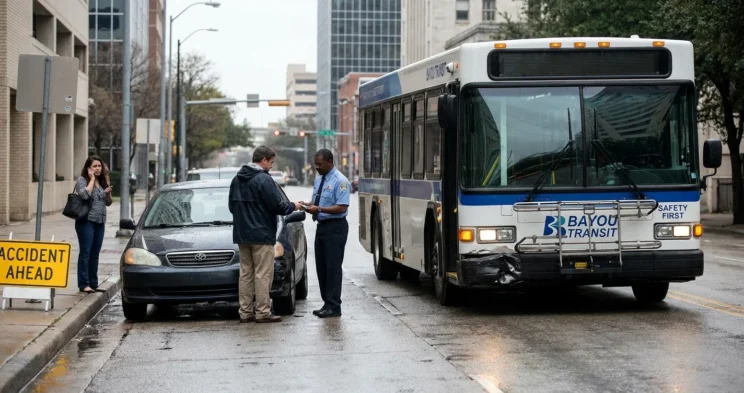
You were riding a METRO bus down Westheimer Road when the driver braked hard and threw you into the seat in front of you. Now, you have a hospital bill and a sore back, and you’re wondering who you even file a claim against when the bus belongs to the government.
Why METRO Claims Work Differently
METRO is the Metropolitan Transit Authority of Harris County, created under Texas Transportation Code § 451.052 as a regional transit authority. That law makes METRO a government entity, so a claim filed against it does not work like a normal insurance claim. This changes everything about how you pursue compensation.
A private bus company carries liability insurance, so in a crash with a private bus company, you would file a claim with their insurer. With METRO, the process is different. Your claim must be filed directly with METRO’s own Claims Division, rather than an outside insurer.
Normally, because METRO is a government entity, sovereign immunity would block you from filing an injury claim at all. However, the Texas Tort Claims Act allows you to pursue compensation in limited situations. One of them is an injury caused by a government employee operating a motor vehicle, and a bus crash applies to this exception under Texas Civil Practice and Remedies Code (CPRC) § 101.021.
The Six-Month Notice Requirement
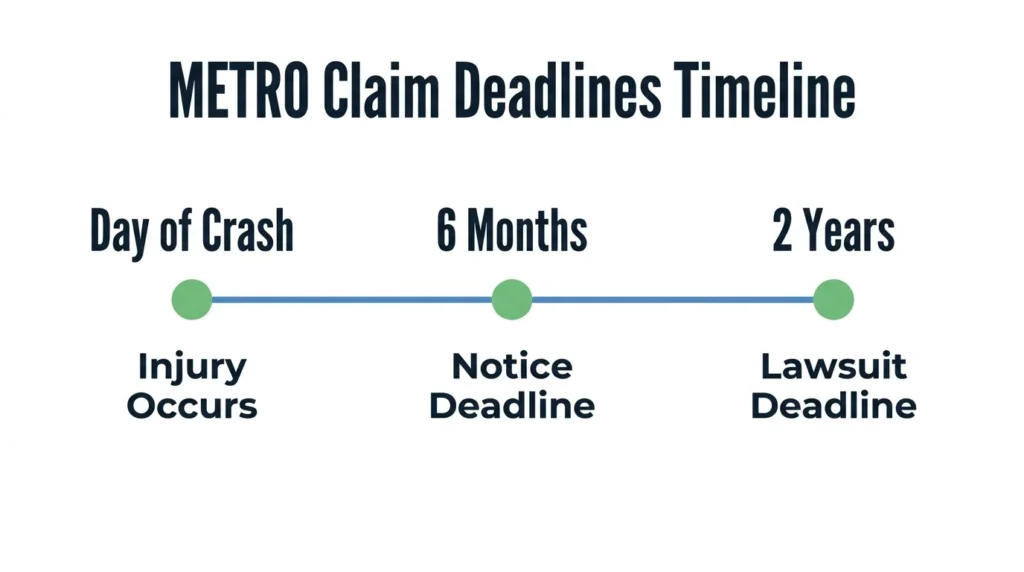
You have six months from the date of the crash to give METRO written notice of your claim. CPRC § 101.101 requires this notice before you file a lawsuit. This notice must describe your injury, the time and location of the incident, and what happened.
METRO requires you to submit a completed Notice of Claim form. The form and filing instructions can be found on METRO’s official Notice of Claim page.
You can also mail the completed form to METRO’s Claims Division at:
METRO Claims Division
P.O. Box 61429
Houston, TX 77208-1429
For alternative delivery instructions, check METRO’s official Notice of Claim page or call the Claims Division to confirm the currently accepted submission methods.
The six-month notice deadline is separate from the deadline you have to file a lawsuit, but the notice has to come first. For a closer look at how this works against any government body, see our guide on suing a government entity in Texas.
If you miss this deadline, your claim can be completely dismissed. The six months start from the date of the crash itself, not when your treatment begins or when you first learn how serious your injuries really are. Talking with an attorney who handles Houston bus accident cases early can protect your rights before the deadline passes.
Damage Caps on METRO Claims
State law limits what you can recover from METRO, no matter how severe your injuries are. The exact limit depends on how the law classifies METRO, and that classification confuses a lot of people.
Unit of Local Government vs Municipality Caps
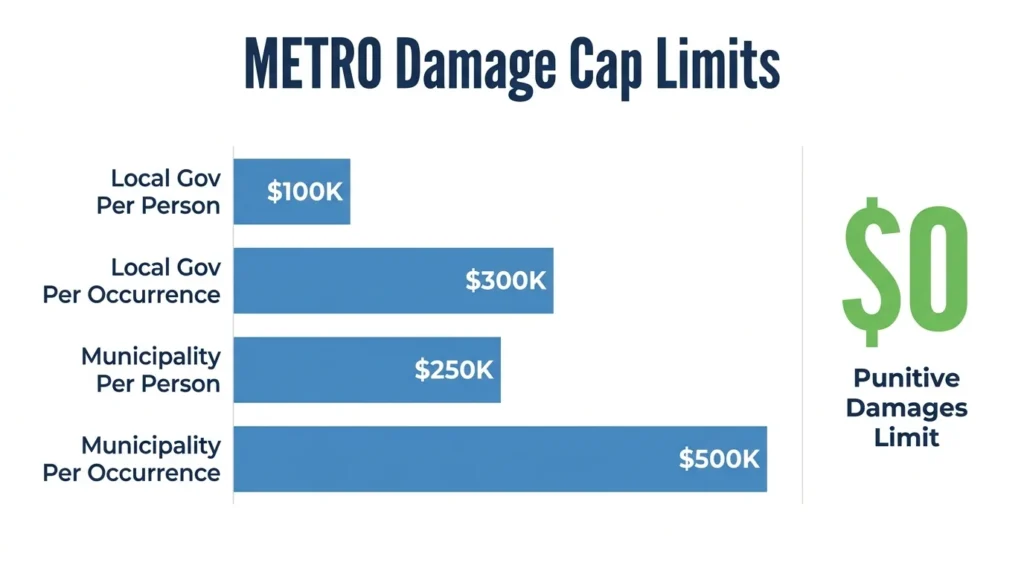
Under CPRC § 101.023, a unit of local government faces a cap of $100,000 per person and $300,000 per occurrence for bodily injury or death. A municipality faces a higher cap of $250,000 per person and $500,000 per occurrence. These damage limits must be followed according to the Texas Supreme Court. If you want to argue for the higher limit, then you must prove that the government entity is a municipality.
METRO falls into the lower tier because it is a unit of local government, not a municipality, under Texas Transportation Code Chapter 451. Texas courts have recently confirmed METRO’s status as a local government entity in a 2025 court of appeals decision.
Other Cap Limits
The per-person and per-occurrence caps are not the only limits on your recovery. You also cannot claim punitive damages against METRO or other government entities under the Texas Tort Claims Act.
These limits are strictly enforced. Even if a jury awards more than the limit, the court will reduce the verdict down to the cap. Our breakdown of how the TTCA limits bus accident recovery explains when these caps apply.
However, not all claims are affected by government damage limits. A claim filed against a third party (such as another driver or a vehicle parts manufacturer) does not have government immunity. That is why it’s important for an attorney to carefully review your specific crash and identify every possible claim, including Texas bus accident liability claims against other parties.
Steps to File a METRO Claim
Filing a METRO claim follows a clear sequence of events, and the earlier you start, the stronger your position will be. Here are the steps to follow in order after a Houston METRO bus crash:
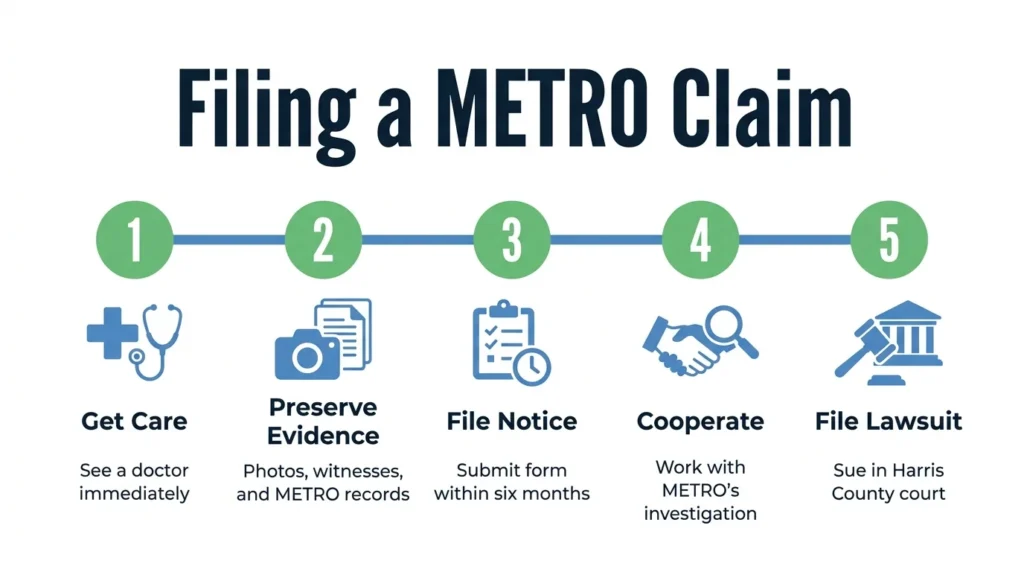
Step 1: Get medical attention right away. See a doctor, even if your injuries feel minor. A medical record proves both the injury and when it happened, which METRO will scrutinize later.
Step 2: Preserve evidence at the scene. Photograph the bus, the location of the crash, and any visible injuries. Collect names and phone numbers from witnesses. Ask whether a METRO incident report number was issued at the scene.
Step 3: Request METRO’s records promptly. METRO controls its own driver logs, maintenance records, and onboard camera footage. Ask for them quickly, because routine systems can delete footage before you ever see it.
Step 4: Complete and submit the Notice of Claim form within six months. This form asks for your name and address, a description of the incident, the date, time, and location of the crash, and a description of your injuries and damages.
Step 5: Work with METRO throughout their investigation. After you file, the Claims Division will investigate. METRO may ask for more information, request a recorded statement, or send you an early settlement offer.
Step 6: File a lawsuit if the claim stalls. If METRO denies your claim, or their offer falls short, you can sue them in Harris County district court. Knowing who is liable in a Texas bus accident will help you understand what your case will involve.
Talk to an Attorney About Your METRO Bus Accident in Houston
Angel Reyes & Associates has spent over 30 years helping injured Texans hold government entities like METRO accountable. We have recovered more than $1 billion for clients, and you can review our bus accident and injury case results to see how we have handled cases like yours.
We work on contingency, which means you pay no fee unless we win your case. We serve clients across Texas, we are available 24/7, and we offer a free consultation to review your options. Contact us today before the six-month notice deadline closes.
Past results do not guarantee future outcomes.
Houston METRO Crash FAQs
Can I still recover compensation if I was partially at fault for the accident?
It depends. Texas uses a proportionate responsibility rule, so your recovery is reduced by your share of fault. You can still collect as long as your fault is 50% or less, but if you are found more than 50% responsible, you cannot recover any compensation at all.
How long do I have to file a lawsuit against METRO after the six-month notice period?
The two-year statute of limitations under Texas Civil Practice and Remedies Code Section 16.003 sets the deadline for filing a lawsuit. The six-month notice is a required first step, and the two-year deadline is separate from that notice.
Does the Texas Tort Claims Act cover a slip-and-fall inside a METRO bus, or just crashes?
A crash caused by a driver who is operating the bus falls under the motor vehicle exception and is generally covered. A slip-and-fall due to a defective condition inside the bus is treated as a premises defect claim, which requires proof that METRO had actual knowledge of the dangerous condition on the bus before your injury happened.
Can a pedestrian or bystander injured by a METRO bus file a claim, or just passengers who were on the bus itself?
Any person injured by a METRO bus operated by a METRO employee can file a claim under the Texas Tort Claims Act, including pedestrians and cyclists hit by the vehicle. The same six-month written notice requirement and damage caps apply to non-passengers.
About the Authors

Angel Reyes
Writer
Angel L. Reyes, III is the Founder and Managing Partner of Angel Reyes & Associates. A nationally recognized trial attorney and business leader, Angel has helped over 70,000 injury victims recover more than $1 billion since founding the firm in 1993. Named to the Texas Super Lawyers list annually since 2008, Angel brings Wall Street experience, Ivy League education, and a deep commitment to client advocacy. He is a frequent legal commentator and published author with extensive contributions to legal scholarship, trial strategy, and consumer protection.

Graham Griffin
Editor
Graham Griffin is the Web & Content Manager at Angel Reyes & Associates, where he oversees content strategy, AI-powered workflows, a...

Angel Reyes
Reviewer
Angel L. Reyes, III is the Founder and Managing Partner of Angel Reyes & Associates. A nationally recognized trial attorney and business...