Company Shuttle Bus Accident Liability in Texas


Every article on this site is researched by our internal team, reviewed for legal accuracy against current Texas law, and held to State Bar of Texas advertising standards before publication. We do not publish content that overstates outcomes or makes promises about results.
Learn more about our
editorial standards .
Key Takeaways
- Texas employers can be liable for shuttle crashes through respondeat superior or direct negligence.
- Workers' comp may bar suing a subscribing employer, but third parties can still file claims.
- You have two years from the shuttle crash date to file a personal injury lawsuit in Texas.
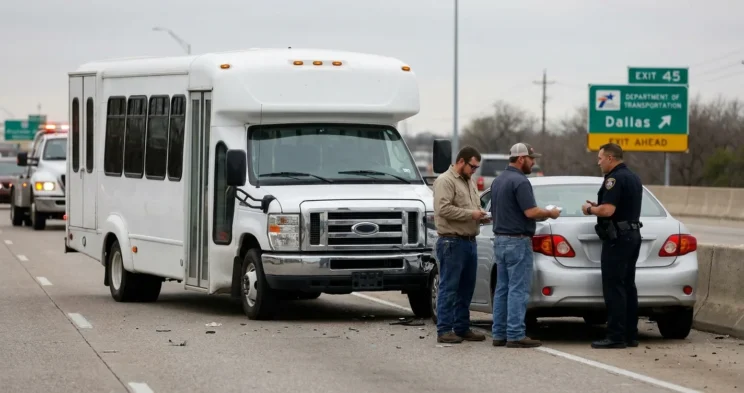
You climbed onto the company shuttle for the ride from the parking lot to the job site, the same as any other morning. Somewhere along I-35 in Austin, the driver rear-ended the truck ahead and your neck snapped forward. Now you are hurt, the bills are starting, and you are wondering if the company that ran that shuttle owes you anything.
How Texas Holds Employers Liable for Shuttle Crashes
When your employer owns and operates the shuttle that injured you, two separate legal theories can put the company on the hook. The first is respondeat superior, a rule that holds the employer responsible for the driver’s negligence. The second is the employer’s own direct negligence.
Respondeat superior applies when the shuttle driver was doing his job at the time of the crash. If he was on the clock and driving the assigned route, the company answers for his mistakes as if they were its own.
The second path does not depend on the driver at all. You can hold the employer responsible for negligent hiring, poor training, weak supervision, or skipped maintenance. These claims can succeed even if the driver is never named or is found not at fault.
Texas courts look at the facts to decide whether the driver was inside the scope of his job. They ask whether the drive benefited the employer and whether the company assigned or authorized the trip.
One statute can also shape the case. The Texas Civil Practice and Remedies Code (CPRC) Chapter 72 governs employer liability when a commercial motor vehicle is involved. Whether a specific shuttle qualifies under that definition is a fact question your attorney will need to confirm.
If you want a broader picture of how these crashes get litigated, our overview of Texas bus accident claims walks through the basics.
The Coming-and-Going Rule & the Shuttle Exception
Texas usually does not hold an employer liable for what happens during an ordinary commute. This is the coming-and-going rule, and the company will lean on it hard. Two well-worn exceptions cut the other way, and shuttle operations tend to fall right inside them.
These two doctrines look alike but turn on different facts. Knowing which one fits your situation can decide whether the company stays in the case.
The Dual-Purpose Doctrine
The dual-purpose doctrine applies when the shuttle trip also served the employer’s business, not just your ride to work. Hauling equipment, picking up materials, or carrying the company’s clients all qualify.
The business reason does not have to be the main reason for the trip. Any real business purpose is enough to pull the drive inside the scope of employment.
Consider the common setup where the shuttle route starts and ends at the work site. Under most fact patterns, a route like that satisfies the dual-purpose test, which is exactly the kind of arrangement that drives a workplace shuttle injury claim.
The Special-Mission Exception
The special-mission exception applies when the employer sends the driver on a specific task outside normal hours or normal routes. That assignment brings the trip back within the scope of the job.
The Texas Supreme Court applied this logic in Painter v. Amerimex Drilling I, Ltd. The court held that paying a worker to drive co-workers between the work site and company-provided housing placed that drive within the course and scope of employment.
Either exception knocks out the coming-and-going defense. Once that happens, the door opens to direct liability against the employer for the crash.
If your employer is calling your shuttle ride “just a commute,” an attorney can assess whether the dual-purpose or special-mission exception applies to your facts.
Workers’ Comp vs. a Third-Party Lawsuit
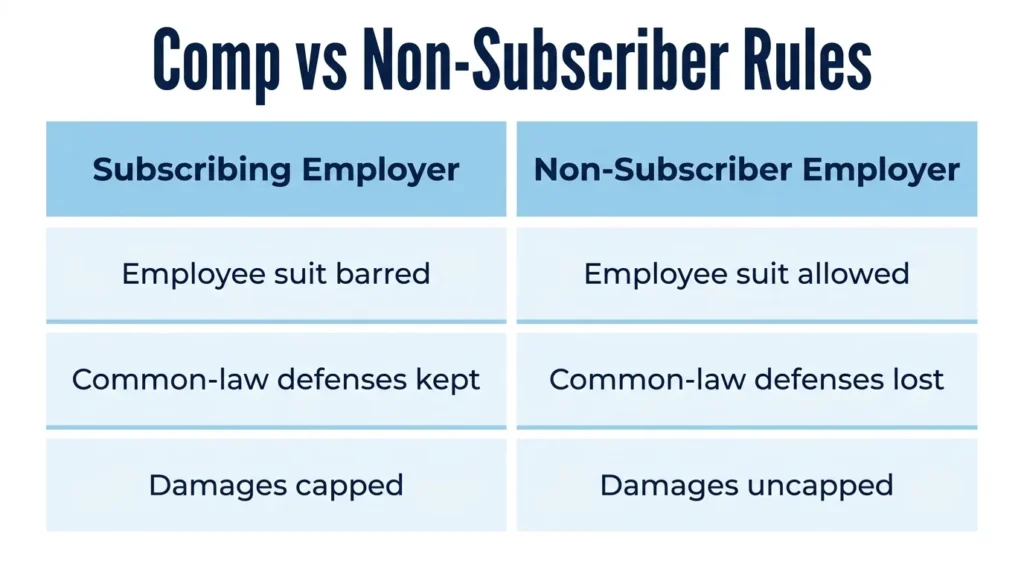
Whether you can sue your employer directly usually comes down to one question: does the company carry workers’ compensation? The Texas Labor Code § 408.001 makes workers’ comp the exclusive remedy of a covered employee against a subscribing employer. That bars a direct negligence suit against the company for an on-the-job shuttle injury.
A workers’ comp claim and a third-party lawsuit are not always an either-or choice. If the driver was a contractor or a co-employee rather than the employer itself, you may pursue both at once.
Third parties face no such bar. If the shuttle hit you on a public road and you do not work for the company, you can bring a direct negligence claim under respondeat superior or any independent theory.
Texas does not force private employers to carry workers’ comp. A company that opts out is a non-subscriber, and that choice costs it dearly. Non-subscribers lose their common-law defenses and face uncapped damages in a direct negligence suit, a point worth understanding before you accept that your only option is a comp claim.
Federal & State Regulations for Employer Shuttles
A regular shuttle operation can cross into regulated carrier territory, which changes what rules the employer had to follow. Federal rules under 49 CFR Part 390 apply when the shuttle operates in interstate commerce and carries nine or more passengers for pay, or 16 or more passengers regardless of pay. A purely intrastate shuttle may not cross the federal threshold, though Texas state regulations can still apply. Cross those thresholds and the employer becomes a regulated motor carrier.
State law adds another layer. The Texas Transportation Code Chapter 643 governs intrastate motor carrier registration. Its § 643.002 exempts entities whose main function is not transportation, but that carve-out does not always shield a company running a steady shuttle route.
When the employer violates a federal safety standard, that violation can support a negligence per se argument. Broken rules on driver hours, medical certification, or vehicle inspection can shift the fault analysis in your favor.
Even employers below the federal thresholds are not off the hook. They still owe a general duty of reasonable care in choosing, training, and maintaining the operation. A company that wants to dispute liability cannot hide behind a regulatory exemption, which is why understanding how to file a bus accident claim early can protect your position.
Damages & Filing Deadlines in Texas
A successful claim can recover far more than a comp check. You can seek medical expenses, lost wages, loss of future earning capacity, and pain and suffering. Where a crash turns fatal, wrongful death and survival damages come into play, and you can review what these claims involve before deciding how to proceed.
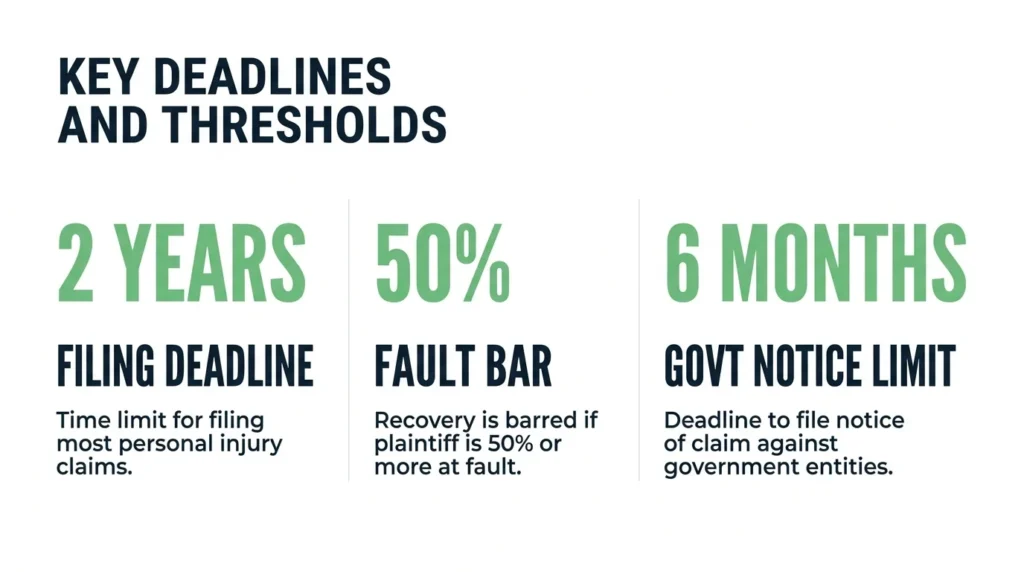
Your own share of fault can reduce the award. The Texas Civil Practice and Remedies Code Chapter 33 applies modified comparative fault. As long as your responsibility does not exceed 50%, you can still recover, with your damages cut by your percentage of fault.
The clock is the part most people get wrong. Under Texas Civil Practice and Remedies Code § 16.003, you have two years from the date of the crash to file. Miss that window and the court will almost certainly throw out your claim no matter how strong it is.
Fatal crashes follow the same two-year rule. Surviving family members bringing wrongful death and survival claims should act quickly to preserve evidence and protect the deadline.
Because evidence fades fast after a crash, talking with an attorney soon after a shuttle accident can help protect your right to recover.
Talk to a Texas Shuttle Bus Accident Lawyer
A shuttle crash can leave you guessing about who is responsible and whether comp is really your only path. Angel Reyes & Associates has spent over 30 years helping injured Texans sort out exactly these questions. We work on a no-fee-unless-we-win basis, so you owe us nothing up front and nothing at all unless we recover for you.
With more than $1 billion recovered for clients across the state, our experience runs deep, and our consultations are always free. We serve injured workers and crash victims throughout Texas and are available to talk whenever you need us.
If a company shuttle left you hurt, reach out for a free consultation and let us review your options. You can also see the attorneys who would handle your case before you decide.
Past results do not guarantee future outcomes.
Frequently Asked Questions
Can a family member sue the employer if a worker died in a company shuttle crash?
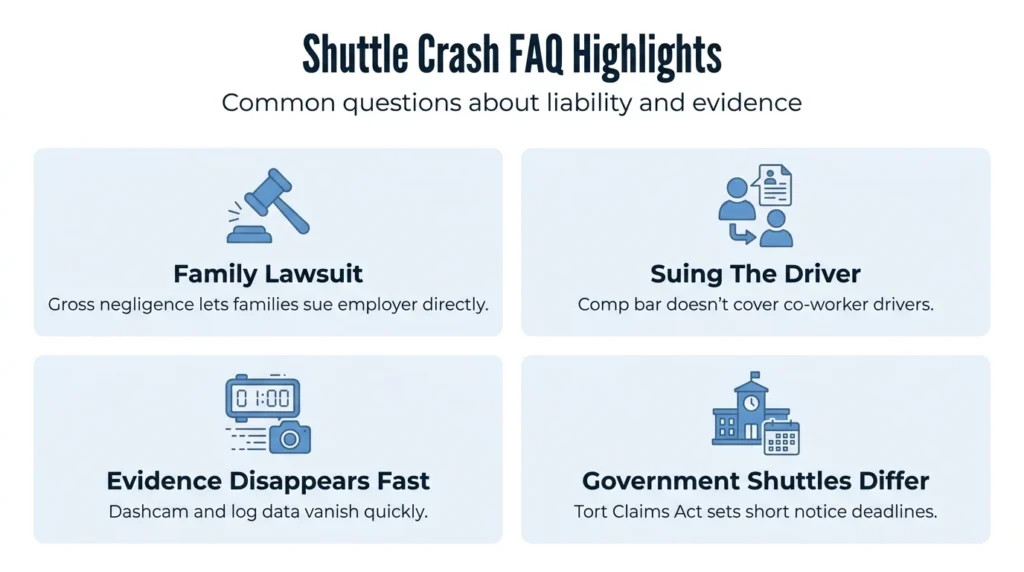
Texas law bars most lawsuits against a subscribing employer, but it carves out one exception: if the employer’s conduct was grossly negligent and the worker died as a result, surviving family members may bring a wrongful death lawsuit directly against the company. Gross negligence requires showing the employer was consciously indifferent to an extreme risk of serious harm.
Can the shuttle bus driver be sued personally, separate from the employer?
Yes. The workers’ compensation bar applies to the employer, not automatically to a co-worker who was behind the wheel. An injured employee can pursue a third-party claim against the driver individually, though collecting a judgment from an individual rather than a company is often harder in practice.
What evidence from a shuttle crash disappears the fastest?
Dashcam footage, driver electronic logs, and vehicle maintenance records are the most time-sensitive. Carriers are only required to keep some records for 90 days to six months, and digital data can be overwritten or lost before a claim is filed.
Do different rules apply if the shuttle was operated by a government agency?
Yes. If a government entity ran the shuttle, the Texas Tort Claims Act applies instead of ordinary negligence rules. You must give written notice to the government unit within six months of the crash, and some cities require notice in as little as 45 to 90 days, well before any lawsuit can be filed.
About the Authors

Angel Reyes
Writer
Angel L. Reyes, III is the Founder and Managing Partner of Angel Reyes & Associates. A nationally recognized trial attorney and business leader, Angel has helped over 70,000 injury victims recover more than $1 billion since founding the firm in 1993. Named to the Texas Super Lawyers list annually since 2008, Angel brings Wall Street experience, Ivy League education, and a deep commitment to client advocacy. He is a frequent legal commentator and published author with extensive contributions to legal scholarship, trial strategy, and consumer protection.

Graham Griffin
Editor
Graham Griffin is the Web & Content Manager at Angel Reyes & Associates, where he oversees content strategy, AI-powered workflows, a...

Angel Reyes
Reviewer
Angel L. Reyes, III is the Founder and Managing Partner of Angel Reyes & Associates. A nationally recognized trial attorney and business...