School Bus Stop Accidents in Texas


Every article on this site is researched by our internal team, reviewed for legal accuracy against current Texas law, and held to State Bar of Texas advertising standards before publication. We do not publish content that overstates outcomes or makes promises about results.
Learn more about our
editorial standards .
Key Takeaways
- Texas law requires drivers to stop for a school bus's flashing red lights, with only one narrow divided-highway exception.
- Violating the stop-arm law can trigger negligence per se, making it easier to prove liability in a civil injury claim.
- Families get two years to file injury or wrongful death claims, though a minor's own injury claim clock pauses until age 18.
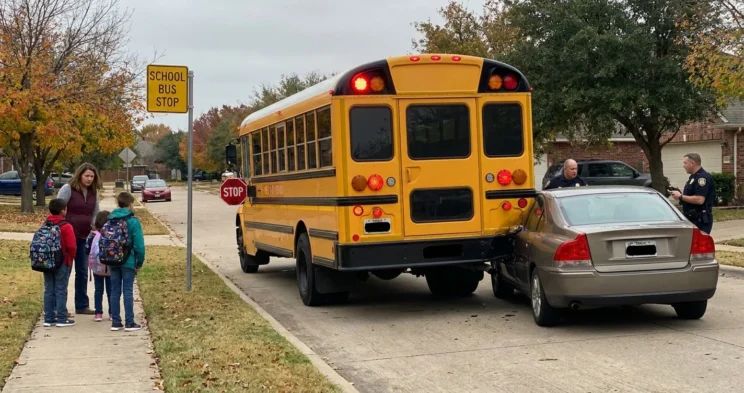
You were walking your daughter to her stop on a quiet street in East Austin when a driver flew past the halted bus. The stop arm was out, the red lights were flashing, and he never slowed down. Your child was inches from the curb, and your heart is still racing. Now you want to know what the law can do about it.
Texas Law on Passing a Stopped School Bus
Every Texas driver must stop when a school bus extends its stop arm and turns on its flashing red lights. On undivided roads, the duty applies to traffic in both directions. You must stay stopped until the bus turns those signals off. The rule comes from Texas Transportation Code § 545.066.
There are some exceptions, though, like for certain controlled-access highway loading zones. According to certain exceptions to the code, drivers on the opposite side of a divided highway do not have to stop when a physical barrier or unpaved median separates the roadways. This exemption does not apply on standard two-lane roads or undivided multi-lane roads. On those roads, everyone stops.
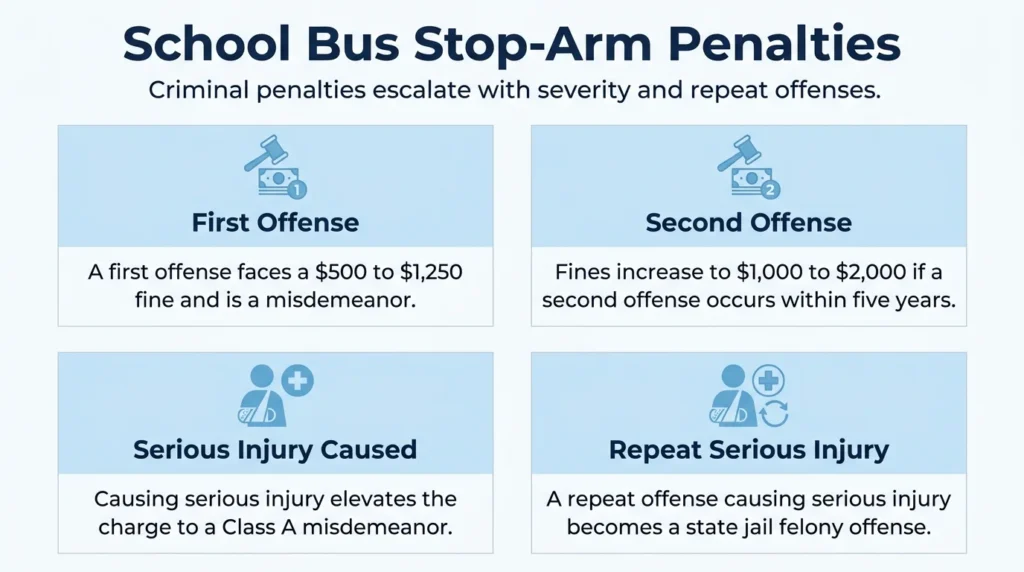
Criminal penalties depend on the circumstances. A first offense is a misdemeanor with a fine of $500 to $1,250. A second offense within five years carries a higher fine of $1,000 to $2,000. If the driver causes serious bodily injury to another person, the offense rises to a Class A misdemeanor. A driver previously convicted of the serious-bodily-injury offense who offends again faces a state jail felony.
How a Criminal Violation Becomes Civil Liability
A criminal ticket and a civil lawsuit are two separate matters, and one can strengthen the other. Texas courts use a rule called negligence per se. When a driver breaks a safety statute and causes the exact harm the law meant to prevent, the violation itself counts as proof of negligent conduct.
That means your family does not have to prove a reasonable driver would have stopped. The broken law does that work for you. If you are weighing a claim after a stop-arm crash, our Texas bus accident cases page explains how these claims come together.
The connection to § 545.066 is direct. The statute exists to protect children and pedestrians at bus stops. A driver who ignores it and hits a child has caused the precise harm the law was written to stop.
Texas modified comparative negligence still applies, even with negligence per se on your side. If the injured person shares some blame, the recovery drops by that share. Anyone found 51% or more at fault recovers nothing under the Texas 51 percent bar rule.
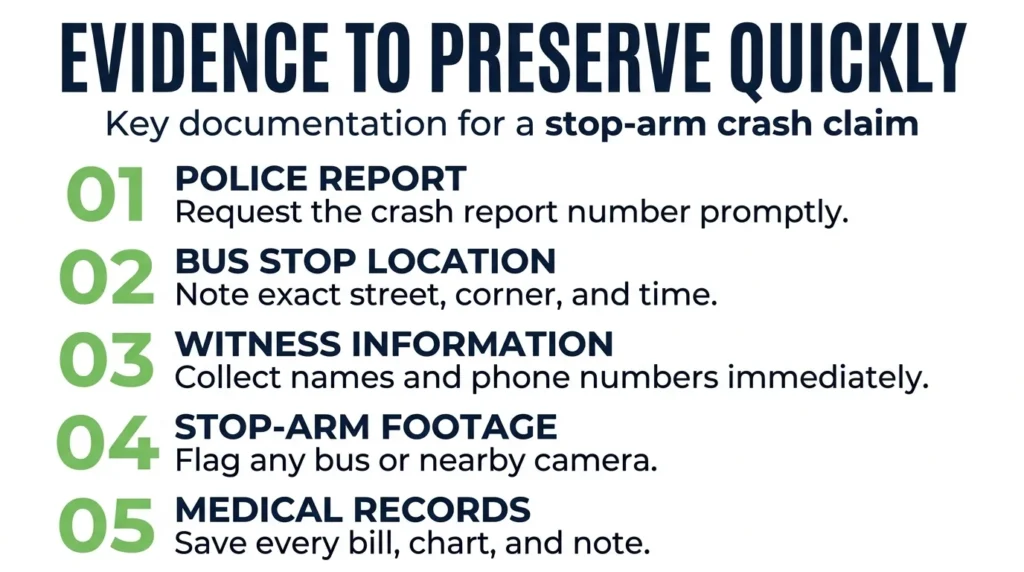
Strong documentation often decides how strong a civil claim becomes. Gather what you can as early as you can.
- Police report: Request the crash report number from the responding officer.
- Bus stop location: Note the exact street, corner, and time of day.
- Witnesses: Collect names and phone numbers before people leave.
- Stop-arm footage: Flag any camera on the bus or nearby property.
- Medical records: Save every bill, chart, and discharge note.
An attorney who handles stop-arm cases can help identify and preserve this evidence in bus stop incidents before it disappears.
Damages a Family Can Recover
Economic Damages
Economic damages cover your direct financial losses. That includes emergency and hospital bills, surgery, and rehabilitation costs. It also covers future medical care for lasting injuries and lost wages when a parent leaves work to care for an injured child.
You must document medical expenses from the date of injury forward. Claims for future care usually require expert testimony to project the cost. For a sense of how these numbers develop, see our overview of average bus accident settlements.
Non-Economic Damages
Non-economic damages pay for harms that never come with an invoice. Think pain and suffering, emotional distress, lost enjoyment of activities, and permanent disfigurement. Texas does not cap non-economic damages in personal injury cases.
These damages are often the largest part of a recovery. Injuries at bus stops tend to be severe, and the victims are usually children. If your child was struck as a walker, our Texas pedestrian accident claims page walks through what these cases involve.
If the driver’s violation kills a child, your family may bring a wrongful death action under Texas Civil Practice and Remedies Code (CPRC) Chapter 71. Parents, spouses, and children of the person who died can file. Recoverable damages include loss of companionship, mental anguish, and funeral expenses.
You can learn more about how these claims proceed through our wrongful death representation page. We also explain the process in our guide to fatal crashes and wrongful death claims.
Filing Deadlines & Time-Sensitive Steps
Texas gives you two years to file. Personal injury and wrongful death claims must be filed within two years of the date of injury or death under CPRC § 16.003. Miss that deadline and you almost always lose the right to recover.
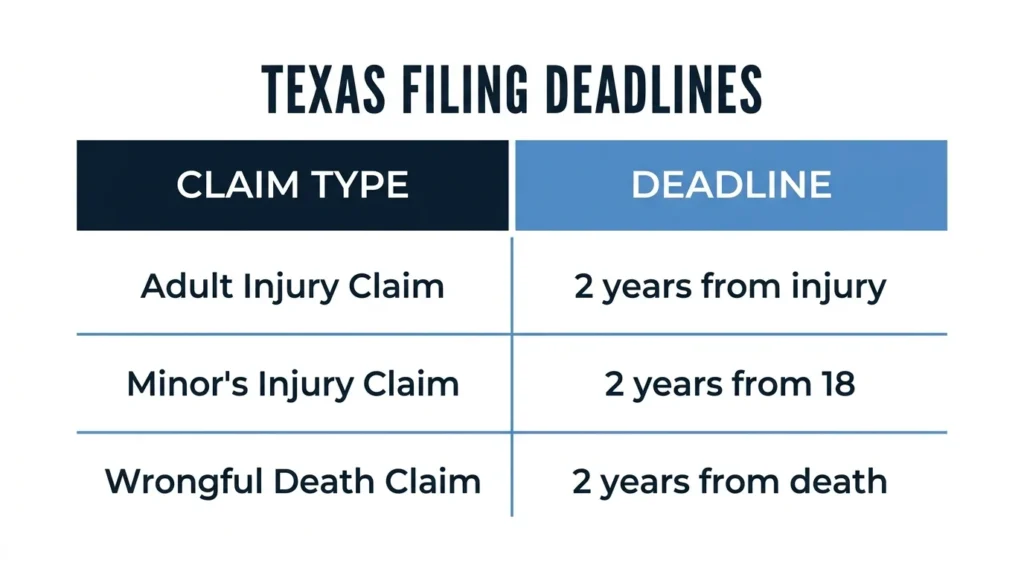
Minor children get more time on their own injury claim. When the injured person is a minor, the two-year clock on the child’s personal injury claim does not start until the child turns 18. A parent’s wrongful death claim under CPRC Chapter 71 is different. That clock runs from the date of death and does not pause. Our guide to exceptions to the Texas filing deadline covers how this plays out.
Camera evidence needs fast attention. Some Texas districts mount cameras on bus stop arms that record violations automatically. You should request preservation of that footage right away, because retention policies vary and video can be overwritten within days. An attorney can send preservation letters to school districts and local agencies, which is one reason claims against public entities move on tight timelines.
Talk to a Texas Bus Accident Attorney
A stop-arm crash leaves your family with medical bills, missed work, and hard questions about what comes next. You do not have to sort through the criminal case and the civil claim on your own. Angel Reyes & Associates has spent more than 30 years standing up for injured Texans, and we have recovered more than $1 billion for clients across our statewide practice.
Our consultations are free, and you pay no fee unless we win. If a driver blew past a stopped bus and hurt someone you love, reach out for a free consultation and let us handle the pressure while you focus on your family.
Past results do not guarantee future outcomes.
School Bus Stop Accident FAQs
Can a school district be responsible for a school bus stop accident in Texas?
In some cases, yes. If unsafe bus stop placement, poor traffic control, or another act of negligence contributed to the crash, a claim against a governmental entity may be possible, although special notice requirements and deadlines often apply.
What evidence is most important after a school bus stop accident?
Video footage, eyewitness statements, vehicle damage, scene photographs, electronic data, and medical records can all help establish how the crash happened and the extent of the injuries. Promptly preserving evidence is often critical because recordings and other records may not be kept for long.
Does insurance cover injuries caused by a driver who illegally passed a stopped school bus?
A liability claim is typically made against the at-fault driver’s auto insurance, and other coverage such as uninsured or underinsured motorist benefits may also apply depending on the circumstances and available policies.
Can emotional trauma be part of a Texas school bus stop injury claim?
Yes. When supported by the facts and evidence, Texas law may allow recovery for mental anguish and other non-economic losses resulting from a serious traumatic event or physical injury.
What if a child is injured while crossing the street to or from the school bus?
Each case depends on the specific facts, including the driver’s actions, the bus driver’s conduct, roadway conditions, and whether traffic laws were followed. A careful investigation can determine who may be legally responsible for the child’s injuries.
About the Authors

Angel Reyes
Writer
Angel L. Reyes, III is the Founder and Managing Partner of Angel Reyes & Associates. A nationally recognized trial attorney and business leader, Angel has helped over 70,000 injury victims recover more than $1 billion since founding the firm in 1993. Named to the Texas Super Lawyers list annually since 2008, Angel brings Wall Street experience, Ivy League education, and a deep commitment to client advocacy. He is a frequent legal commentator and published author with extensive contributions to legal scholarship, trial strategy, and consumer protection.

Kyle Nicolas
Editor
Kyle Nicolas is the Web Content & SEO Manager at Angel Reyes & Associates. He has more than 10 years of experience as a marketing co...

Angel Reyes
Reviewer
Angel L. Reyes, III is the Founder and Managing Partner of Angel Reyes & Associates. A nationally recognized trial attorney and business...