Defective Parts & Product Liability in Bus Accidents


Every article on this site is researched by our internal team, reviewed for legal accuracy against current Texas law, and held to State Bar of Texas advertising standards before publication. We do not publish content that overstates outcomes or makes promises about results.
Learn more about our
editorial standards .
Key Takeaways
- Texas recognizes design, manufacturing, and failure-to-warn defects under Chapter 82.
- A product liability claim against a parts maker is not capped by the Tort Claims Act.
- You have two years from the injury date to file a Texas product liability claim.
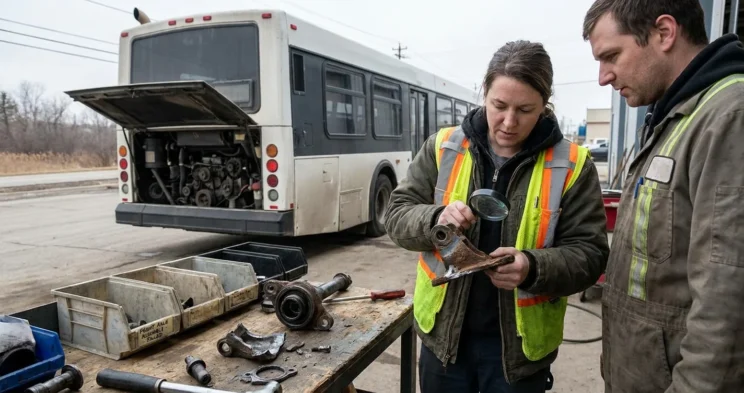
You were riding the bus to work along the I-35 corridor when the brakes failed and the driver could not stop in time. Now you are facing medical bills and missed paychecks, and someone told you the transit agency only has to pay so much. You may have a claim against a party you never thought about: the company that built the faulty part.
What Makes a Bus Part Legally Defective?
Texas law recognizes three kinds of product defects, and any one of them can make a bus part legally defective. These categories come from Chapter 82 of the Texas Civil Practice and Remedies Code (CPRC), which governs product liability claims in the state.
The three types are design defects, manufacturing defects, and marketing defects. Marketing defects are also called failure-to-warn defects. Each one points to a different problem and a different responsible party.
Knowing which type fits your crash shapes the evidence you need and who you pursue. The faulty part decides the path.
Design Defects vs. Manufacturing Defects
A design defect means the part was unsafe as it was drawn up, so every unit off the line carries the same flaw. A manufacturing defect means one specific unit came out wrong even though the design was sound.
With a design defect, the blueprint itself creates the danger. If a brake system was engineered in a way that makes failure likely, you must show a safer alternative design was possible.
With a manufacturing defect, the design was fine but the build was not. A single batch of brake calipers might have left the piston or guide pin out, even though thousands of others were made correctly.
This split decides who bears the most exposure and what proof you gather. The components that show up most often in these claims include brake systems, tires, steering assemblies, emergency exits, door mechanisms, mirrors, and restraint systems.
Marketing Defects (Failure to Warn)
A marketing defect happens when a part is safe to use correctly, but the maker never warned about a known risk. The part works as designed, yet the danger hides in what nobody told the operator.
This applies when a manufacturer knew about a hazard and left it out of the installation or maintenance instructions. A bus operator who was never told about a known failure mode cannot guard against it.
Federal rules set a baseline here. The standards under 49 CFR Part 393 lay out minimum requirements for parts like brakes, tires, lighting, and emergency exits. When a component falls short of those standards, that gap can support a defect finding.
Product Liability vs. the Texas Tort Claims Act
A product liability claim against the parts maker is not limited the way a claim against a public transit agency is. That single difference can change what money you actually recover.
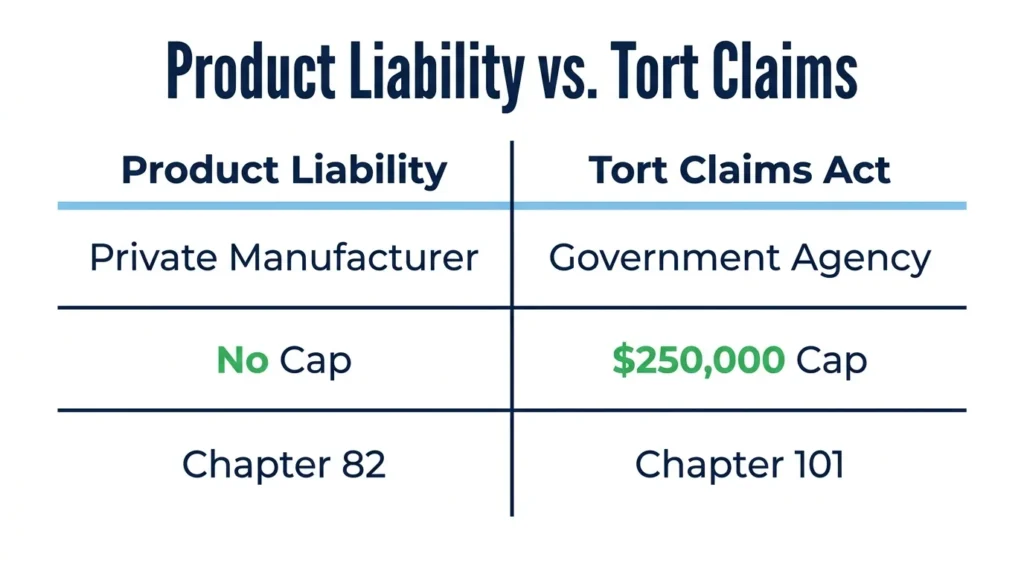
Government-run transit agencies are shielded by Texas Tort Claims Act, Chapter 101. It limits compensation at $250,000 per person for state entities, and some local government units carry even lower limits.
A product liability claim under Chapter 82 runs against the manufacturer or parts supplier instead. That defendant is a private company, not a government body, so the Tort Claims Act caps do not apply.
You do not have to choose between the two. You can pursue the transit agency under the Tort Claims Act and the manufacturer under product liability at the same time. Fault then gets divided under Texas’s proportionate responsibility rules.
That uncapped path matters most when your bills are large. It can be the difference between a capped partial payout and full compensation for medical costs, lost wages, and the harm that does not show up on a receipt.
An attorney who handles multi-defendant bus claims can tell you whether a product liability theory fits your specific crash and component.
Who Can Be Named in a Bus Product Liability Claim?
The whole chain that brought the part to the road can share liability, not just the original bus maker. That chain runs from the manufacturer down to the shop that installed a replacement part.
The original equipment manufacturer is one target. So are the component suppliers who made the brakes or tires, the aftermarket parts distributors, and sometimes the maintenance contractor who installed a defective aftermarket part on the agency’s behalf.
Strict liability is what makes these claims reachable. You do not have to prove anyone was careless. You only show the product was defective and that the defect was a producing cause of your injury.
You can also check the part’s history yourself. The NHTSA vehicle recalls database lets you confirm whether a component in your crash was already under a safety recall, which strengthens a manufacturing defect claim.
Filing Deadlines & Evidence for a Defect Claim
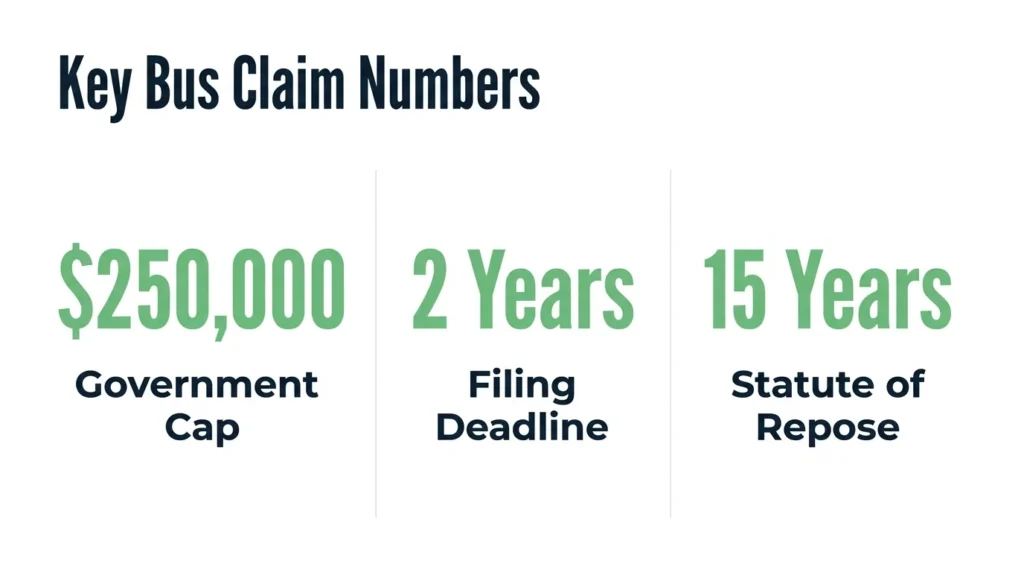
You generally have two years from the date of injury to file a product liability claim in Texas. That deadline comes from Texas Civil Practice and Remedies Code § 16.003, and missing it almost always ends the case.
A second clock can run too. A 15-year statute of repose can also stop claims against a manufacturer if more than 15 years have passed since the product was first sold. The age of the specific component — counted from its sale date — decides whether this limit applies to your situation.
Evidence in defect cases disappears fast, because damaged parts get repaired or swapped out within days. Preserve what you can as early as possible:
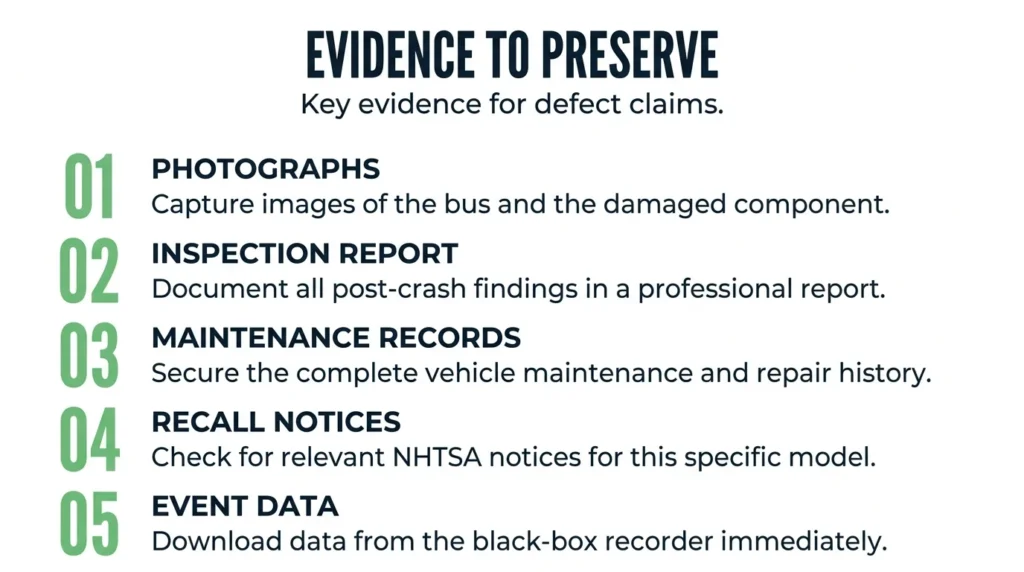
- Photographs of the bus and the damaged component
- The post-crash inspection report
- Maintenance records for the vehicle
- NHTSA recall notices for the bus model
- Black-box or event data recorder data
FMCSA inspection and maintenance records for the operator’s fleet can also help. They may show that a component had a documented history of failure before your crash.
The single most time-sensitive step is keeping the physical part itself. A litigation hold or spoliation letter can stop the operator from repairing or discarding the evidence your case depends on.
Acting quickly protects your claim. An attorney can send a preservation demand to the operator on the same day you retain them.
Talk to a Knowledgeable Attorney Today
If a faulty part played a role in your bus crash, you may have more options than the capped recovery you were told to expect. Angel Reyes & Associates has handled bus accident and product liability claims for over 30 years, and we serve injured riders across the entire state of Texas.
We work on contingency, so you pay no fee unless we win your case. We are available 24/7, and we have more than $1 billion recovered for clients. You can see what our clients say about working with us before you call.
Reach out to us for a free consultation so we can review your crash and tell you which claims you can bring.
Past results do not guarantee future outcomes.
Bus Accident Defective Part FAQs
If a family member died in the bus crash, can surviving relatives file a product liability claim against the parts manufacturer?
Yes. Texas Civil Practice and Remedies Code Chapter 71 allows the surviving spouse, children, and parents of the deceased to bring a wrongful death claim, and that claim can be based on product liability under the same strict liability standard as a personal injury case. The deadline is two years from the date of death.
Can I file a product liability claim against the bus manufacturer if workers' compensation is already covering my injuries?
Yes. Under Texas Labor Code Section 417.001, an injured worker can pursue a third-party product liability claim against the manufacturer while also receiving workers’ compensation benefits. If you recover from the manufacturer, the workers’ comp carrier will typically have a right to be reimbursed out of that recovery for benefits it has paid.
Does the product liability claim work the same way if the bus was a private charter or tour bus rather than a public transit vehicle?
Yes. The product liability claim against the manufacturer is the same regardless of whether the bus was publicly or privately operated, because the manufacturer is always a private party. The difference is on the operator side: private charter and tour bus companies are not protected by the Texas Tort Claims Act, so there is no compensation limit on the operator claim either.
What does "producing cause" mean in a Texas product liability case?
Producing cause means the defect was an efficient or contributing cause that, in a natural sequence, led to the injury. Unlike proximate cause, producing cause does not require the harm to have been foreseeable, which is why it is the standard used for design defect claims in Texas.
What happens if the bus operator already repaired or replaced the defective part before it could be preserved?
You can still pursue the claim. If a court finds that the operator intentionally or negligently destroyed evidence, it may issue a spoliation instruction that allows the jury to draw an adverse inference against that party. Indirect evidence, such as maintenance records, inspection reports, and expert testimony, can also help reconstruct what the destroyed part would have shown.
About the Authors

Angel Reyes
Writer
Angel L. Reyes, III is the Founder and Managing Partner of Angel Reyes & Associates. A nationally recognized trial attorney and business leader, Angel has helped over 70,000 injury victims recover more than $1 billion since founding the firm in 1993. Named to the Texas Super Lawyers list annually since 2008, Angel brings Wall Street experience, Ivy League education, and a deep commitment to client advocacy. He is a frequent legal commentator and published author with extensive contributions to legal scholarship, trial strategy, and consumer protection.

Graham Griffin
Editor
Graham Griffin is the Web & Content Manager at Angel Reyes & Associates, where he oversees content strategy, AI-powered workflows, a...

Angel Reyes
Reviewer
Angel L. Reyes, III is the Founder and Managing Partner of Angel Reyes & Associates. A nationally recognized trial attorney and business...