Bus Accident Spinal Cord & Back Injuries in Texas


Every article on this site is researched by our internal team, reviewed for legal accuracy against current Texas law, and held to State Bar of Texas advertising standards before publication. We do not publish content that overstates outcomes or makes promises about results.
Learn more about our
editorial standards .
Key Takeaways
- Most Texas buses have no passenger seatbelts, so unbelted riders can still recover fully.
- Injury severity and lifetime care costs are the biggest drivers of settlement value.
- Government bus claims are capped and need written notice within six months of the crash.
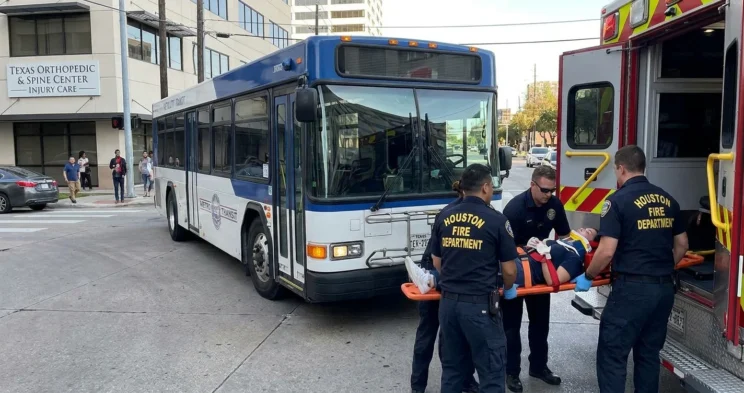
You were standing on a crowded Houston Metro bus heading up Westheimer Road when the driver slammed the brakes to avoid a stalled car. There was nothing to hold but a pole, and the stop threw you hard into the seat in front of you.
Now your back will not stop screaming, and a doctor has used the words “spinal cord.” The bills are only starting, and you have no idea how you will keep supporting your family.
Why Bus Accidents Cause Severe Spinal Injuries
Buses cause severe spinal injuries through simple physics. A sudden stop, rollover, or side impact throws standing and unbelted passengers into seats, poles, and walls. A belted car occupant rides out that force in a seat. A bus passenger often absorbs it with their spine.
These forces commonly produce serious spinal cord injuries, herniated discs, and vertebral fractures. A back injury from a bus crash tends to be worse than a similar collision in a passenger car.
Part of the reason is that most transit and school buses are not required to carry passenger seatbelts. Federal seatbelt rules apply narrowly, and the federal standards for motorcoach seat belts leave most buses without belts for riders. So when the bus stops short, a standing passenger has nothing holding them back.
How Doctors Classify Spinal Cord Injury Severity
Doctors grade a spinal cord injury with the ASIA Impairment Scale, which measures how much movement and feeling remain below the level of the injury. That grade also becomes central to a settlement, because it documents how much function you lost.
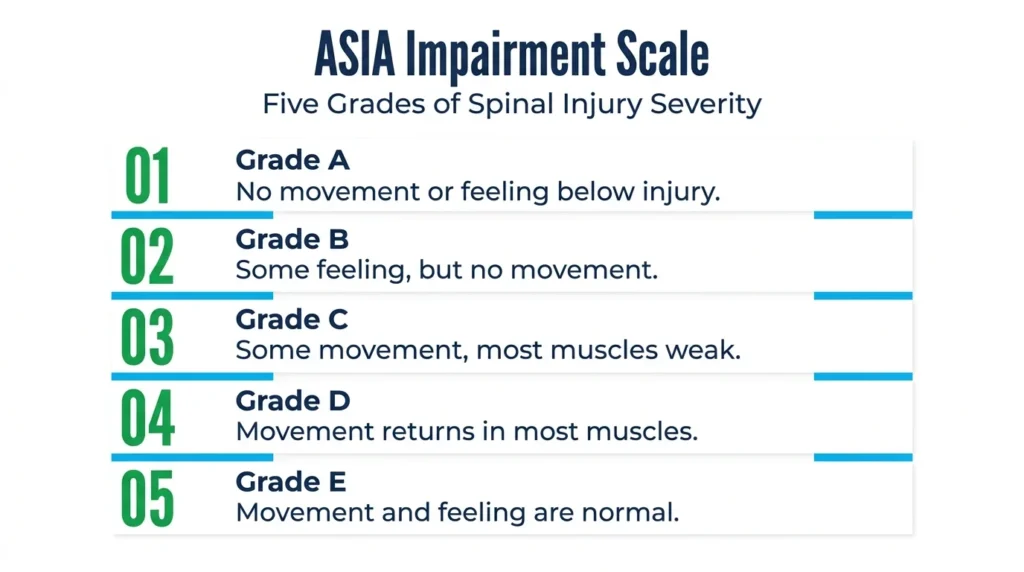
The ASIA Impairment Scale sorts injuries into five grades:
- Grade A: No movement or feeling remains below the injury.
- Grade B: Some feeling remains, but no movement.
- Grade C: Some movement returns, though most muscles stay weak.
- Grade D: Movement returns in most muscles below the injury.
- Grade E: Movement and feeling are normal.
Where the injury sits on your spine matters just as much. A cervical injury in the neck affects far more of the body than a lower lumbar one.
Complete Spinal Cord Injuries
A complete injury, graded ASIA A, means no movement or feeling remains below the injury level. It does not mean the spinal cord was fully severed.
These injuries usually bring the most severe, permanent disability and the highest lifetime care needs. They are among the most serious spinal cord injury cases following a bus crash.
Incomplete Spinal Cord Injuries
An incomplete injury, graded ASIA B through D, means some function remains below the injury level. Outcomes range widely, from partial impairment to lasting disability.
Even an incomplete injury can leave you with permanent mobility loss, chronic pain, or partial paralysis. Any of these can cut how much you are able to earn for the rest of your life.
Lifetime Cost of Spinal Cord Injury Care
Motor vehicle crashes are the leading cause of spinal cord injury in the United States, and the cost of care climbs sharply as the injury grows more severe. For a catastrophic injury, that cost is measured across a lifetime, not a single hospital stay.
The national spinal cord injury statistics show that first-year and lifetime costs rise with both the severity and the level of the injury. A high cervical injury can require round-the-clock attendant care for decades.
Those numbers cover far more than hospital bills. They include attendant care, home modifications, assistive equipment, and the wages you lose when the injury ends your ability to work.
What Drives High-Value Spinal Injury Settlements
Injury severity and lifetime care costs are the biggest drivers of a spinal injury settlement, but liability strength and the number of responsible defendants matter almost as much. A catastrophic injury with weak liability evidence is still a hard case.
What separates a catastrophic-injury settlement from a routine one is documentation. Detailed future medical needs, proof of lost earning capacity, and a formal life-care plan turn a serious injury into a fully valued claim.
When you are ready to move forward, there are practical steps for filing a bus accident claim to keep in mind.
Texas Laws That Affect Spinal Injury Claims
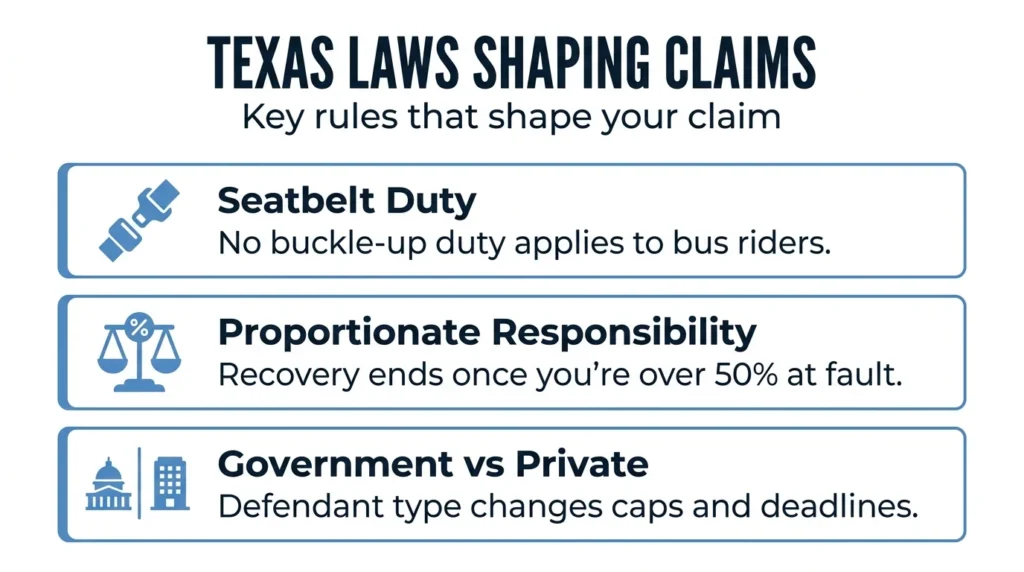
Texas law shapes your claim in three ways that matter most: the seatbelt duty, the fault-sharing rule, and whether a government or a private company ran the bus. The first one often works in your favor.
Texas’s seatbelt-use law only covers cars, light trucks, SUVs, and vans carrying 15 or fewer passengers, not buses built to carry more, under the definition in Texas Transportation Code § 545.412. Under the Texas Transportation Code § 545.413, a bus passenger, standing or seated, carries no legal duty to buckle up, whether or not that particular seat happens to have a belt.
Whether a belt existed also affects how fault gets shared. Texas uses a proportionate responsibility rule, and Texas Civil Practice and Remedies Code (CPRC) § 33.001 ends your request for compensation once your share of fault passes 50 percent. Since no seatbelt duty exists on most buses, an insurer generally cannot cut your compensation just because you were not belted.
These deadlines and defendant rules overlap in ways that trip up unrepresented passengers.
Government-Operated Bus Claims
If a city transit agency or school district ran the bus, statute caps your compensation and you must give notice fast. These limits do not apply to private carriers.
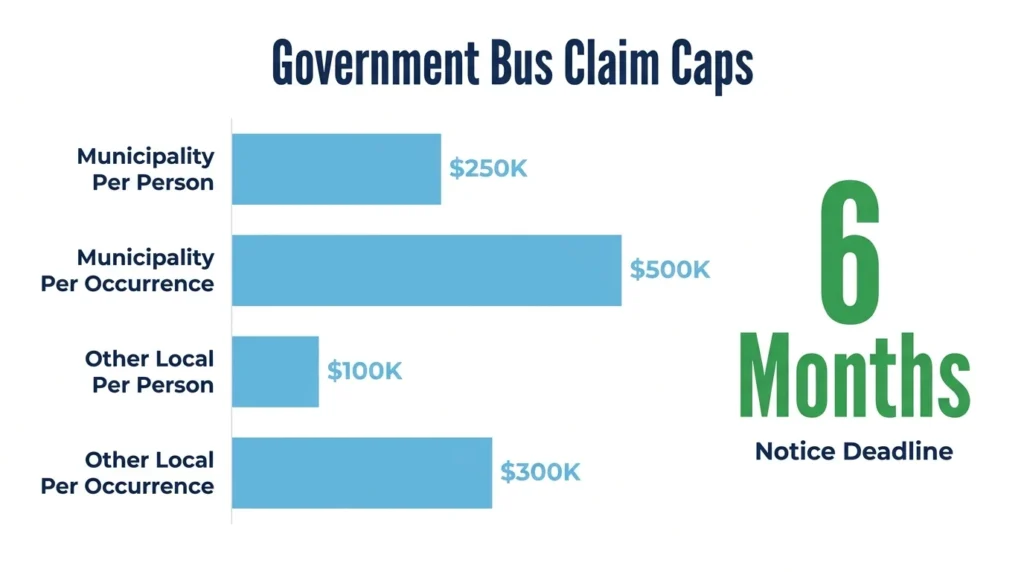
Under Texas Civil Practice and Remedies Code (CPRC) § 101.023, financial recovery against a municipality is capped at $250,000 per person and $500,000 per occurrence. For other local government units, the cap drops to $100,000 per person and $300,000 per occurrence.
You must also give written notice to the government unit within six months of the crash under Texas Civil Practice and Remedies Code (CPRC) § 101.101, and some city charters demand it even sooner. That short window is why early legal guidance helps when you are still in treatment.
Privately-Operated Bus Claims
A claim against a private bus company has no damage cap and follows the standard personal injury deadline. You generally have two years from the crash to file under Texas Civil Practice and Remedies Code (CPRC) § 16.003.
More than one party may share the blame. The bus company, the driver, and a maintenance contractor can each owe you compensation under the high duty of care that carriers owe their passengers.
Work with an Experienced Attorney Today
A serious spinal injury strains your finances as much as your health, and the right legal help should never add to that weight. Angel Reyes & Associates has guided injured Texans through catastrophic injury claims for over 30 years, with more than $1 billion recovered for clients.
We work on a no-fee-unless-we-win basis, so you pay nothing up front and nothing at all unless we recover for you.
With offices across Texas, we can handle most of your case remotely while you focus on getting better. Schedule a free consultation so we can review your options and the deadlines that apply to you.
Past results do not guarantee future outcomes.
Bus Accident Spinal Cord Injury Claim FAQs
Can I still file a claim if I had a back problem before the bus accident?
Yes. Texas law lets you recover for how the crash worsened an existing back problem, even though you cannot recover for the pre-existing condition itself.
Can a family member get paid for taking care of an injured passenger after a spinal cord injury?
In some cases, yes. Documented caregiving hours and lost wages from a family member who provides nursing-level care can be added to the claim as part of your damages.
Will my health insurance take money back from my spinal injury settlement?
Often, yes. Your health plan may have a right to be repaid for medical bills it paid, but that amount can sometimes be reduced through negotiation.
Do interstate charter or tour buses follow different safety rules than city buses in Texas?
Yes. Buses that cross state lines must carry at least $5 million in insurance and follow stricter driver hour limits than a bus that stays within Texas.
What if spinal cord injury symptoms do not show up until days after the bus accident?
This happens. Numbness, tingling, or new pain that shows up days later can still point to a serious spinal injury, so it should be evaluated by a doctor right away.
About the Authors

Angel Reyes
Writer
Angel L. Reyes, III is the Founder and Managing Partner of Angel Reyes & Associates. A nationally recognized trial attorney and business leader, Angel has helped over 70,000 injury victims recover more than $1 billion since founding the firm in 1993. Named to the Texas Super Lawyers list annually since 2008, Angel brings Wall Street experience, Ivy League education, and a deep commitment to client advocacy. He is a frequent legal commentator and published author with extensive contributions to legal scholarship, trial strategy, and consumer protection.

Kyle Nicolas
Editor
Kyle Nicolas is the Web Content & SEO Manager at Angel Reyes & Associates. He has more than 10 years of experience as a marketing co...

Angel Reyes
Reviewer
Angel L. Reyes, III is the Founder and Managing Partner of Angel Reyes & Associates. A nationally recognized trial attorney and business...