Bus Accident Wrongful Death Claims in Texas


Every article on this site is researched by our internal team, reviewed for legal accuracy against current Texas law, and held to State Bar of Texas advertising standards before publication. We do not publish content that overstates outcomes or makes promises about results.
Learn more about our
editorial standards .
Key Takeaways
- Texas lets families file both a wrongful death claim and a survival action after a fatal crash.
- Government bus claims cap recovery at $250,000 or $100,000 per person, not doubled.
- A government bus claim needs written notice within six months, plus filing within two years.
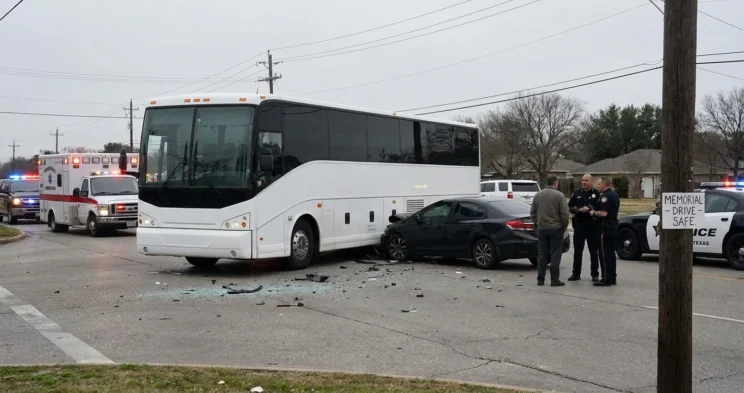
You got the call no one is ready for. A city bus ran the light near the Museum District, and the person you love did not come home. Now the medical bills are arriving, the paychecks have stopped, and you are left wondering whether the law can do anything at all.
Two Claims Texas Law Allows After a Fatal Bus Crash
Texas law gives your family two separate legal tools after a fatal bus crash, not one. You can pursue a wrongful death claim and a survival action at the same time, and each one recovers different losses.
The two claims flow to different people. The wrongful death claim belongs to the surviving family members. The survival action belongs to the person who died, carried forward by their estate.
Both claims come from the same law: Chapter 71 of the Texas Civil Practice and Remedies Code (CPRC), which governs wrongful death and survival actions across the state.
The type of bus does not change this framework. A commercial carrier, a school bus, a city bus, and a charter operator all trigger the same two claims after a fatal bus accident. What changes is the defendant, and that can change how much money you are allowed to recover.
Which claims apply, and what realistic compensation looks like, depends heavily on who owned and operated the bus. An attorney can sort out both before you commit to anything.
Wrongful Death vs. Survival Action in Texas
These two claims sound similar, but they answer different questions. One asks what your family lost when your loved one died. The other asks what your loved one suffered before death.
Texas Wrongful Death Claim
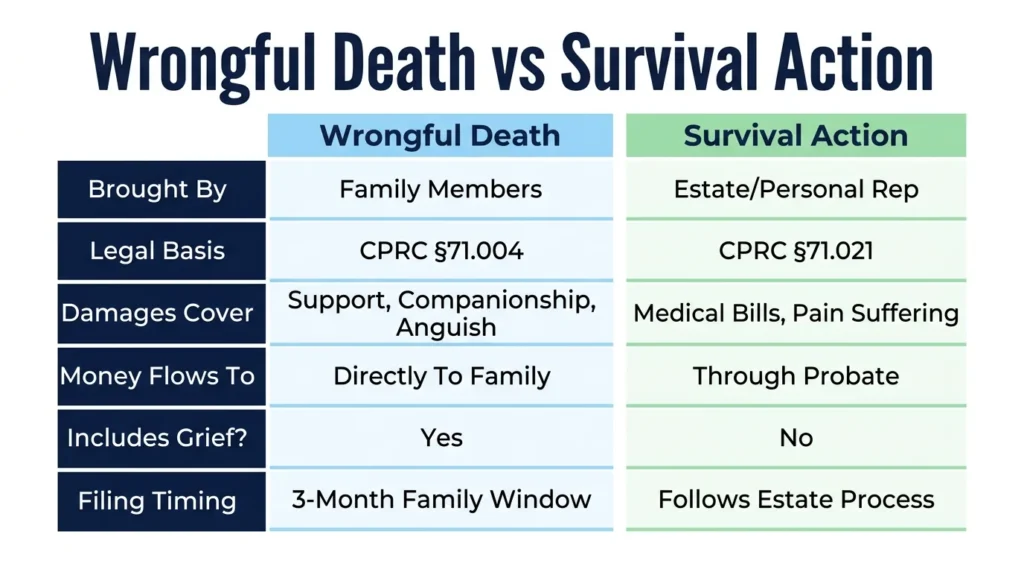
A wrongful death claim is brought by the surviving family members directly, not by the estate. The money goes to those family members, not to creditors or through probate.
Standing is limited. Only the spouse, children, and parents of the person who died may bring a claim under Texas Civil Practice and Remedies Code (CPRC) § 71.004.
The damages cover your family’s own losses. That includes lost financial support, lost companionship and comfort, the mental anguish you carry, and the inheritance your loved one would have left behind.
There is a timing rule inside the claim. If the family members do not file within three months of the death, the estate’s personal representative may file on their behalf.
When more than one family member qualifies, they share the compensation. If a government bus caused the crash, all of them share a single per-person cap, or limit.
Texas Survival Action
A survival action is not a new claim. It is the claim your loved one could have brought had they lived, now carried forward by the estate under Texas Civil Practice and Remedies CPRC § 71.021.
The damages cover what your loved one endured before death. That means pre-death medical bills, the pain and suffering they experienced, and any damage to their property.
The money moves differently here. It flows into the estate and passes through probate, and family members receive it as heirs rather than as direct claimants.
This claim cannot recover your grief or your lost companionship. Those losses belong to the wrongful death claim, which is exactly why both claims often get filed together.
Government Bus Accident Texas Lawsuit: Recovery Caps
When a government agency operates the bus, a hard ceiling limits what you can recover. That is the single most important fact for families weighing whether a claim is worth pursuing.
Texas Tort Claims Act, CPRC Chapter 101, waives government immunity for certain claims. That waiver is what lets you sue a city transit agency, a school district, or a state entity at all.
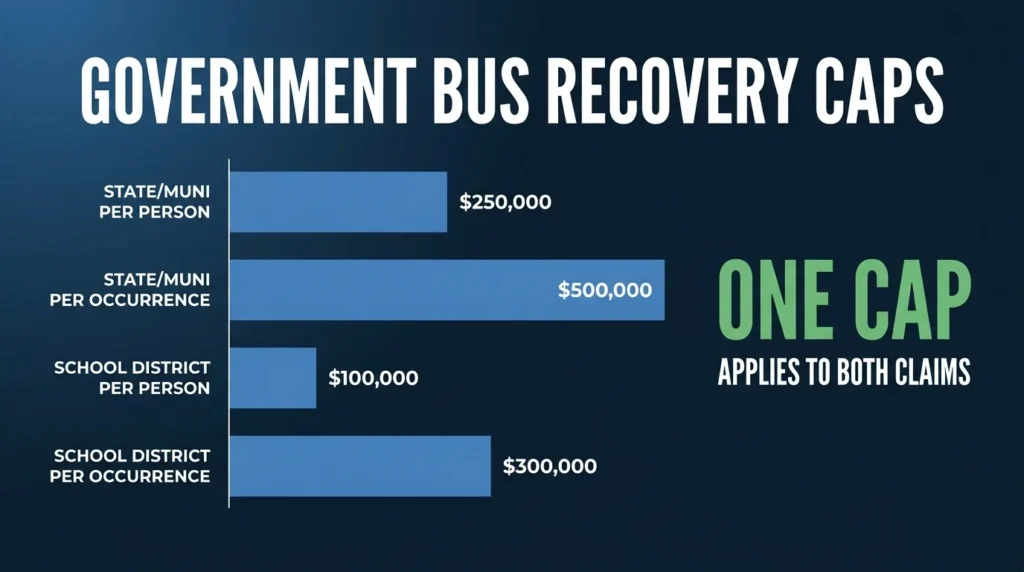
The waiver comes with strict dollar limits. Under Texas Civil Practice and Remedies Code (CPRC) § 101.023, state and municipal units are capped at $250,000 per person and $500,000 per occurrence. For school districts and other units, the caps drop to $100,000 per person and $300,000 per occurrence.
Here is the part that surprises most families. When a wrongful death claim and a survival action both come from the same government bus crash, the per-person cap applies to both claims combined. Filing two claim types does not double the ceiling.
Private operators are a different story. A private charter company or a private school bus contractor is not a government unit, so the compensation limits do not apply, and full compensatory damages stay on the table.
Because the rules split so sharply between public and private buses, it helps to see how these Tort Claims Act limits play out and how the claim filing process unfolds for each type of defendant.
Filing Deadlines & Notice Requirements
Two clocks run at once after a fatal bus crash, and missing either one can end your case. The general deadline is two years, but a government bus adds a much shorter one.
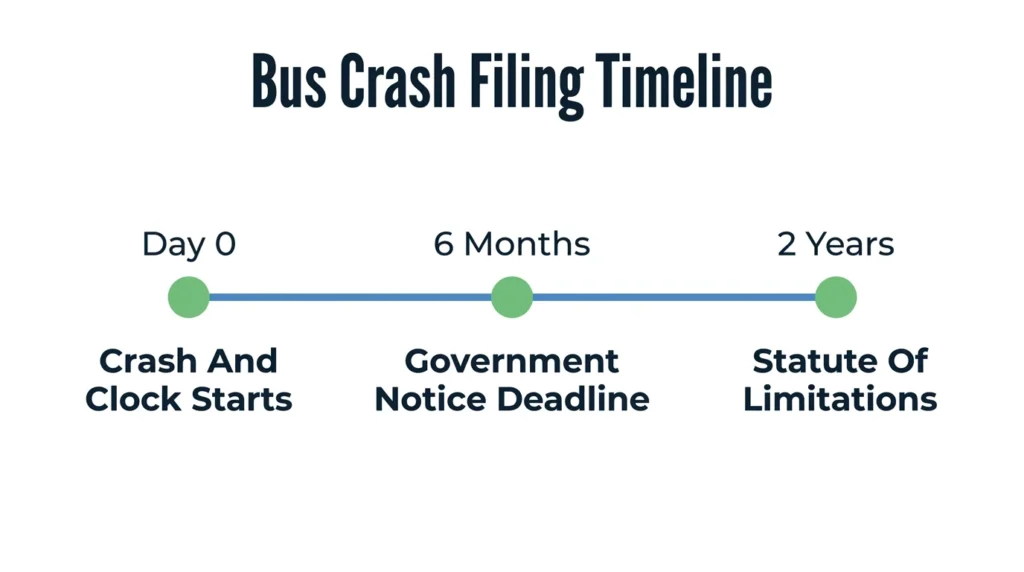
The two-year deadline comes from Texas Civil Practice and Remedies Code (CPRC) § 16.003, which sets the statute of limitations for wrongful death and survival actions. The clock starts on the date of death.
The second clock is far tighter. When a government unit operated the bus, Texas law requires written notice of your claim within six months of the crash. This notice deadline runs on its own, separate from the two-year window.
Missing that six-month notice usually ends your claims against the government entity for good. That holds true even if the two-year deadline is still months or years away.
The notice itself has to say the right things, in the right place, to count. A police report or news story about the crash almost never satisfies the requirement:
- Name the claimant. The notice must identify who is bringing the claim.
- Describe the incident and the injuries. State when and how the crash happened and what harm resulted.
- Deliver it to the correct governmental unit. Serve the specific agency that operated the bus, not a general office.
Given how short the notice window is, families dealing with a government bus should not wait. Speaking with an attorney early can protect a claim that a missed deadline would otherwise erase.
Work with an Experienced Attorney
Losing someone in a bus crash is not something you should have to sort through alone. Angel Reyes & Associates has spent over 30 years helping Texas families understand their options after a fatal crash and pursue the compensation the law allows.
We offer free initial consultations, and we work on contingency, so you pay no fee unless we win. Over the years, we have recovered more than $1 billion for clients across the state.
If you are ready to talk through what happened, contact us for a free consultation. You can also read what our clients say about working with us or learn more about our firm and how we handle these cases.
Past results do not guarantee future outcomes.
Bus Accident Wrongful Death Claim FAQs
Can a family recover punitive damages after a fatal bus crash in Texas?
Punitive damages (called exemplary damages in Texas) are available against a private bus operator if the crash resulted from gross negligence or an intentional act. They are completely blocked when the bus was operated by a governmental unit, because the Texas Tort Claims Act prohibits exemplary damages against government entities.
What happens if the person who died was partly at fault for the crash?
Texas follows a modified comparative fault rule: if the deceased was 50% or less at fault, the family can still recover, but the award is reduced by the deceased’s fault percentage. If the deceased was found 51% or more at fault, the family will not receive any compensation.
Are funeral and burial expenses recoverable in a Texas wrongful death case?
Yes, Texas law allows families to recover reasonable funeral and burial costs as part of a wrongful death claim. Keeping receipts and invoices helps document what was actually spent.
Can a family sue both a private company and a government entity if both share fault for the crash?
Yes, when multiple defendants share responsibility, claims can be filed against both at the same time. The private defendant is not subject to compensation limits, while the government defendant’s share is still limited by Texas Tort Claims Act ceilings.
How long do Texas wrongful death bus accident cases typically take to resolve?
Cases that settle before trial often resolve within one to two years after a lawsuit is filed, though straightforward cases with clear liability can settle sooner. Cases that go to trial, or that involve appeals, can take three years or longer.
About the Authors

Angel Reyes
Writer
Angel L. Reyes, III is the Founder and Managing Partner of Angel Reyes & Associates. A nationally recognized trial attorney and business leader, Angel has helped over 70,000 injury victims recover more than $1 billion since founding the firm in 1993. Named to the Texas Super Lawyers list annually since 2008, Angel brings Wall Street experience, Ivy League education, and a deep commitment to client advocacy. He is a frequent legal commentator and published author with extensive contributions to legal scholarship, trial strategy, and consumer protection.

Kyle Nicolas
Editor
Kyle Nicolas is the Web Content & SEO Manager at Angel Reyes & Associates. He has more than 10 years of experience as a marketing co...

Angel Reyes
Reviewer
Angel L. Reyes, III is the Founder and Managing Partner of Angel Reyes & Associates. A nationally recognized trial attorney and business...