Filing a Rideshare Accident Claim Without a Police Report


Every article on this site is researched by our internal team, reviewed for legal accuracy against current Texas law, and held to State Bar of Texas advertising standards before publication. We do not publish content that overstates outcomes or makes promises about results.
Learn more about our
editorial standards .
Key Takeaways
- A missing police report does not bar your rideshare accident claim under Texas law.
- Uber and Lyft trip data can fix the crash time, location, and driver status for you.
- Texas gives you two years to file, but app data and footage vanish within weeks.
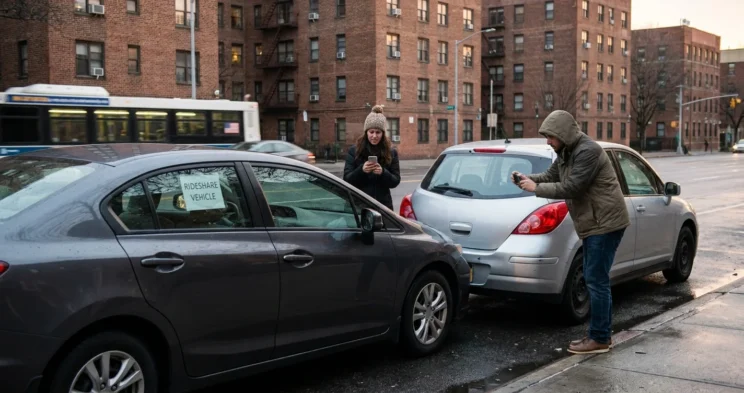
You were riding through Uptown Dallas late one night when your Uber driver got hit at an intersection. The other driver took off, no officer ever showed up, and now you are staring at medical bills with nothing official to point to. You did everything right, so why does it feel like the missing paperwork already cost you your case?
No Police Report Does Not Kill Your Claim
The absence of a police report does not prevent you from filing a rideshare accident claim in Texas. An insurer cannot deny a valid claim for that reason alone, and the law never made an officer’s report a condition of getting paid.
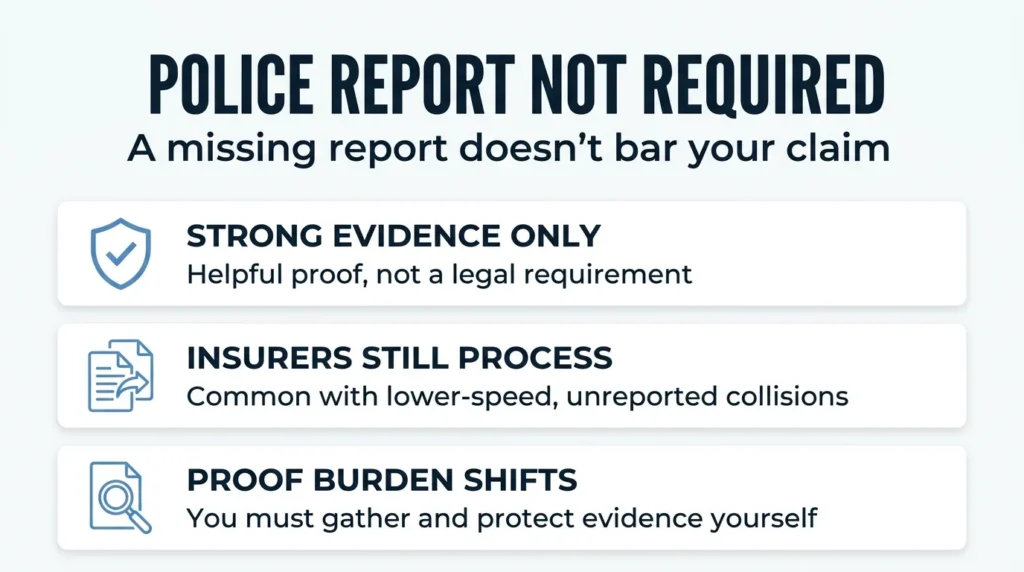
A police report is strong evidence, not a legal requirement. Texas does not tie your right to compensation to the existence of a CR-3 crash report.
Insurers process rideshare claims without officer-filed reports all the time. This happens often with lower-speed collisions, where law enforcement declines to send anyone out.
What the missing report does change is who carries the weight of proof–the burden shifts to you. The less paperwork you have to pull from, the more carefully you have to gather and protect other evidence.
If you are worried the lack of report has already damaged your position, it helps to understand how reports actually affect insurance claims before you talk to an adjuster.
Texas CR-3 Reports & When They Are Filed
A CR-3 is the standard crash report a Texas peace officer files after investigating a collision. You do not file it, and neither does the driver. The officer at the scene does.
If no officer responds, no CR-3 ever gets created. That is the gap many rideshare riders fall into.
An officer must file a written report within 10 days when investigating a crash involving injury, death, or property damage over $1,000, under Texas Transportation Code § 550.062. No officer at the scene means that report never happens.
Your own duty is separate. Texas Transportation Code § 550.026 requires a driver to immediately report a crash involving injury, death, or a vehicle that cannot be driven safely. That obligation runs to local law enforcement and does not produce a CR-3 by itself.
You can check whether a report ever existed through the TxDOT crash records system. Enter the date, location, and driver details to search.
If nothing turns up, that confirms the gap. It also tells you that substitute evidence is now your main tool, which is why understanding how reports shape a case puts the rest of these steps in context.
Rideshare App Data as Substitute Evidence
The app itself is your strongest substitute for a police report. Every Uber or Lyft ride creates a timestamped data record that can fix the time and location of the crash.
That record includes the request time, the driver’s GPS route, the trip start and end, and the fare receipt. Together they prove the trip was in progress when you were hurt.
The driver’s status at the moment of impact decides which insurance tier pays. Data showing the driver was en route to you or carrying you as a passenger triggers the highest coverage tier under Texas Insurance Code Chapter 1954.
Those status windows are worth understanding, because the difference between them can be the difference between a small policy and a large one. You can review a breakdown of the Uber and Lyft coverage periods and learn how each tier works.
Screenshots taken at the moment of the crash, or right after, can lock in the driver’s identity, trip status, and route. Capture them before the app resets or the session closes.
The Texas Department of Licensing and Regulation oversees rideshare operations and can confirm a platform’s compliance obligations if you need a secondary source.
Evidence to Gather After a Rideshare Crash
Your case now rests on what you can collect, so start today. Even if you have already left the scene, much of this evidence can still be recovered.
- Photos and video: Capture vehicle positions, road conditions, property damage, and visible injuries. If you left the scene, returning later or asking nearby businesses for dashcam footage may recover some of it.
- Witness contact information: Get names and phone numbers of anyone who saw the crash or what followed. Their statements can stand in for the observations an officer would have recorded.
- Medical records: Even care sought days later helps. Records tied to the incident date anchor your injury to the crash.
- In-app data: Screenshot the trip receipt, driver profile, and any messages with the driver or platform. Request your full trip history from the app settings.
- Your written account: Write a detailed, dated narrative as soon as you can. Memory fades fast, and a record made early can carry real weight.
- A preservation letter: A demand sent to Uber or Lyft through an attorney tells the platform to hold trip and GPS data. Platforms routinely delete or archive these records within weeks.
If you are unsure whether what you have is enough, it is worth knowing the full sequence of steps after a rideshare crash before you send anything to the insurer.
Understanding the pattern of how these claims develop also gives you an idea of what to expect.
Texas Statute of Limitations & Why Timing Matters
You generally have two years from the date of the crash to file a personal injury lawsuit in Texas, under Texas Civil Practice and Remedies Code § 16.003. Miss that deadline and your claim is almost always gone.
Two years sounds like plenty. The problem is that evidence disappears far faster than the legal clock runs.
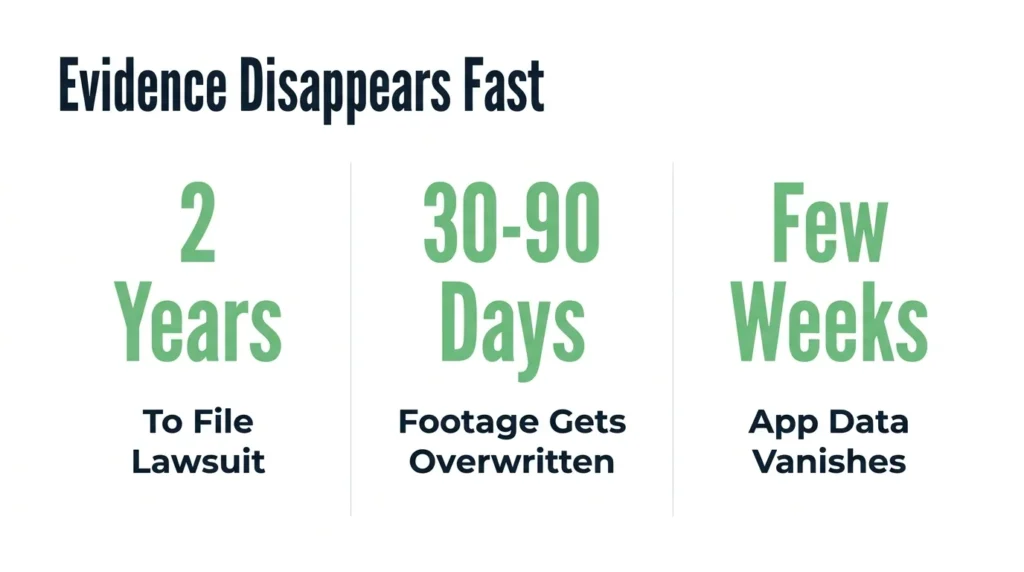
App trip data can vanish in weeks. Witness memories fade. Footage from nearby businesses is usually overwritten, or deleted, within 30 to 90 days.
So your real deadline for saving evidence is much shorter than your deadline to file. The missing police report makes early action more urgent, not less.
Every week without preserved evidence is a week your claim gets harder to support. Knowing what happens when an Uber gets in a wreck can help you see why moving quickly protects the value of a car accident claim.
Pursue Your Claim with Angel Reyes & Associates
Missing documentation does not mean a missing claim. The right evidence, gathered in time, can carry a rideshare case even when no officer ever wrote a word.
Angel Reyes & Associates has handled Texas rideshare accident cases for over 30 years, and we know how to rebuild a claim from app data, witness accounts, and medical records. We work on contingency, so there is no fee unless we win, and we have recovered more than $1 billion for clients across the state.
Your first consultation is free, we are available 24/7, and se habla espanol. You can reach out to us to review your options, or learn more about who we are and how we work.
The sooner we hear from you, the more of your evidence we can still protect.
Past results do not guarantee future outcomes.
Rideshare Accident Claim FAQs
Does reporting the crash through the Uber or Lyft app substitute for a police report?
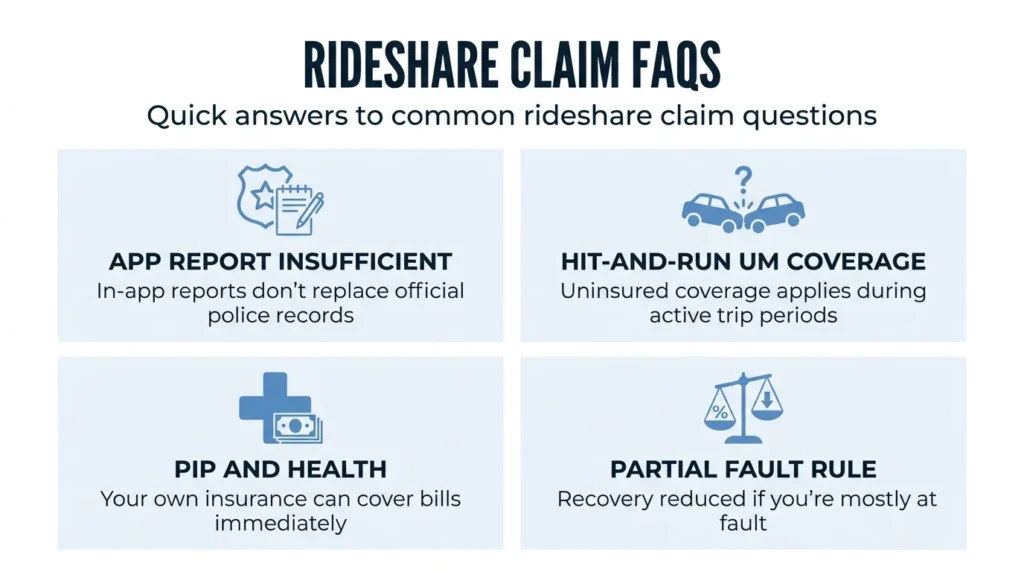
Filing an in-app incident report notifies the platform and opens an internal file, but it does not create an official government record. It is separate from a CR-3 and separate from your insurance claim, so it does not replace either one.
Can a hit-and-run driver trigger uninsured motorist coverage on a rideshare claim?
Yes. Under Texas Insurance Code Chapter 1954, Uber and Lyft must carry uninsured and underinsured motorist coverage during active trips, which covers passengers when a hit-and-run driver causes the crash. That coverage applies during Period 2 and Period 3 regardless of whether a police report was filed.
Can I use my own PIP or health insurance while my rideshare claim is pending?
Yes. If your auto policy includes Personal Injury Protection, it can pay your medical bills and a portion of lost wages right away without waiting for the liability claim to resolve. Your health insurance can also cover treatment costs in the meantime.
Does partial fault as a passenger reduce my rideshare injury recovery in Texas?
Under Texas Civil Practice and Remedies Code Chapter 33, your recovery is reduced by your percentage of fault, but you can still collect as long as your share of responsibility is 50 percent or less. Passengers are rarely assigned fault in rideshare crashes, but the rule applies if it comes up.
About the Authors

Angel Reyes
Writer
Angel L. Reyes, III is the Founder and Managing Partner of Angel Reyes & Associates. A nationally recognized trial attorney and business leader, Angel has helped over 70,000 injury victims recover more than $1 billion since founding the firm in 1993. Named to the Texas Super Lawyers list annually since 2008, Angel brings Wall Street experience, Ivy League education, and a deep commitment to client advocacy. He is a frequent legal commentator and published author with extensive contributions to legal scholarship, trial strategy, and consumer protection.

Kyle Nicolas
Editor
Kyle Nicolas is the Web Content & SEO Manager at Angel Reyes & Associates. He has more than 10 years of experience as a marketing co...

Angel Reyes
Reviewer
Angel L. Reyes, III is the Founder and Managing Partner of Angel Reyes & Associates. A nationally recognized trial attorney and business...