Is the Trucking Company Liable for an Owner-Operator’s Crash?


Every article on this site is researched by our internal team, reviewed for legal accuracy against current Texas law, and held to State Bar of Texas advertising standards before publication. We do not publish content that overstates outcomes or makes promises about results.
Learn more about our
editorial standards .
Key Takeaways
- A placarded, leased truck usually makes the motor carrier liable for the crash.
- The lease's own control clause usually defeats the independent contractor defense.
- Name the trucking company, not just the driver, when a leased truck causes harm.
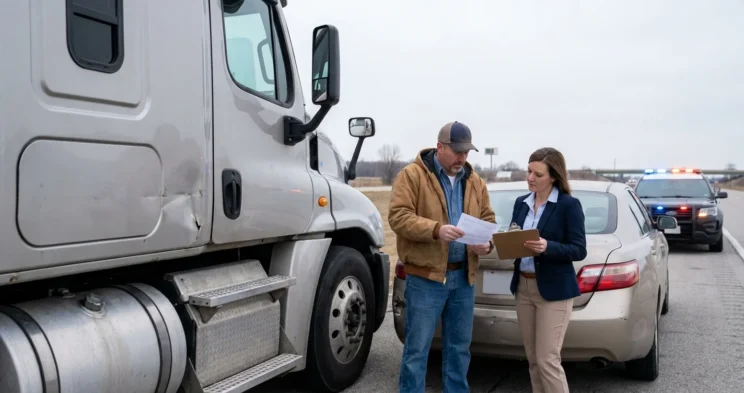
You pull the crash report after the wreck on I-35 and something does not add up. The trailer that hit you carried one company’s name and DOT number on the door, but the driver told the officer he owns his rig and works for himself.
So who answers for your injuries? In most cases, the trucking company does.
When a motor carrier leases a truck and driver and runs that truck under its own federal operating authority, the carrier is generally responsible for that driver’s negligence behind the wheel. The word “independent contractor” in the lease does not end the analysis. Federal trucking regulation and Texas courts both look past the paperwork to the control the carrier agreed to hold.
Owner-Operator vs. Company Driver: Why the Label Doesn’t Settle Liability
The two arrangements look nearly identical from the shoulder of the highway, and the legal difference is smaller than most carriers want you to believe.
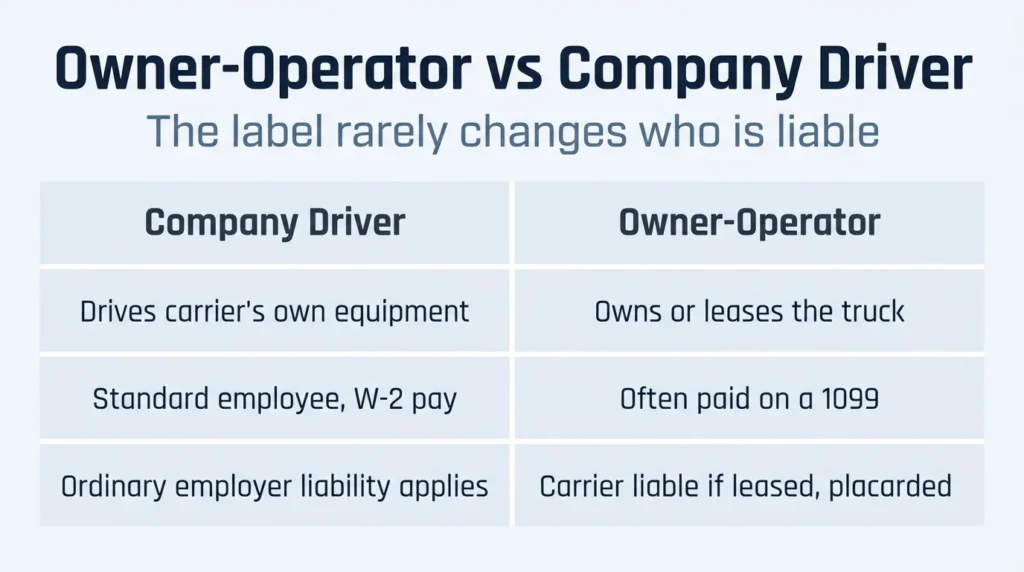
A company driver is a carrier’s employee driving the carrier’s own equipment. If that driver runs a red light in Deep Ellum on a Tuesday morning, ordinary employer liability applies and no one seriously argues about it.
An owner-operator owns or leases the truck and contracts with a carrier to haul freight. The driver is often paid on a 1099, and the lease almost always calls the relationship an independent contractor arrangement.
That label carries less weight than it appears to. The Federal Motor Carrier Safety Administration does not define “owner-operator” as a regulatory category at all. It regulates employers and drivers, and an owner-operator can occupy either role depending on how the arrangement is structured.
FMCSA’s Truck Leasing Task Force has spent recent years examining how these lease terms actually operate in the industry.
For an injured Texan, a carrier running a leased owner-operator’s truck under its own authority is generally liable for that driver’s negligence in the same way it would be for a company driver.
Carriers raise the contractor defense often after a leased-truck crash, and the lease terms usually
defeat it. Truck accident attorneys start with that document.
The Regulatory Anchor: 49 CFR Part 376 and the “Statutory Employee” Definition
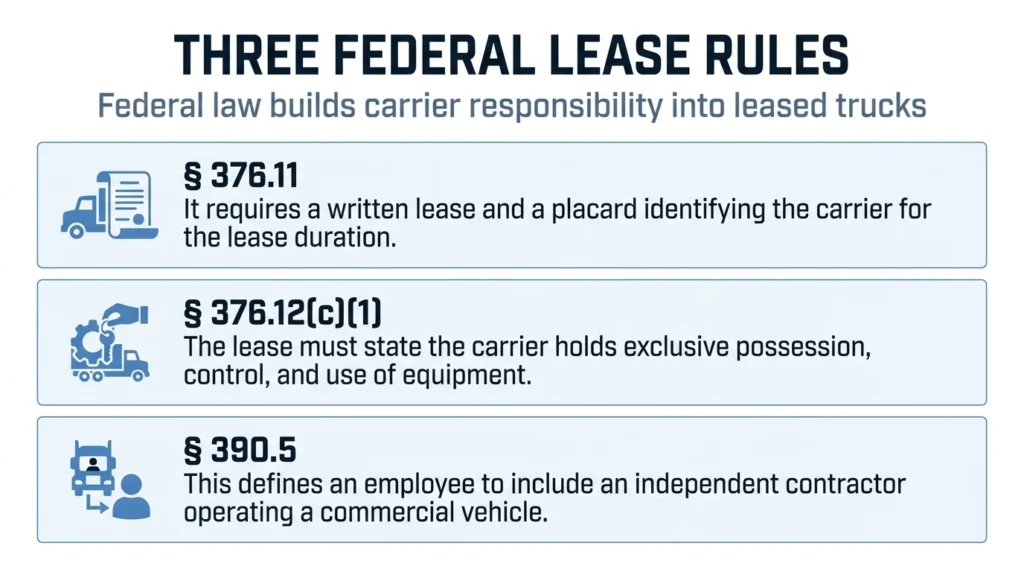
Federal law does not let a carrier borrow a truck and disclaim responsibility for it. 49 CFR Part 376 sets the rules for how an authorized for-hire carrier may operate equipment it does not own, and those rules build responsibility into the arrangement from the start.
Three provisions carry the weight:
- 49 CFR § 376.11 requires a written lease and the carrier to identify the equipment as being in its service for the length of the lease. That is the placard and the DOT number you photographed on the door.
- 49 CFR § 376.12(c)(1) requires the lease to state that the carrier has “exclusive possession, control, and use of the equipment” and “assume[s] complete responsibility for the operation of the equipment” for the lease term. This language is mandatory, not a negotiating point.
- 49 CFR § 390.5 defines “employee,” for federal motor carrier safety purposes, to include “a driver of a commercial motor vehicle (including an independent contractor while in the course of operating a commercial motor vehicle).”
These rules explain why a placarded truck puts the public on notice. The carrier
whose name rides on that door has told the federal government it is answerable for how the truck is operated.
Operational responsibility is the key here. Which insurance policy ultimately pays a claim is a
separate matter with its own rules.
How Texas and Federal Courts Apply the Statutory Employee Doctrine
Courts have enforced this framework for more than 50 years. A carrier that leases a truck and placards it under its own authority is generally liable, as a matter of law, for the leased driver’s on-duty negligence, whatever the lease calls the driver.
The doctrine traces to Simmons v. King, 478 F.2d 857 (5th Cir. 1973). The Fifth Circuit held that when a federally authorized carrier leases equipment and the truck carries the carrier’s placard, the driver is treated as the carrier’s statutory employee, and the carrier answers to the public for negligent operation of that truck. Federal regulation, the court held, overrides state-law attempts to reach a different result.
Texas courts apply the same rule. In Morris v. JTM Materials, Inc., 78 S.W.3d 28 (Tex. App. Fort Worth 2002, no pet.), a carrier leased a tractor-trailer and then argued that the driver was an independent contractor who was not on carrier business when the collision happened.
The Fort Worth Court of Appeals rejected both arguments and reversed summary judgment for the carrier. Statutory employee status turned on whether a Part 376 lease existed and the truck was placarded, not on whether the driver happened to be running a load at that exact moment.
The lease’s mandatory control clause creates a retained right of control, and “it is the right of control, and not the actual exercise of control, that gives rise to a duty.” A carrier holding operating authority, the court explained, “may not delegate to another the rights conferred by such certificate or permit and then release himself from liability.”
Morris is a Texas court of appeals decision rather than a Texas Supreme Court holding. It has stood for over two decades without contrary Texas authority and lines up with the Fifth Circuit, so it remains the working rule in Texas trucking cases.
Why the Lease Agreement Itself Usually Defeats the Contractor Defense
The carrier’s own contract usually sinks the contractor defense before anyone asks who set the driver’s schedule.
Texas uses a common-law right-to-control test to sort employees from independent contractors. Limestone Products Distribution, Inc. v. McNamara, 71 S.W.3d 308 (Tex. 2002) weighs factors such as who furnishes the equipment, who directs the details of the work rather than just the result, who sets the schedule and routes, who pays for fuel and maintenance, and whether the worker receives a 1099 or a W-2.
In Limestone, a private hauling arrangement with no federally regulated lease or carrier placard involved, the driver owned his truck, covered his own expenses and taxes, and set his own hours and routes. The Texas Supreme Court held he was an independent contractor as a matter of law.
The regulated leased owner-operator situation usually comes out the other way. The test has not changed, the evidence has.
A Part 376 lease must state, by federal command, that the carrier holds exclusive possession, control, and use of the truck. That is direct written evidence of the carrier’s right to control, and it is far more pointed than the scattered factual factors a Limestone analysis produces.
Carriers sometimes point to § 376.12(c)(4), which says the required control clause is not intended to affect whether the driver is an independent contractor or an employee of the carrier. Courts read that disclaimer narrowly.
It addresses general employment status questions such as taxes, benefits, and workers’ compensation. It does not erase the carrier’s responsibility in tort for how its placarded truck is driven.
These are two distinct tests for two distinct situations, not competing rules pulling against each other. Where no regulated lease and placard exist, Limestone governs. Where a Part 376 lease and a carrier placard are in play, the statutory employee doctrine controls, and the common-law factors become largely beside the point.
What This Means for Your Claim After a Leased-Truck Crash
If a placarded, leased truck caused your crash, the motor carrier belongs in your claim. Stopping at the individual driver often means pursuing the party with the least ability to make you whole.
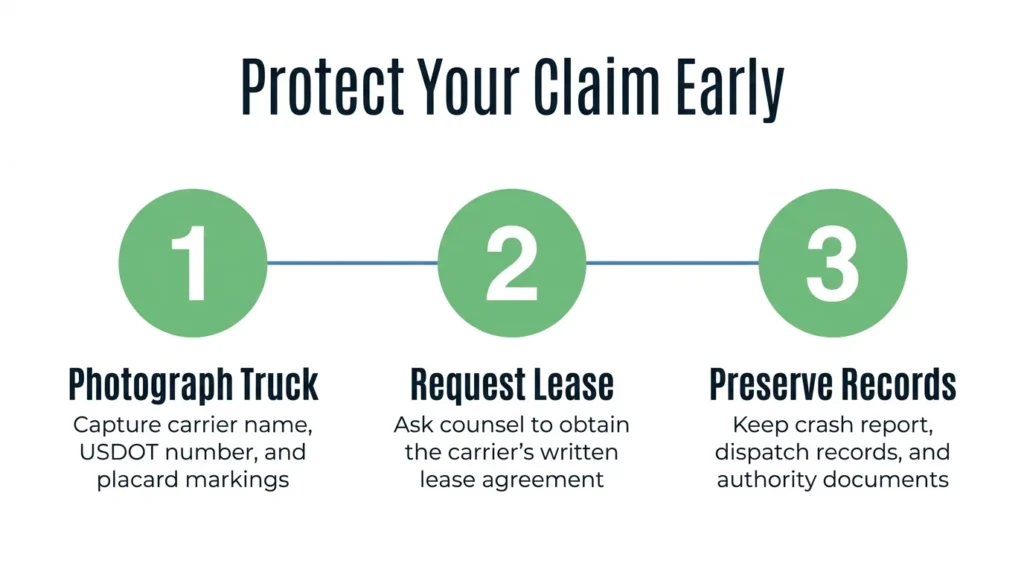
A few practical steps protect that theory early:
- Photograph the tractor and trailer doors, including the carrier name, USDOT number, and placard markings.
- Ask counsel to request the written lease agreement between the carrier and the owner-operator, since § 376.12 requires it to exist in writing.
- Preserve the crash report, dispatch records, and any documents showing which carrier’s authority the load moved under.
Insurance rules for leased owner-operators differ slightly.
Talk to an Attorney About Your Claim
Sorting out lease agreements, operating authority, and placarding is not something an injured person should have to do from a hospital bed. Carriers and their adjusters already know this framework, and they know most crash victims do not.
Angel Reyes & Associates has guided injured Texans through situations like this for over 30 years, with board-certified personal injury attorneys, investigators, and accident reconstruction specialists working the details that decide these cases.
Contact Angel Reyes & Associates for a free consultation and a clear read on who can be held responsible for your crash.
Past results do not guarantee future outcomes.
Owner-Operator Truck Crash FAQs
Does it matter whether the owner-operator was on an active dispatch for the carrier at the exact moment of the crash?
No. Under the statutory employee doctrine, courts have held that liability turns on whether a federally required lease existed under 49 CFR § 376.12 and the truck was placarded in the carrier’s name, not on whether the driver happened to be running a specific load at that precise moment. A carrier cannot avoid responsibility simply by pointing to gaps between loads or arguing the driver was technically “off the clock” for that particular trip.
Can a lease agreement's "independent contractor" language legally override the statutory employee doctrine?
No. Federal regulation (49 CFR § 376.12(c)(4)) states that the lease’s mandatory possession-and-control clause is not intended to affect whether the driver is classified as an independent contractor or an employee, but courts read that disclaimer narrowly. It addresses general employment-law questions such as taxes, benefits, and workers’ compensation. It does not undo the carrier’s responsibility for how the truck is operated on the road.
If a truck wasn't properly placarded with the carrier's identification at the time of the crash, does that change who's liable?
Not by itself. Placarding is one of the federal requirements tied to this framework under 49 CFR § 376.11, and courts have looked at whether the truck was placarded together with whether a § 376.12 lease existed when assessing statutory-employee status. A missing or incorrect placard is itself a separate regulatory violation, but it does not erase the lease’s mandatory control clause. The carrier’s written commitment to exclusive possession and control of the equipment remains the central piece of evidence supporting liability.
If an owner-operator was leased to more than one carrier, how is responsibility sorted out between them?
The same lease-and-placard analysis applies to each carrier separately. Because § 376.12(c)(1) requires the governing lease to give one carrier exclusive possession, control, and use of the equipment, the question becomes which carrier’s lease and operating authority covered that truck when the crash happened.
About the Authors

Angel Reyes
Writer
Angel L. Reyes, III is the Founder and Managing Partner of Angel Reyes & Associates. A nationally recognized trial attorney and business leader, Angel has helped over 70,000 injury victims recover more than $1 billion since founding the firm in 1993. Named to the Texas Super Lawyers list annually since 2008, Angel brings Wall Street experience, Ivy League education, and a deep commitment to client advocacy. He is a frequent legal commentator and published author with extensive contributions to legal scholarship, trial strategy, and consumer protection.

Kyle Nicolas
Editor
Kyle Nicolas is the Web Content & SEO Manager at Angel Reyes & Associates. He has more than 10 years of experience as a marketing co...

Alex Ivanov
Reviewer
Alex Ivanov is a personal injury attorney at Angel Reyes & Associates, focused on car, truck, and motorcycle accident cases. Licensed in...