Common Injuries in Texas Personal Injury Cases


Every article on this site is researched by our internal team, reviewed for legal accuracy against current Texas law, and held to State Bar of Texas advertising standards before publication. We do not publish content that overstates outcomes or makes promises about results.
Learn more about our
editorial standards .
Key Takeaways
- Common injuries in personal injury cases include head trauma, neck and back injuries, fractures, burns, internal injuries, amputations, and psychological damage.
- The severity of an injury often affects the value of a claim, the evidence needed, and the amount of future care involved.
- Fast medical treatment and consistent documentation can protect both your recovery and your legal claim.

You are sitting in traffic on I-35E in Dallas when a driver looking down at their phone hits you from behind. You walk away, thinking you got lucky, then you wake up the next morning with neck pain, a pounding headache, and trouble lifting your left arm.
This scenario is common in Texas injury cases. Some injuries are obvious at the scene. Others take hours or days to show up, and the injury itself often shapes how much medical care, time away from work, and legal help you need.
The success of many Texas personal injury cases is often determined by one critical issue: gathering clear proof of what caused your injuries, how serious they are, and how they have changed your daily life.
What Injuries Are Most Common After an Accident in Texas?
Head injuries are some of the most serious injuries sustained after a car accident. A concussion or traumatic brain injury can affect your memory, focus, sleep, mood, and balance, and the CDC notes that concussion symptoms can appear either right away or days later, which is why delayed symptoms still deserve immediate medical attention.
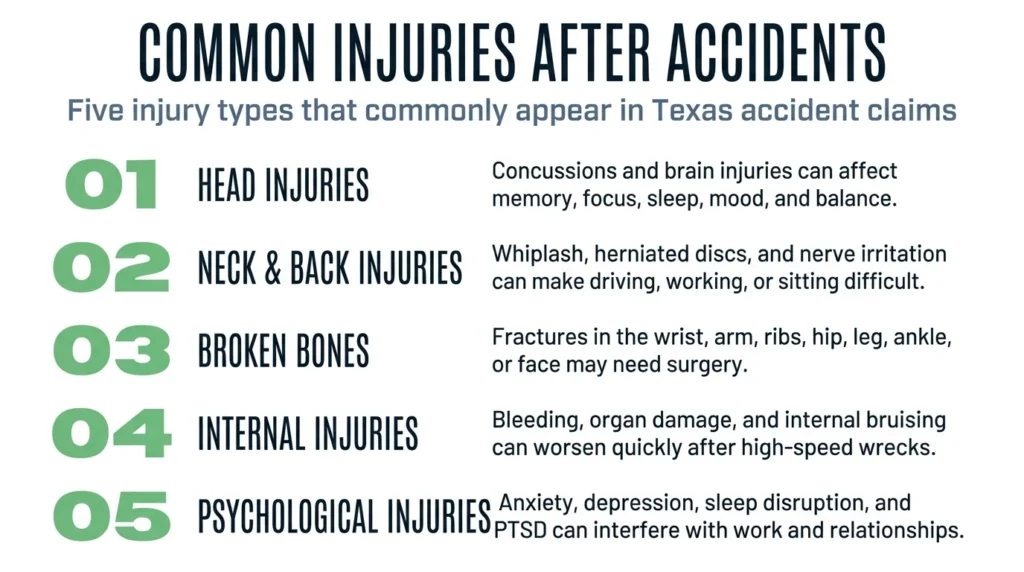
Neck and back injuries are also common after crashes, falls, and other sudden impacts. Whiplash, herniated discs, and nerve irritation can make it hard to drive, work, sleep, or sit comfortably for long periods of time.
Spinal cord injuries are less common, but they can be catastrophic. The National Institute of Neurological Disorders and Stroke explains how spinal cord injuries can cause lasting changes in movement, strength, and bodily function, and those losses often create the need for major care in the future.
Broken bones show up in many personal injury cases because the body absorbs impact in similar ways. Fractures in the wrist, arm, ribs, hip, leg, ankle, or face may require surgery, metal plates or screws, physical therapy, and long recovery periods.
Burns can happen in vehicle fires, electrical accidents, workplace incidents, and motorcycle crashes. Even after the skin heals, scarring, nerve pain, and emotional distress can last much longer than the initial hospital stay.
Internal injuries are dangerous because you may not see them. Bleeding, organ damage, and internal bruising can worsen fast, especially after high-speed wrecks or blunt-force trauma.
Amputations and injuries caused by severe compression or force can change nearly every part of your daily life. Someone suffering from these injuries may need multiple surgeries, prosthetics, home modifications, and long-term rehabilitation just to regain basic independence.
Psychological injuries are also important. Anxiety, depression, sleep disruption, and post-traumatic stress can interfere with work, relationships, and normal routines even after visible wounds start to improve.
If you want a broader look at how fault and damages fit together, our post on what qualifies as a personal injury case explains the legal foundation behind these claims.
Why These Injuries May Change Your Claim
The same crash can lead to very different claims, depending on your injury. A sore shoulder that heals in a few weeks is not handled the same way as a spinal injury that affects your movement for years to come.
Serious injuries usually increase the value and complexity of a case because they can lead to future treatment, reduced earning ability, pain, and permanent impairment. They also require better evidence, including imaging, specialist records, work documentation, and testimony about how your life has changed due to the injury.
Insurance companies are businesses. Their goal is to resolve claims for the lowest possible payout, so they often question delayed symptoms, soft tissue injuries, and conditions that do not show up clearly in one emergency room visit.
This is why early documentation is so important. Medical records, follow-up care, and consistent symptom reporting can help connect the injury to the event that caused it.
Crash conditions also play a role. Our review of the deadliest counties in Texas for drivers shows how severe roadway collisions across the state can lead to the kind of catastrophic injuries that require long-term care.
What You Should Do After Symptoms Start
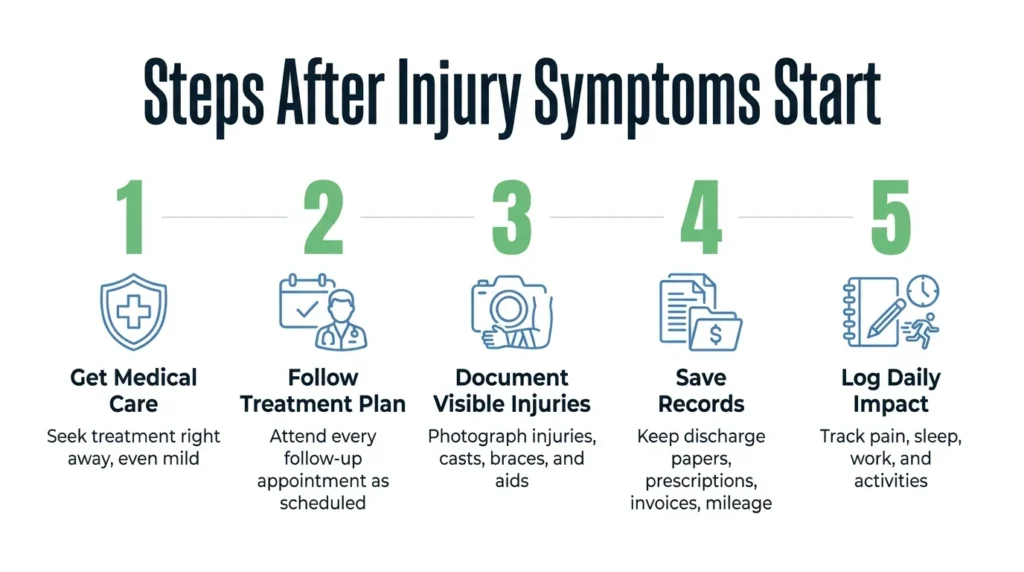
The first days after an injury often shape both your recovery and your case. Take these steps as soon as you can:
- Get medical care right away, even if your symptoms seem mild at first.
- Follow the treatment plan and show up to every follow-up appointment.
- Take photos of visible injuries, casts, braces, scars, and mobility aids.
- Save discharge papers, prescriptions, invoices, and mileage records.
- Log how the injury affects your work, sleep, pain level, and daily activities.
- Be careful when speaking with insurance adjusters before you know the full extent of your injuries.
You should also avoid assuming that a “minor” symptom means an unimportant one. A sprain can hide a tear. A headache can point to a concussion. Numbness can signal nerve damage that needs quick evaluation.
If you want to see how injury cases can unfold over time, our case results page provides useful context about the kinds of losses that may be involved in serious claims.
How to Get Help After a Serious Injury in Texas
A serious injury can affect your health, your paycheck, and your family long after the accident scene is cleared. At Angel Reyes & Associates, we help injured Texans understand what their medical records mean, what evidence to preserve, and what compensation may be available.
Use our case review form to get legal guidance after a serious injury so we can explain your next steps as clearly as possible. We offer free initial consultations, and you pay no fee unless we win, which makes it easier to get answers without the added stress.
Past results do not guarantee future success.
Common Injury FAQs
Can you still file a Texas personal injury claim if your pain did not start until the next day?
Yes. Many injuries (including concussions, whiplash, and some back injuries) can become more noticeable hours or days after the accident, but you will still need prompt medical evaluation and records that connect the symptoms to the accident.
How do you prove a soft tissue injury when X-rays or the emergency room visit looked normal?
These cases often depend on follow-up care, imaging beyond regular X-rays when appropriate, physical therapy records, doctor observations, and consistent reports of pain, limitations, and the inability to engage in your usual activities over time. A normal emergency room visit does not automatically mean you were not injured.
Can you recover compensation if the accident made an old injury worse?
Usually, yes. Under Texas law, you may recover compensation if a pre-existing condition is aggravated, but your records need to show how your symptoms changed after the incident, and what got worse as a result of the new event.
What if the insurance company says your injury is minor because your car damage was small?
That argument is common, but low property damage does not automatically rule out a serious physical injury. The strongest proof is medical evidence, symptom history, and logs detailing how the injury has affected your work, movement, and daily routine.
Do future complications from a serious injury count in a Texas personal injury case?
Yes, when there is evidence that the complications are reasonably likely, such as future surgery, rehabilitation, long-term work restrictions, or ongoing pain management. Serious cases often require physicians’ opinions and other evidence to support these future losses.
About the Authors

Angel Reyes
Writer
Angel L. Reyes, III is the Founder and Managing Partner of Angel Reyes & Associates. A nationally recognized trial attorney and business leader, Angel has helped over 70,000 injury victims recover more than $1 billion since founding the firm in 1993. Named to the Texas Super Lawyers list annually since 2008, Angel brings Wall Street experience, Ivy League education, and a deep commitment to client advocacy. He is a frequent legal commentator and published author with extensive contributions to legal scholarship, trial strategy, and consumer protection.

Kyle Nicolas
Editor
Kyle Nicolas is the Web Content & SEO Manager at Angel Reyes & Associates. He has more than 10 years of experience as a marketing co...

Angel Reyes
Reviewer
Angel L. Reyes, III is the Founder and Managing Partner of Angel Reyes & Associates. A nationally recognized trial attorney and business...