What Damages Can You Recover in a Texas Personal Injury Lawsuit?


Every article on this site is researched by our internal team, reviewed for legal accuracy against current Texas law, and held to State Bar of Texas advertising standards before publication. We do not publish content that overstates outcomes or makes promises about results.
Learn more about our
editorial standards .
Key Takeaways
- Texas personal injury damages usually include economic losses, noneconomic harm, and in some cases, exemplary damages.
- The amount you recover depends on the proof you have for both financial losses and the effect the injury has on your daily life.
- Shared fault and missed filing deadlines can reduce or block compensation even when your injuries are serious.
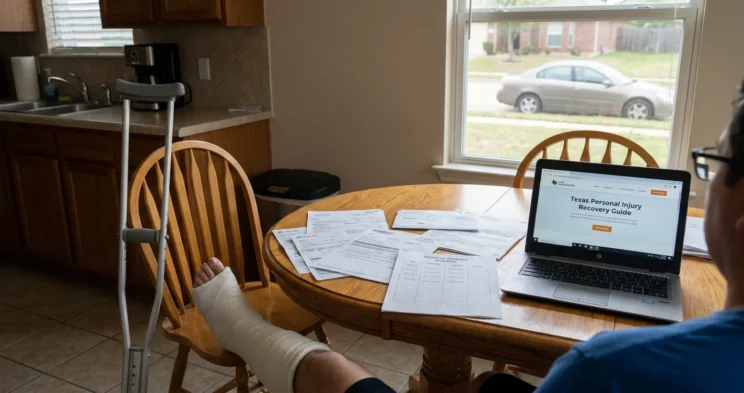
Picture this: You are hurt in a car crash in Texas, and the bills start rolling in before you know how serious your injury really is. You may need more treatment, more time off work, and more help at home than you expected. A personal injury claim can cover those losses, but only if you identify them and support them with proof.
In Texas, these losses are legally defined as “compensatory damages.” Under Texas Civil Practice and Remedies Code § 41.001, compensatory damages are divided into two main categories: economic damages and noneconomic damages. Understanding this distinction is key because it shapes what you can recover and how you’ll need to prove your claim.
Economic Damages
Economic damages cover losses you can usually prove with records, bills, and wage documents. In many cases, that includes:
- Medical bills you have already received
- Future medical care you will likely need
- Lost income from missed work
- Reduced earning capacity (if your injuries will affect your job long term)
- Property damage
- Out-of-pocket expenses for treatment and recovery
This part of the claim is often the easiest to document, but it still needs careful work. Save medical bills, prescription receipts, repair estimates, pay stubs, tax records, and any written recommendations for future care.
Our post on what qualifies as a personal injury case can help you see how these losses fit into a larger claim.

Noneconomic Damages
The same definition in § 41.001 also recognizes noneconomic damages for losses that do not come with a fixed dollar amount. These often include:
- Physical pain
- Mental anguish
- Physical impairment
- Disfigurement
- Loss of enjoyment of daily life
- Inconvenience caused by the injury
These damages focus on how the injury has changed your life. If you now struggle to sleep, drive, work, exercise, care for your children, or handle routine tasks without pain, that impact may be part of your case.
Our article on pain and suffering in a personal injury case explains how these losses are often evaluated.
Can You Recover Exemplary Damages?
Some cases may also support exemplary damages, but they are not available in every claim. Exemplary damages are awarded not to compensate you for your losses, but to punish the defendant and deter similar behavior in the future. A severe injury by itself does not create a claim for exemplary damages. The facts have to show especially dangerous or wrongful conduct, not just ordinary carelessness.
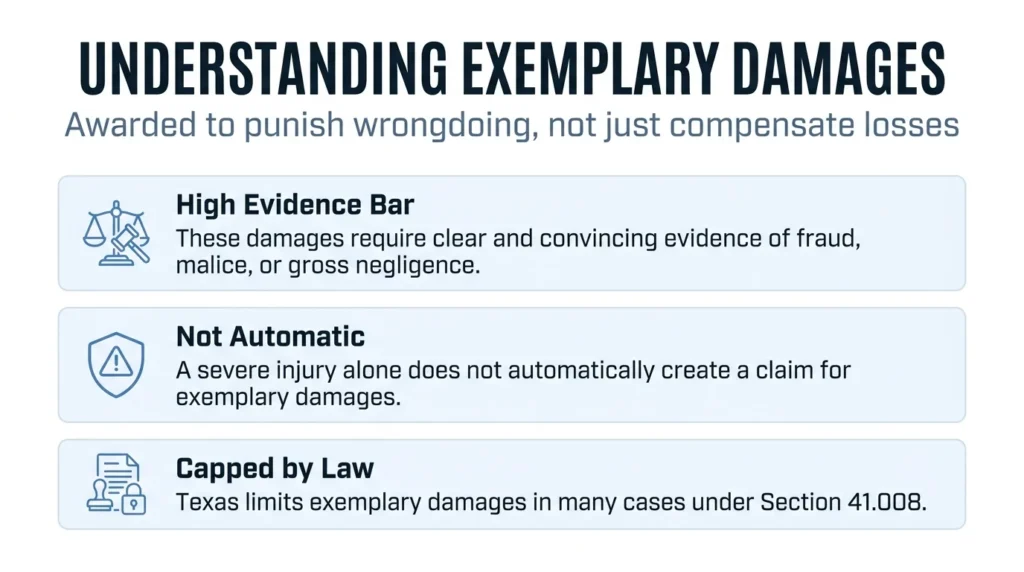
Under CPRC § 41.003, you generally need clear and convincing evidence of fraud, malice, or gross negligence. Under § 41.008, Texas also limits exemplary damages in many cases.
What Can Reduce the Damages You Recover?
Even when your losses are legitimate, your recovery may still be reduced. Under § 33.001, you generally cannot recover damages if you are more than 50 percent responsible for the incident. If you are 50 percent or less responsible, your compensation may be reduced by your share of fault.
Timing can also affect your case. Most Texas personal injury lawsuits must be filed within the deadline set by § 16.003. Our post on how long you have to file a personal injury claim in Texas explains why waiting can hurt both your legal rights and the quality of your evidence.
Evidence That Helps Prove Damages
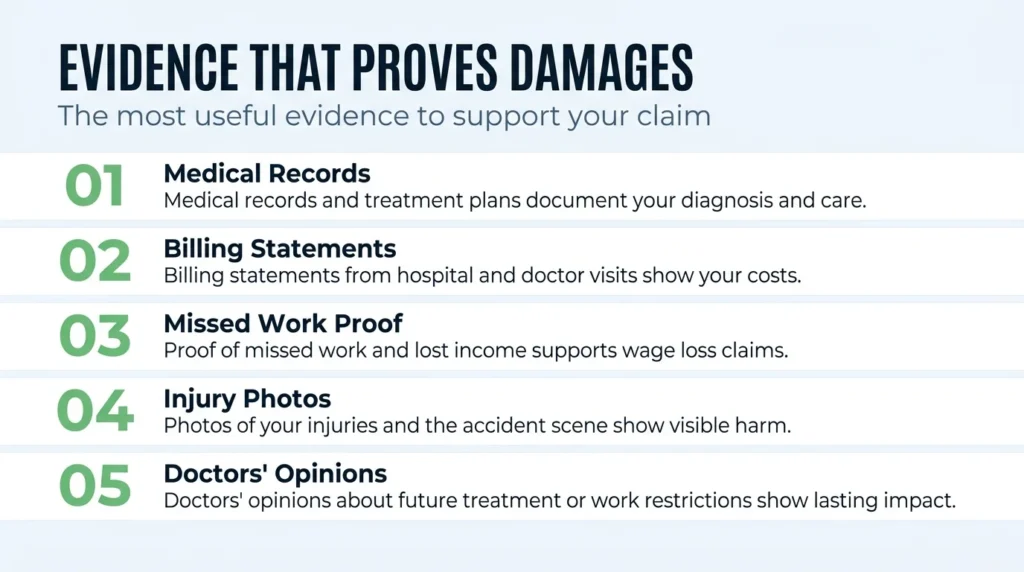
The value of your claim depends on what you can prove, not what you believe the case should be worth. The most useful evidence often includes:
- Medical records and treatment plans
- Billing statements from hospital and doctor visits
- Proof of missed work and lost income
- Photos of your injuries and the accident scene
- Repair bills or replacement estimates for damaged property
- Doctors’ opinions about future treatment or work restrictions
- Logs that show how the injury affects your daily routine
Good evidence will help tie your losses directly to the incident. It also helps counter arguments made by the insurance company that your treatment was unnecessary, your symptoms are exaggerated, or your future losses are uncertain.
You can also review our case results and client reviews to learn more about how we handle injury cases and how real clients describe the process.
Make Sure Your Claim Includes Future Losses
A fast settlement can leave out future treatment, missed earning ability, and the lasting effect the injury will have on your daily life. Before you accept an offer, make sure you understand both the losses you can already measure and the ones that may continue for months or years.
At Angel Reyes & Associates, we offer free initial consultations, and we work on contingency, meaning you pay no fee unless we win. If you want help evaluating what your case may include, use our contact form to discuss your injury claim.
Past results do not guarantee future success.
Damages FAQs
Can you recover the full amount of your medical bills in a Texas personal injury case?
Not always. Under Texas Civil Practice and Remedies Code § 41.0105, recovery for medical or health care expenses is generally limited to the amount actually paid or still owed, not the higher amount originally billed.
Can you still recover damages if the accident made a pre-existing condition worse?
Yes. Under Texas law, you can seek damages for the aggravation of a pre-existing condition, but you usually need medical evidence identifying how the damages caused by the incident made your pre-existing condition worse.
Are personal injury settlements taxable in Texas?
Usually no, if the settlement is for personal physical injuries or physical sickness. However, punitive damages, interest, and some amounts that are not tied to a physical injury can be taxable under federal law.
Do medical liens or health insurance claims affect how much money you actually keep?
Yes. A hospital lien, health insurer reimbursement claim, or government benefit lien can attach to part of a settlement, so the amount you receive in hand may be less than the gross recovery.
Are pain and suffering damages capped in Texas personal injury cases?
In most ordinary Texas injury cases, there is no general cap on pain and suffering damages. But some claims, including many healthcare liability claims under § 74.301, have statutory limits, and exemplary damages are capped under § 41.008.
About the Authors

Angel Reyes
Writer
Angel L. Reyes, III is the Founder and Managing Partner of Angel Reyes & Associates. A nationally recognized trial attorney and business leader, Angel has helped over 70,000 injury victims recover more than $1 billion since founding the firm in 1993. Named to the Texas Super Lawyers list annually since 2008, Angel brings Wall Street experience, Ivy League education, and a deep commitment to client advocacy. He is a frequent legal commentator and published author with extensive contributions to legal scholarship, trial strategy, and consumer protection.

Kyle Nicolas
Editor
Kyle Nicolas is the Web Content & SEO Manager at Angel Reyes & Associates. He has more than 10 years of experience as a marketing co...

Angel Reyes
Reviewer
Angel L. Reyes, III is the Founder and Managing Partner of Angel Reyes & Associates. A nationally recognized trial attorney and business...