Can You Reopen a Personal Injury Case?


Every article on this site is researched by our internal team, reviewed for legal accuracy against current Texas law, and held to State Bar of Texas advertising standards before publication. We do not publish content that overstates outcomes or makes promises about results.
Learn more about our
editorial standards .
Key Takeaways
- You usually cannot reopen a Texas personal injury case after you sign a settlement release or a final judgment.
- You may still have a slim option if a deadline is still open or the case was not fully closed in the first place.
- You can protect yourself by making sure that your original claim includes future treatment, lost income, and long-term injury effects.
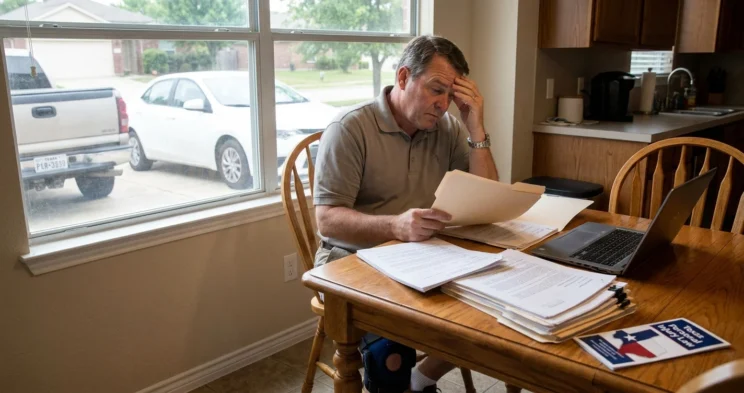
You are driving home in Dallas when you’re hit by a driver who was texting behind the wheel. The crash seemed straightforward at first. You settled your claim, signed the paperwork, and tried to move on, but then your pain got worse, your doctor is recommending surgery due to lack of improvement, and the bills keep rolling in.
You may be asking the same question that many injured Texans ask: can you reopen your personal injury case?
In Texas, the answer is usually no. If you signed a settlement release and accepted payment, or if the court entered a final judgment and the review deadlines passed, your case is generally over. That is why it is so important to fully value your claim before you sign anything.
How to Determine Whether Your Case Is Fully Closed
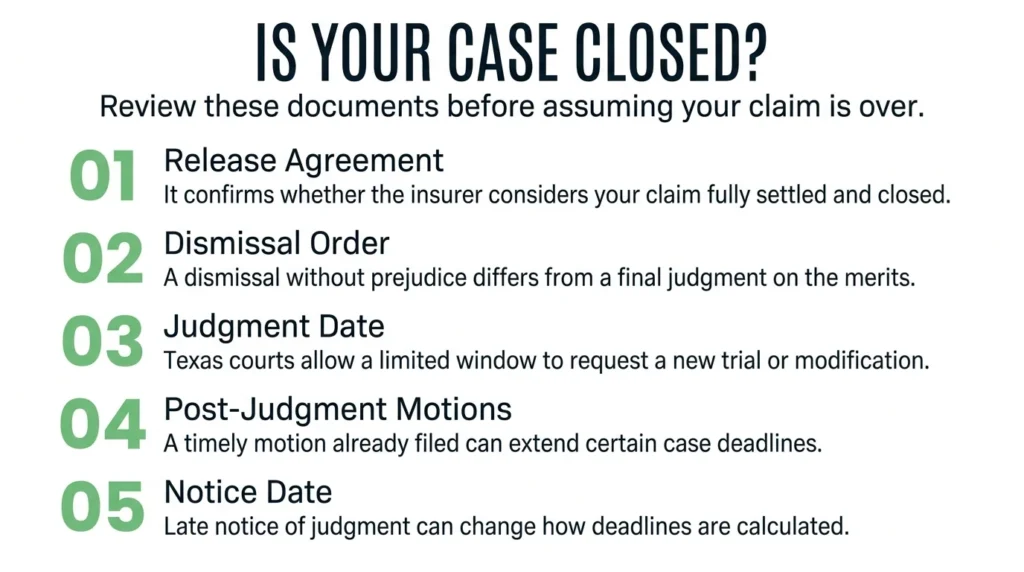
Before you assume there are no options left, you should take a look at the documents that ended your claim. These are the first documents you should review:
- Your release agreement: If you did not sign a release, the insurer may not have fully closed the claim.
- Your dismissal order or judgment: A dismissal without prejudice is not the same as a final judgment on the merits of your case.
- The date the judgment was signed: Texas courts allow only a limited period of time to request a new trial or ask the court to modify its judgment.
- Any post-judgment motion that has already been filed: A timely motion can extend certain deadlines.
- When you received notice of the judgment: Late notice can affect how some deadlines are calculated.
These details can mean the difference between a fully closed case and a case that still has a narrow procedural option.
What Reopening a Case Usually Means
When people ask whether they can reopen a personal injury case, they are often talking about two different situations. The first is a settlement. The second is a court judgment. In both situations, your options are usually limited.
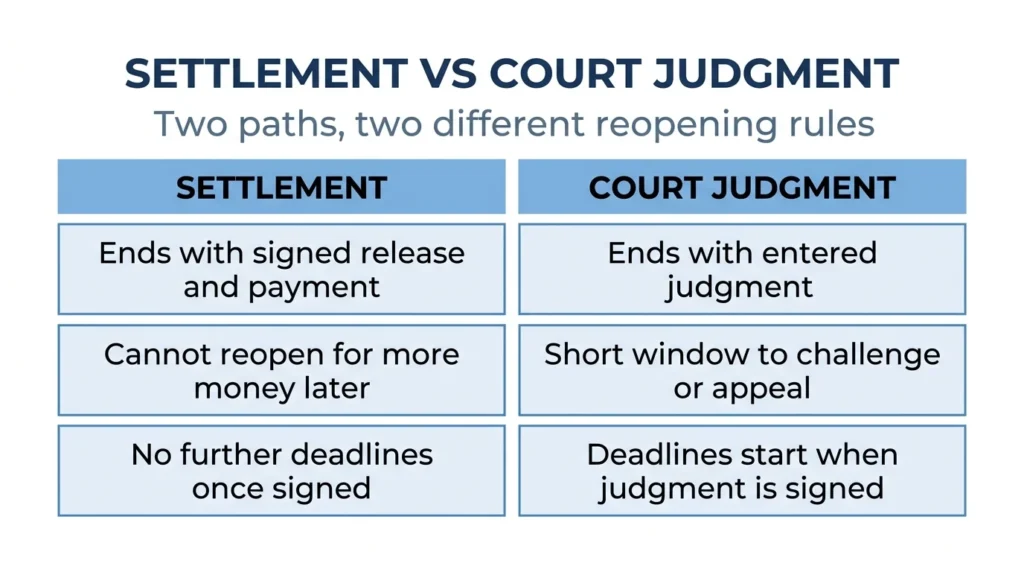
If you settled your case and signed a release, you usually cannot reopen it later for more money just because your injury turned out to be more serious than you expected. That is why a good legal team will focus on your future medical care, lost income, and long-term effects before you agree to settle.
If your case went to court, the rules are different, but the window is still short. In many cases, you may have limited time to file a motion for a new trial, ask the court to modify the judgment, or pursue an appeal. Once these deadlines expire, reopening the case becomes much harder.
Texas also gives you a general two-year deadline to file most personal injury lawsuits under Texas Civil Practice and Remedies Code § 16.003. That filing deadline is separate from the issue of reopening a case that has already been resolved. In some situations, § 16.001 can pause the limitations period for a person who is under 18 or of unsound mind when the claim accrues.
Why the First Case Value Is So Important
If you want to protect yourself, the best step is to make sure that your first claim includes the full cost of your injury. A quick settlement may look beneficial at first, but it can leave you paying for future losses on your own.
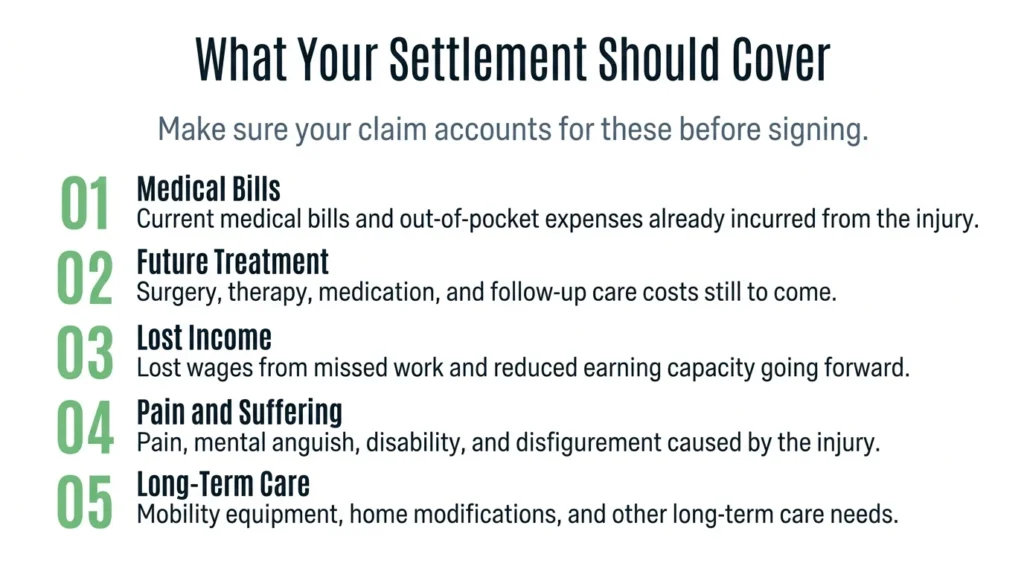
Before you accept any settlement, you should make sure the claim accounts for:
- Current medical bills and out-of-pocket expenses
- Future treatment costs, including surgery, therapy, medication, and follow-up care
- Lost wages from missed work
- Reduced earning capacity if you cannot return to the same type of work or hours
- Pain, mental anguish, disability, and disfigurement
- Long-term care needs, such as mobility equipment or home modifications
This is why a thorough case review is critical. Once you sign a release, your leverage in this department usually disappears.
You can learn more about how claims are built on our personal injury page. You may also find it helpful to read what qualifies as a personal injury case and how long a personal injury case can take in Texas. To see how injury severity, treatment, and liability can affect the value of your claim, review our case results.
Talk to Us Before You Give Up Your Rights
If you are wondering whether your case can be reopened, the better question may be whether your claim was closed and valued the right way to begin with. In some situations, you may still have a narrow window to act. In others, the real issue is whether you are about to sign away your rights before you understand the full impact of your injury.
At Angel Reyes & Associates, we offer free initial consultations, and you pay no fee unless we win. If you want us to review your release, dismissal, or judgment, contact us through our injury case review page.
Reopening a Claim FAQs
Can I reopen a personal injury case because my injuries turned out to be worse than expected after I settled?
Usually, no. If you signed a settlement release and accepted payment, Texas law will usually treat the claim as finished even if your condition gets worse later on.
What if I never received notice that the court signed the judgment in my case?
In some situations, late notice can affect when certain post-judgment deadlines are set, which is why the date you actually learned about the judgment may be important.
Is there any way to challenge a final judgment after the normal deadlines have already passed?
Sometimes, but only in specific circumstances. Texas courts allow limited ways to challenge a final judgment after normal deadlines pass, but those options are treated as exceptional, rather than routine.
Does the rule for minors or people of unsound mind let them reopen a case that was already settled?
Not automatically. Under Texas law, tolling can extend the time to file a claim in the first place, but it does not reopen or undo a settlement or final judgment.
How fast do post-judgment deadlines happen if I want the court to change the result?
Very fast. In many Texas cases, the deadline to seek a new trial or ask the court to modify the judgment is set as soon as the judgment is signed, so waiting even a few weeks can be risky.
About the Authors

Alex Ivanov
Writer
Alex Ivanov is a personal injury attorney at Angel Reyes & Associates, focused on car, truck, and motorcycle accident cases. Licensed in Texas and multiple federal districts, Alex brings international legal experience and a global education to his practice. He earned his LL.M. from Texas A&M University School of Law after graduating from Belarussian State University in 2016. Alex is fluent in Russian, English, Ukrainian, and Belarussian, and is recognized by multiple national trial lawyer associations for his results and leadership under 40.

Kyle Nicolas
Editor
Kyle Nicolas is the Web Content & SEO Manager at Angel Reyes & Associates. He has more than 10 years of experience as a marketing co...

Angel Reyes
Reviewer
Angel L. Reyes, III is the Founder and Managing Partner of Angel Reyes & Associates. A nationally recognized trial attorney and business...