How Does Axle Weight Affect a Truck Crash?


Every article on this site is researched by our internal team, reviewed for legal accuracy against current Texas law, and held to State Bar of Texas advertising standards before publication. We do not publish content that overstates outcomes or makes promises about results.
Learn more about our
editorial standards .
Key Takeaways
- Texas caps a single axle at 20,000 pounds and a tandem axle at 34,000 pounds.
- Sliding the trailer tandems shifts weight between axles without unloading freight.
- Weight tickets and axle-position records sit on short federal retention clocks.

You are driving on I-35 when a tractor-trailer swerves into your lane. Nothing at the scene shows how the freight was distributed or how much weight each axle was carrying.
Axle weight affects how much a truck can legally haul and how it brakes, steers, and handles on the road. A truck may have a clean scale ticket even when the position of its axles or cargo has changed how it responds.
After a crash, weight tickets, loading records, and axle-position records can help show how the truck’s weight was distributed before impact.
How Texas Axle Weight Limits Work
Texas does not cap a truck at one number. Texas Transportation Code Sec. 621.101 sets the fixed limits, while a formula determines the maximum weight allowed for certain axle groups.
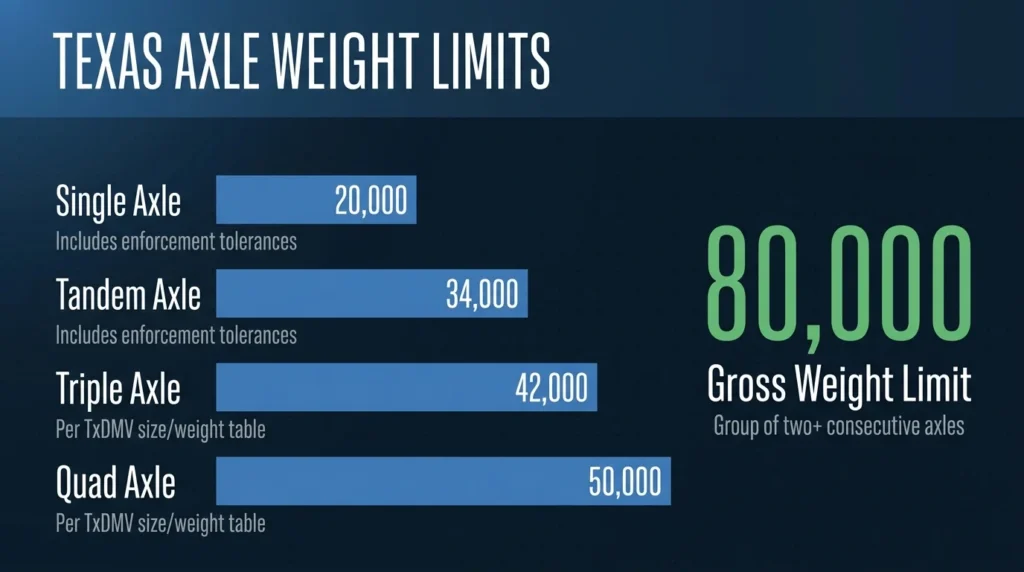
The statute states that these limits include all enforcement tolerances:
- Single axle: not heavier than 20,000 pounds
- Tandem axle: not heavier than 34,000 pounds
- Gross weight on a group of two or more consecutive axles: not more than 80,000 pounds
Two consecutive sets of tandem axles may each carry up to 34,000 pounds when the distance between the first and last axles of those sets is 36 feet or more.
Everything between those fixed numbers is calculated using the federal bridge formula, W = 500 [ LN/(N-1) + 12N + 36 ], rounded to the nearest 500 pounds. In FHWA’s Bridge Formula Weights publication, W is the maximum gross weight on a group of consecutive axles, L is the distance in feet between the outer axles, and N is the number of axles.
Congress adopted it in 1975 to protect bridges, on the premise that axle spacing is as important as axle weight.
The legal limit depends on how many axles a truck has and how far apart they sit, so moving the axles changes what the truck may legally carry.
TxDMV’s size and weight table also lists a 42,000-pound limit for a triple axle group and a 50,000-pound limit for a quad axle group. Axles within a group must be at least 40 inches apart.
The word “tolerance” appears in two other contexts, and neither one is a statutory cap. One is field enforcement practice. The other is a purchased TxDMV over axle and over gross tolerance permit, which does not apply on the Interstate Highway System.
In a Texas truck accident case, the investigation may also examine how the weight was distributed across the axles.
How Truck Axle Configuration Affects Weight Distribution
A modern trailer may use adjustable axles to change how its weight is distributed. A tandem axle group consists of two axles positioned close together to share a load. On many semitrailers, the tandem group sits on a slider that locks into a rail at set pin positions.
Sliding the tandems changes the distance between the kingpin and the trailer axles, which in turn changes how the load is shared between the tractor’s drive axles and the trailer’s axles. Sliding rearward generally shifts weight from the drives to the trailer tandems. Sliding forward does the reverse.
Sliding the tandems does not change gross weight at all. Nothing leaves the trailer, and only the distribution changes.
The bridge formula considers both axle spacing and axle count, so moving the tandems can also change the weight allowed on an axle group. Lift and auxiliary axles work on the same principle, since more axles and a wider spread raise the ceiling.
A lift axle contributes only when it is lowered and carrying weight. When raised, it carries no weight and provides no braking effort at the road surface. 49 CFR 393.42 generally requires brakes to act on all wheels, subject to specific exceptions.
49 CFR 393.207 sets the federal condition standards for this equipment:
- Axles, 393.207(a): no axle positioning part may be cracked, broken, loose, or missing, and all axles must be in proper alignment
- Adjustable axles, 393.207(b): locking pins may not be missing or disengaged
- Air suspensions: the regulator valve must not admit air into the suspension until at least 55 psi is in the braking system, the vehicle must sit level rather than tilting left or right, and leakage may not exceed 3 psi in 5 minutes at normal operating pressure
- Exhaust controls: the full text of the section restricts controls that selectively exhaust air from one axle of a two-axle air-suspension trailer, the closest the federal rules come to addressing air dumped to move weight between axles
An unpinned slider can move in service, and a slider that shifts under hard braking relocates load in the middle of an emergency maneuver.
How Weight Distribution Changes Braking & Stability
Where the load sits across the axles decides how much braking work each axle can do and how the combination behaves in a swerve or a curve. Start with the standard the tractor was certified against.
FMVSS No. 121 is the federal air brake standard. Its loaded test condition under S5.3.1.1(a) requires the vehicle to be loaded to its GVWR, so that the load on each axle is as nearly proportional as possible to its respective GAWR.
This requirement describes the conditions used to test and certify the vehicle’s stopping performance. It does not show how the weight was distributed during a particular crash.
When the weight distribution changes, the truck is no longer operating under the same conditions used for the certification test. Axles carrying less weight may have less traction available for braking, while more heavily loaded axles carry a greater share of the braking demand. Sliding the tandems can change that distribution while the truck’s total weight stays the same.
Federal law also treats distribution as its own duty. 49 CFR 392.9(a) bars a driver from operating, and a carrier from requiring or permitting a driver to operate, a commercial motor vehicle unless the cargo is properly distributed and adequately secured.
49 CFR 393.100 also addresses cargo shifting. Cargo must be contained, immobilized, or secured to prevent shifting to an extent that the vehicle’s stability or maneuverability is adversely affected.
So a truck can sit under every posted weight number and still handle differently from how it was certified to handle. Records showing where the weight sat may therefore be relevant in rollover truck accidents in Texas and other loss-of-control crashes.
When Axle Weight Becomes a Contributing Cause
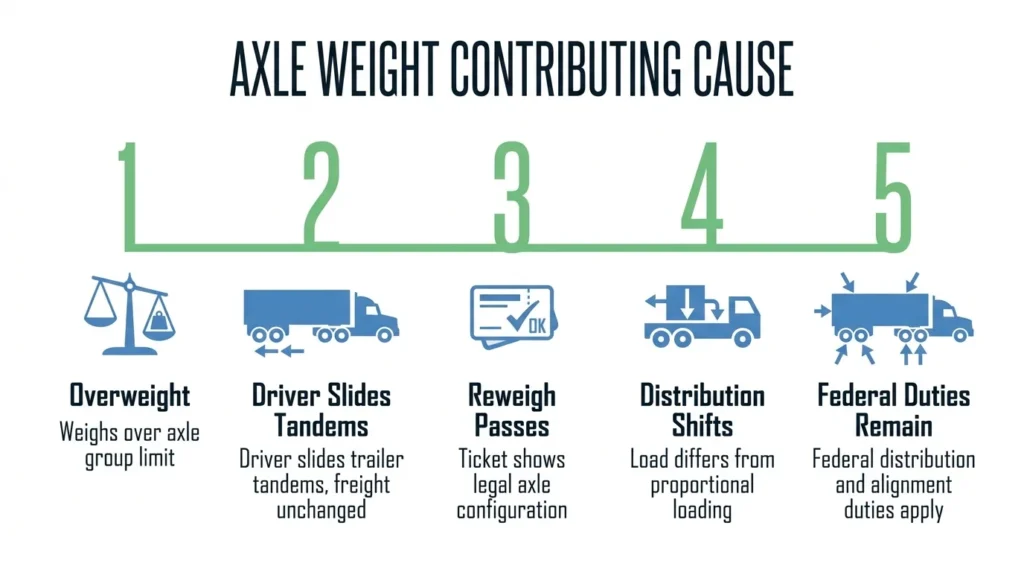
A clean scale ticket is evidence of one thing only, which is the weight recorded at that scale at that moment. The following sequence shows how axle weight can become a contributing cause. Evidence in a particular case can prove or disprove each step.
1. The loaded combination weighs in over the limit on an axle group. Sec. 621.101 and the bridge formula define the violation.
2. Instead of removing or rearranging freight, the driver slides the trailer tandems. Nothing comes off the trailer.
3. The reweigh clears, and the ticket shows a legal configuration.
4. The distribution is now different from the one that produced the first ticket, and different from the proportional loading FMVSS 121 assumes.
5. Independent federal duties stay live regardless of the ticket: proper distribution under 392.9(a), no shifting that adversely affects stability or maneuverability under 393.100, slider pins present and engaged under 393.207(b), and axles in proper alignment with no loose or missing positioning parts under 393.207(a).
The person or company that loaded the truck may also be responsible. Texas Transportation Code Sec. 621.503 provides that a person may not load, or cause to be loaded, a vehicle for highway operation in excess of the Sec. 621.101 limits. Intent to violate is presumed when the loaded vehicle is 15 percent or more over the applicable axle or gross limit, and Texas DPS restates that loading prohibition in its enforcement guidance.
Sec. 621.506 makes both operating and loading an offense. Fines scale with the pounds of excess weight, with enhanced penalties for repeat offenses and for operating above 84,000 pounds with a load that can reasonably be dismantled.
These provisions can apply to a shipper or loading facility that overloaded the vehicle. Cargo loading practices may also be relevant in shifting cargo truck accidents.
Weight Tickets and Axle-Position Records

Records can help show where the truck’s weight was distributed. Federal rules determine how long those records must be kept. 49 CFR Part 379, Appendix A sets the retention schedule:
- Records, reports, orders, and tickets pertaining to the weighing of freight: 3 years
- Loading and unloading records, and freight diversion or reconsignment documentation: 2 years
- Bills of lading, shipping orders and tickets, freight waybills, paid freight bills, and delivery and arrival records: 1 year
- Unsettled freight bills and supporting papers: 1 year after disposition
The vehicle side runs on 49 CFR 396.3. Carriers must systematically inspect, repair, and maintain every vehicle under their control, including the frames, suspension systems, axles, wheels, and steering systems.
Subsection (b) requires records identifying the vehicle, its inspection and maintenance schedule and due dates, and documentation of what was inspected and repaired. Those records stay where the vehicle is housed for 1 year, and for 6 months after it leaves the carrier’s control.
Axle position can be reconstructed using scale and weight tickets, shipping and loading paperwork, and the carrier’s suspension and axle maintenance records.
Records with a one-year retention period may be unavailable by the time a claim develops. An early preservation demand can help prevent those documents from being discarded.
Talk to an Accident Lawyer About Your Case
Some of the records used to evaluate axle weight and position are kept for only one year. Requesting weight tickets, scale receipts, and axle records soon after a crash can reduce the risk of them being discarded.
Angel Reyes & Associates has guided injured Texans through the legal process for more than 30 years. Our Texas truck accident attorneys work from offices across the state and are reachable 24/7. Se habla español, and most cases can be handled remotely.
The initial consultation is free and gives you an opportunity to discuss the records that may be needed for your claim.
Contact Angel Reyes & Associates to have a lawyer review your situation.
Every case is different. Past results do not guarantee future outcomes.
Texas Axle Weight FAQs
Can a truck in Texas legally exceed the 80,000-pound gross weight limit?
Yes, in limited circumstances. TxDMV issues an annual over-axle and over-gross-weight tolerance permit that allows a divisible load to exceed the maximum allowable axle weight by 10 percent and the allowable gross weight by 5 percent. The permit is issued under Transportation Code Sec. 623.011 and 43 Texas Administrative Code Sec. 219.30, and applicants must keep a $15,000 tolerance permit bond or an irrevocable letter of credit on file with TxDMV. The permit does not cover the Interstate Highway System. It applies to county roads and state-maintained roadways in selected counties, with a narrow carve-out for certain U.S. routes and for Texas SH 44 where it was designated as Interstate 69 and prior permit authority was preserved. A permit is a separate mechanism from the Sec. 621.101 caps, which are stated as including all enforcement tolerances.
Who is allowed to weigh a commercial truck in Texas, and where?
Weight enforcement officers, the highway patrol, sheriffs, and certified municipal police officers may all weigh a commercial vehicle, according to Texas DPS Commercial Vehicle Enforcement. They may use portable or stationary scales that are furnished or approved by the Department. If the vehicle needs to be weighed elsewhere, the officer may require it to be driven to the nearest available scales.
How often does a driver need to recheck the distribution of a load during a trip?
More than once. Under 49 CFR 392.9(b), the driver must assure that the cargo is properly distributed and secured before driving, then inspect the cargo and the securement devices within the first 50 miles after beginning the trip and make any adjustments needed. After that first check, the driver must reexamine the cargo and its securement whenever there is a change of duty status, after every 3 hours of driving, or after 150 miles, whichever comes first. Section 392.9(c) carves out sealed vehicles the driver has been ordered not to open and vehicles loaded in a way that makes inspection impracticable.
Does a natural gas or electric truck get a higher weight limit in Texas?
Slightly. Texas Transportation Code Sec. 621.101 allows a vehicle with a natural gas or electric powertrain to exceed the otherwise applicable weight limits by up to 2,000 pounds, with a maximum gross weight of 82,000 pounds. This is a narrow carve-out tied to the powertrain, not a general increase. The 20,000-pound single axle limit, the 34,000-pound tandem limit, the 80,000-pound gross cap, and the bridge formula still govern every other combination on a Texas highway.
About the Authors

Angel Reyes
Writer
Angel L. Reyes, III is the Founder and Managing Partner of Angel Reyes & Associates. A nationally recognized trial attorney and business leader, Angel has helped over 70,000 injury victims recover more than $1 billion since founding the firm in 1993. Named to the Texas Super Lawyers list annually since 2008, Angel brings Wall Street experience, Ivy League education, and a deep commitment to client advocacy. He is a frequent legal commentator and published author with extensive contributions to legal scholarship, trial strategy, and consumer protection.

Kyle Nicolas
Editor
Kyle Nicolas is the Web Content & SEO Manager at Angel Reyes & Associates. He has more than 10 years of experience as a marketing co...

Angel Reyes
Reviewer
Angel L. Reyes, III is the Founder and Managing Partner of Angel Reyes & Associates. A nationally recognized trial attorney and business...