What Happens If You Get an Infection After Accident Surgery?


Every article on this site is researched by our internal team, reviewed for legal accuracy against current Texas law, and held to State Bar of Texas advertising standards before publication. We do not publish content that overstates outcomes or makes promises about results.
Learn more about our
editorial standards .
Key Takeaways
- A foreseeable infection after accident surgery does not end your claim against the driver.
- Texas breaks the chain only for an unforeseeable new and independent cause.
- A claim against a treating provider follows different deadlines than the driver claim.
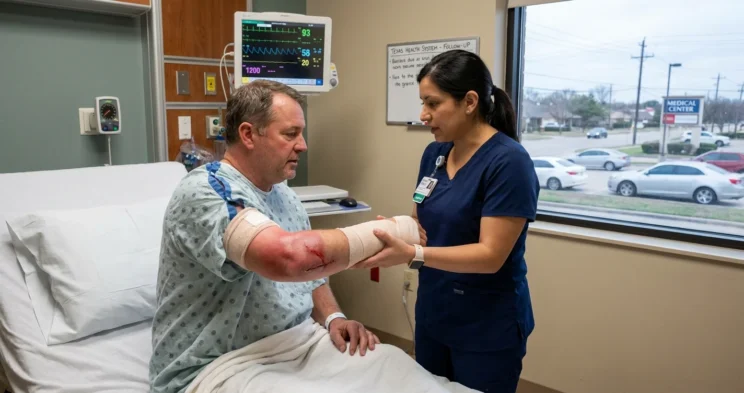
You made it through surgery after the crash and expected recovery to begin. Then the incision turned red and warm, you developed a fever, and the doctor used the word infection.
An infection after accident-related surgery may still be included in your claim against the driver who caused the crash. If a medical provider’s care caused the infection or worsened it, that provider may also share responsibility.
What Counts as a Surgical Site Infection After Accident Surgery
A surgical site infection is an infection in the part of the body where the operation took place, and the CDC treats it as a healthcare-associated infection. Most people who face this question were hurt in a car accident and needed an operation they never planned on.
Federal surveillance standards sort these infections by depth, which are superficial incisional, deep incisional, and organ or space. They track these infections within a 30-day window after surgery, or 90 days for certain procedures, including many that involve implanted hardware.
Those windows help a reviewing expert tie a specific infection back to a specific operation.
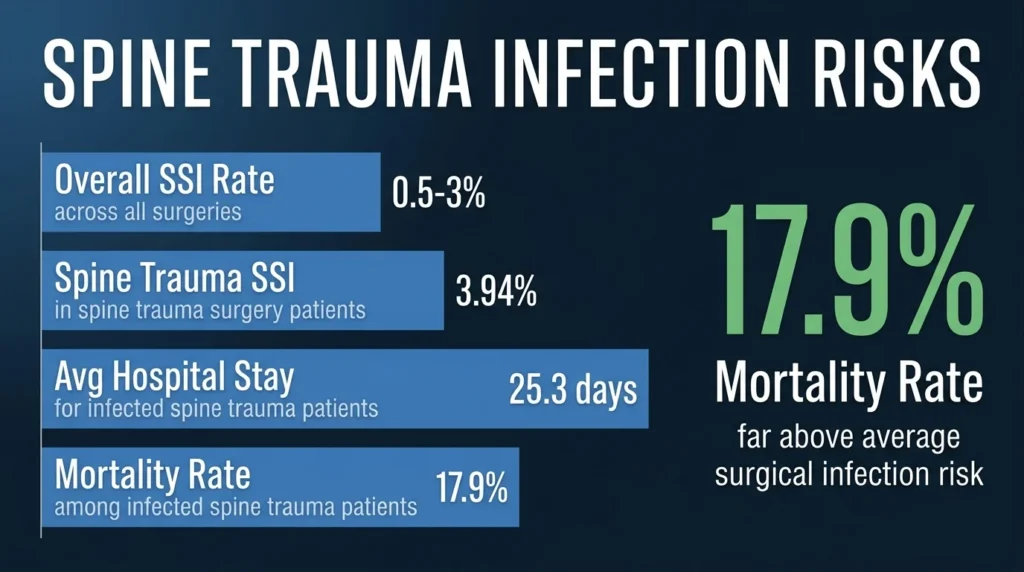
Across all operations, surgical site infections run roughly 0.5% to 3%. Trauma surgery runs higher. In one peer-reviewed study of surgery for spine trauma, 3.94% of patients developed a surgical site infection, and those patients averaged 25.3 days in the hospital, with a 17.9% mortality rate.
Recognized risk factors include:
- Diabetes
- Obesity
- Smoking
- Other chronic health conditions
- Improper hair removal near the incision, such as razor shaving
Having one of these does not mean the infection was inevitable, and it does not mean nothing went wrong. Those figures come from national clinical literature, not Texas-specific data.
How Sepsis Develops After a Traumatic Injury
Sepsis is the body’s overwhelming, organ-damaging response to an infection. A surgical incision is a recognized starting point because opening skin and tissue creates a route for bacteria to reach the bloodstream.
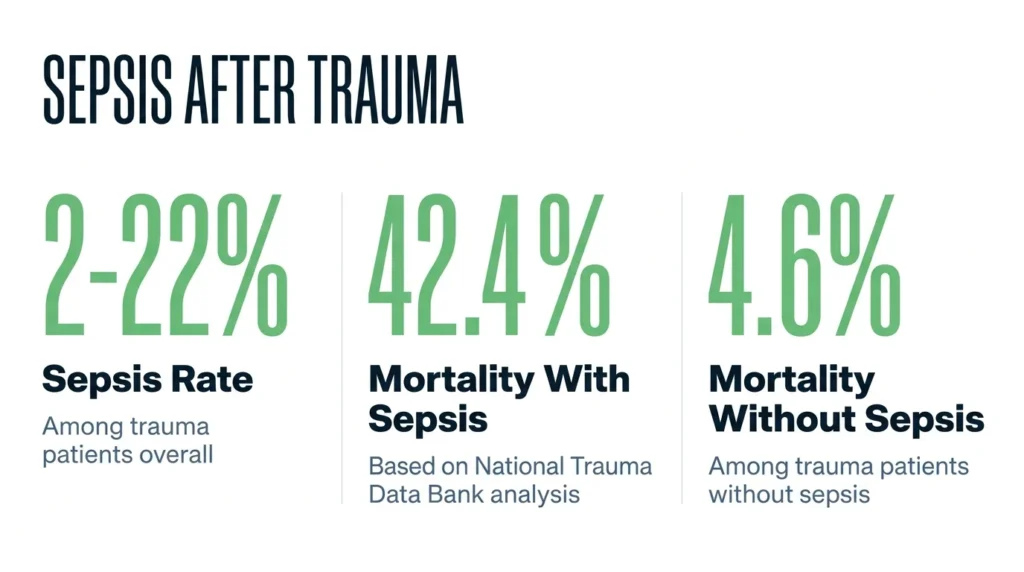
Studies of trauma patients report post-traumatic sepsis rates somewhere between 2% and 22%, depending on the population and how severe the injuries were.
One large National Trauma Data Bank analysis found in-hospital mortality of 42.4% among septic trauma patients, compared with 4.6% among trauma patients without sepsis, along with substantially longer hospital stays.
Reported risk factors for sepsis after injury include:
- Older age
- Male sex
- Greater injury severity
- Early blood transfusion
- Abdominal, pelvic, or lower-extremity trauma
- Diabetes, high blood pressure, COPD, smoking, or anticoagulant use
Treatment for a serious infection may involve additional surgery, medication, and hospitalization, raising questions about who pays medical bills after a car accident. When an infection after an injury causes a death, eligible family members may be able to pursue a wrongful death claim.
Who May Be Responsible for the Infection
Where the infection started determines who pays. Either it began in the wound itself, contaminated at the moment of the crash and carried into surgery, or it began in how that wound was managed afterward.
Under Texas proximate-cause law, a defendant who negligently injures someone is responsible for the harm that injury foreseeably leads to, including the ordinary medical treatment it requires, even when that treatment is imperfect. A wound infection after trauma surgery is a recognized complication.
Responsibility may change when a provider’s separate act or omission causes or worsens the infection. Texas juries may be instructed on new and independent cause, which applies when an unforeseeable intervening event breaks the causal connection to the original negligence. (Texas Pattern Jury Charge 3.1)
Records may show a missed diagnosis, delayed wound cleaning, or an antibiotic choice that did not account for culture results. Courts can examine those decisions to determine whether the care fell below the standard of care.
More than one party may share responsibility. Chapter 33 of the Civil Practice and Remedies Code lets a jury assign percentages of responsibility between the driver and a provider. A provider may also be designated as a responsible third party under Section 33.004 without being named as a defendant.
Severe injuries from truck accidents may involve larger wounds and several procedures, making the infection timeline more complex.
Evidence That Can Trace the Infection
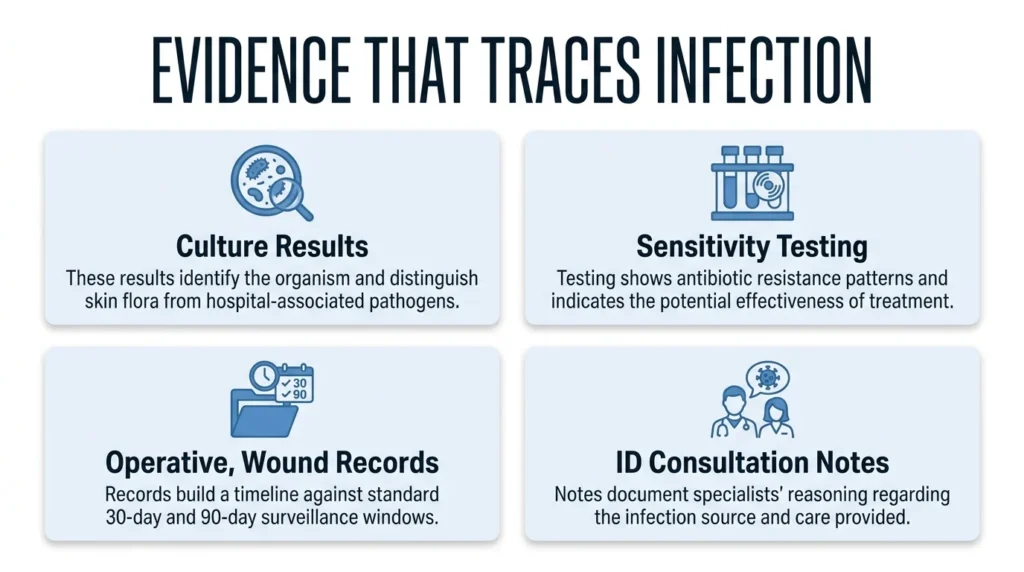
No single document settles where an infection came from. Four categories of records carry the weight, and reviewing experts read them together:
- Culture results identify the organism. Skin and environmental flora suggest contamination at the time of injury. A hospital-associated pathogen points somewhere else.
- Sensitivity testing shows what the organism resists. A resistance pattern can suggest a healthcare-associated source and whether the chosen antibiotic ever had a chance of working.
- Operative and wound care records build the timeline against the 30-day and 90-day surveillance windows and document what was monitored, charted, and actually done.
- Infectious disease consultation notes often include the treating specialists’ reasoning about the likely source and the care delivered at each decision point.
An expert can compare these records to establish the infection timeline and evaluate the care you received. Requesting them early helps preserve a complete medical history.
Why Your Deadline Depends on Who Is Responsible
A claim against the at-fault driver falls under the general Texas personal injury deadline, two years from the date the claim accrues.
A claim against a treating provider is a health care liability claim under Chapter 74, and it runs on a different track. A suit must be filed within two years of the breach, the tort, or the completion of the relevant treatment or hospitalization, with a narrow tolling exception for children under 12. An outer 10-year statute of repose closes the door regardless of when the problem was discovered.
Chapter 74 also requires pre-suit notice to the provider before filing, which extends the limitations period by 75 days as to the provider who received it.
The timeline can become more complicated when treatment includes several operations over several months. This can happen after serious motorcycle accidents and other high-impact crashes.
Responsibility also affects how damages are divided. Under Section 33.013(a), each party generally owes its assigned percentage of the damages. A party found more than 50% responsible may be jointly and severally liable for the full award.
Separate deadlines may apply to claims against the driver and the medical provider, even when both arise from the same injury.
Talk to Angel Reyes & Associates Before the Clock Runs Out
Angel Reyes & Associates has guided injured Texans through complications like these for more than 30 years, with offices across Texas and someone available 24 hours a day.
Bring whatever you already have. If you don’t have copies, we can request the operative report, wound care notes, culture and sensitivity results, and any infectious disease consult on your behalf.
Contact Angel Reyes & Associates for a free consultation. A lawyer can review where your infection likely started, who may share responsibility, and which deadline applies to your situation.
Past results do not guarantee future outcomes.
Surgical Infection Claim FAQs
Can you receive compensation for additional surgery caused by an infection after a car accident?
If an infection requires another operation, you may be able to recover compensation for the additional medical expenses, lost income, and pain associated with that treatment. Under Texas law, recovery depends on establishing that the additional harm resulted from the accident or another party’s negligence.
What happens if a surgical infection causes permanent disability after an accident?
A serious infection may cause lasting nerve damage, reduced mobility, or other complications that prevent you from returning to your previous activities. A Texas personal injury claim may include compensation for future medical care, diminished earning capacity, and physical impairment when supported by the evidence.
Can you file a medical malpractice claim if a hospital fails to diagnose a post-surgical infection?
A delayed diagnosis may support a medical malpractice claim if the hospital or treating provider failed to meet the applicable standard of care and that failure caused additional harm. Under Texas Civil Practice and Remedies Code Section 74.351, these claims generally require a qualified medical expert’s report addressing the provider’s conduct and its connection to the injury.
Does health insurance affect compensation for an infection after accident surgery?
Health insurance may cover treatment for a surgical infection, but your insurer may seek reimbursement from a personal injury settlement under your policy terms and applicable law. Texas law also limits recovery of medical expenses to amounts actually paid or incurred, rather than the full amount originally billed.
Can you still pursue an injury claim if you develop an infection after settling your car accident case?
A signed settlement agreement may release the at-fault driver and other specified parties from liability for complications discovered after the settlement. Whether you can pursue additional compensation depends on the agreement’s language, the parties released, and whether a separate claim against a medical provider remains available.
About the Authors

Angel Reyes
Writer
Angel L. Reyes, III is the Founder and Managing Partner of Angel Reyes & Associates. A nationally recognized trial attorney and business leader, Angel has helped over 70,000 injury victims recover more than $1 billion since founding the firm in 1993. Named to the Texas Super Lawyers list annually since 2008, Angel brings Wall Street experience, Ivy League education, and a deep commitment to client advocacy. He is a frequent legal commentator and published author with extensive contributions to legal scholarship, trial strategy, and consumer protection.

Kyle Nicolas
Editor
Kyle Nicolas is the Web Content & SEO Manager at Angel Reyes & Associates. He has more than 10 years of experience as a marketing co...

Angel Reyes
Reviewer
Angel L. Reyes, III is the Founder and Managing Partner of Angel Reyes & Associates. A nationally recognized trial attorney and business...