Winter Driving Safety Tips for Wet & Icy Texas Roads


Every article on this site is researched by our internal team, reviewed for legal accuracy against current Texas law, and held to State Bar of Texas advertising standards before publication. We do not publish content that overstates outcomes or makes promises about results.
Learn more about our
editorial standards .
Key Takeaways
- NOAA expects a wetter winter in Texas, raising the odds of sleet, freezing rain, and icy roads.
- Slow down, brake gently, and treat every bridge and overpass as icy when temperatures drop.
- Texas law requires drivers to slow down for weather, so ice does not excuse a speed-caused crash.
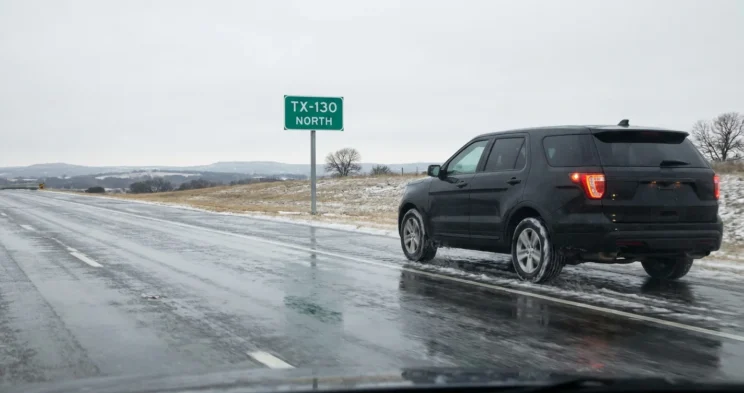
Winter in North Texas rarely means weeks of snow. More often, it brings short bursts of sleet, freezing rain, and ice that can turn I-35E or US-75 slick overnight. These storms arrive only a few times a season, so you get little practice driving on ice before the next one hits.
However, weather forecasters expect a wetter-than-average winter across the southern United States this year. NOAA’s 2026-27 Winter Outlook indicates that the agency expects a very strong El Niño for December through February. El Niño pushes the jet stream south, which will steer more storms toward Texas.
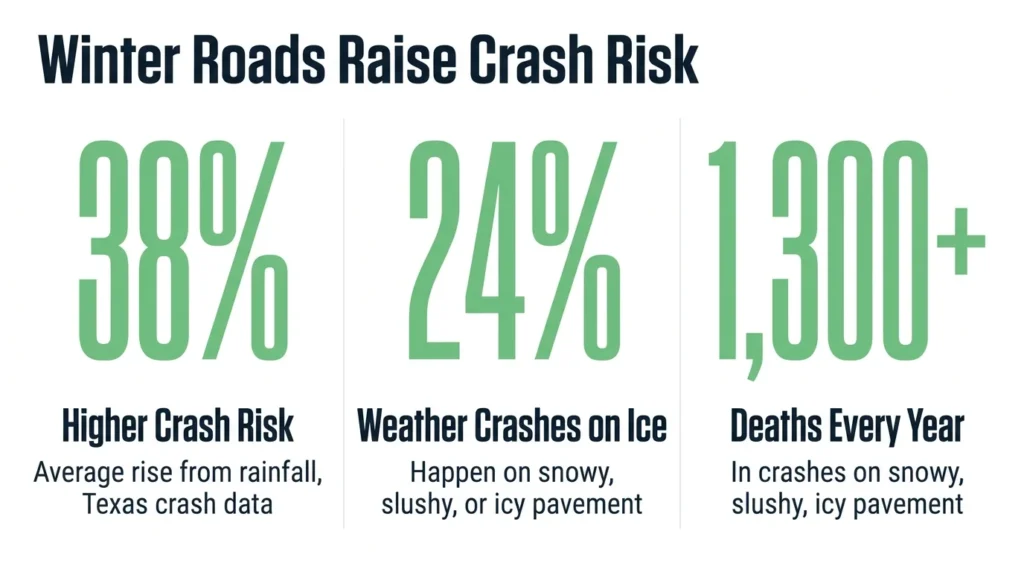
Rain alone raises your crash risk. A study of 16 years of Texas crash data found that rainfall increased the risk of a crash by an average of 38 percent. When precipitation meets a hard freeze, it can fall as sleet, freezing rain, or heavy snow in parts of the state. You may also wake up to roads that look wet but are actually glazed with ice.
You don’t need a record El Niño for ice to be dangerous, though. The Federal Highway Administration reports that 24 percent of weather-related crashes happen on snowy, slushy, or icy pavement. More than 1,300 people die in those crashes every year.
5 Habits That Keep You Safer on Ice
The safest winter drivers do a few simple things well: they slow down, move gently, and expect ice before they see it. Likewise, if a trip can wait until crews treat the roads, the safest drivers let it wait and only go when the roads are safe to navigate again.
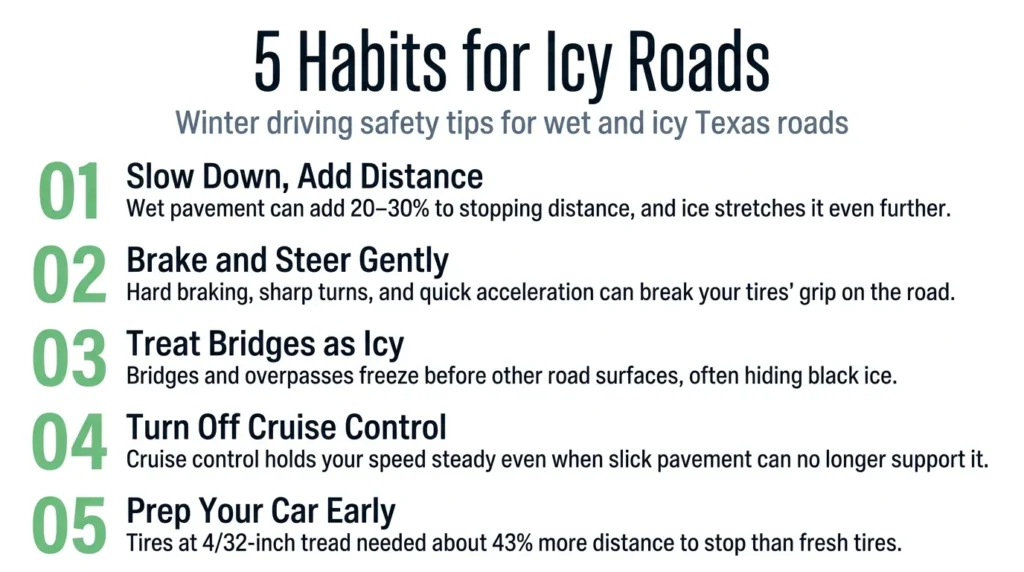
Slow Down & Add Distance
Wet pavement lengthens your stopping distance. A 2008 Danish study estimated that ordinary drivers needed an extra 20-30 percent of additional distance when stopping on wet pavement compared to dry. Ice stretches that figure even further.
When roads are icy or slippery, drive well below the posted limit and leave extra room behind the car ahead. That gap gives you time to brake gently instead of slamming the pedal. Losing traction in an already-slick environment can send your car careening out of control.
Brake & Steer Gently
Your tires grip on the road is arguably the most important factor in slick driving conditions. Hard braking, sharp turns, and quick acceleration can all break your tires’ grip, causing you to lose control. If your car starts to slide, ease off the gas and steer smoothly where you want to go.
With anti-lock brakes, press firmly and hold the pedal rather than pumping it, but do not slam down on the brake pedal. It’s not uncommon to feel that pedal pulsing when your car starts to skid—this is normal, and it’s your brake system compensating to keep traction.
Treat Bridges & Overpasses as Icy
The National Weather Service warns that bridges and overpasses freeze before other road surfaces. Black ice on a bridge often looks like a harmless wet patch, and they can cause you to quickly lose control.
Be mindful of bridges during cold weather. Even if the temperature isn’t below freezing, there may still be frost or ice on a bridge surface. Lift off the gas before you reach the bridge and keep the wheel steady as you cross.
Turn Off Cruise Control
Cruise control holds your speed steady, even when the road can no longer support it. On slick pavement, you need to feel the car and react the moment traction changes. Keep your own foot in charge whenever roads are wet or icy.
Prep Your Car Before the Freeze
Before the weather starts to turn, take an opportunity to prep your car for low-traction conditions. A study conducted by AAA shows that cars driving on 4/32” of tread (the legal limit for what is considered “safe”) needed roughly another 43% more distance to come to a stop safely than a car on fresh tires.
Check your tire tread and pressure, replace streaky wiper blades, and test every light. Pack an emergency kit with a blanket, flashlight, phone charger, water, snacks, and an ice scraper. If an ice storm strands you on the highway, that kit can keep you warm until help arrives.
Bad Weather Doesn’t Excuse Careless Driving
Ice does not let a careless driver off the hook. Texas Transportation Code § 545.351 requires drivers to keep a speed that is reasonable for current conditions, including mandating slowing down when weather or road conditions create a special hazard.
A driver who hits you at full highway speed on a glazed freeway made a choice. Insurers may argue that the weather caused the crash, not their driver. However, Texas law places the onus on all motorists to operate their vehicle safely, and the weather does not excuse a driver from that duty. The same rule applies to truck drivers, delivery vans, and rideshare drivers working through a storm.
What to Do After a Winter Crash
Your first job after a winter crash is safety, and your second is evidence. Check for injuries, call 911, and stay clear of traffic, because other drivers will encounter the same ice that caught you. It’s not uncommon for a single ice patch to catch multiple vehicles in a short span.
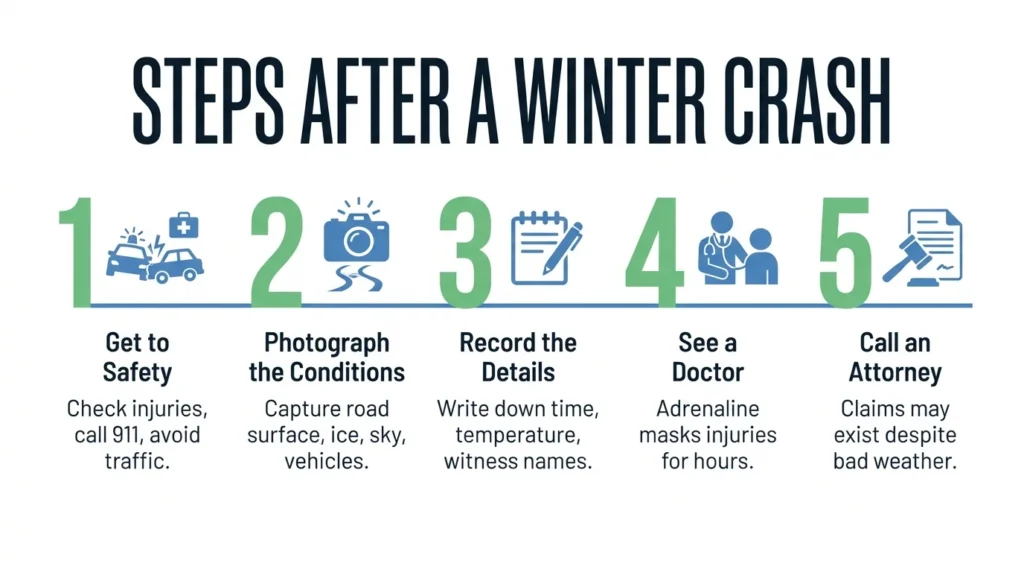
Next, photograph the road and weather conditions before they change. Capture the road surface, any ice or standing water, the sky, and every vehicle involved. Ice can melt within just a few hours above freezing temperatures, especially in direct sunlight. Your photos may be the only proof of what the road looked like.
Write down the time, the temperature if you can see it, and the names of any witnesses. See a doctor even if you feel fine, since adrenaline can hide injuries for hours. A step-by-step checklist for the first hours after a crash walks you through the rest.
If another driver’s choices caused your injuries, you may still have a car accident claim even though the weather played a part. An attorney can review the evidence and tell you where you stand.
Hurt in a Winter Crash? We Can Help
Since 1993, Angel Reyes & Associates has stood up for injured Texans against powerful insurance companies. We have helped more than 70,000 injury victims, with more than $1 billion recovered for clients.
Consultations are free, you pay nothing unless we win, and we are available 24/7 in English and Spanish. Contact us today to talk through your options.
Past results do not guarantee future outcomes.
Slippery Road FAQs
Can I Still Recover Damages If I Was Partly at Fault?
Yes, if you were not more than 50 percent responsible. Under Texas Civil Practice and Remedies Code § 33.001, a claimant more than 50 percent at fault recovers nothing. Otherwise, your damages shrink by your share of fault, so a driver found 20 percent at fault keeps 80 percent.
Can the State or a City Be Blamed for an Icy Bridge?
It’s rare. The Supreme Court of Texas addressed this question in State Department of Highways & Public Transportation v. Kitchen, decided December 8, 1993. The court held that an icy bridge in freezing, wet weather is predictable, not a special defect, which makes these claims hard to win.
If you do have a claim against a government entity, Texas Civil Practice and Remedies Code § 101.101 generally requires written notice within six months. Some city charters set an even shorter deadline.
Will Insurance Pay If I Slid Off the Road Alone?
Your own policy may help through personal injury protection, or PIP. Texas Insurance Code § 1952.152 requires auto liability policies to include PIP unless a named insured rejected it in writing. PIP pays regardless of fault, which matters after a single-car crash with no other driver to blame.
Should I Move My Car After a Minor Freeway Crash?
If no one is hurt and every car can be driven safely, yes. For damage-only crashes on metro-area freeways, Texas Transportation Code § 550.022 requires drivers to move to a frontage road, cross street, or other safe spot.
If your car can’t move, stay buckled inside with your hazard lights on rather than standing near traffic.
Can Roads Be Icy When My Car Reads Above 32?
Yes. Your dashboard measures the air, but pavement can stay colder than the air after a cold night. Shaded stretches and low spots often hold black ice longest, especially in the early morning.
About the Authors

Angel Reyes
Writer
Angel L. Reyes, III is the Founder and Managing Partner of Angel Reyes & Associates. A nationally recognized trial attorney and business leader, Angel founded the firm in 1993, which has gone on to help over 70,000 injury victims recover more than $1 billion. Named to the Texas Super Lawyers list annually since 2008, Angel brings Wall Street experience, Ivy League education, and a deep commitment to client advocacy. He is a frequent legal commentator and published author with extensive contributions to legal scholarship, trial strategy, and consumer protection.

Kyle Nicolas
Editor
Kyle Nicolas is the Web Content & SEO Manager at Angel Reyes & Associates. He has more than 10 years of experience as a marketing co...

Angel Reyes
Reviewer
Angel L. Reyes, III is the Founder and Managing Partner of Angel Reyes & Associates. A nationally recognized trial attorney and business...