What Burn Injuries Happen in Car Crashes?


Every article on this site is researched by our internal team, reviewed for legal accuracy against current Texas law, and held to State Bar of Texas advertising standards before publication. We do not publish content that overstates outcomes or makes promises about results.
Learn more about our
editorial standards .
Key Takeaways
- Depth and body surface area measure different things, and the burn unit chart documents both.
- Texas law treats scarring and substantial lost function as distinct, fact-specific damages.
- A car fire alone does not prove a defect. A qualified investigation must trace its cause.
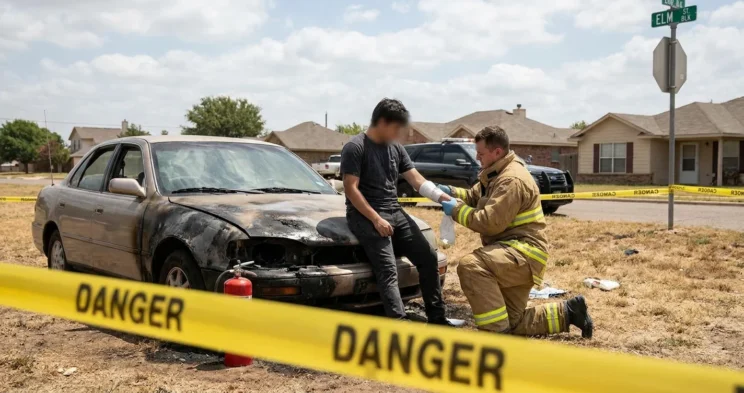
A burn injury from a car accident can involve heat, chemicals, electricity, or friction. If you are recovering from a crash, unfamiliar terms such as “partial thickness” or “graft” can make your treatment hard to follow. A vehicle fire can also injure the airways and lungs. Doctors classify each burn by how deep it goes and how much of the body it covers.
Those measurements guide treatment and help document scarring and lost function for a Texas claim. The fire’s cause determines who should be investigated.
What Kinds of Burns Can a Car Crash Cause?
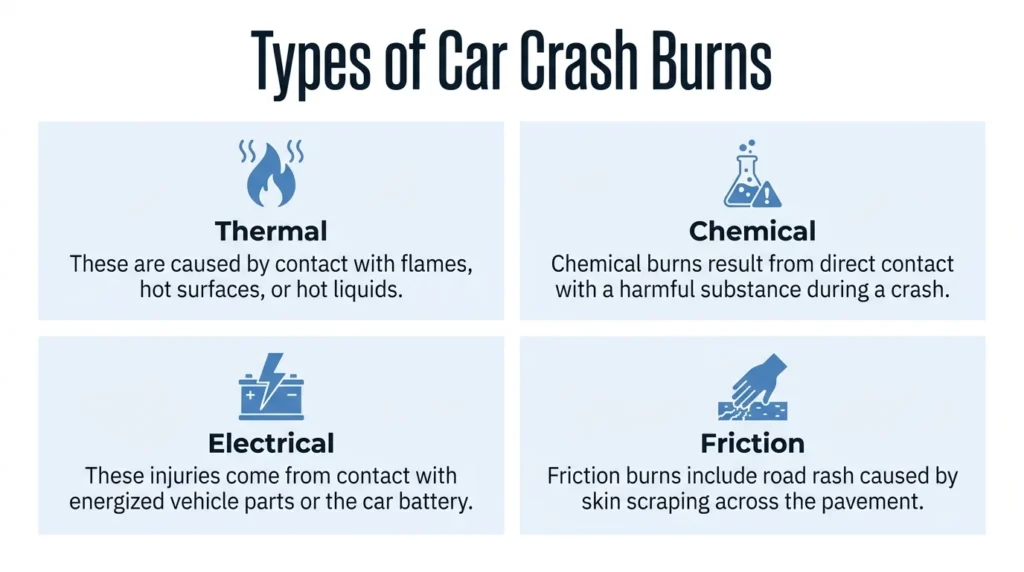
Burns from a car accident can be thermal, chemical, electrical, or friction injuries. Your exposure history and medical findings show which types apply to you.
Thermal burns come from flames, hot surfaces, or hot liquids. Chemical burns come from contact with a harmful substance. Electrical burns can come from contact with energized parts, including an automobile battery. Friction burns include road rash, when skin scrapes across pavement.
A vehicle fire adds another risk. Smoke and hot gases can damage the airways and lungs. Breathing problems after a fire deserve medical attention even without visible burns.
The type of burn describes its cause, not its severity. A friction burn and a flame burn can each be shallow or deep.
Electric vehicles carry a specific caution. NHTSA warns that a damaged high-voltage battery can release toxic or flammable gases and start a fire right away or later, and exposed parts may stay energized. Call emergency services for any fire and leave damaged electrical systems to trained professionals.
If you’re sorting out a crash claim more broadly, the right lawyer will explain the wider process.
How Do Doctors Describe Burn Depth & Extent?
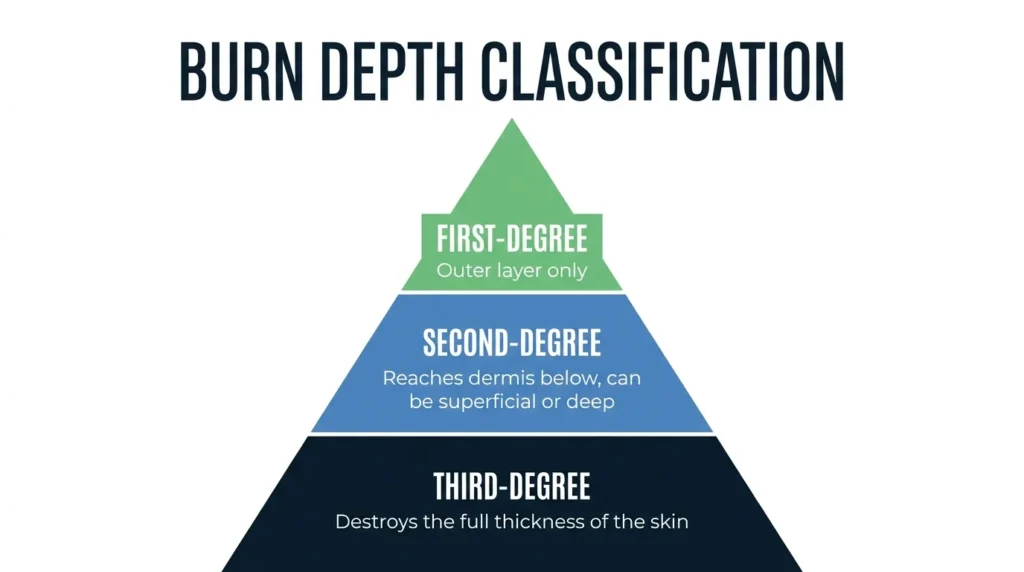
Doctors describe a burn in two ways. The first is depth, meaning how many skin layers it reaches, and the second is extent, meaning the share of the body it covers. Neither measure alone predicts your financial recovery or settles what a claim is worth.
First-degree, or superficial, burns affect only the epidermis, the outer layer of skin. Second-degree, or partial-thickness, burns reach into the dermis below and can be superficial or deep. Third-degree, or full-thickness, burns destroy the full thickness of the skin.
Doctors measure extent as total body surface area, or TBSA. Under American Burn Association referral guidelines, clinicians leave superficial burns out of the TBSA count and include partial- and full-thickness burns. They estimate the percentage with tools such as the Rule of Nines for adults and use different proportions for children.
Your burn team documents the clinical estimate in its chart and body diagrams.
A small percentage does not make a burn minor. The ABA recommends immediate consultation, with consideration of transfer to a burn center, for full-thickness burns, partial-thickness burns covering at least 10% TBSA, deep burns to the face, hands, feet, or joints, and suspected inhalation injury. A deep burn across your palm can matter a great deal even at a low percentage.
Photographs help in a different way. They show how the injury looks and changes over time. The clinical chart, not a photo, establishes depth and extent.
What Treatment & Lasting Effects Can Follow a Deep Burn?
Deep burns may need skin grafts, and healing scars can tighten into contractures that limit movement. Your own medical course, not a general rule, determines which treatments you need and which effects last.
A skin graft covers a burned area with skin from a donor site. An autograft uses your own skin, so the procedure also creates a second wound called the donor site. The care team chooses a graft based on the wound and its location. Some deep injuries need surgery, but a second-degree label does not by itself mean you need a graft.
A contracture forms when scarring across a joint pulls tight and restricts motion. It can make walking, dressing, grooming, or using your hands harder. Scar rehabilitation may include therapist-guided stretching, splints, and scar treatment, and some people need surgery. No single approach fits everyone.
Your records tell your actual treatment story. Operative notes, donor site records, therapy evaluations, and your treating providers’ opinions document what happened and what future care may look like.
How Can Texas Law Account for Scarring & Lost Function?
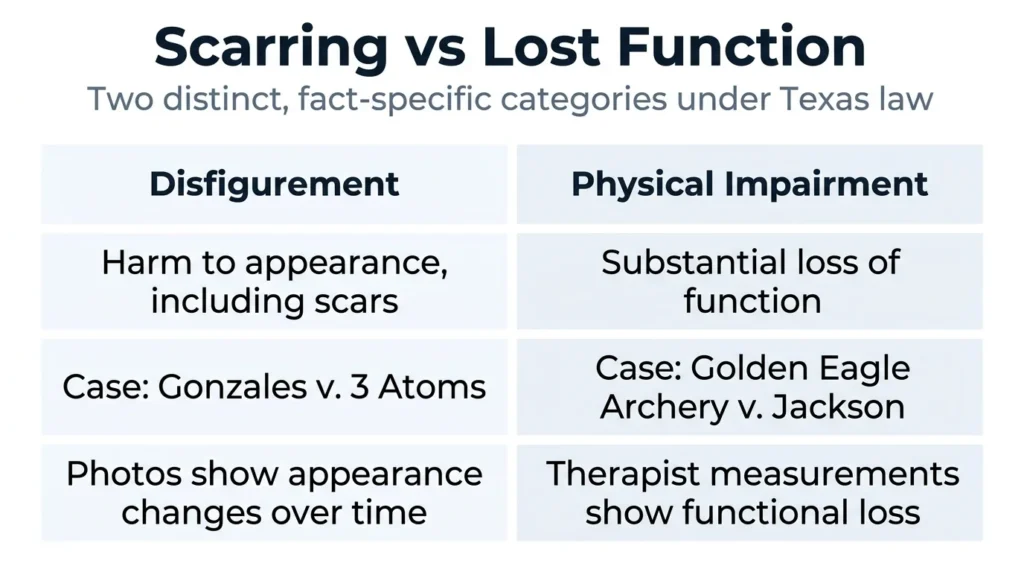
Texas law treats disfigurement, which is harm to appearance, separately from physical impairment, which is a substantial loss of function. Both are fact-specific questions, and the law does not pay twice for the same loss.
Disfigurement & Visible Scarring
Disfigurement covers changes to how you look, including surgical scars. In Gonzales v. 3 Atoms, a Texas appeals court explained that future disfigurement does not require new scarring later, and that embarrassment can be relevant without being required. The same court still upheld that jury’s decision not to award future damages on the evidence it heard.
That outcome shows a real limit. A scar does not automatically produce a particular award. Dated photographs of your scars and graft sites, taken over months, help show how your appearance has changed.
Physical Impairment & Daily Life
Physical impairment addresses losses beyond pain, mental anguish, lost wages, or reduced earning capacity. In Golden Eagle Archery v. Jackson, the Texas Supreme Court held that the impairment must have a substantial effect beyond those other categories. Loss of enjoyment of life can be relevant.
A diagnosis, hospital stay, or painful task does not alone establish a separate impairment award. Stronger proof comes from therapist measurements of your range of motion and specific before-and-after details, such as no longer gripping tools or lifting your child.
Medical bills, lost work, and anticipated care belong in their own records. A graft or photo alone does not prove a permanent condition. Your treating providers’ opinions support any claim about future effects.
What Evidence Shows Who Caused a Crash-Related Fire?
What caused the collision and what caused the fire are two separate questions. The answers may point to a driver, a vehicle or component maker, or someone who repaired or modified the vehicle. A fire alone does not prove a defect or identify who is responsible.
How Texas Product Law Applies to a Car Fire Burn Injury Claim
When evidence suggests a defect caused or worsened a fire, Texas Civil Practice and Remedies Code Chapter 82 governs product claims against manufacturers and sellers. For a design defect claim, § 82.005 requires the injured person to prove, by a preponderance of the evidence:
- A safer alternative design existed that would probably have prevented or significantly reduced the risk of injury without substantially impairing the product’s usefulness.
- That design was economically and technologically feasible when the product left the defendant’s control.
- The defect was a producing cause of the injury.
These elements apply to design defect theories specifically. Section 82.003 generally protects sellers who did not make the product unless a statutory exception applies, so a dealership is not automatically liable.
Section 82.008 can create a presumption, which the injured person may challenge, for certain allegations when a product met applicable federal safety standards. That presumption does not cover manufacturing flaws.
Driver conduct, defects, and repair errors can overlap. Each possible defendant is a line of investigation, not a conclusion.
Evidence to Preserve After a Vehicle Fire
Records help connect your injuries to the fire’s cause. These steps help preserve that evidence:
- Keep burn unit records, depth assessments, body diagrams, and TBSA documentation.
- Save operative, graft, donor site, and therapy records, plus your providers’ opinions.
- Keep original, dated photographs of your injuries over time.
- Collect crash and fire reports, scene photos, and witness information.
- Gather maintenance history and any available vehicle data.
- Arrange for appropriate professionals to preserve the vehicle and its components.
Never handle a damaged high-voltage battery to gather evidence. A qualified fire investigation should examine where the fire started, what ignited it, and how the collision, fire, and injury connect.
Talk With Angel Reyes & Associates About a Burn Injury Claim
Recovering from a serious burn takes time, and you shouldn’t have to sort through medical records and fire reports alone. Angel Reyes & Associates has guided injured Texans for over 30 years. Our team includes investigators and accident reconstruction specialists who can help examine what the crash and fire evidence shows.
Request a free consultation to talk through your burn injury, your treatment records, and your options. You can reach us 24/7.
Past results do not guarantee future outcomes.
Burn Injuries From Car Crashes FAQs
Can a car accident cause nerve damage even if the burn looks small?
Yes. Deep burns can damage nerves, causing numbness, tingling, or changes in sensation around the injured area. A medical evaluation can help determine whether nerve damage is present and whether additional treatment or rehabilitation is needed.
Can a burn injury from a car accident become infected weeks after the crash?
Yes. Burn wounds and skin graft donor sites can develop infections during recovery, particularly when the skin barrier has not fully healed. Signs such as increasing redness, swelling, drainage, fever, or worsening pain warrant prompt medical attention.
Can a passenger file a burn injury claim if a vehicle catches fire after a collision?
Yes. An injured passenger may have a claim against a negligent driver or another responsible party, even if the passenger did nothing to cause the crash. Depending on the evidence, a vehicle manufacturer or repair provider may also be responsible if a defect or improper repair contributed to the fire.
Can a vehicle manufacturer be liable if a car fire makes crash injuries worse?
Yes. Under Texas product liability law, a manufacturer may be responsible if a defective vehicle or component was a producing cause of the burn injuries. Liability can involve a defect that caused the fire or one that made the resulting injuries more severe.
What happens if multiple parties contributed to a car accident fire in Texas?
More than one party may share legal responsibility, including drivers, manufacturers, and repair providers. Texas proportionate responsibility rules generally determine how fault is allocated among responsible parties and can affect the amount of compensation an injured person may recover.
About the Authors

Angel Reyes
Writer
Angel L. Reyes, III is the Founder and Managing Partner of Angel Reyes & Associates. A nationally recognized trial attorney and business leader, Angel founded the firm in 1993, which has gone on to help over 70,000 injury victims recover more than $1 billion. Named to the Texas Super Lawyers list annually since 2008, Angel brings Wall Street experience, Ivy League education, and a deep commitment to client advocacy. He is a frequent legal commentator and published author with extensive contributions to legal scholarship, trial strategy, and consumer protection.

Kyle Nicolas
Editor
Kyle Nicolas is the Web Content & SEO Manager at Angel Reyes & Associates. He has more than 10 years of experience as a marketing co...

Angel Reyes
Reviewer
Angel L. Reyes, III is the Founder and Managing Partner of Angel Reyes & Associates. A nationally recognized trial attorney and business...