How Is a Spinal Cord Injury Case Valued?


Every article on this site is researched by our internal team, reviewed for legal accuracy against current Texas law, and held to State Bar of Texas advertising standards before publication. We do not publish content that overstates outcomes or makes promises about results.
Learn more about our
editorial standards .
Key Takeaways
- Document injury effects and losses to support a Texas spinal cord injury valuation.
- Future care damages require evidence of probable needs and reasonable costs.
- Compare supported losses with verified coverage, including applicable excess policies.

A Texas spinal cord injury settlement depends on documented losses, probable future care, liability evidence, and available payment sources. When medical bills arrive before you know what your recovery will involve, those factors help explain why an early settlement figure may tell you very little.
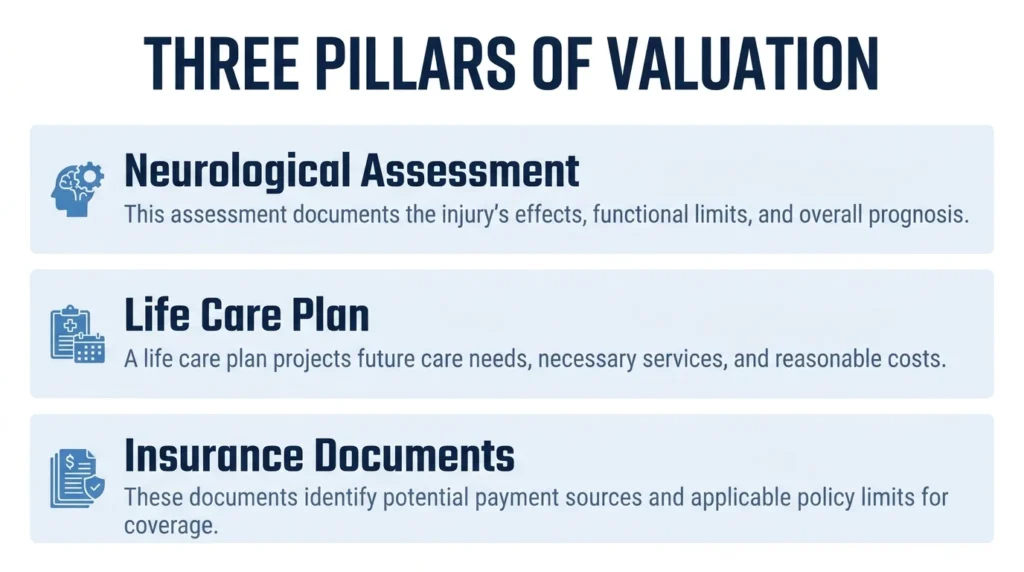
Three kinds of evidence work together, which are the neurological assessment documents the injury’s effects, the life care plan projects support future needs, and the insurance documents identify potential payment sources. None sets the settlement amount by itself.
How Does the Spinal Cord Injury Affect the Person’s Needs?
The level and severity of the injury shape care needs and the losses a person can prove. A diagnosis or paralysis label alone cannot set a settlement figure. The treating team’s findings, functional limits, recommended care, and prognosis provide the starting evidence.
The World Health Organization explains that both injury level and severity affect impairment. Paraplegia generally preserves arm function, while tetraplegia affects the arms as well. Depending on the injury, walking, hand use, dressing, and bowel or bladder management may be affected.
MedlinePlus distinguishes complete injuries from incomplete ones. An incomplete injury is not necessarily mild, and a complete injury is a medical description, not a legal damages category. Two people with the same diagnosis can have different support needs.
When an injury results from a collision, Texas car accident claims also require evidence about who caused the crash. Medical records explain the harm; they do not resolve liability by themselves.
Which Texas Damages Go into the Valuation?
Texas law distinguishes economic losses from non-economic harm. Chapter 41 of the Texas Civil Practice and Remedies Code defines these categories, but the evidence must support the losses claimed in your case.
Medical and payment records help document medical expenses. Employment and earnings records help establish lost income and lost earning capacity. Testimony, treatment records, and evidence of daily limitations can support physical pain, mental anguish, and physical impairment; disfigurement may also count where the evidence supports it.
These categories do not apply automatically to every claim, and overlapping losses should not be counted twice. Their value is also a separate question from how much one insurance policy will pay.
Recovery of incurred medical expenses is limited to amounts actually paid or incurred by or for the injured person. Under § 41.0105, a provider’s original invoice is not automatically the recoverable amount.
Exemplary damages require additional proof and are separate from compensation. Chapter 41’s limits on exemplary damages are not a general ceiling on compensatory damages.
How Does a Life Care Plan Support Future Damages?
Future care damages require evidence that the care will probably be needed and evidence of its reasonable cost. In Gunn v. McCoy, the Texas Supreme Court explained that absolute certainty is not required.
A life care plan organizes medically supported needs and costs into an individualized projection. It does not guarantee that a court will admit every item or that an insurer will pay for it.
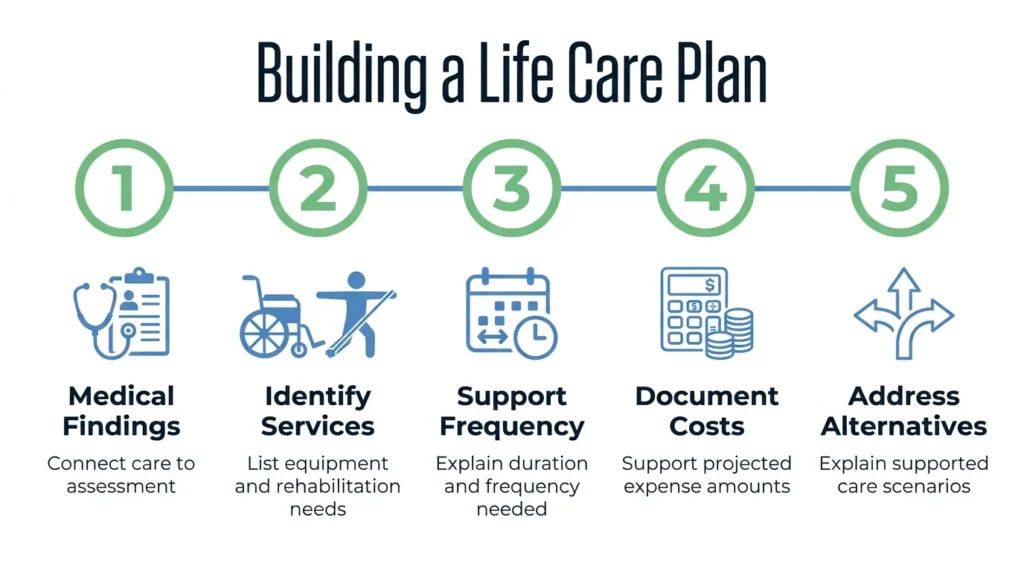
A supported projection follows these steps:
- Start with medical findings. Connect recommended care to the neurological assessment and functional limits.
- Identify services and equipment. Include rehabilitation, mobility equipment, personal assistance, and other care when medically indicated.
- Support frequency and duration. Explain how often each item will be needed and for how long.
- Document reasonable costs. Support the projected expense of each item.
- Address supported alternatives. Explain different care scenarios when the evidence supports them.
An average settlement for spinal cord injury cannot tell you what your claim is worth. A published verdict, lifetime care estimate, or law firm’s selected results does not establish a reliable settlement average for an individual Texas case.
A case-specific valuation range can reflect supported differences in care needs, disputed evidence, and liability proof. Injury level, functional limitations, work history, and future care are value drivers. Dollar endpoints require the person’s actual evidence; a bill multiplier or injury label cannot supply them.
How Do Coverage Documents Affect a Potential Settlement?
Verified coverage helps show whether available payment sources can meet the documented losses. When one policy is the only collectible source, its limit may constrain a practical settlement. That limit does not measure the injury’s full value or necessarily cap total recovery.
The Texas Department of Insurance explains that liability policies have dollar limits and an at-fault driver may owe losses beyond available insurance. It also describes uninsured and underinsured motorist coverage, which may mean something if applicable coverage exists.
TDI’s umbrella policy guidance describes additional liability coverage that may respond after underlying coverage. Whether another policy applies depends on its terms, insured status, exclusions, and the loss.
A coverage investigation may examine primary and excess policies, relevant commercial coverage, other responsible parties, and collectible resources. Policies do not automatically stack. A commercial truck’s involvement in an I-35 crash, for example, does not by itself prove a business is liable.
Under Texas Rule of Civil Procedure 192.3(f), parties may discover relevant insurance and indemnity agreements that may satisfy a judgment or reimburse its payment. In non-exempt district- or county court civil suits not governed by the Family Code, Rules 194.1 and 194.2(b)(7) require disclosure without awaiting a request, subject to the rules, agreement, and court order.
These litigation rules do not create a universal right to immediate policy disclosure before suit.
Disclosure also does not make insurance evidence admissible at trial.
The life care plan measures supported needs; the policy search identifies potential payment sources. Both count even when projected care already exceeds one known policy limit.
When Can a Policy Limit Demand Count?
A properly framed demand can count when liability and damages expose the insured to a judgment above the policy limit. Texas’s Stowers doctrine addresses an insurer’s duty to exercise reasonable care in settlement. Neither a demand nor a large loss automatically requires payment above the limit.
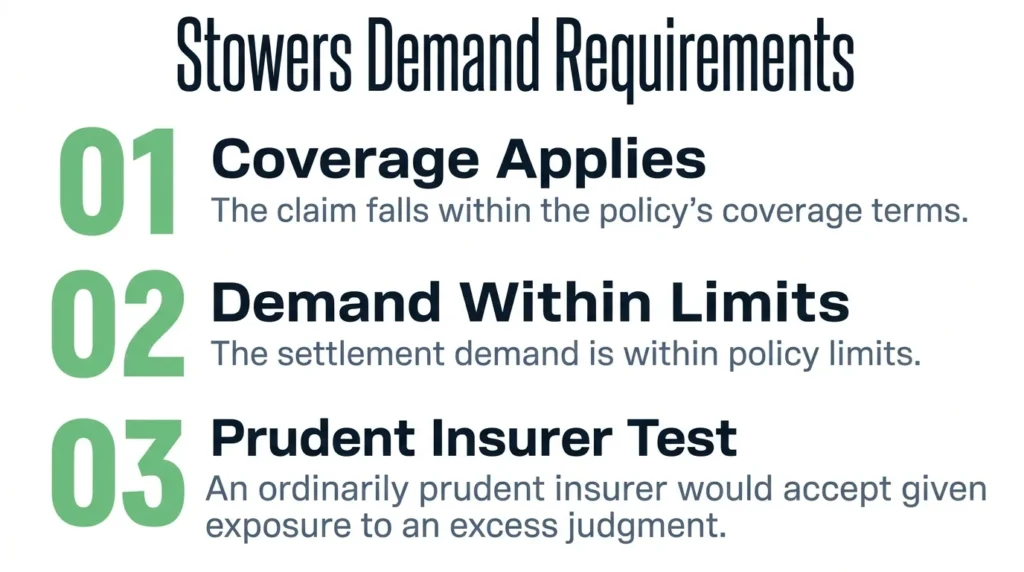
In American Physicians Insurance Exchange v. Garcia, the Texas Supreme Court identified three prerequisites:
- The claim falls within the policy’s coverage.
- The settlement demand is within policy limits.
- An ordinarily prudent insurer would accept its terms given the likelihood and degree of exposure to an excess judgment.
The demand generally must offer a full release of the insured for a stated amount or policy limits. Neurological findings and future care evidence can help show potential exposure, while verified coverage helps frame the demand.
In re Farmers Texas County Mutual Insurance Co. confirms that Stowers protects the insured and requires liability exceeding policy limits. Refusing a demand followed by a large award does not by itself establish negligent failure to settle. A demand cannot create coverage, override exclusions, or give the injured person an automatic direct bad faith claim.
Discuss Your Spinal Cord Injury Claim with Angel Reyes & Associates
You do not have to sort through care projections and insurance documents on your own. Angel Reyes & Associates has guided injured Texans for over 30 years.
A free consultation can address your injury evidence, future care needs, liability questions, and potentially available coverage. Gather the medical records, bills, earnings information, and insurance documents you have so the team can review your situation.
Contact Angel Reyes & Associates for a free consultation to discuss your options.
Past results do not guarantee future outcomes.
Spinal Cord Injury Claim Worth FAQs
How does a pre-existing medical condition affect a Texas spinal cord injury claim?
A pre-existing condition does not automatically prevent recovery under Texas law, but the injured person must distinguish harm caused or worsened by the accident from limitations that already existed. Medical records and expert opinions can help establish the accident’s contribution to the person’s current condition.
Can a spinal cord injury claim still proceed if multiple parties contributed to the accident?
Yes. Texas proportionate responsibility rules allow fault to be allocated among multiple responsible parties, potentially including drivers, employers, or other entities when supported by the evidence. Under Chapter 33 of the Texas Civil Practice and Remedies Code, an injured person’s recovery may be reduced by their percentage of responsibility and is generally barred if their responsibility exceeds 50%.
How does inflation affect the valuation of future medical expenses in a spinal cord injury case?
Future care projections may account for anticipated changes in medical costs over time, including increases in the cost of treatment, equipment, and personal assistance. Economic experts may help evaluate projected expenses and present their future value in a way supported by the evidence.
Does accepting Social Security disability benefits affect a Texas spinal cord injury settlement?
Receiving Social Security Disability Insurance does not automatically prevent someone from pursuing a personal injury claim. However, potential reimbursement rights, benefit coordination, and other legal considerations may affect how settlement proceeds are handled.
About the Authors

Angel Reyes
Writer
Angel L. Reyes, III is the Founder and Managing Partner of Angel Reyes & Associates. A nationally recognized trial attorney and business leader, Angel founded the firm in 1993, which has gone on to help over 70,000 injury victims recover more than $1 billion. Named to the Texas Super Lawyers list annually since 2008, Angel brings Wall Street experience, Ivy League education, and a deep commitment to client advocacy. He is a frequent legal commentator and published author with extensive contributions to legal scholarship, trial strategy, and consumer protection.

Graham Griffin
Editor
Graham Griffin is the Web & Content Manager at Angel Reyes & Associates, where he oversees content strategy, AI-powered workflows, a...

Angel Reyes
Reviewer
Angel L. Reyes, III is the Founder and Managing Partner of Angel Reyes & Associates. A nationally recognized trial attorney and business...