How Is a Broken Bone Case Valued?


Every article on this site is researched by our internal team, reviewed for legal accuracy against current Texas law, and held to State Bar of Texas advertising standards before publication. We do not publish content that overstates outcomes or makes promises about results.
Learn more about our
editorial standards .
Key Takeaways
- Imaging, operative records, and your doctor's prognosis are the core fracture evidence.
- Surgery or hardware matters through documented costs, recovery, and lasting limits.
- No formula or standard Texas range sets a broken bone settlement; proven losses do.

In Texas, a broken bone case is valued by the losses your evidence proves. Those losses can include reasonable medical expenses, lost earnings or earning capacity, pain, mental anguish, disfigurement, and distinct physical impairment. Your imaging, operative records if you had surgery, and treating physician’s prognosis help connect the fracture to those losses.
When bills are piling up and you cannot return to your usual work, a diagnosis alone offers little guidance about compensation. What’s more, workers’ compensation, claims against government entities, and medical malpractice follow separate rules.
Texas Damages That Can Shape a Broken Bone Claim
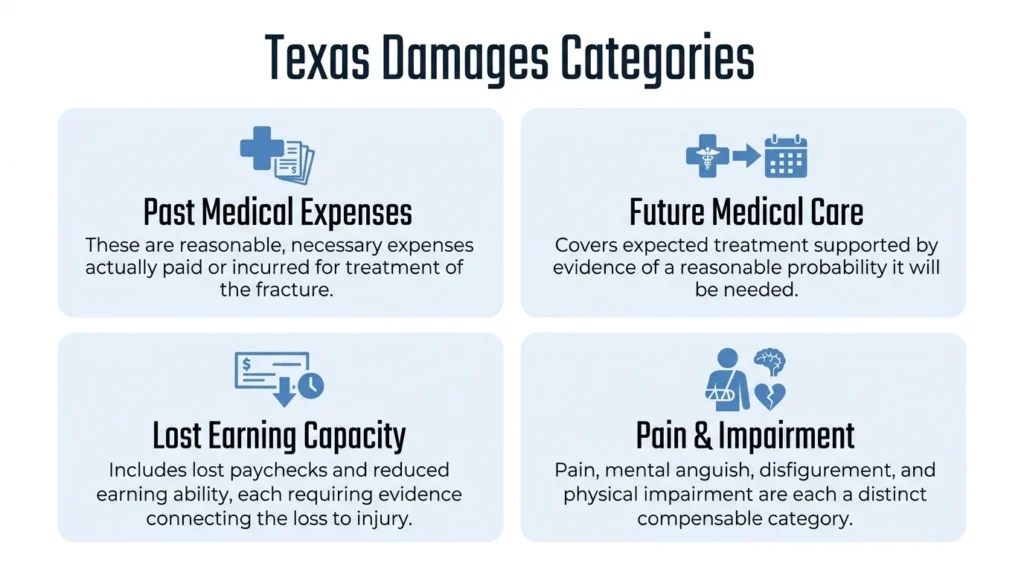
Texas law recognizes several categories of damages in an injury claim. Each requires evidence, and the same loss cannot be counted twice.
Past Medical Expenses
You can seek the reasonable expenses of necessary medical care. In In re K & L Auto Crushers, LLC, the Texas Supreme Court explained that financial recovery is limited to amounts actually paid or incurred under Texas Civil Practice and Remedies Code § 41.0105, and that the charges must also be reasonable.
The face amount printed on a hospital bill is not automatically what you financially recover. “Paid or incurred” is not limited to cash you personally handed over, either.
Future Medical Care
Future treatment requires a separate assessment. In Gunn v. McCoy, the Texas Supreme Court explained that future medical expenses require evidence of a reasonable probability that the care will be needed, even though certainty is impossible.
Your treating physician’s expected plan of care and evidence of its cost help support that claim. A comment that another surgery “might” happen someday does not establish its value.
Lost Earnings & Earning Capacity
Missed paychecks show income you lost during recovery. Reduced earning capacity concerns an injury’s effect on your ability to earn. The court in Golden Eagle Archery, Inc. v. Jackson discussed past lost earnings as a recognized damages category.
Huston v. United Parcel Service, Inc. describes earning capacity through the ability to earn before and after injury, supported by evidence that allows a monetary assessment. It is more than a tally of missed paychecks. Either type of claim needs evidence connecting the loss to the injury.
Pain, Mental Anguish, Disfigurement & Physical Impairment
These categories can overlap. Golden Eagle Archery explains that physical impairment requires a substantial loss distinct from the pain, anguish, or other harms already compensated.
A fracture visible on an X-ray does not trigger a separate award in every category. Activities you can no longer do may serve as evidence of impairment, but they do not create an automatic extra payment.
How the Fracture & Its Treatment Affect the Losses
The bone involved counts through its actual effect on your movement, treatment, recovery, and work. Surgery and hardware can increase documented costs and recovery burdens, but neither automatically increases a settlement or proves permanent disability.
Imaging & Treatment Evidence
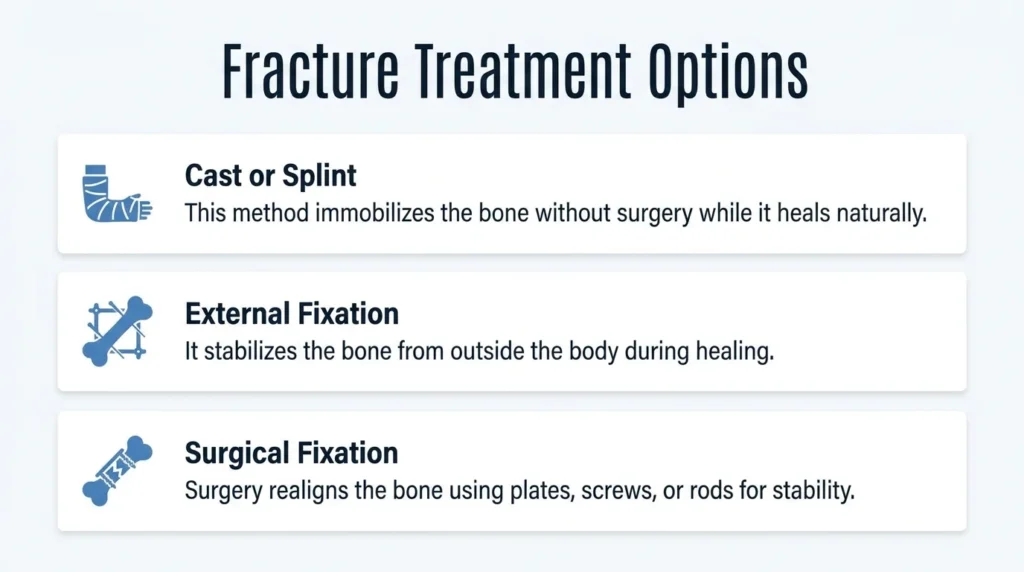
X-rays establish a break’s location and type. Treatment can involve a cast or splint, external fixation, or surgery that realigns the bone and holds it with plates, screws, or rods.
Healing depends on the extent and location of the injury and patient-specific factors. Pain can improve before the bone is strong enough for normal activity. Feeling better and recovering full function are different milestones.
The Effect of Fracture Location
The severity and location of adult forearm fractures can affect wrist or elbow movement and the ability to rotate the forearm.
Some of these fractures heal without surgery. Others need surgical fixation, and complications such as a bone that fails to heal or troublesome implants can occur. These are possibilities, not predictions for every patient. The effect on your function matters more to the assessment than the bone’s name alone.
Hardware & Lasting Restrictions
Plates, screws, and rods stabilize bone fragments while they heal. Some implants remain after healing and others are removed in selected circumstances.
Retained hardware alone does not establish a permanent restriction or a future removal operation. A lasting limitation carries weight when your treating physician’s prognosis supports it and your records show how it affects your activities or ability to earn.
Records That Show Recovery & Time Away From Work
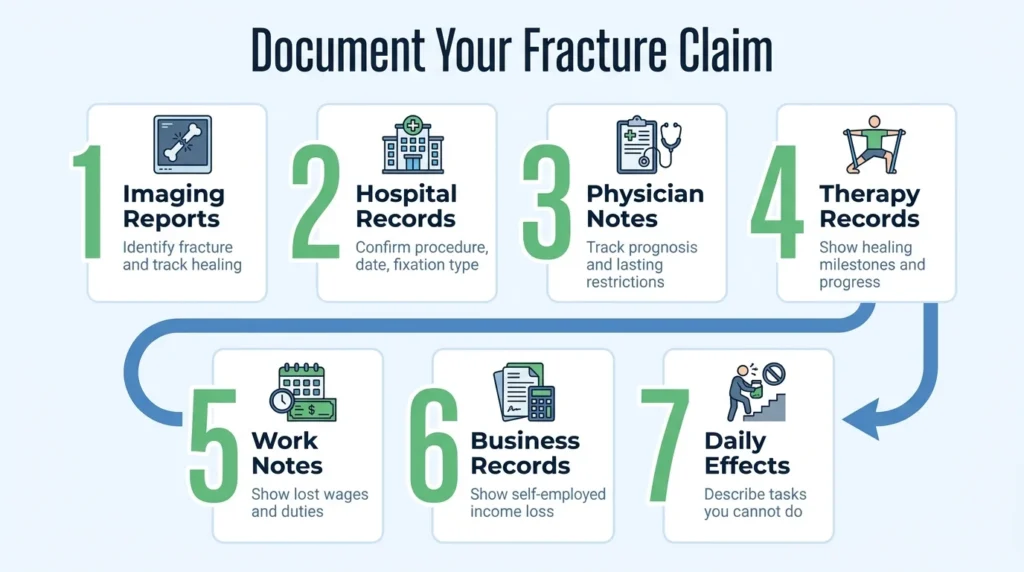
A useful evaluation connects the injury, treatment, recovery, and each claimed loss through records. Imaging, operative records, and the treating physician’s prognosis provide the core evidence; bills, therapy notes, and employment records show the financial and functional effects.
These steps can help you organize that information:
- Keep your imaging and radiology reports. They identify the bone and fracture pattern, and follow-up studies show change over time. An image alone does not prove who caused the crash or what the injury is worth.
- Request hospital and operative records. They confirm the procedure, date, and type of fixation used. A scar or implant is not a substitute for the surgical record.
- Track your treating physician’s notes and prognosis. These distinguish temporary instructions, such as avoiding weight-bearing during healing, from restrictions your doctor expects to last.
- Save therapy and follow-up records. Cast removal, reduced pain, bone healing, full function, and return to work are different milestones. Records help explain your progress.
- Pair work notes with employment records. Pay stubs, attendance records, employer confirmation, job duties, and modified duty arrangements help show what you lost. A lifting restriction affects a warehouse worker differently than an office worker.
- Gather business records if you are self-employed. Income and business records help explain the loss when no employer pay stub exists.
- Write down specific daily effects. Concrete accounts of tasks you cannot do and visible changes, such as scarring, help explain the harm without guaranteeing separate awards.
Why a Broken Bone Settlement Has No Standard Dollar Range
A standard dollar range cannot tell you what your Texas broken bone settlement should be. A useful estimate needs the losses your records support and the facts of your case.
The circumstances can range from a fracture treated with a cast, followed by restored function and a short absence from work, to one requiring surgery and leaving medically supported restrictions on daily life and earning ability.
Those circumstances differ in treatment, recovery time, work effects, and long-term function. More intense treatment does not mechanically produce a higher payment. Its documented consequences mean a lot.
A medical bill multiplier, per-screw amount, hardware bonus, or guaranteed minimum cannot replace that assessment. An individual verdict reported in the news is not an average for your claim. A case-specific range needs a basis in your own records and circumstances.
Discuss Your Broken Bone Case With Angel Reyes & Associates
Your treatment, recovery, and work history help explain your claim. The team at Angel Reyes & Associates offers a free case review in which a licensed attorney evaluates your situation at no cost.
Bring your imaging reports, surgical records, doctor’s notes, and pay records if you have them.
Contact Angel Reyes & Associates to talk through your options.
Past results do not guarantee future outcomes.
Broken Bone Case Valuation FAQs
Does a pre-existing condition affect the value of a broken bone claim in Texas?
A pre-existing condition does not automatically prevent recovery, but the evidence must distinguish the effects of the new injury from symptoms or limitations that existed before the incident. Medical history and physician opinions can help establish whether the accident aggravated an existing condition.
Can I recover compensation if my broken bone prevents me from returning to my previous job?
Potentially. If the fracture limits your ability to perform your former job or reduces your ability to earn income in the future, you may have a claim for diminished earning capacity supported by medical and employment evidence.
What happens if a broken bone develops an infection or fails to heal properly?
Complications such as infection, delayed healing, or nonunion may increase treatment needs and extend recovery. Their effect on a claim depends on medical evidence connecting the complication to the original injury and documenting its consequences.
Can I still pursue a broken bone claim if I was partly responsible for the accident in Texas?
Potentially. Under Texas’s proportionate responsibility rules, an injured person may recover damages if their percentage of responsibility is not greater than 50%, but the recovery is reduced by their assigned percentage of responsibility.
About the Authors

Angel Reyes
Writer
Angel L. Reyes, III is the Founder and Managing Partner of Angel Reyes & Associates. A nationally recognized trial attorney and business leader, Angel founded the firm in 1993, which has gone on to help over 70,000 injury victims recover more than $1 billion. Named to the Texas Super Lawyers list annually since 2008, Angel brings Wall Street experience, Ivy League education, and a deep commitment to client advocacy. He is a frequent legal commentator and published author with extensive contributions to legal scholarship, trial strategy, and consumer protection.

Kyle Nicolas
Editor
Kyle Nicolas is the Web Content & SEO Manager at Angel Reyes & Associates. He has more than 10 years of experience as a marketing co...

Angel Reyes
Reviewer
Angel L. Reyes, III is the Founder and Managing Partner of Angel Reyes & Associates. A nationally recognized trial attorney and business...