What Injuries Happen in Head-On Collisions?


Every article on this site is researched by our internal team, reviewed for legal accuracy against current Texas law, and held to State Bar of Texas advertising standards before publication. We do not publish content that overstates outcomes or makes promises about results.
Learn more about our
editorial standards .
Key Takeaways
- - Head-on crashes can injure the chest, aorta, knees, hips, wrists, and face.
- - A little outward bruising does not rule out internal injury, so get prompt medical care.
- - Medical records, vehicle damage, and restraint data together help document your injuries.

Head-on collision injuries can include a broken breastbone, knee and hip injuries from hitting the dashboard, wrist and facial fractures, and life-threatening damage to the aorta, the body’s main artery. Your injuries depend on the force of the crash, where you sat, whether the vehicle crushed into the passenger space, and how your seat belt and airbags performed.
After a crash on a Texas farm road or an I-35 frontage road, pain in several places can leave you unsure what happened. Understanding these injury patterns can help you discuss your symptoms with your medical team.
Why a Head-On Crash Can Cause Different Injuries
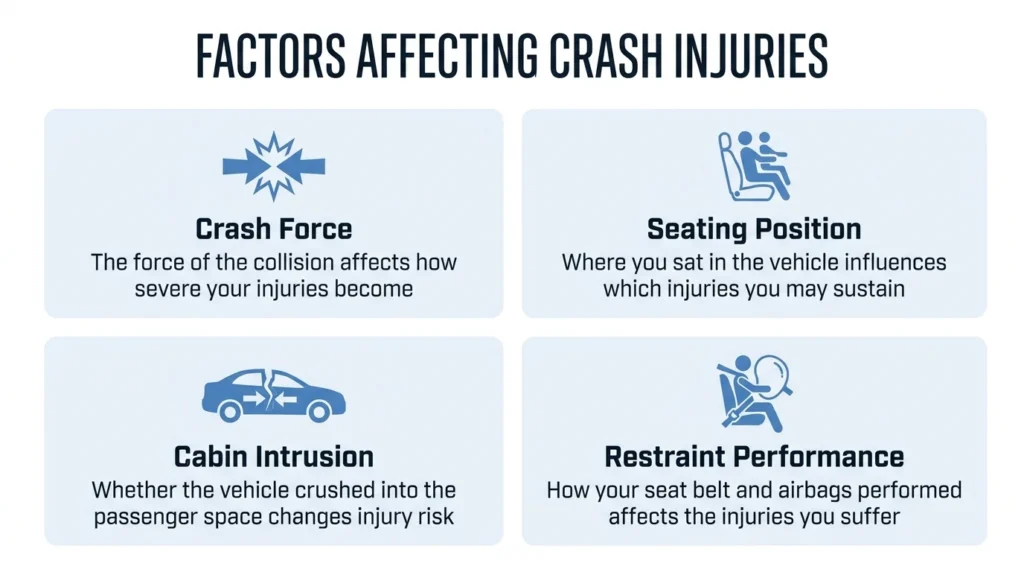
A head-on crash can injure you when the vehicle stops suddenly, your body strikes the interior, or the front of the vehicle pushes into the passenger space. Where you sit and how your seat belt and airbags perform can affect your injuries. The direction of the crash alone cannot tell anyone what is wrong with your body.
During sudden deceleration, the vehicle slows abruptly while your body and internal organs continue moving forward. Your chest, knees, hands, or face may strike the steering wheel, dashboard, or other surfaces. Parts of the vehicle may also collapse into the space where you sit.
Seat belts and frontal airbags are designed to work together. The National Highway Traffic Safety Administration (NHTSA) describes airbags as supplemental protection that works with seat belts to reduce contact between your head and upper body and the vehicle interior. Proper belt use and seating position also help keep you from sitting too close to an airbag, which can cause injuries as it deploys.
Seat belts and airbags reduce harm, though injuries can still occur. An airbag that did not deploy does not, by itself, prove a defect. Deployment depends on the crash, the system’s design, and its sensors.
A peer-reviewed review of crash injury patterns describes injuries from frontal impacts and how seating position affects dashboard injuries. The research covers frontal crashes broadly, including more than head-on collisions between two vehicles. It illustrates how injuries can happen without ranking how common each one is.
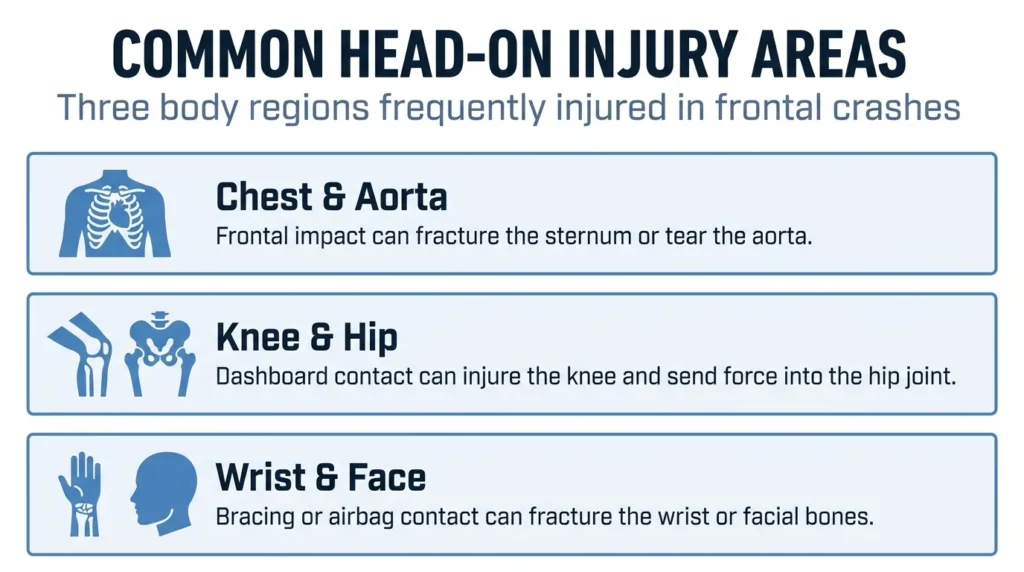
Chest & Aortic Injuries After a Frontal Impact
Chest injuries can include a fractured breastbone or potentially fatal damage to the aorta, the body’s major artery. External bruising can’t show the extent of internal injury, so you still need a medical exam even when visible injuries seem minor.
Chest Contact Can Fracture the Sternum
When your chest strikes the steering wheel, the impact can fracture the sternum, the flat bone in the center of your chest. A bruise on your chest may hide a more serious injury. Your doctor may need an examination and imaging to assess the damage.
A Sudden Stop Can Injure the Aorta
According to the MSD Manual, a sudden, severe slowdown in a vehicle crash can tear the aorta. This is potentially fatal internal trauma.
A physical exam and a standard chest X-ray may not be enough to rule out aortic injury. Doctors may order imaging specifically to examine the aorta based on how the crash happened. After any severe crash, get prompt emergency care rather than waiting to see how you feel.
Knee & Hip Injuries From Dashboard Contact
Hitting a bent knee against the dashboard can injure the knee and send force through the leg toward the hip. An examination and imaging can help identify which injuries occurred.
Dashboard Impact Can Injure the Knee
The American Academy of Orthopaedic Surgeons explains that a forceful dashboard blow to a bent knee can injure the posterior cruciate ligament (PCL). Get checked if you have swelling, difficulty walking, or a knee that feels unstable.
Doctors use an examination and imaging to identify ligament damage. An MRI shows ligaments better than an ordinary X-ray. Dashboard contact may also fracture the kneecap, known as the patella.
Force Through the Knee Can Injure the Hip
Force from the dashboard can travel through the leg and injure the hip. The imaging review documents a hip dislocation with an acetabular fracture after a frontal impact. The acetabulum is the hip socket.
Hitting your knee does not always cause a hip injury. If you have hip pain after a crash, get a medical evaluation to check for damage.
Wrist & Facial Injuries From Contact Inside the Vehicle
Bracing with an outstretched hand, striking the interior, or contact with an airbag can injure your wrist. A frontal crash can also break bones in your face. Seat belts and airbags help reduce these injuries, though protection varies with the crash.
Bracing & Interior Contact Can Injure the Wrist
The force on an outstretched hand during a frontal crash can break the wrist. The imaging review illustrates a fracture near the wrist at the end of the radius, one of the forearm bones, along with a dislocated joint.
Hand, wrist, and forearm bruises, abrasions, sprains, and some fractures may be related to airbag contact or secondary contact with the interior.
Frontal Contact Can Injure the Face
A frontal crash can fracture bones in the face. Wearing a seat belt can help reduce your chances of injury. However, seat belts and airbags cannot prevent every facial injury. Get prompt medical care for any facial injury after a collision.
How to Document Injuries After a Head-On Collision
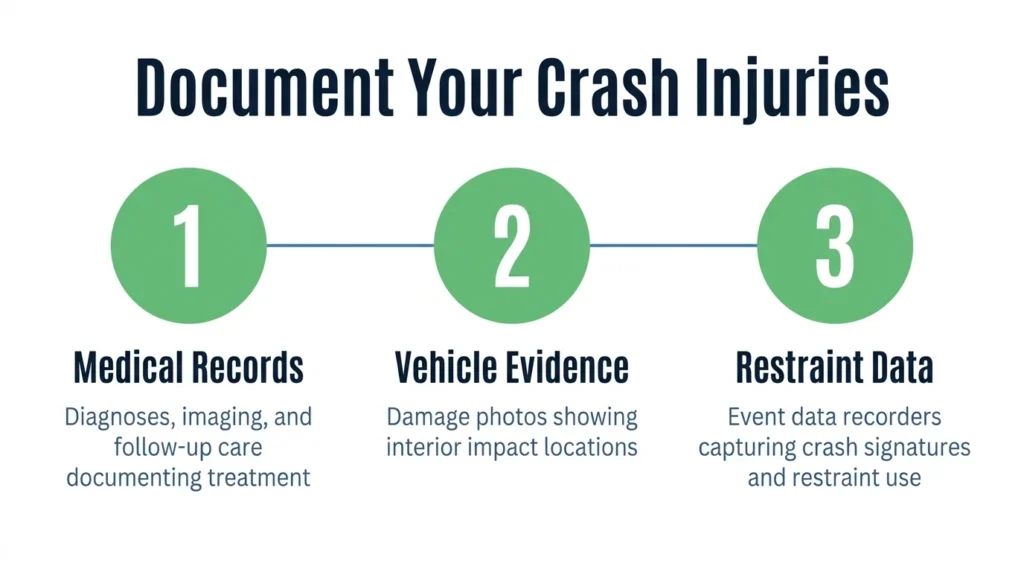
Medical records, vehicle evidence, and available restraint data help explain different parts of a crash injury.
Your medical records are the foundation. They capture diagnoses, imaging, procedures, follow-up care, and any limitations your providers document. Keep copies and attend follow-up appointments so the record reflects your treatment and ongoing limitations.
Vehicle evidence adds context. Damage photographs and inspection records may show where your body struck the interior or how far the front of the vehicle pushed into the cabin. If you can, photograph the vehicle before anyone repairs or salvages it. A lawyer can send an evidence preservation letter asking whoever holds the vehicle to preserve it for inspection.
Restraint evidence can fill in technical details. NHTSA explains that an event data recorder may capture vehicle dynamics, driver inputs, crash signatures, and restraint use or deployment. It stores technical crash data, not video or audio, and what is available varies by vehicle.
Insurers may review these records when evaluating your car accident claim. Complete, accurate documentation can help support the injuries, treatment, and limitations you describe.
Talk With Angel Reyes & Associates About Your Injuries
Recovering from a head-on crash takes time, and you should not have to sort through medical records and vehicle evidence alone.
Angel Reyes & Associates has served injured Texans for over 30 years. Ask about a review of your medical records, vehicle damage, and available restraint data during a free consultation. Contact us 24/7 to talk through your options.
Past results do not guarantee future outcomes.
Head-On Collision Injury FAQs
Can a head-on collision cause a traumatic brain injury without a direct blow to the head?
Yes. A head-on collision can cause a concussion or other traumatic brain injury when sudden acceleration or deceleration makes the brain move inside the skull, even without direct head contact.
Can neck and spinal injuries from a head-on collision cause long-term complications?
Yes. Damage to spinal discs, vertebrae, or nerves can cause persistent pain, numbness, weakness, or reduced mobility. Severe spinal cord injuries may result in permanent paralysis.
What happens if a pre-existing injury gets worse after a head-on collision in Texas?
Under Texas law, you may recover compensation for the aggravation of a pre-existing condition caused by another driver’s negligence. Medical evidence can help distinguish your previous symptoms from the additional harm caused by the crash.
How long do you have to file a head-on collision injury lawsuit in Texas?
Texas Civil Practice and Remedies Code § 16.003 generally gives injured people two years from the accident date to file a personal injury lawsuit. Certain exceptions may change this deadline.
Can you recover compensation for head-on collision injuries if you were partially at fault in Texas?
Yes. Under Texas Civil Practice and Remedies Code Chapter 33, you may recover damages if your percentage of responsibility is 50% or less, although your share of fault reduces your compensation.
About the Authors

Angel Reyes
Writer
Angel L. Reyes, III is the Founder and Managing Partner of Angel Reyes & Associates. A nationally recognized trial attorney and business leader, Angel founded the firm in 1993, which has gone on to help over 70,000 injury victims recover more than $1 billion. Named to the Texas Super Lawyers list annually since 2008, Angel brings Wall Street experience, Ivy League education, and a deep commitment to client advocacy. He is a frequent legal commentator and published author with extensive contributions to legal scholarship, trial strategy, and consumer protection.

Kyle Nicolas
Editor
Kyle Nicolas is the Web Content & SEO Manager at Angel Reyes & Associates. He has more than 10 years of experience as a marketing co...

Angel Reyes
Reviewer
Angel L. Reyes, III is the Founder and Managing Partner of Angel Reyes & Associates. A nationally recognized trial attorney and business...