Can a Crash Cause a Pinched Neck Nerve?


Every article on this site is researched by our internal team, reviewed for legal accuracy against current Texas law, and held to State Bar of Texas advertising standards before publication. We do not publish content that overstates outcomes or makes promises about results.
Learn more about our
editorial standards .
Key Takeaways
- MRI shows structure and EMG shows nerve function, but neither alone proves the crash caused it.
- Texas generally requires expert medical evidence to link a complex neck injury to a crash.
- Treating notes should record onset, symptom pattern, exam findings, and prior neck history.

Yes, a crash can injure a disc in the neck and affect a nerve root. If you have burning arm pain or tingling fingers after a collision, a clinician can evaluate whether you have cervical radiculopathy, which is a problem with a nerve root in the neck. Proving that a pinched nerve in your neck after a car accident came from the crash takes more than symptoms or a single scan.
Texas law asks for competent evidence connecting your specific injury to the collision. In medically complex cases, that usually means a doctor’s reasoned opinion.
How Can a Car Crash Affect a Neck Nerve?
A crash can push disc material out of place so it presses on a nerve root as the root leaves the spine. The American Academy of Orthopaedic Surgeons identifies injury as one way this disc protrusion happens.
Cervical radiculopathy does not always involve a visible physical pinch. The American Academy of Physical Medicine and Rehabilitation notes that nerve root problems can involve compression, inflammation, or other mechanisms. Trauma is one recognized cause.
Age counts too. Disc wear and bone spurs can narrow the space around a nerve root, and these changes can appear on imaging in people who feel no pain at all.
That is why an abnormal disc image alone does not prove a crash caused your symptoms. A clinician has to read the scan against what you feel and what the exam finds.
What Symptoms Call for Medical Evaluation?
Pain that travels from the neck into the arm deserves a doctor’s attention, especially when tingling, numbness, or weakness comes with it. These symptoms can point to nerve root involvement. They do not confirm a diagnosis on their own.
The pain is often described as sharp or burning. It can spread into the shoulder, arm, or hand, and some people notice weakness in those areas. Patterns vary from person to person, so no single map of symptoms fits everyone.
During the exam, your doctor checks strength, sensation, and reflexes. Those findings help show whether a nerve root is actually working abnormally.
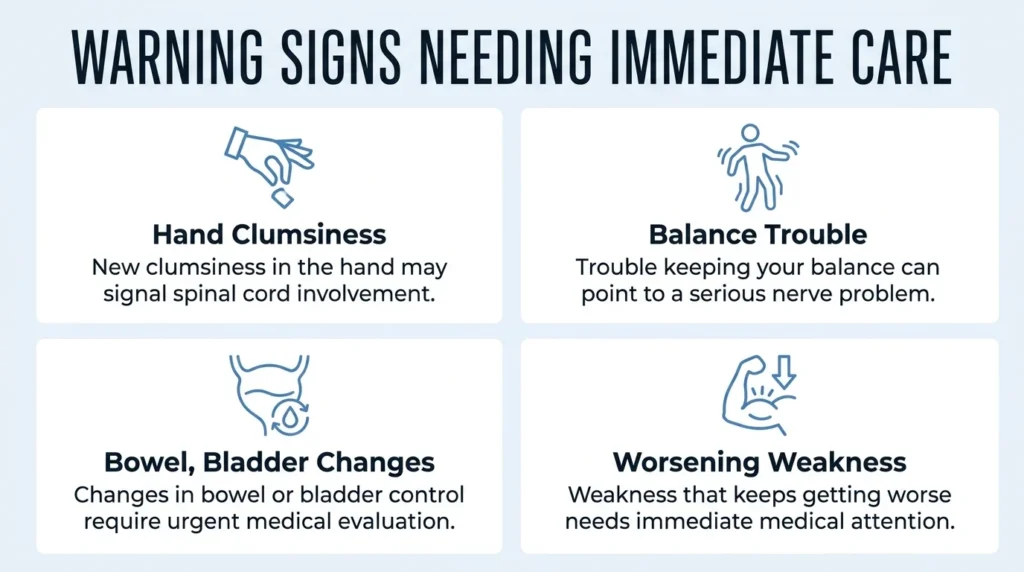
Get evaluated right away for new hand clumsiness, trouble keeping your balance, changes in bowel or bladder control, or weakness that keeps getting worse. These warning signs can point to spinal cord involvement or another serious problem.
What Can MRI, EMG & Nerve Conduction Studies Show?
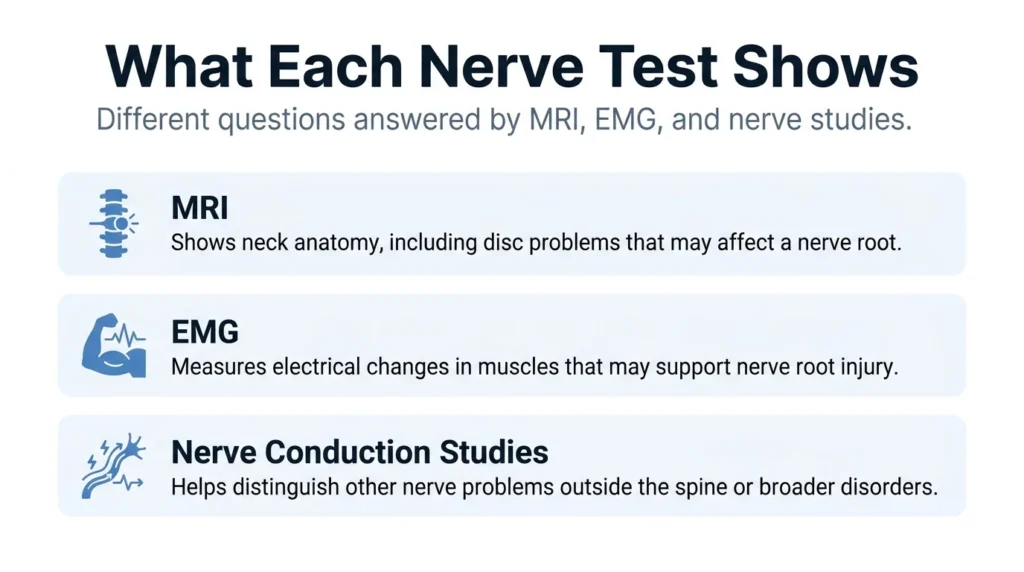
Each test answers a different question. A cervical MRI shows anatomy. Needle EMG evaluates electrical changes in muscles that may support nerve root injury, and nerve conduction studies help distinguish other nerve problems. No test by itself establishes when or why a condition developed.
What a Cervical MRI Shows
An MRI shows soft tissue, including a disc problem that may affect a nerve root. It does not replace your doctor’s exam or your medical history.
Your doctor should compare the side and level of the MRI finding with your symptoms and exam results. When they match, the picture gets clearer. When they don’t, the mismatch needs an explanation.
What EMG & Nerve Conduction Studies Show
Needle EMG measures electrical changes in muscles that can support a nerve root injury. Changes in muscles that share a root but connect through different nerves help pinpoint the level.
Nerve conduction studies help sort out other explanations, such as a nerve trapped outside the spine or a broader nerve disorder. Neither test takes a picture of a compressed nerve.
A normal result does not rule out radiculopathy. Sensory nerve conduction can stay normal, and mild or sensory-only cases may produce normal studies. Abnormal findings can also take time to develop, so your doctor decides when testing makes sense.
Emergency Imaging After a Serious Crash
Serious crash injuries follow a different path than ordinary neck pain. After a high-risk blunt injury, emergency teams may start with a CT scan and add an MRI if they suspect cord, ligament, or nerve root damage.
Never put off emergency care while waiting for an MRI.
What Must a Texas Claim Show About Causation?
Proving that another driver caused a collision is separate from proving that the collision caused your neck injury. A Texas claim against that driver needs evidence connecting the crash to the injury for which you seek compensation.
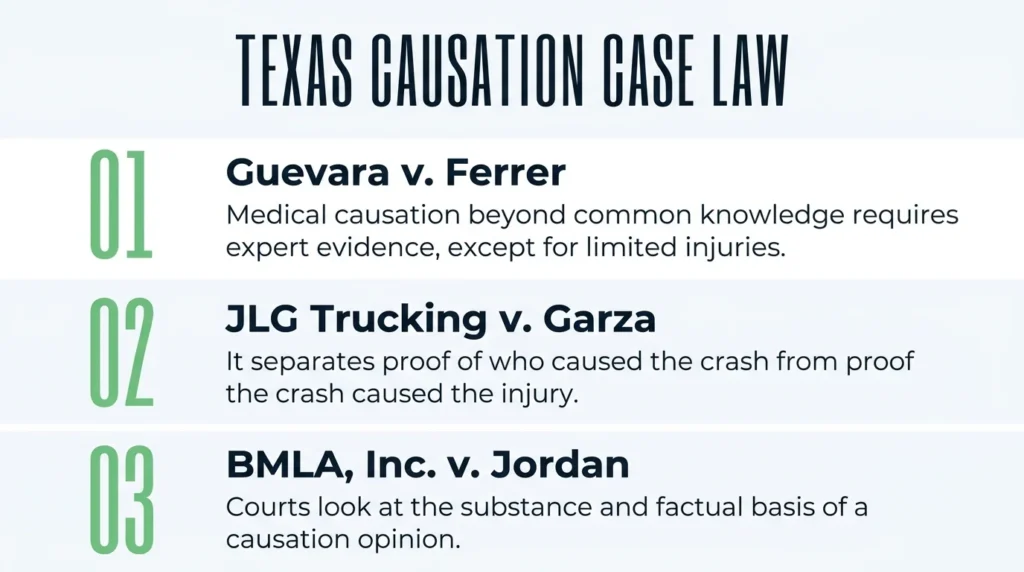
In Guevara v. Ferrer, the Texas Supreme Court held that medical causation beyond jurors’ common knowledge requires expert evidence. The court allowed lay evidence for limited, straightforward injuries.
The court also addressed timing. Symptoms that begin after an event can support a causal explanation, but timing alone does not prove complex medical causation. A nerve root injury involving disc findings and specialized testing can raise exactly the kind of medical questions that call for a doctor’s explanation.
JLG Trucking, LLC v. Garza involved herniated cervical discs and a later second crash. The court separated proof of who caused the collision from proof that the collision caused the injuries.
When the evidence presents other plausible causes that can be negated, the party offering the causation testimony must provide evidence excluding those causes with reasonable certainty. That does not mean ruling out every imaginable cause.
An older neck problem or a later injury may raise a competing explanation. Your doctor’s opinion should address plausible alternatives supported by the evidence.
The opinion must also rest on reasonable medical probability. As BMLA, Inc. v. Jordan illustrates, courts look at the substance and factual basis of the opinion, whether it appears in testimony or medical records. No magic formula of words is required.
How Do the Medical Records Fit Together?
An attorney can review the cervical MRI, any EMG or nerve conduction results, and your treating doctor’s notes side by side. Together, these records can support a diagnosis. A doctor’s reasoned opinion still has to explain why the crash caused or worsened your particular injury.
An attorney assessing a cervical radiculopathy claim after a car accident can work through these steps:
- Gather the MRI images and report. These show the structure of your neck and where any disc problem sits.
- Collect EMG and nerve conduction results if your doctor ordered them. These may support nerve root injury and help distinguish other nerve problems, subject to the testing limits described above.
- Review the treating notes for key details. Useful notes record when symptoms began, where they spread, strength, sensation, and reflex findings, functional changes, the treatment course, and other injuries or events.
- Account for your prior history. Your doctor should identify and explain any earlier neck symptoms or imaging.
- Compare the findings. The doctor checks whether the side and level of any lesion match your symptoms and exam.
- Look for a reasoned causation opinion. The doctor should explain how the crash, rather than another reasonable cause, caused or aggravated your injury.
Your report that the pain started after the crash belongs in your medical history. It is not automatically your doctor’s conclusion about what caused it.
Matching MRI and EMG results also do not, by themselves, show when or why a disc problem developed. MRI plus EMG is not a statutory checklist for proving a claim. Any claim that the crash worsened an existing condition needs an individualized medical explanation.
Talk With Angel Reyes & Associates
If neck and arm symptoms started after a Texas crash, you don’t have to sort through the medical records and legal questions alone. Angel Reyes & Associates has guided injured Texans for over 30 years.
Contact Angel Reyes & Associates for a free consultation. Bring whatever records you have, including imaging reports, test results, and treatment notes, and we can walk through your options. You can reach us 24/7.
Past results do not guarantee future outcomes.
Pinched Neck Nerve From a Crash FAQs
Can a pinched nerve in the neck cause permanent damage after a car accident?
Yes. Severe or prolonged nerve compression can sometimes cause lasting weakness, numbness, or other neurological problems, although many cases improve with appropriate treatment. The extent of recovery depends on the underlying injury and how much nerve damage occurred.
How long after a car accident can cervical radiculopathy symptoms appear?
Symptoms may develop immediately or become noticeable days or weeks after a collision. Delayed symptoms should still be documented and evaluated because the timing and progression of symptoms can help a doctor assess the possible relationship to the crash.
Can a pinched nerve in the neck cause headaches, dizziness, or shoulder pain?
Cervical radiculopathy commonly causes pain that travels into the shoulder or arm, but headaches and dizziness are not specific indicators of a pinched nerve. Those symptoms may have other causes after a collision and warrant medical evaluation rather than assuming they come from the same injury.
What compensation can you recover for a pinched nerve after a car accident in Texas?
Depending on the evidence, an injured person may seek compensation for medical expenses, lost income, reduced future earning capacity, physical pain, and physical impairment. The available damages depend on the injury’s effects, supporting documentation, and proof that the collision caused or aggravated the condition.
About the Authors

Angel Reyes
Writer
Angel L. Reyes, III is the Founder and Managing Partner of Angel Reyes & Associates. A nationally recognized trial attorney and business leader, Angel founded the firm in 1993, which has gone on to help over 70,000 injury victims recover more than $1 billion. Named to the Texas Super Lawyers list annually since 2008, Angel brings Wall Street experience, Ivy League education, and a deep commitment to client advocacy. He is a frequent legal commentator and published author with extensive contributions to legal scholarship, trial strategy, and consumer protection.

Graham Griffin
Editor
Graham Griffin is the Web & Content Manager at Angel Reyes & Associates, where he oversees content strategy, AI-powered workflows, a...

Angel Reyes
Reviewer
Angel L. Reyes, III is the Founder and Managing Partner of Angel Reyes & Associates. A nationally recognized trial attorney and business...