Are Wrongful Death Settlements Taxable?


Every article on this site is researched by our internal team, reviewed for legal accuracy against current Texas law, and held to State Bar of Texas advertising standards before publication. We do not publish content that overstates outcomes or makes promises about results.
Learn more about our
editorial standards .
Key Takeaways
- Texas has no income tax, so only federal rules can tax a wrongful death settlement.
- Compensatory damages are tax-free under IRC 104(a)(2), but punitive damages are not.
- Interest on a judgment and previously deducted medical bills are taxable income.

The settlement money finally arrived. You’re sitting at the kitchen table with the paperwork, trying to work out how much of it is actually yours to keep.
Your family lost someone in a crash on Loop 1604 near Stone Oak, and this money has to cover the bills that have piled up since. Before you plan around a single dollar of it, you need to know what the IRS can claim.
Is a Wrongful Death Settlement Taxable in Texas?
Most of a wrongful death settlement is not taxable, and Texas taxes none of it. The state has no personal income tax, so every tax question about your recovery comes from federal law.
Federal law treats most of what you recover in a wrongful death claim as compensation for a loss rather than income.
Your right to bring the claim comes from the Texas Wrongful Death Act. Texas Civil Practice and Remedies Code (CPRC) § 71.004 names who can file, and Texas courts have long defined which losses your family can recover.
Those wrongful death damage categories shape your tax picture, because the IRS treats money that replaces a loss differently than other damages.
Settlement size does not change any of this. It only changes how much is at stake, and wrongful death settlement values vary widely from one case to the next.
Which Damages Are Taxable or Tax-Free?
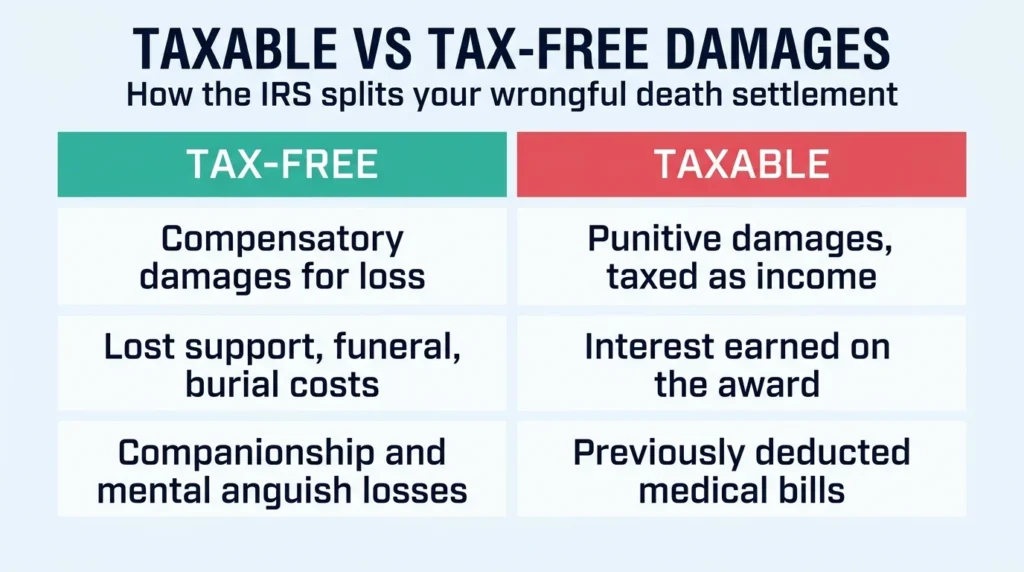
The federal rule splits your settlement in two. Compensatory damages reach you tax-free, and punitive damages do not.
Compensatory Damages Are Tax-Free
Compensation for your family member’s death stays out of your gross income under Internal Revenue Code (IRC) § 104(a)(2). That exclusion covers the bulk of most wrongful death settlements.
Lost financial support, funeral and burial costs, and lost household services all qualify. So do non-economic losses, including lost companionship and the mental anguish you have carried since the death.
Punitive Damages Are Taxable
Punitive damages are fully taxable. The IRS counts them as ordinary income because they punish the defendant instead of replacing something your family lost.
A narrow federal exception exists under IRC § 104(c). It applies only when state law allows nothing but punitive damages in a wrongful death case. However, Texas allows both compensatory and punitive damages in the same action, so that exception never reaches your claim. Any punitive portion of your settlement stays taxable, no matter how the rest is treated.
How much lands in that taxable slice depends on the award itself, and how punitive damages are calculated shows what drives the number.
Other Taxable Exceptions To Know
Two other pieces of a settlement can generate a tax bill even when the compensatory portion does not.
- Interest on the award: Interest that builds on a settlement or judgment counts as ordinary income, separate from the damages themselves. The rules at 26 Code of Federal Regulations § 1.104-1 limit the exclusion to the damages, not to what they earn.
- Medical bills you already deducted: If your family deducted your loved one’s final medical expenses on an earlier return, recovering those same bills makes that amount taxable. The earlier deduction gets reversed.
Survival damages sit in a separate category. They belong to your loved one’s own injury claim, not your family’s loss. The Texas CPRC § 71.021 keeps that claim alive after death.
Because a survival claim covers the injury itself, previously deducted medical bills usually show up there. Which claim the money came from can change how you report it.
If your family is handling more than one claim, car accident settlement taxes follow the same allocation logic.
Do You Pay Taxes on Wrongful Death Settlements?
You pay federal tax only on the taxable portions: punitive damages, interest, and medical expenses your family already deducted. The rest reaches you free of income tax.
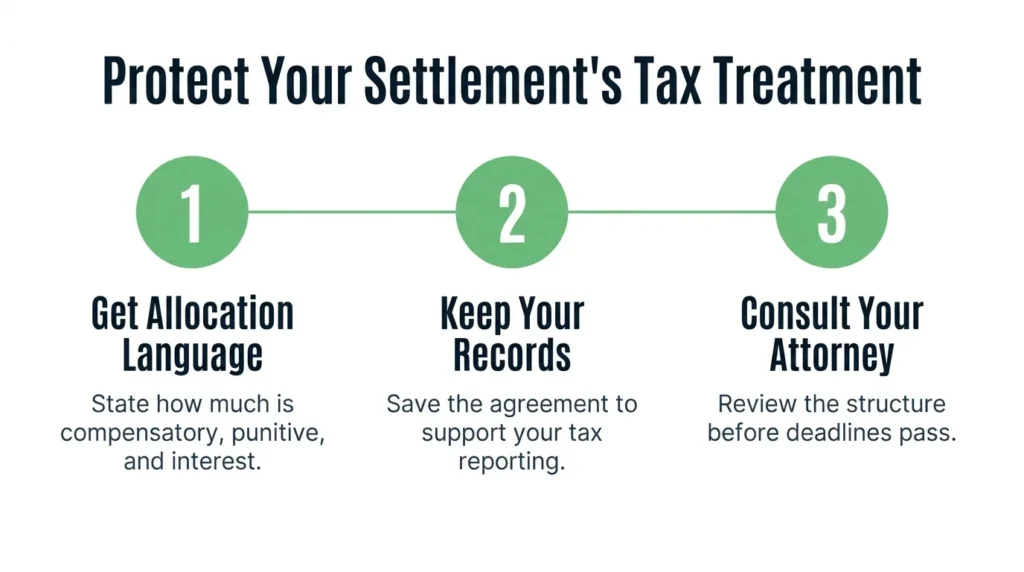
How your settlement agreement divides those amounts drives what you report. Ask for allocation language that states plainly how much is compensatory, how much is punitive, and how much is interest.
Keep that agreement with your tax records. The IRS explains its view of settlement and judgment tax treatment, and the origin of your claim controls the answer.
You may receive a Form 1099 for the taxable portion. The tax-free compensatory portion usually generates nothing, so your own records carry the weight.
Your attorney can review your settlement structure while there is still time to change it.
Work with a Texas Wrongful Death Attorney
Angel Reyes & Associates has guided Texas families through wrongful death claims for over 30 years. We can review your settlement structure and flag which portions the IRS will treat as income. We will also tell you when to bring in a tax professional.
You can read our background and approach before you call. Our past case results show the kinds of claims we handle.
We work on contingency, so you owe no attorney fee unless we recover money for you. Our fee and case expenses come out of that recovery, not out of your pocket.
Consultations are free, and we can handle most of your case remotely. You can schedule a free consultation to find out what your settlement will actually leave your family.
Past results do not guarantee future outcomes.
Wrongful Death Settlement FAQs
Does a wrongful death settlement become part of the taxable estate?
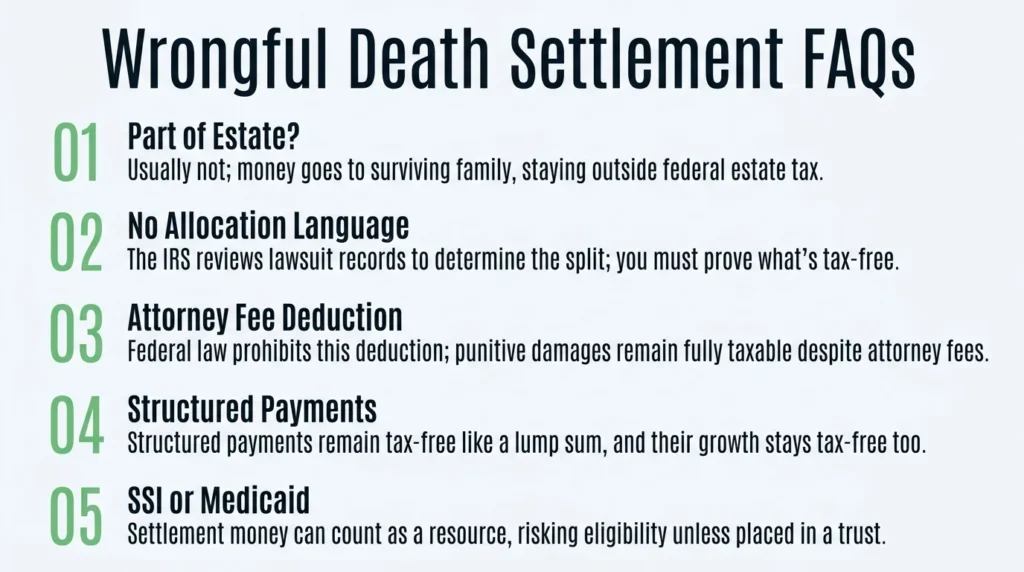
Usually not. The money belongs to the surviving family, not the person who died, so it generally stays out of the estate for federal estate tax purposes.
What happens if the settlement agreement doesn't say how much is compensatory and how much is punitive?
The IRS looks at your original lawsuit and other records to decide how the payment breaks down. You carry the burden of proving which part should be tax-free.
Can I deduct my attorney's fees on the taxable part of a wrongful death settlement?
No. Federal tax law no longer allows this deduction, so you owe tax on the full punitive damages award even though part of it pays your attorney.
Does spreading settlement payments out over time change how they are taxed?
Payments from a properly structured settlement stay tax-free just like a lump sum. The growth on those payments can also stay tax-free, unlike interest earned by investing a lump sum yourself.
Can a wrongful death settlement affect a family member's SSI or Medicaid benefits?
Yes, because both programs are need-based and settlement money can count as a resource that puts you over the limit. Placing funds in a special needs trust or spreading payments out over time can help protect eligibility.
About the Authors

Angel Reyes
Writer
Angel L. Reyes, III is the Founder and Managing Partner of Angel Reyes & Associates. A nationally recognized trial attorney and business leader, Angel has helped over 70,000 injury victims recover more than $1 billion since founding the firm in 1993. Named to the Texas Super Lawyers list annually since 2008, Angel brings Wall Street experience, Ivy League education, and a deep commitment to client advocacy. He is a frequent legal commentator and published author with extensive contributions to legal scholarship, trial strategy, and consumer protection.

Kyle Nicolas
Editor
Kyle Nicolas is the Web Content & SEO Manager at Angel Reyes & Associates. He has more than 10 years of experience as a marketing co...

Angel Reyes
Reviewer
Angel L. Reyes, III is the Founder and Managing Partner of Angel Reyes & Associates. A nationally recognized trial attorney and business...