Bus Accident Involving a Cyclist in Texas


Every article on this site is researched by our internal team, reviewed for legal accuracy against current Texas law, and held to State Bar of Texas advertising standards before publication. We do not publish content that overstates outcomes or makes promises about results.
Learn more about our
editorial standards .
Key Takeaways
- Texas gives you two years to sue a private bus company for a cycling injury.
- Claims against city transit buses require written notice within just six months.
- A cyclist more than 50% at fault under Texas law recovers nothing for the crash.
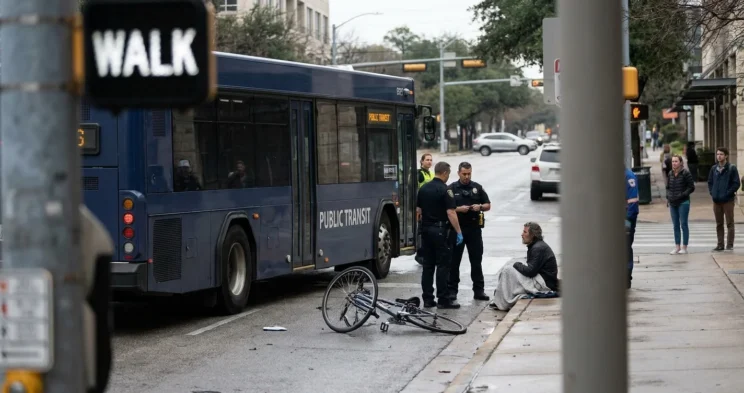
You were riding home along Lamar Boulevard in Austin when a city bus pulled across your lane without warning. Now you are on the pavement, your bike is bent under the bus, and your medical bills are already stacking up. You did nothing wrong, so why does it feel like the deck is stacked against you?
Cyclist Rights on Texas Roads
You have the same rights on the road as any driver behind the wheel. Texas law treats a cyclist as the operator of a vehicle, which means the same right-of-way protections that apply to a car apply to your bicycle.
That legal footing applies the moment a bus strikes you. The bus driver does not get extra deference just because they were driving something bigger.
Texas law does set rules for where you ride on the roadway. A bus driver may try to argue you were positioned improperly on the road at the moment of impact, so your actual road position often becomes a central question.
Bus drivers carry duties of their own. Under Texas Transportation Code Chapter 545, they must follow right-of-way rules and keep a safe passing distance when overtaking or crossing your path.
The stakes for cyclists are real. TxDOT crash data shows cyclists are among the most vulnerable people on Texas roads, and a bus collision often causes some of the worst injuries.
The Duty of Care a Bus Operator Owes Cyclists
Texas treats bus companies as common carriers, which means a heightened duty of care toward passengers. Bus operators must also meet the standard of a reasonable driver toward all road users, including cyclists, and when a bus driver speeds, fails to yield, or changes lanes carelessly, that conduct can support a negligence claim.
The duty does not end at the moment of impact. When a driver hits you and then fails to stop or help, Texas Transportation Code § 550.021 imposes added obligations that can weigh heavily on who is found liable.
Private bus lines answer to federal rules too. Interstate carriers fall under FMCSA safety regulations, and a violation of those safety rules can support your negligence claim on its own.
Cyclists hit by a bus often have more legal options than they expect, and an attorney who handles both bus and bicycle cases can spot every path to compensation.
City Bus vs Private Bus: Why the Difference Matters
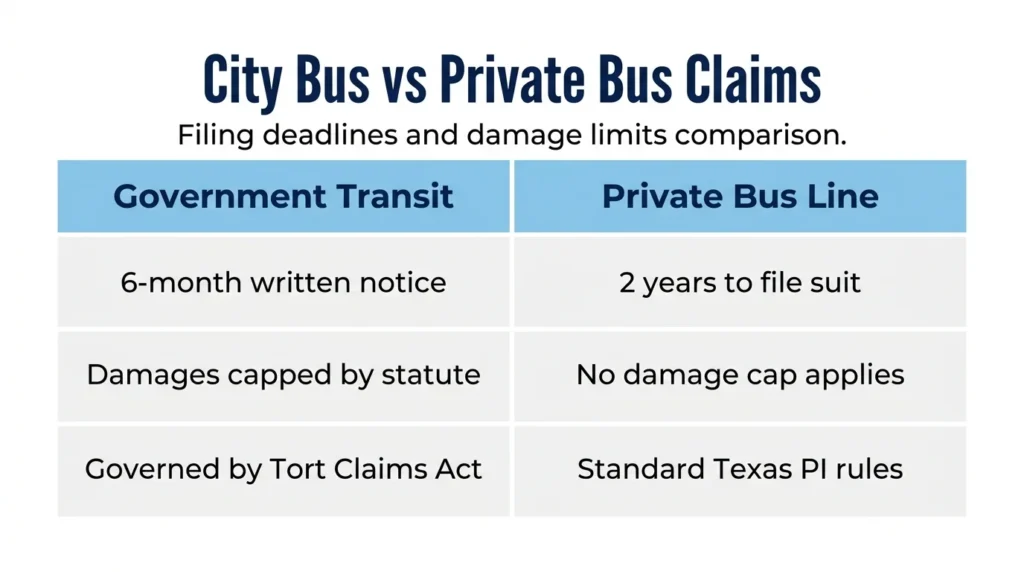
The type of bus that hit you changes almost everything about your claim. A government transit bus and a private bus company follow different filing rules, different deadlines, and different limits on what compensation you can recover.
Claims Against Government Transit Agencies (DART, METRO, VIA, Cap Metro)
Government transit buses like DART, METRO, VIA, and Cap Metro belong to governmental entities. That means your claim runs through the Texas Tort Claims Act, which adds requirements a private claim never faces.
Texas Civil Practice and Remedies Code (CPRC) Chapter 101 gives up sovereign immunity in limited situations, which is what lets your injury claim against a transit agency move forward at all.
The catch is the notice deadline. Under Texas Civil Practice and Remedies Code (CPRC) § 101.101, you must give the government entity formal written notice within six months of the crash. Miss that window and your claim is usually over for good.
An incident report filed at the scene does not count. The law requires a separate written notice sent directly to the government entity, so filing paperwork with the transit agency’s claims office is not enough on its own.
The Tort Claims Act also limits what you can recover from a governmental entity. Your total compensation can be limited even when your actual losses run far higher.
Claims Against Private Bus Companies
Private bus companies do not hide behind sovereign immunity. Charter buses, shuttle services, private coach lines, and interstate carriers all face standard Texas personal injury rules, which usually works in your favor.
You have two years from the date of your injury to file suit under Texas Civil Practice and Remedies Code (CPRC) § 16.003. Let that deadline pass and you give up your right to compensation entirely.
Interstate carriers must also carry federal minimum insurance under 49 CFR Part 387. Those required policy limits often run far higher than a personal auto policy, which can mean more money available to cover your losses.
No damage limit applies to a private carrier. A successful claim can pursue the full range of economic and non-economic damages Texas law allows.
What Compensation Cyclists Can Pursue
You can pursue far more than just your emergency room bill. A bus-cyclist claim typically covers past and future medical costs, lost wages, reduced earning capacity, and pain and suffering. In a fatal crash, surviving family may bring a wrongful death claim as well.
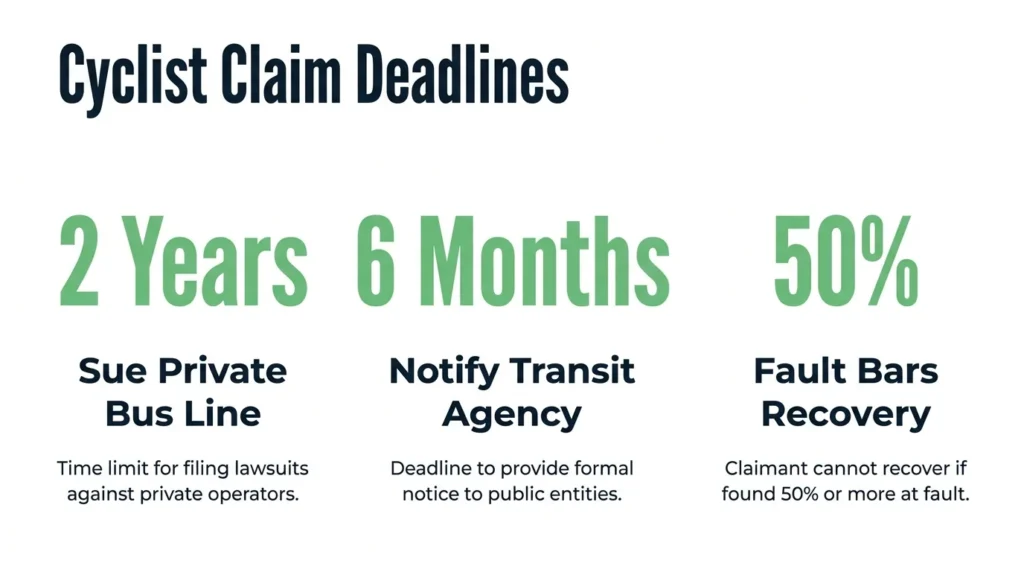
One rule can reduce what you take home. Texas follows a fault-sharing system under CPRC Chapter 33, so a cyclist found more than 50% at fault recovers nothing. Partial fault below that line does not end your claim; it only reduces your award by your share.
This is exactly where bus operators fight back. Their insurers routinely claim you were positioned wrong, failed to yield, or rode unpredictably to shift blame onto you.
A clear record of where you were riding is your best defense. Witness accounts, traffic camera footage, and accident reconstruction can all counter these arguments, and understanding who is liable in a bus accident helps you see what evidence matters most.
The sheer size of a bus works against non-occupants. FMCSA crash data shows bus collisions cause outsized injury severity for people outside the vehicle, which supports a claim for higher damages when a bus’s weight drove the harm.
An attorney familiar with Texas bicycle claims can help gather and preserve this evidence before critical records disappear.
Steps to Take After a Bus Hits You on a Bicycle

The choices you make in the first hours after a crash can protect both your health and your claim. If you are able, work through these steps:
- Step 1: Get emergency medical care right away. Do this even if you feel fine. Internal injuries and brain trauma are common in bus-cyclist crashes and may not show symptoms for hours or days.
- Step 2: Call 911 and make sure a police report is filed. Write down the bus route number, the agency or company name, and the bus number or license plate before you leave.
- Step 3: Photograph everything before it moves. Capture the scene, your bicycle, your injuries, and the bus’s final position. Video from your phone or a nearby traffic camera can be especially valuable later.
- Step 4: Collect contact information from any witnesses. People leave quickly, so get names and phone numbers while they are still at the scene.
- Step 5: Do not give a recorded statement to any insurance adjuster or claims office. Wait until you have spoken with an attorney. Early statements are frequently twisted to minimize or deny your claim.
- Step 6: Act fast if a government bus was involved. You may have as little as six months to file formal written notice, so it helps to know how to file a bus accident claim in Texas and to talk with an attorney promptly.
Work with an Angel Reyes & Associates Attorney
Being hit by a bus while riding leaves you facing serious injuries and a claim that does not fit the usual playbook. Angel Reyes & Associates has spent more than 30 years representing injured Texans in bus and bicycle accident claims across the state. We have more than $1 billion recovered for clients.
There is no fee unless we win, and we handle the costs of building your case. Our team is available 24/7, and you can reach us for a free consultation to learn how we have handled cases like yours.
Past results do not guarantee future outcomes.
Bus-Cyclist Accident FAQs
Can a cyclist recover compensation for a damaged or destroyed bicycle after a bus accident?
Yes. Damage to your bicycle is treated as property damage and can be included in your claim alongside medical expenses and other losses. You can request the repair cost or the fair market value of the bike if it cannot be repaired.
What happens if the bus left the scene without stopping after hitting a cyclist?
File a police report immediately and give officers the bus route number, direction of travel, and any identifying details. Transit agencies log every trip on their vehicles, and traffic camera footage often identifies the bus within hours; a hit-and-run does not end your ability to bring a claim.
If there are no eyewitnesses, can a cyclist still win a claim against a bus operator?
Witness testimony is helpful but not required. Physical evidence, including the damage pattern on your bicycle, your injury documentation, the bus’s event data recorder, and road markings, can establish what happened, and an accident reconstruction expert can translate that evidence into a clear account of fault.
Does a cyclist's own auto or health insurance come into play after a bus accident?
Your health insurance may cover initial medical costs while your personal injury claim is pending, and uninsured motorist coverage on your own auto policy can apply if the bus operator is uninsured or if the bus left the scene without being identified. Coordinating these coverages correctly can affect how much you ultimately net from your total recovery.
If the injured cyclist is a minor, does the filing deadline still apply?
For claims against private bus companies, Texas law pauses the two-year statute of limitations until the minor turns 18, giving them until age 20 to file. Claims against a government transit agency are more complex: the Texas Tort Claims Act’s six-month notice requirement may still apply, so consulting an attorney promptly after the crash is advisable regardless of the injured cyclist’s age.
About the Authors

Angel Reyes
Writer
Angel L. Reyes, III is the Founder and Managing Partner of Angel Reyes & Associates. A nationally recognized trial attorney and business leader, Angel has helped over 70,000 injury victims recover more than $1 billion since founding the firm in 1993. Named to the Texas Super Lawyers list annually since 2008, Angel brings Wall Street experience, Ivy League education, and a deep commitment to client advocacy. He is a frequent legal commentator and published author with extensive contributions to legal scholarship, trial strategy, and consumer protection.

Kyle Nicolas
Editor
Kyle Nicolas is the Web Content & SEO Manager at Angel Reyes & Associates. He has more than 10 years of experience as a marketing co...

Angel Reyes
Reviewer
Angel L. Reyes, III is the Founder and Managing Partner of Angel Reyes & Associates. A nationally recognized trial attorney and business...