Bus Accident Scarring and Disfigurement Claims in Texas


Every article on this site is researched by our internal team, reviewed for legal accuracy against current Texas law, and held to State Bar of Texas advertising standards before publication. We do not publish content that overstates outcomes or makes promises about results.
Learn more about our
editorial standards .
Key Takeaways
- Texas law treats bus accident scarring as an injury that you can be compensated for, separate from pain and suffering.
- Government bus claims require written notice within six months; private claims allow two years.
- Photos, medical records, and a surgeon's testimony build the value of a disfigurement claim.
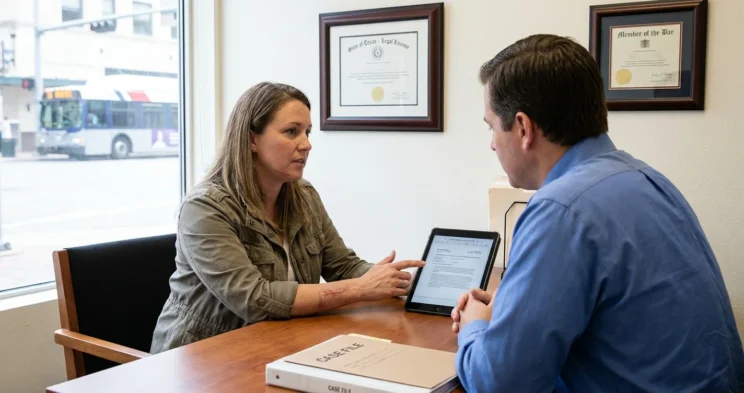
You were riding the bus home along I-35 when another vehicle slammed into the side of the bus, throwing you against a metal rail. Months later, the cuts have healed into scars that will not fade, an insurance adjuster is calling, and the offer on the table does not feel like it properly compensates for the way your skin looks today.
Will Texas law treat your scarring as a real injury worth paying for?
Compensation for Scarring Under Texas Law
Yes. Texas law treats disfigurement as its own injury that you can be paid for, separate from your medical bills and pain. The Texas Civil Practice and Remedies Code (CPRC) § 41.001 lists disfigurement as a named noneconomic damage category.
This means your scarring stands on its own. You do not have to bundle it with pain and suffering or mental anguish to recover damages for it.
Texas courts define “disfigurement” as any permanent change to your body that lessens your physical appearance or attractiveness.
Furthermore, the scar does not have to be on your face to count. A scar on your arm, leg, or back still qualifies as a compensable bus accident injury. The location on your body can affect how much the scar is worth, but it does not decide whether you can claim damages at all.
Texas also splits disfigurement into two parts that you can recover separately:
- Past disfigurement covers the scar as it looks at the time of trial.
- Future disfigurement covers the permanent impairment that you will carry going forward.
A jury can award both parts in a single verdict. So, a scar that you will live with for decades may support a larger claim than the raw injury alone.
How Texas Juries Evaluate Disfigurement
A jury decides disfigurement by looking at the injury directly in the courtroom. There is no fixed formula under Texas law, so the value comes from what the jury sees and believes.
Strong evidence shapes that judgment. Before-and-after photographs, medical illustrations, and testimony from a plastic surgeon all build a clear record of what happened to your body.
Several factors contribute to the amount of damages awarded by the jury. The scar’s size, its location, whether it is permanent, and how it affects your daily life and your job all weigh into the decision.
For working Texans, a visible scar that changes how you do your work or how customers see you can push the value of your claim higher.
In close cases, the jury’s decision often depends on your credibility. Juries sometimes award zero dollars, even when the scarring is clearly visible. Inconsistent testimony, gaps in your medical treatment, or a weak day on the witness stand can sink an otherwise solid claim. That is why early medical documentation protects your claim.
How Revision Surgery and Mental Anguish Increase Damages
Compensation for disfigurement is just one part of the claim. You may also be able to recover damages for economic and noneconomic losses, and each category is proven separately.
Revision Surgery Costs
Revision and reconstructive surgery costs are economic damages. They are not bundled with the disfigurement award, so they must be itemized separately through medical bills, surgical quotes, and testimony on the medical necessity of the surgery.
- Past surgery costs are the simplest to prove. You only have to show the actual bills you paid or were charged.
- Future costs take more work. A plastic surgeon or reconstructive specialist must estimate how many procedures you will need and what each will cost.
Revision surgery is optional, but the at-fault party is still responsible for the full cost of medically necessary work, as long as you can tie that need to the crash.
Mental Anguish from Disfigurement
Mental anguish from living with a changed appearance is its own named damage category under CPRC § 41.001. You can recover for it, but courts require real proof; they won’t just take you at your word.
In this case, evidence includes testimony about depression, pulling away from people, trouble at work, and disruption to your daily routine. The deeper the emotional toll, the stronger your claim may be.
Treatment records and your mental health provider’s testimony are key factors here, but your own honest account of the daily challenges you face is just as important. Review how we have handled serious injury claims to understand how these pieces fit together.
Government vs. Private Bus Operators
The single biggest factor in your deadline is who owned the bus. When a city, county, school district, or public transit authority was operating it, the Texas Tort Claims Act § 101.101 controls your claim. In this case, different laws apply, and you have to act a lot faster.
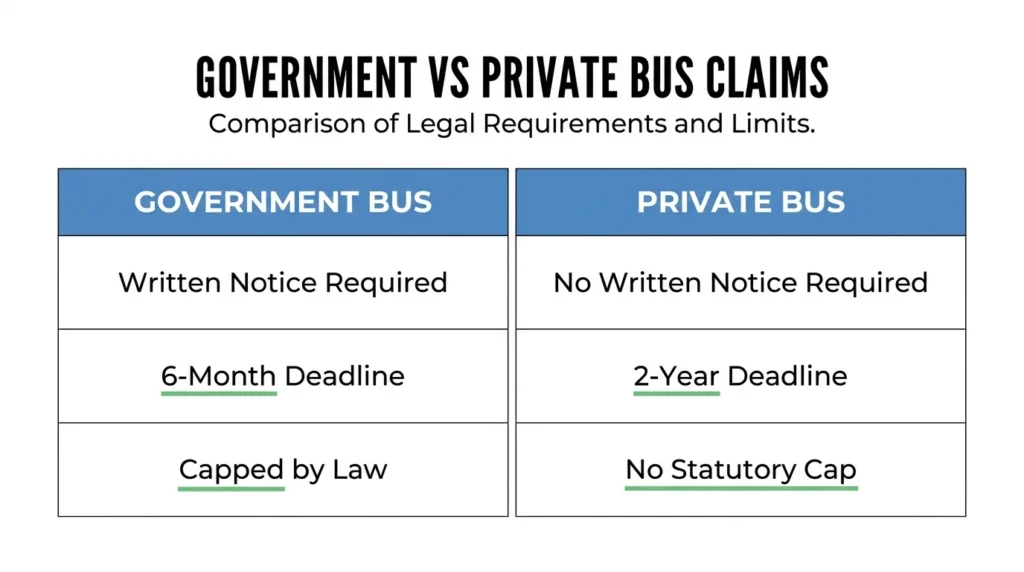
Government claims have rules that private claims do not. Here is how the two types of claims are different:
- Notice deadline on a government bus: You must file a formal written notice of claim within six months of the crash. Missing that deadline dismisses your claim entirely, even if you didn’t know the rule existed.
- Damage caps on a government bus: The Texas Tort Claims Act limits how much you can recover against a government entity, which can reduce your disfigurement and surgery recovery, as compared to a private claim.
- Private carrier deadline: A crash involving a private bus company follows standard negligence rules and a two-year personal injury deadline under Texas Civil Practice and Remedies Code § 16.003. In this case, you’re not required to give formal notice before filing a lawsuit.
The deadlines and limits are very different, so the first thing you should do is confirm which one applies to your case. Read more about the damage limits on government bus claims.
Building a Strong Bus Accident Scarring Claim
A well-documented disfigurement claim depends on proof you gather over time, not all at once. The goal is to establish a clear medical record that shows the scar is permanent, severe, and tied directly to the crash.
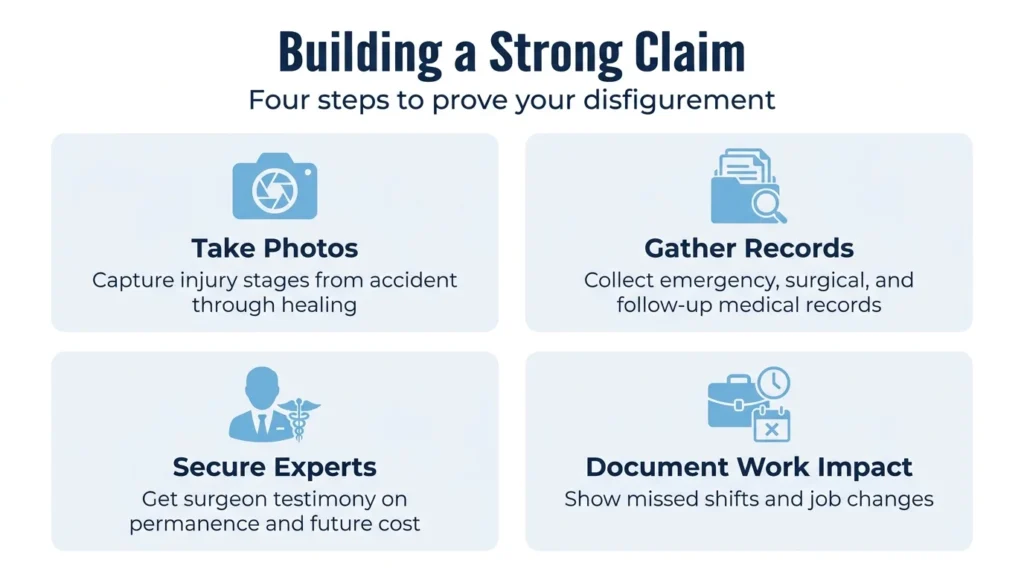
Start by taking photographs at every stage of your recovery. Capture the injury right after the accident, after you are discharged from the hospital, throughout the healing process, and after any surgery. Pictures taken over months show permanence in a way that a single image cannot.
Pull all your medical records next. Get emergency notes, surgical reports, follow-up visits, and any specialist referrals. Missing records can make it harder for a jury to believe your claim.
Secure expert testimony as well. A plastic surgeon or reconstructive specialist can determine whether the scarring is permanent and what future procedures will cost. This is often the difference in how a bus accident claim holds up when closely examined.
Finally, document the effect that the injury has had on your work. Missed shifts, an inability to perform your job, or a change in employment due to your new appearance all support your economic losses and your disfigurement damages.
Talk to an Attorney About Your Bus Accident in Texas
Scarring from a bus crash is a real injury that you can be compensated for, but proving its full value takes careful attention within tight deadlines. Angel Reyes & Associates has spent over 30 years handling serious injury claims, including bus accident disfigurement cases across the state.
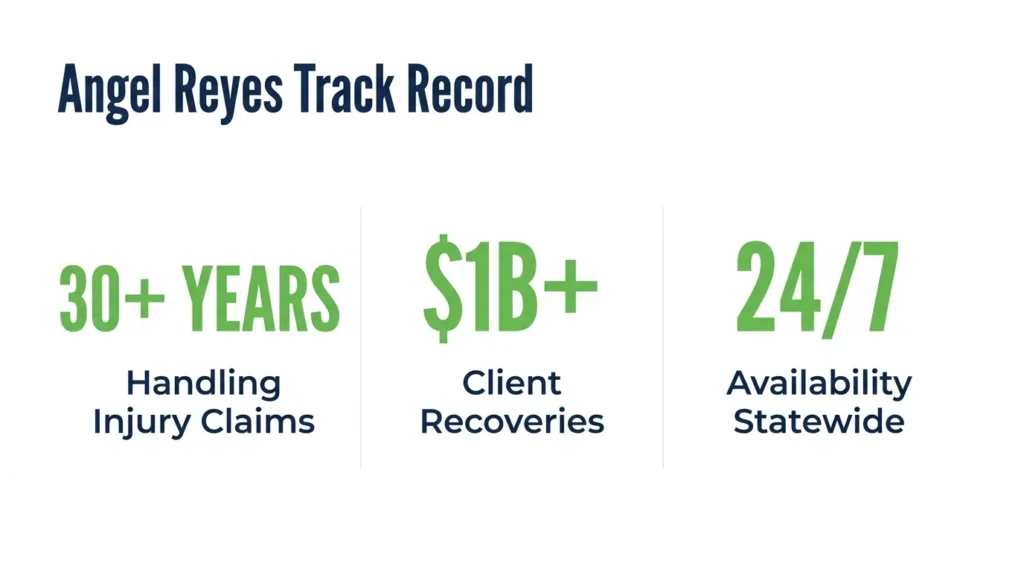
We offer free initial consultations, and we charge no fee unless we win your case. Over the years, we have recovered more than $1 billion for clients, and our team is available 24/7 to help injured Texans anywhere in the state.
You can see what past clients have said about working with us before you decide. When you are ready, contact us for a free consultation to discuss your claim.
Past results do not guarantee future outcomes.
Bus Accident Scarring and Disfigurement FAQs
If my scar improves over time, can I still recover for disfigurement?
Most likely. A scar does not have to last forever to support a disfigurement claim, but whether it will be permanent is a key factor to a jury. If your treating physician or a plastic surgeon can testify that the scar is unlikely to fully resolve, their opinion protects your claim, even if the scar has faded somewhat since the crash.
If my health insurance pays for revision surgery, does that reduce what I can recover from the bus company?
It depends. Texas generally follows the collateral source rule, meaning the bus company’s liability is not reduced just because your health insurer covered some of your medical costs. However, under Texas Civil Practice and Remedies Code Section 41.0105, your recovery for medical expenses is limited to the amount that you actually paid or the debt you actually incurred, not the original billed amount.
How long does a child have to file a bus accident disfigurement claim in Texas?
For claims against a private bus company, the two-year deadline is paused until the injured person turns 18, under Texas Civil Practice and Remedies Code Section 16.001. This means the filing deadline does not begin until the child turns 18, which gives them until they turn 20 to file the claim.
Can I file a disfigurement claim against the bus company if I was riding the bus while on the job and already received workers' compensation?
Yes. Workers’ comp covers your employer’s liability, but it does not stop you from filing a separate personal injury claim against a third party, like the bus company. Under Texas Labor Code Chapter 417, you can pursue both claims, but any workers’ comp benefits you receive may reduce your final recovery amount because part of that money may have to be paid back through a subrogation lien. A subrogation lien is when an insurance company has the right to get paid back from your settlement or judgment for money it already paid on your behalf upfront.
Are there minimum insurance limits that apply to commercial bus companies in Texas?
Yes. The federal regulation under 49 CFR Part 387 requires that interstate for-hire bus carriers operating vehicles designed for 16 or more passengers must carry at least $5 million in liability coverage. This minimum applies regardless of how much your damages are in total, but a settlement or verdict may still be limited, depending on what the carrier’s actual policy covers.
About the Authors

Angel Reyes
Writer
Angel L. Reyes, III is the Founder and Managing Partner of Angel Reyes & Associates. A nationally recognized trial attorney and business leader, Angel has helped over 70,000 injury victims recover more than $1 billion since founding the firm in 1993. Named to the Texas Super Lawyers list annually since 2008, Angel brings Wall Street experience, Ivy League education, and a deep commitment to client advocacy. He is a frequent legal commentator and published author with extensive contributions to legal scholarship, trial strategy, and consumer protection.

Graham Griffin
Editor
Graham Griffin is the Web & Content Manager at Angel Reyes & Associates, where he oversees content strategy, AI-powered workflows, a...

Angel Reyes
Reviewer
Angel L. Reyes, III is the Founder and Managing Partner of Angel Reyes & Associates. A nationally recognized trial attorney and business...