Bus Overcrowding Accident Injuries in Texas


Every article on this site is researched by our internal team, reviewed for legal accuracy against current Texas law, and held to State Bar of Texas advertising standards before publication. We do not publish content that overstates outcomes or makes promises about results.
Learn more about our
editorial standards .
Key Takeaways
- Overcrowding can be operator negligence separate from the crash that injured you.
- Government bus claims require written notice within six months, sometimes just 90 days.
- You have two years to sue a private bus operator under Texas Code Section 16.003.
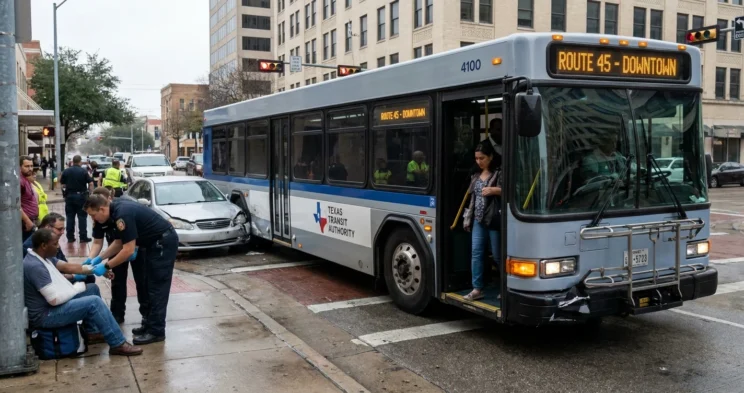
You were standing in the aisle of a packed bus on I-35 in Austin, gripping nothing because every handhold was already taken. The driver braked hard, and you went down with a dozen other riders before you could catch yourself. Now your back is throbbing, and you keep wondering whether all those extra people on the bus made it worse.
How Overcrowding Causes Bus Injuries
Overcrowding makes injuries worse because standing passengers have nothing protecting them when a bus stops short or crashes. A seated rider with a seatbelt absorbs some of that force. You, standing in a crammed aisle, take the full hit.
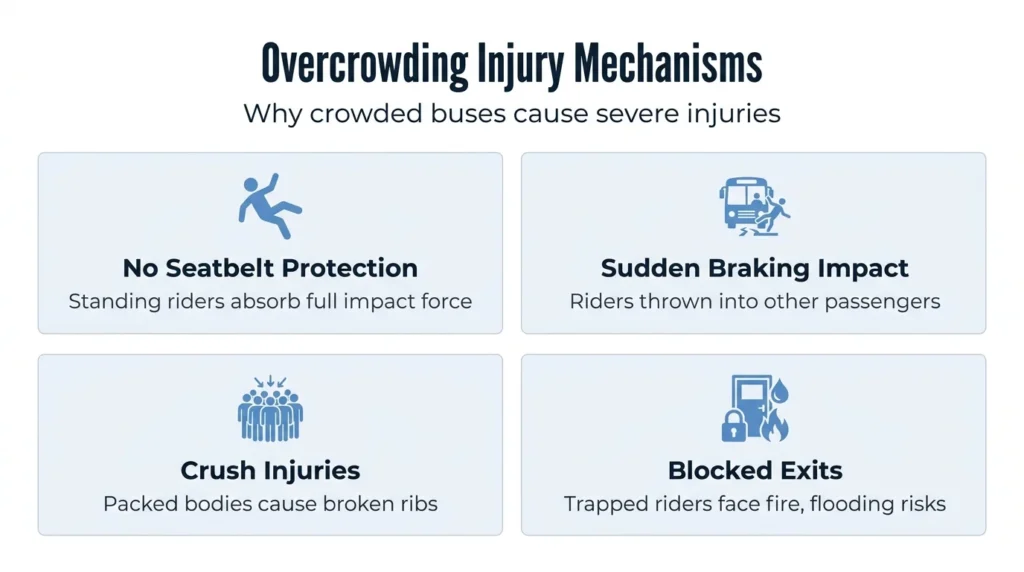
Hard braking or a collision throws standing passengers forward, sideways, or straight into other riders. That motion produces head, neck, and back injuries that seated passengers are partly shielded from. The more crowded the bus, the harder you land.
Crush injuries follow a different pattern. When riders are packed too tightly to brace or pull apart on impact, the bodies around you become part of the force. Broken ribs, deep lacerations, and soft tissue damage are common results.
Then there is the problem of getting out. Blocked aisles and emergency exits can trap you inside a damaged bus. That delay can make your injuries worse and exposes you to secondary hazards like fire or flooding.
These harms can support a negligence claim separate from the crash itself, and riders hurt this way often have options worth reviewing alongside the average bus accident settlement in Texas.
Bus Operator Duty to Control Capacity
Texas treats bus operators as common carriers, which holds them to a high degree of care for your safety from the moment you board until you step off. Allowing a crowd that violates federal standee rules breaks that duty. That breach is the heart of an overcrowding claim.
Federal rules set a clear line. Operators may not run a bus unless every standing passenger stays behind the standee line, and baggage or freight must be stowed to ensure unobstructed access to all exits, under 49 C.F.R. § 392.62. When an operator ignores those rules, the violation becomes direct evidence of negligence.
A companion rule makes the standard visible. Every bus built for standees must display a physical standee line and post a notice that loading past it breaks federal law, under 49 C.F.R. § 393.90. That marking turns overcrowding into something you can document and photograph.
These rules reach most buses you ride. The federal passenger carrier safety framework covers commercial buses designed or used to transport 16 or more people including the driver, or 9 or more passengers that the driver carried. Operators at or above those thresholds must follow the standee and capacity rules.
Texas folds those federal standards into state law. Texas Transportation Code Chapter 644 lets the Texas Department of Public Safety adopt rules matching the federal commercial vehicle regulations. That makes the standee standard enforceable on Texas roads even when no interstate travel is involved.
Knowing which operator put you in that crowded bus shapes everything that follows, including who is liable in a bus accident in Texas. The answer depends on whether the bus was private or government-run.
Private vs Government Bus Liability in Texas
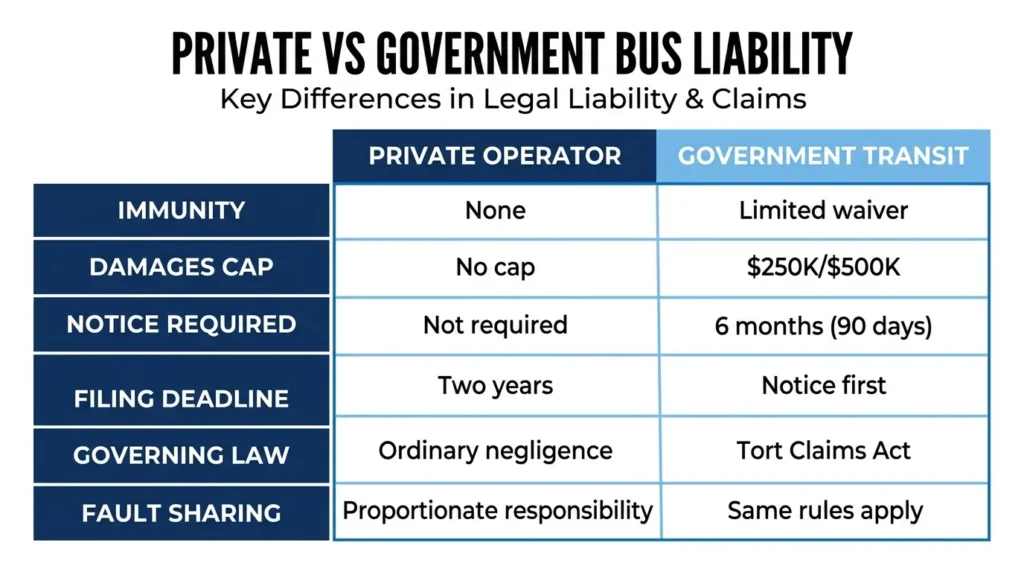
The party that operated your bus decides which set of rules governs your claim. Private operators answer to ordinary negligence law. Government transit agencies sit behind a wall of limited immunity with strict deadlines and capped damages.
Private Charter & Commercial Bus Liability
Private charter companies and commercial operators have no sovereign immunity, so you may sue for full economic and non-economic damages. That means medical bills, lost wages, and pain are all on the table.
Responsibility often reaches past the driver. The company that dispatched the overcrowded bus can share fault, along with managers who set or ignored capacity policy and any contractor handling passenger loading. Several parties can be on the hook at once.
Texas splits fault among them using proportionate responsibility, set out in Texas Civil Practice and Remedies Code (CPRC) Chapter 33. You can still recover as long as your own share of fault does not pass 50 percent. Your damages drop by whatever percentage of fault lands on you.
When an overcrowded bus crash takes a life, the stakes change entirely. Surviving family members can bring a wrongful death claim against the private operator.
Government Transit Authority Liability
Public agencies like DART and METRO operate under a narrow waiver of immunity governed by the Texas Tort Claims Act. You must follow specific procedural steps or lose the right to recover, no matter how strong your case is.
The Act limits what you can collect. Damages are limited to $250,000 per person and $500,000 per occurrence for claims against government transit authorities, under the Texas Civil Practice and Remedies Code Chapter 101.
The clock is also much shorter. You must give written pre-suit notice within six months of the incident under CPRC § 101.101, and some city charters cut that to 90 days in Houston and San Antonio. Missing the window can end your claim before it begins, so understanding the Texas Tort Claims Act bus accident limits early matters.
Filing Deadlines for Texas Bus Injury Claims
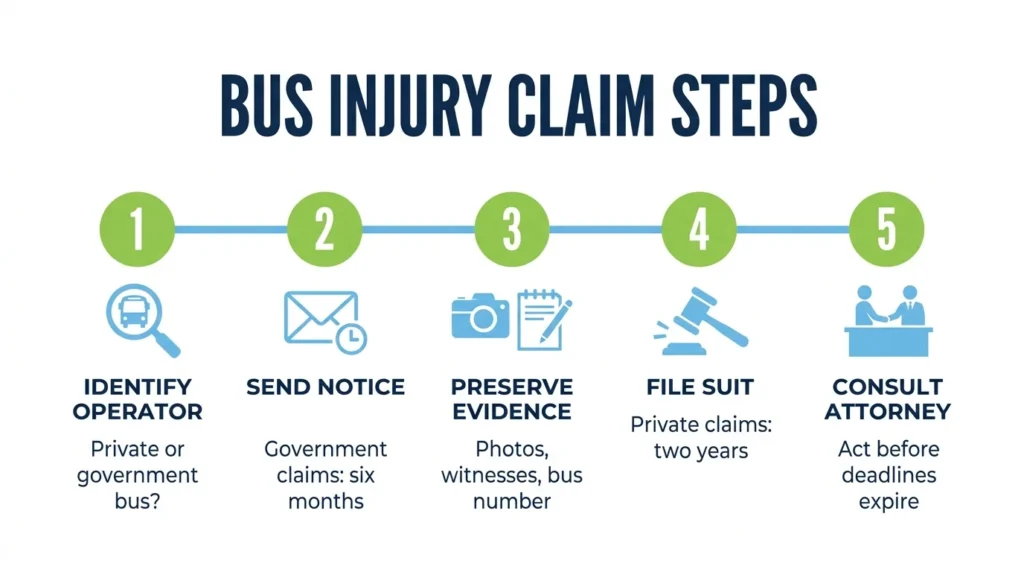
Your deadlines depend entirely on who operated the bus, and the shortest ones arrive fast. Follow these steps in order to protect your right to recover compensation:
- Step 1: Identify the operator. Determine whether a private company or a government transit authority ran the bus. This single fact decides which deadlines apply and what steps you must take.
- Step 2: Send government notice early. If a government transit authority operated the bus, submit written pre-suit notice within six months of the incident. Houston and San Antonio city charters cut that to 90 days.
- Step 3: Preserve the evidence now. Record the bus number, route, and time, and collect witness contacts. Photograph the overcrowding and any standee line markings while they are still in front of you.
- Step 4: File suit against a private operator within two years. A personal injury lawsuit against a private operator must be filed within two years of the injury date under the Texas Civil Practice and Remedies Code § 16.003.
- Step 5: Talk to an attorney before the deadlines pass. Notice and filing windows are strict, and missing one usually means no compensation, no matter how strong your claim is. Acting early gives you the most room.
Work with a Knowledgeable Attorney
If overcrowding played a part in your injury, you do not have to sort out the operator question, the deadlines, and the federal rules on your own. Angel Reyes & Associates represents injured passengers across Texas, including riders hurt on overcrowded private charter buses and on government transit vehicles.
We bring more than 30 years of experience to these cases, and we have more than $1 billion recovered for clients. Our consultations are free, and there is no fee unless we win your case. You also pay nothing up front, since we work on contingency and front the costs of building your claim.
Time runs short on bus injury claims, especially against government buses. Reach out for a free consultation so you understand your options before a deadline closes the door. We can also point you to our office locations across Texas.
Past results do not guarantee future outcomes.
Bus Overcrowding Accident Claim FAQs
Do you have to be in a collision to file a bus injury claim in Texas?
No. A crash is not required. Texas courts have held that hard braking, a sharp turn, or any sudden movement that causes a standing passenger to fall can support a negligence claim if the operator breached its duty of care.
Are school buses subject to the same federal overcrowding rules as commercial buses?
No. School district bus operations are exempt from most FMCSA regulations, including the standee line requirements. Claims involving school buses are governed by separate state rules and the Texas Tort Claims Act rather than federal commercial carrier standards.
If a child was hurt on an overcrowded bus, do the filing deadlines change?
The two-year deadline to sue a private operator is tolled until the child turns 18, giving them until age 20 to file. Government notice deadlines, however, still apply promptly after the incident, so those steps should not wait.
What if another driver caused the crash that injured you on an overcrowded bus?
You may have claims against both the bus operator and the at-fault driver. Texas proportionate responsibility rules allow fault to be split among multiple parties, and a passenger can pursue both sources of recovery at the same time.
Does workers' compensation cover you if you were hurt on a bus while traveling for work?
If the injury happened during a routine commute, workers’ compensation typically does not apply and the claim is treated as a personal injury matter. If you were traveling on your employer’s behalf at the time, your employer’s coverage may become relevant and the analysis changes.
About the Authors

Angel Reyes
Writer
Angel L. Reyes, III is the Founder and Managing Partner of Angel Reyes & Associates. A nationally recognized trial attorney and business leader, Angel has helped over 70,000 injury victims recover more than $1 billion since founding the firm in 1993. Named to the Texas Super Lawyers list annually since 2008, Angel brings Wall Street experience, Ivy League education, and a deep commitment to client advocacy. He is a frequent legal commentator and published author with extensive contributions to legal scholarship, trial strategy, and consumer protection.

Kyle Nicolas
Editor
Kyle Nicolas is the Web Content & SEO Manager at Angel Reyes & Associates. He has more than 10 years of experience as a marketing co...

Angel Reyes
Reviewer
Angel L. Reyes, III is the Founder and Managing Partner of Angel Reyes & Associates. A nationally recognized trial attorney and business...