Can a Shipper Be Liable for a Tired Truck Driver?


Every article on this site is researched by our internal team, reviewed for legal accuracy against current Texas law, and held to State Bar of Texas advertising standards before publication. We do not publish content that overstates outcomes or makes promises about results.
Learn more about our
editorial standards .
Key Takeaways
- Waiting at a dock counts as on-duty time and burns the driver's 14-hour window.
- Under Texas law, a passive shipper owes no duty, but its own conduct can create one.
- Gate logs, dock records, electronic log entries, and detention invoices prove delay.

The Short Answer: Usually No, But Sometimes Yes
A tractor-trailer drifts out of its lane on I-35 at the end of a long day, and the people it hits are left asking who besides the driver should answer for it.
Usually the company whose freight was in that trailer is not on the list. A shipper that hands ordinary goods to a federally regulated motor carrier owes no duty of care to the motoring public for how that carrier’s driver drives. The Supreme Court of Texas held exactly that in In re Home Depot U.S.A., Inc., No. 25-0317 (Tex. May 15, 2026), conditionally granting mandamus and ordering the negligence claims against the shipper dismissed.
Two things survived. A shipper or receiver that controls the details of the driver’s work is not a passive shipper. Neither is one that takes affirmative acts creating or increasing the danger.
Detention is where that line gets tested. Detention time trucking disputes tend to start the same way: a facility holds a driver on its dock for hours, then insists on an appointment that can no longer be met legally.
That is the facility’s own conduct, not passive receipt of goods.
One more point matters before the details. Even when an injured person cannot recover from the facility, the detention records still count, because the carrier will very likely try to shift blame onto the facility.
What follows is the clock, the line, and the evidence. If you are early in a Texas truck accident claim, start with the clock.
What Detention Time Is, and Why It Is a Safety Problem
Detention is the time a driver spends at a shipper’s or receiver’s facility waiting to load or unload beyond what the parties treated as normal. The Federal Motor Carrier Safety Regulations (FMCSR) do not define it. The term comes from commercial practice and federal study work, which is part of why it goes unmeasured.

The safety cost has been estimated at the federal level. In Estimates Show Commercial Driver Detention Increases Crash Risks and Costs, but Current Data Limit Further Analysis (Jan. 31, 2018), the Department of Transportation Office of Inspector General (DOT OIG) estimated that a 15-minute increase in average dwell time increases the average expected crash rate by 6.2 percent.
DOT OIG cautioned in the same report that accurate industrywide data on driver detention do not currently exist. The 6.2 percent figure is an agency estimate, not a settled count.
The Federal Motor Carrier Safety Administration (FMCSA)-funded Virginia Tech Transportation Institute study Impact of Driver Detention Time on Safety and Operations reports that roughly two-thirds of drivers experience detention each month. That study is still underway, and no final report has been published.
Fatigue is how a delay at a dock becomes a crash on a highway. Occupational Safety and Health Administration (OSHA) reports that after 17 consecutive hours awake, impairment is estimated to be equivalent to a blood alcohol content of .05, and after 24 hours awake, equivalent to a BAC of .10.
OSHA describes what that looks like behind the wheel:
- Reacting more slowly to changing road conditions, other drivers, or pedestrians
- Drifting from the travel lane
- Experiencing brief sleep episodes lasting from a fraction of a second up to 30 seconds
- Forgetting the last few miles driven
How Dock Waiting Eats the 14-Hour Window
Under 49 CFR 395.2, on-duty time is all time from the moment a driver begins work or is required to be in readiness to work until the driver is relieved from work and all responsibility for performing work.
The enumerated categories are explicit about docks. They include all time at a plant, terminal, facility, or other property of a motor carrier or shipper waiting to be dispatched, and all time loading or unloading a commercial motor vehicle.
Driving time under the same section is only time spent at the driving controls of a commercial motor vehicle in operation. Detention is on-duty-not-driving; it is not rest.
49 CFR 395.3 closes the trap. A driver may not drive after a period of 14 consecutive hours after coming on duty following 10 consecutive hours off duty, with a total of 11 hours of driving allowed inside that window.
The window runs on the clock, not on miles. The arithmetic on an ordinary Dallas-area run works like this:
- 6:00 a.m. Gate-in. The 14-hour window opens and closes at 8:00 p.m.
- 6:00 a.m. to 10:00 a.m. The truck waits in the yard for a door. Four hours of on-duty-not-driving.
- 10:00 a.m. to 11:30 a.m. Loading at the door. Still on duty, still not driving.
- 11:30 a.m. The driver rolls with 8.5 hours left and an appointment set on the assumption of a full day.
Five and a half hours are gone before the first mile, and there is no way to get them back short of a full 10-hour reset.
One nuance cuts the driver’s way. Under 395.3, driving is not permitted once more than 8 hours of driving time have passed without at least a consecutive 30-minute interruption, and that interruption may be satisfied by off-duty, sleeper berth, or on-duty-not-driving time. Dock time can satisfy the break. It still does nothing for the 14-hour window.
Our overview of Texas truckers’ hours of service regulations covers the penalties and the full duty-status framework.
Interstate Versus Intrastate Texas Runs
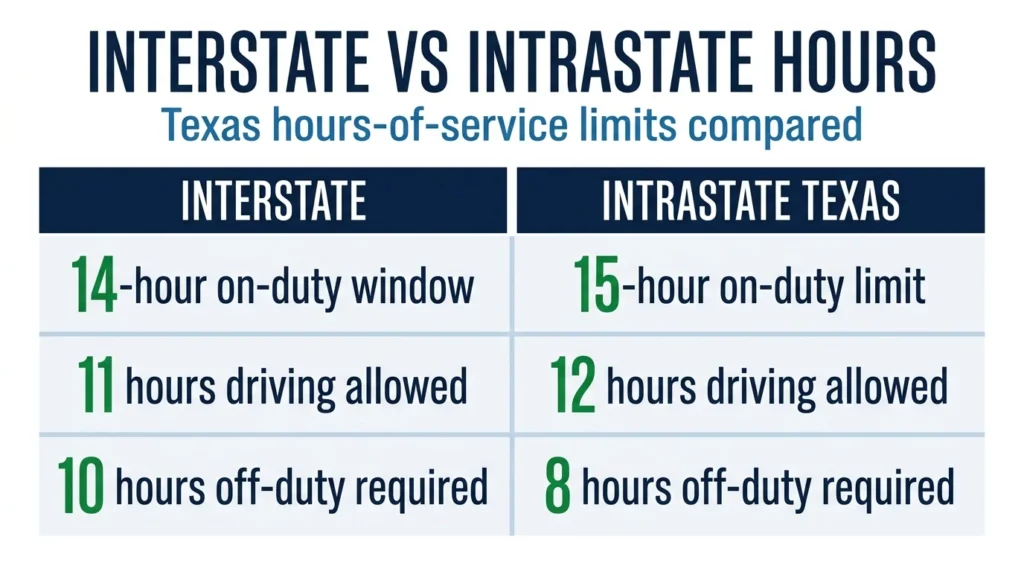
The 14-hour figure is a federal interstate number, and Texas does not apply it to purely intrastate runs. Under 37 Tex. Admin. Code § 4.12(a)(2), 49 CFR 395.3 does not apply to intrastate commerce.
Texas intrastate drivers may drive 12 hours following 8 consecutive hours off duty, and may not drive after 15 hours on duty following 8 consecutive hours off duty. A driver who violates those limits is placed out of service for 8 consecutive hours.
An accurate statement of truck detention time law in Texas therefore carries two numbers:
- a 14-hour on-duty window for interstate runs
- a 15-hour on-duty limit for purely intrastate runs
The detention mechanic is identical. Only the number changes.
The rest of the federal framework still reaches Texas intrastate carriers, because 37 Tex. Admin. Code § 4.11(a) incorporates the federal motor carrier safety regulations by reference.
When the Facility That Held the Driver Is More Than a Passive Shipper
The line In re Home Depot drew separates status from conduct. Being the shipper is not enough. Taking an action that creates or increases a danger on a public highway is a different question.
The Court reasoned from the general Texas rule that one generally has no duty to control the conduct of another, and found that Home Depot undertook no affirmative acts that created or increased the danger.
It rejected negligent selection on those facts. If the carrier’s authority to operate did not come from the shipper, the Court reasoned, the shipper cannot be said to have put that carrier’s trucks on the road in any legally meaningful sense. Vetting more than a million regulated carriers would be neither practical nor workable.
The Court contrasted United Rentals North America, Inc. v. Evans, where the shipper’s own employees loaded oversized equipment onto an incompatible trailer without required permits and created an actual highway danger. Home Depot’s freight, in the Court’s framing, was onboard but uninvolved.
The difference is not the size of the company or the value of the load. A passive shipper tenders freight, pays the rate, and leaves the driving to a carrier that answers to federal regulators. A detaining facility sets the appointment, controls the gate, decides when a door opens, and decides whether that appointment moves after its own yard has consumed the driver’s day.
What the Texas Supreme Court Preserved
Three paths survived the opinion, and they are the real subject of this article:
- Affirmative acts that create a danger on a public highway
- Cargo presenting an unusual hazard or risk, on which the Court expressly reserved opinion
- Control over the injury-producing actor, the instrumentality, or the premises
One caution belongs here. The opinion contains no analysis of delivery scheduling or appointment-time control, no analysis of detention, and no analysis of driver fatigue or hours of service. In re Home Depot did not decide the detention scenario.
That makes the detention theory an argument a plaintiff would have to build and prove, not settled Texas law. We are not aware of a Texas decision imposing liability on a detaining facility for a fatigued driver’s highway crash.
The conduct that would have to be proven looks like this:
- Setting or refusing to move an appointment after the facility itself consumed the driver’s clock
- Withholding paperwork or a delivery receipt until the driver complied
- Refusing to let the driver take required rest on the property
- Directing the driver’s movements and sequence on the dock
- Instructing the driver to log dock time as off duty
The Federal Anti-Coercion Rule, & What It Does Not Do
Federal law reaches the facility directly, within limits. 49 CFR 390.6 prohibits coercion by a motor carrier, shipper, receiver, or transportation intermediary, and the hours-of-service rules sit inside the range it covers. 49 CFR 390.13 adds that no person shall aid, abet, encourage, or require a motor carrier or its employees to violate the rules of the chapter.
The definition has a trigger. 49 CFR 390.5 defines coercion in terms of conditions which the driver stated would require a violation. The driver has to have said something.
FMCSA drew the boundary itself. In the final rule Prohibiting Coercion of Commercial Motor Vehicle Drivers, 80 Fed. Reg. 74695 (Nov. 30, 2015), the agency stated that the rule does not require shippers, receivers, and transportation intermediaries to monitor a driver’s hours-of-service compliance, and that those parties cannot commit coercion unless and until the driver puts them on notice.
The same preamble acknowledged that withholding a delivery receipt might be used to coerce a driver into violating the safety rules, and recorded driver reports of being told to deliver on a schedule impossible to meet legally.
Here is the limitation that matters to an injured motorist. The coercion rule is a federal enforcement mechanism carrying a civil penalty that FMCSA adjusts annually for inflation, not a claim you file. Available authority does not establish a private right of action under 49 CFR 390.6, so its value in a Texas injury case is as a standard of conduct, as an evidence hook, and as support for designating the facility a responsible third party.
One distinction keeps cases straight. An injury on the dock is a premises analysis. A highway crash miles later is a different case.
For a broader view of the parties who can end up in a commercial vehicle case, see our overview of who is liable in a truck accident.
The Detention Evidence Spine, & Who Ends Up Paying

Four records prove a detention case, and most of them do not sit with the trucking company. They sit with the facility, which is why someone has to ask for them early.
- Gate-in and gate-out records. Facility yard-management and gate systems timestamp arrival and departure. These are the cleanest objective measure of how long the facility held the truck, and they sit with the facility rather than the carrier.
- Dock and door assignment logs. These show when the driver was actually given a door versus left staged in the yard. The gap between gate-in and door assignment is often the bulk of the detention.
- On-duty-not-driving segments in the electronic logs. 49 CFR 395.8(b) requires duty status to be recorded as Off duty, Sleeper berth, Driving, or On-duty not driving. A long ON segment with no movement, geotagged at the facility, is the detention event in the regulated record. Dock time booked as OFF is the tell for falsification.
- Detention invoices and accessorial billing. A detention charge is the facility’s own admission, in its own accounting, of how long it held the truck and that the delay exceeded the agreed free time. Rate confirmations and broker records set the free-time threshold.
Speed matters. Under 49 CFR 395.8(k)(1), a motor carrier must retain records of duty status and supporting documents for not less than 6 months from the date of receipt, and drivers must keep the previous 7 consecutive days available for inspection.
Six months is a floor, not a promise. A preservation and spoliation letter belongs in the first weeks of a case, and it has to go to the facility as well as the carrier.
49 CFR 395.11 governs the paper around the logs. Drivers submit supporting documents to the carrier within 13 days, and the retained categories include bills of lading, itineraries and trip documents, dispatch and trip records, expense receipts for on-duty non-driving time, fleet management and electronic mobile communication records, and payroll or settlement sheets.
Carriers generally need not retain more than eight supporting documents per driver per 24-hour period. What they keep must be matched to the corresponding record of duty status and may not be obscured, defaced, or altered.
The dispatch and electronic mobile communication records are where the pressure lives. That is the message traffic about whether the appointment could still be made.
Two more items round out the file. The bill of lading and appointment confirmation establish the promised window and who set it. The driver’s own statement and any coercion complaint matter because 49 CFR 390.5 turns on what the driver stated, and because 49 CFR 390.6 lets a driver file a written complaint with FMCSA describing the coercive action and identifying the regulation involved.
Be clear about who the defendants usually are. In re Home Depot removed the shipper, not the carrier. The carrier owns hours-of-service compliance, dispatch decisions, and the decision to accept an appointment that could not be met. In most detention-fatigue crashes, the carrier is where the recovery is.
Proportionate responsibility is the practical lever. Under Tex. Civ. Prac. and Rem. Code § 33.003, the trier of fact determines the percentage of responsibility, stated in whole numbers, for each claimant, each defendant, each settling person, and each designated responsible third party, and no question may be submitted without sufficient evidence to support it.
Under § 33.004(a), a defendant may move for leave to designate a responsible third party, and that motion must be filed on or before the 60th day before trial unless the court finds good cause for a later filing.
So even where an injured person cannot recover from the facility directly, the carrier will very likely designate it and try to shift blame. That is why the detention evidence belongs in the plaintiff’s file from the beginning.
The filing deadline runs on its own clock. Tex. Civ. Prac. and Rem. Code § 16.003(a) requires a personal injury suit not later than two years after the day the cause of action accrues. Subsection (b) applies the same two years to an action for injury resulting in death, with the cause of action accruing on the death of the injured person, which is the deadline that governs a Texas wrongful death claim after a fatal truck crash.
Talk to a Texas Truck Accident Lawyer Before the Records Disappear
The records that prove detention are the ones most likely to disappear first. Gate and dock logs sit with the facility, and the federal floor for keeping records of duty status is six months.
The two-year filing deadline is the outer limit, not the working one. Preservation letters have to go out while the files still exist.
Angel Reyes & Associates has guided injured Texans for over 30 years, serves clients across Texas, is available 24/7, and works with clients in English and Spanish. Contact us for a free consultation and bring what you have: the police report, the carrier’s name, and the delivery location if you know it.
Past results do not guarantee future outcomes.
Shipper Liability for Driver Fatigue FAQs
Is there a legal limit on how long a shipper or receiver can hold a truck driver at a dock?
No. The federal motor carrier safety regulations do not define detention time and do not cap how long a facility may keep a truck on its property. The limits that actually bite come from somewhere else: the driver’s hours-of-service clock, which runs the entire time the truck sits (49 CFR 395.2 and 49 CFR 395.3), and the free time written into the shipping arrangement. That is why a long hold usually shows up as a billing line rather than as a safety violation by the facility. Rate confirmations and broker records set the free time the delay is measured against, and the detention invoice is the facility’s own accounting of how far past it the truck sat.
Can a truck driver refuse to drive after detention has eaten the clock?
Yes. The hours-of-service limits are not negotiable, and a driver who is out of hours may not lawfully drive. Federal law also backs a driver who says so. 49 CFR 390.6 prohibits a motor carrier, shipper, receiver, or transportation intermediary from coercing a driver into violating those rules, and 49 CFR 390.5 defines coercion to include threatening to withhold business or work opportunities, or taking adverse employment action, to induce a driver to operate under conditions the driver stated would require a violation. The driver’s own words are what activate the rule. The Federal Motor Carrier Safety Administration (FMCSA) has said a facility cannot commit coercion unless and until the driver puts it on notice, and a driver may file a written complaint with FMCSA describing the coercive action and identifying the regulation involved. In a later injury case, that complaint or any contemporaneous record that the driver objected is often what separates a provable pressure theory from speculation.
Do the same hours-of-service numbers apply to a purely intrastate Texas run?
No, and the difference is easy to miss. Under 37 Tex. Admin. Code § 4.12(a)(2), 49 CFR 395.3 does not apply to intrastate commerce. A Texas intrastate driver may drive 12 hours following 8 consecutive hours off duty and may not drive after 15 hours on duty following 8 consecutive hours off duty, and a violation carries an 8-hour out-of-service order. So the on-duty ceiling is 14 hours for an interstate run and 15 hours for a purely intrastate one. Which set of numbers applies depends on the run itself, not on anything the injured person has to work out. Either way, dock time counts against the driver’s clock the same way.
What if the injury happened on the facility's property instead of on the highway?
That is a different case. An injury that happens in the yard or at the dock is a premises analysis, turning on the condition of the property and who controlled it. A crash that happens miles later, after the driver leaves, is a highway negligence question about the driver, the carrier, and whose conduct put a fatigued driver on the road. The two should not be run together, even when the same delay sits at the center of both.
Does any of this apply to a freight broker rather than a shipper or receiver?
Partly. For coercion purposes, 49 CFR 390.5 and 390.6 name transportation intermediaries alongside shippers and receivers, so a broker that pressures a driver to run after being told the schedule cannot be met legally is within the reach of the same federal prohibition. The Texas duty question is less settled. In re Home Depot U.S.A., Inc., No. 25-0317 (Tex. May 15, 2026) involved a shipper whose goods were on the truck, and the opinion did not address brokers. How a Texas court would apply that reasoning to an intermediary is an open question, so a broker’s role is worth documenting early rather than assuming it is either covered or excluded.
About the Authors

Angel Reyes
Writer
Angel L. Reyes, III is the Founder and Managing Partner of Angel Reyes & Associates. A nationally recognized trial attorney and business leader, Angel has helped over 70,000 injury victims recover more than $1 billion since founding the firm in 1993. Named to the Texas Super Lawyers list annually since 2008, Angel brings Wall Street experience, Ivy League education, and a deep commitment to client advocacy. He is a frequent legal commentator and published author with extensive contributions to legal scholarship, trial strategy, and consumer protection.

Graham Griffin
Editor
Graham Griffin is the Web & Content Manager at Angel Reyes & Associates, where he oversees content strategy, AI-powered workflows, a...

Angel Reyes
Reviewer
Angel L. Reyes, III is the Founder and Managing Partner of Angel Reyes & Associates. A nationally recognized trial attorney and business...