Can Missing Truck Maintenance Records Prove Negligence?


Every article on this site is researched by our internal team, reviewed for legal accuracy against current Texas law, and held to State Bar of Texas advertising standards before publication. We do not publish content that overstates outcomes or makes promises about results.
Learn more about our
editorial standards .
Key Takeaways
- A missing or blank DVIR is evidence of a federal violation, not automatic proof.
- Texas adopts 49 CFR Part 396, so intrastate carriers owe the same record duties.
- DVIRs are kept three months, so send a preservation letter fast after a crash.
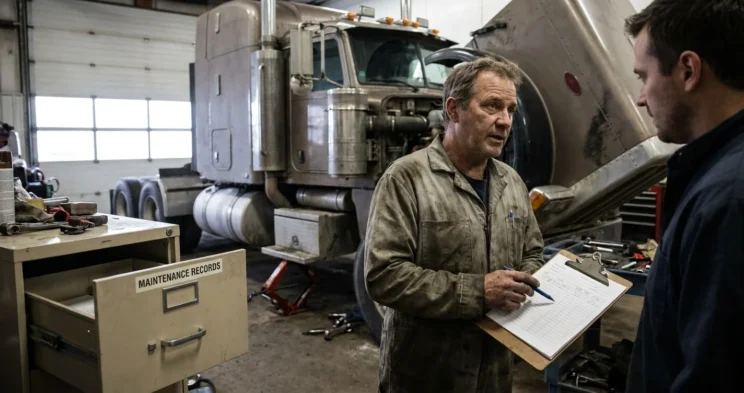
You asked the trucking company for the truck’s inspection paperwork, and what came back has holes in it. Some days have no report at all, while others are signed but blank.
Missing maintenance records do not prove negligence on their own. They do something close to it by becoming evidence that the carrier violated a specific federal duty, and they can raise a separate question about whether evidence was destroyed after your crash.
Those are two different arguments built from the same gap in the file, and each one runs on its own timeline.
What a DVIR Is, and What a Missing or Falsely Certified One Means
A DVIR is the written report a truck driver must complete at the end of every duty day. When one is missing, left blank, or certified as repaired with nothing behind it, that gap is direct evidence the carrier broke a federal rule with a clearly defined standard.
Under 49 CFR § 396.11, every motor carrier must require a written driver vehicle inspection report at the end of each day’s work. The report identifies the vehicle and lists any defect or deficiency that would affect safety or risk a mechanical breakdown, covering items such as brakes, steering, lighting, tires, wheels and rims, coupling devices, and emergency equipment.
The driver signs the report. Before that truck is dispatched again, the carrier or its agent must certify on the same DVIR that the listed defect was repaired, or that repair was not necessary.
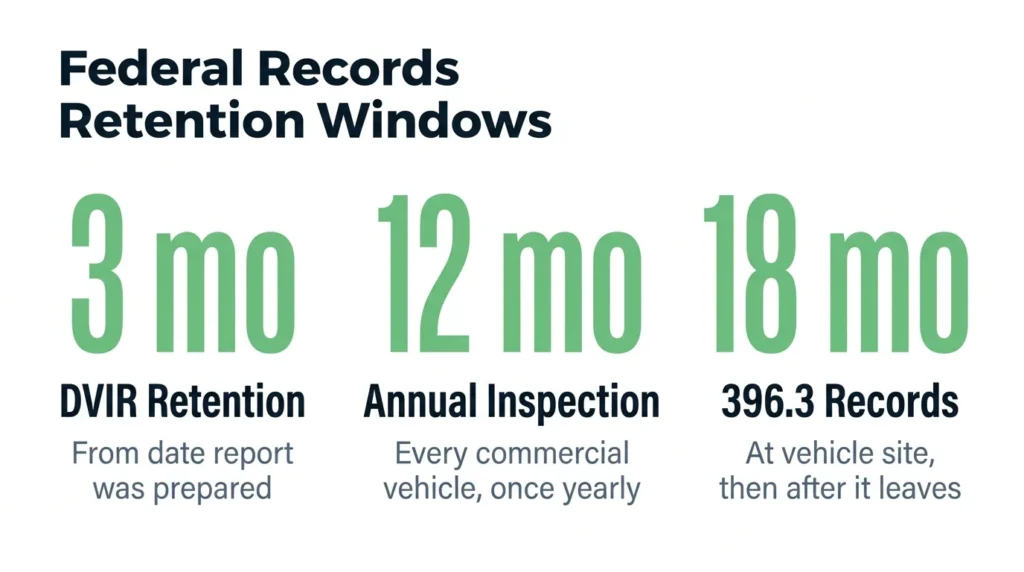
The rule also starts a clock. The DVIR, the repair certification, and the certification that the driver reviewed the prior report must be kept for three months from the date the report was prepared. Federal rules allow carriers to keep these records electronically.
Three months is short, so a DVIR from the week of your crash can age out of that window before you finish your first round of medical appointments.
None of that makes a blank DVIR automatic proof of negligence, it makes the DVIR evidence of a certification duty violation. Texas truck accident claims often turn on paperwork of this kind long before anyone argues about the crash itself.
The Carrier’s Systematic Maintenance Duty and the Annual Inspection Requirement
Daily DVIRs are only one layer of the record. Separate rules require carriers to maintain their fleet on a system, document that work truck by truck, and put every commercial vehicle through a full inspection once a year.
49 CFR § 396.3 and 49 CFR § 396.17 set out those duties:
- 396.3(a): Carriers must systematically inspect, repair, and maintain all vehicles and intermodal equipment so critical safety components such as the frame, suspension, axles, wheels, and steering stay in safe operating condition.
- 396.3(b): For each vehicle, the carrier must keep identification information, an inspection and maintenance schedule, a record of inspections, repairs, and maintenance showing dates and the nature of the work performed, and test records for bus emergency equipment.
- 396.3(c): Those records must be kept where the vehicle is housed or maintained for one year, and for six months after the vehicle leaves the carrier’s control.
- 396.17: Every commercial motor vehicle must pass an inspection of the components listed in Part 396 Appendix A at least once every 12 months, and each unit in a combination counts separately, including the tractor, semitrailer, full trailer, and converter dolly.
A carrier can run the annual inspection itself or send the truck to a qualifying commercial garage, fleet leasing company, or truck stop with qualified inspectors. A qualifying government inspection can substitute for it.
The documentation must stay with the vehicle. It has to show the inspection date, the name and address of the inspecting entity, the vehicle identification, and a certification that the vehicle passed.
A carrier that skips the required annual inspection is exposed to federal penalties. Those files are where a pattern of trucking company negligence becomes clear. One missed repair is a bad day, while a year of undocumented maintenance is a practice.
Why These Federal Rules Apply to Texas Trucking Companies
These duties are not limited to carriers hauling loads across state lines. Texas adopts the same federal rules for trucks that never leave the state.
37 Tex. Admin. Code § 4.11 incorporates by reference 49 CFR Parts 40, 380, 382, 385 through 387, 390 through 393, and 395 through 397 for commercial vehicles operating intrastate in Texas. That last range includes Part 396, which carries the DVIR, maintenance record, and annual inspection requirements.
The same section designates the FMCSA director as the relevant authority for intrastate enforcement in Texas.
That reach counts for your case, as a regional carrier running aggregate down I-35 between Dallas and Waco owes the same recordkeeping duties as a national fleet moving freight along I-10 toward El Paso.
The Negligence Per Se Pathway: Using a Regulatory Violation as Evidence
A regulatory violation can support a negligence claim in Texas, but the court decides first whether the rule fits the claim. That screening step is why a records gap is powerful evidence rather than an automatic win.
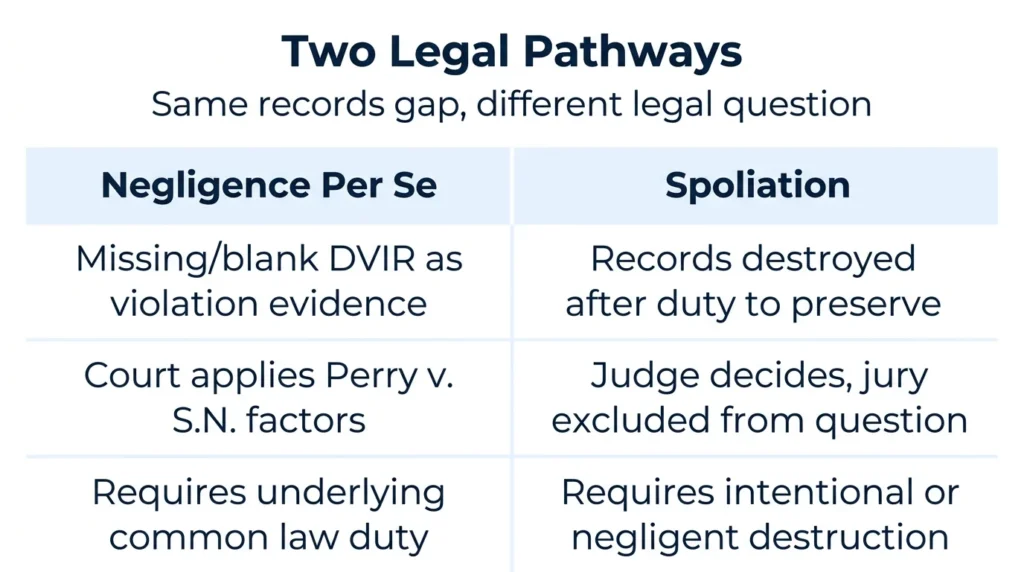
Perry v. S.N., 973 S.W.2d 301 (Tex. 1998) sets the framework. The court asks whether the injured person falls within the class the rule was written to protect and whether the injury is the type the rule was designed to prevent.
From there, the court weighs several factors. Those include whether the rule creates a duty of its own or simply supplies a standard for a duty that already exists at common law, whether it gives clear notice of the conduct required, whether applying it would impose liability without fault, whether the damages are proportionate to the violation, and how directly the violation caused the harm.
One point from Perry does the heavy lifting in a maintenance records case. There is no negligence per se without an underlying common law duty, because the regulation supplies the standard of care rather than the duty itself.
That distinction works in an injured Texan’s favor here. A trucking company’s common law duty to maintain its trucks safely is well established, and Part 396 states in concrete terms what compliance with that duty looks like: certify listed defects as repaired before redispatch, keep dated maintenance records, and pass the annual inspection.
So a DVIR that is missing, left blank, or certified “repaired” with no matching repair order is direct evidence of a 396.11 violation, measured against a standard the federal government already wrote down. Sorting out who is liable in a truck accident often comes down to which of those records the carrier can actually produce.
The Spoliation Pathway: Building a Retention Window Analysis
When a record that should exist cannot be produced, Texas law asks a second and separate question. Was evidence destroyed, and does that justify a remedy?
Brookshire Bros., Ltd. v. Aldridge, 438 S.W.3d 9 (Tex. 2014) makes it clear that a spoliation instruction to the jury is available only when intentional destruction meant to conceal or fabricate evidence. This type of letter also becomes necessary when a negligent breach of the duty to preserve that irreparably deprives the other side of any meaningful opportunity to present its claim or defense.
The trial judge alone decides whether spoliation occurred, outside the jury’s presence, and evidence bearing only on that question is kept from the jury.
The duty to preserve begins when a party knows or reasonably should know that litigation is likely and that the evidence is relevant. After a serious crash, that point usually arrives well before the three month DVIR window or the one year plus six month window under 396.3 would have run out on their own.
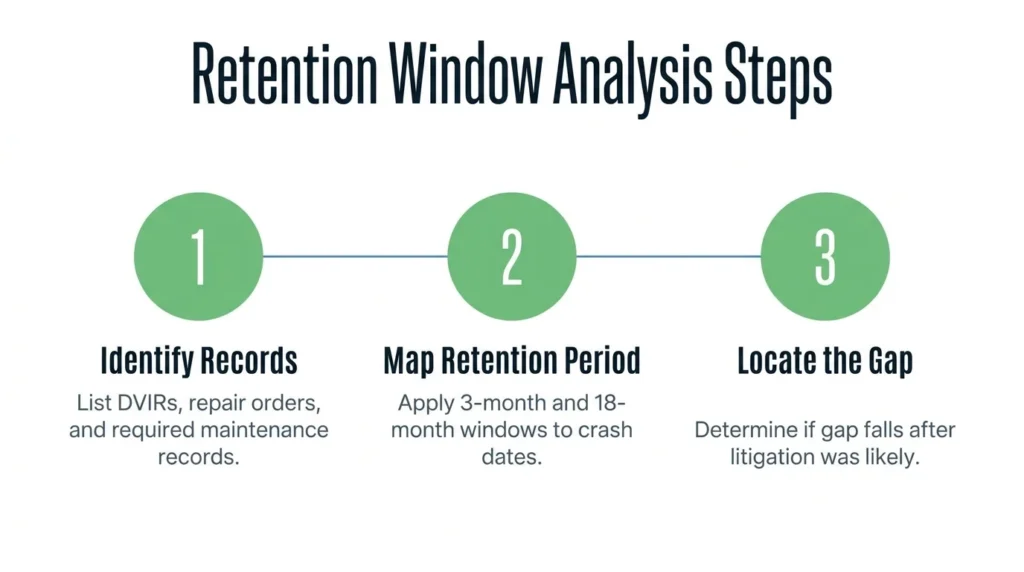
A retention window analysis puts those two timelines side by side. It runs in three steps:
- Identify what should exist. List the DVIRs, repair orders, maintenance records, and annual inspection reports Part 396 required the carrier to keep for the truck involved.
- Map the required retention period. Apply the three month DVIR window and the one year plus six month window for 396.3 records to the dates surrounding your crash.
- Locate the gap in time. Determine whether the missing record falls inside a period when the carrier already knew or should have known litigation was likely, such as after a crash, a demand letter, or a preservation letter.
Where the gap falls decides which argument you are making. A gap opening before any preservation trigger is a recordkeeping failure that feeds the negligence analysis. A gap opening after one raises the separate spoliation question the judge decides.
No reported Texas decision applies these standards to a missing, blank, or falsely certified DVIR specifically. Both frameworks are settled law and the DVIR application follows from them, but it is a reasoned argument rather than a fact pattern a Texas court has already decided.
That is why Texas truck accident cases call for lawyers who handle them regularly. The preservation letter that freezes a carrier’s records has to go out early, long before anyone knows which document has the most influence.
Talk to Angel Reyes & Associates About Your Truck Accident Case
If the trucking company’s records are thin, blank, or missing after your crash, the value of that gap depends on how quickly someone documents it. Retention windows keep running while you are recovering.
Angel Reyes & Associates has guided injured Texans through the legal process for over 30 years, and our team includes investigators and crash reconstruction professionals who know which carrier records to demand and how soon they can disappear. The firm works on contingency, so there is no upfront cost to you.
Contact Angel Reyes & Associates for a free consultation and we can begin requesting the carrier’s DVIRs, repair orders, and maintenance files before those windows close. Every case is different, and reviewing yours costs you nothing.
Past results do not guarantee future outcomes.
Truck Maintenance Record FAQs
Can a Trucking Company's Electronic DVIR System Satisfy the Same Requirements as Paper Logs?
Yes. Federal rules permit carriers to keep DVIRs and related certifications electronically rather than on paper, under 49 CFR 390.32, within the recordkeeping framework set by 49 CFR 396.11.
Does a Single Missing Inspection Report Automatically Win a Truck Accident Negligence Case?
No. A missing, blank, or falsely certified DVIR does not automatically prove negligence by itself; it functions as evidence that feeds two separate legal theories.
Under Texas’s negligence-per-se framework (Perry v. S.N., 973 S.W.2d 301 (Tex. 1998)), a regulatory violation like this can support a negligence claim once a court weighs factors such as whether the injured person falls within the class the rule protects and whether the rule supplies a standalone duty or merely a standard of care.
What Should I Do if I Suspect a Trucking Company Destroyed Maintenance Records After My Accident?
The most useful step is identifying what should exist and by when. Federal rules set specific retention windows: three months for DVIRs and their certifications, and one year plus six months for the broader 396.3 maintenance records. Map those windows against the dates surrounding your crash.
About the Authors

Angel Reyes
Writer
Angel L. Reyes, III is the Founder and Managing Partner of Angel Reyes & Associates. A nationally recognized trial attorney and business leader, Angel has helped over 70,000 injury victims recover more than $1 billion since founding the firm in 1993. Named to the Texas Super Lawyers list annually since 2008, Angel brings Wall Street experience, Ivy League education, and a deep commitment to client advocacy. He is a frequent legal commentator and published author with extensive contributions to legal scholarship, trial strategy, and consumer protection.

Kyle Nicolas
Editor
Kyle Nicolas is the Web Content & SEO Manager at Angel Reyes & Associates. He has more than 10 years of experience as a marketing co...

Angel Reyes
Reviewer
Angel L. Reyes, III is the Founder and Managing Partner of Angel Reyes & Associates. A nationally recognized trial attorney and business...