What Happens When a Truck Is Placed Out of Service?


Every article on this site is researched by our internal team, reviewed for legal accuracy against current Texas law, and held to State Bar of Texas advertising standards before publication. We do not publish content that overstates outcomes or makes promises about results.
Learn more about our
editorial standards .
Key Takeaways
- A DOT out-of-service order bars a truck from the road until repairs are certified.
- CVSA inspection Levels I through VIII determine how closely a truck gets checked.
- Inspection and repair records can become key evidence in a Texas truck accident case.
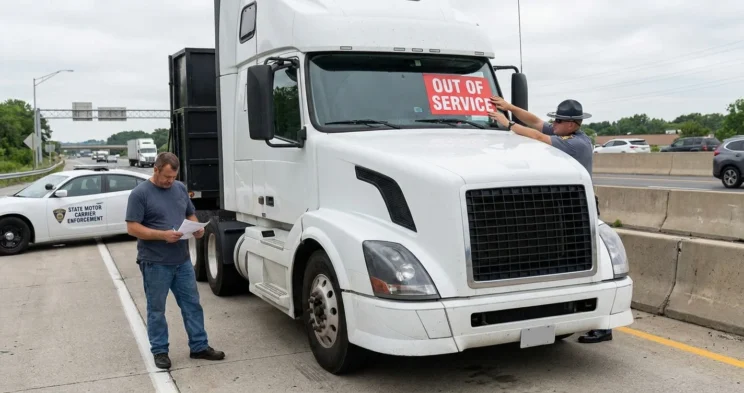
You pull the crash report and see a phrase you don’t recognize. The truck that hit you was “placed out of service.” The trooper’s notes may mention worn brake linings, a cracked frame rail, or a tire that should never have been on I-35.
An out-of-service designation is a federal safety finding, and it can become one of the most important pieces of evidence in your truck accident case.
The DOT out-of-service violations list and related inspection records can show why a commercial motor vehicle (CMV) was removed from the road and whether the required repairs were completed.
What “Out of Service” Means Under Federal Law
A truck is placed out of service when a federal or state-certified inspector, including a Texas Department of Public Safety trooper working under CVSA reciprocity, finds a condition that “would likely cause an accident or a breakdown.” That standard comes from 49 CFR § 396.9, the federal rule behind every roadside out-of-service order in the country.
Once the vehicle carries an out-of-service sticker, the carrier and driver are legally barred from operating it. The only exception is moving the truck by tow, crane, or hoist to a repair location, which does not count as “operating” the vehicle under the rule.
No one may remove that sticker until the disqualifying defect is repaired. This applies whether a CMV placed out of service is a loaded rig on I-10 or an empty flatbed parked in a Dallas rail yard.
In a truck accident investigation, this rule can determine whether the vehicle should have been on the road and whether the carrier violated other federal trucking regulations.
Repairing, Certifying, & Documenting an Out-of-Service Defect
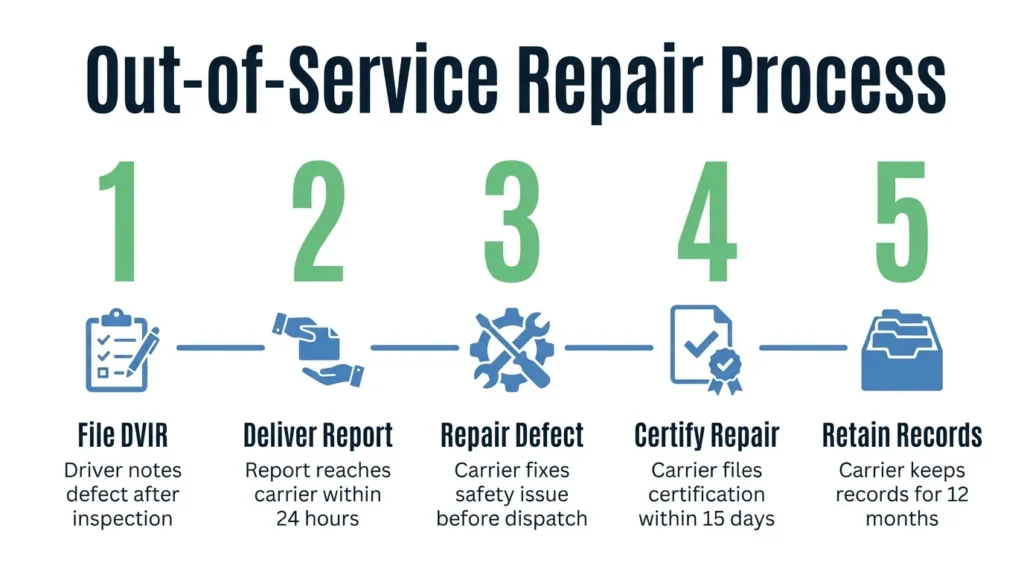
After an inspector cites a defect, federal law requires the carrier to repair it, certify the repair, and retain documentation. Maintenance and inspection records may be needed when filing a truck accident claim.
- The driver completes a Driver Vehicle Inspection Report (DVIR) under 49 CFR § 396.11, noting any defect that could affect safe operation.
- The driver delivers that report to the carrier at the next terminal, or within 24 hours if the truck will not reach one sooner.
- The carrier must repair any defect likely to affect safety before dispatching the truck again.
- The carrier certifies the repair and must file that certification within 15 days under § 396.9.
- The carrier keeps the inspection and repair-certification records for 12 months.
This paper trail shows whether a defect was fixed or whether a truck went back on the road carrying the same problem that later caused a crash.
CVSA Out-of-Service Criteria & the Roadside Inspection Levels (I to VIII)
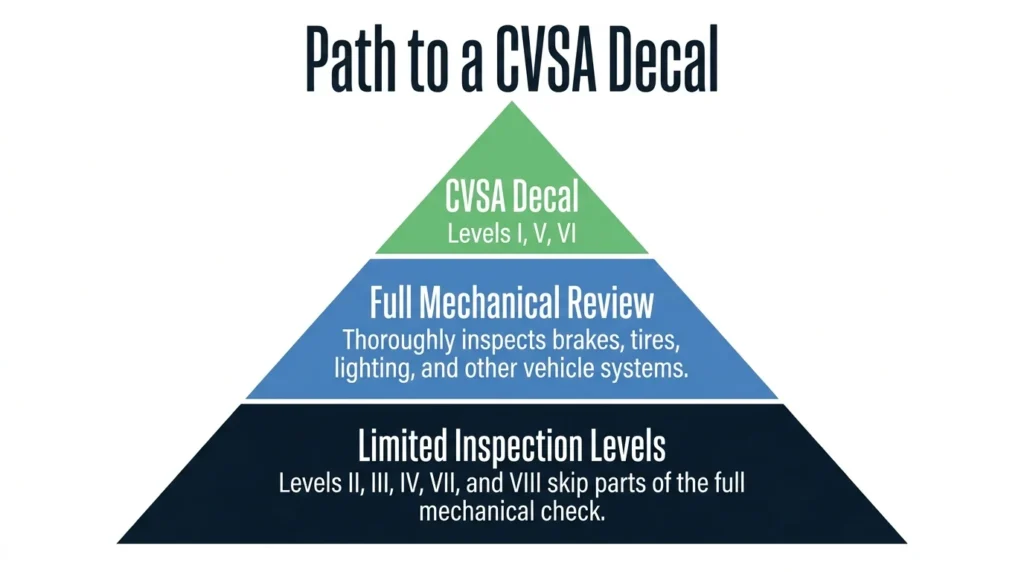
The Commercial Vehicle Safety Alliance (CVSA) publishes the North American Standard Out-of-Service Criteria, the detailed rulebook inspectors use to determine when brake wear, tire damage, or lighting failure crosses the line into a violation. CVSA is not a federal agency, but its criteria are incorporated by reference into federal law under 49 CFR § 385.4.
This is a different standard than the annual inspection checklist in Appendix A to Part 396, covered below. Appendix A governs the mandatory yearly inspection, while the CVSA criteria govern what an inspector checks during a roadside stop.
CVSA also defines eight inspection “levels” that determine how much of a truck and driver get examined:
- Level I (North American Standard Inspection): the most thorough check, covering the driver’s license, medical certificate, and hours-of-service records along with a full vehicle inspection, including components underneath the truck.
- Level II (Walk-Around Inspection): the same driver and vehicle review as Level I, without going underneath the vehicle.
- Level III (Driver/Credential Inspection): a driver-only review of license, medical certificate, and hours-of-service records, with no mechanical check.
- Level IV (Special Inspection): a one-time or targeted check of a single item, often used during campaigns like CVSA’s Brake Safety Week.
- Level V (Vehicle-Only Inspection): a full mechanical inspection performed without the driver present, often at a terminal or impound lot.
- Level VI (Enhanced Inspection for Radioactive Shipments): an expanded Level I inspection required for select radioactive cargo.
- Level VII (Jurisdictional Inspection): a state program inspection for vehicles such as school buses or limousines that do not fit the other categories.
- Level VIII (Electronic Inspection): a wireless inspection conducted while the truck is moving, without a physical stop.
Only Levels I, V, and VI can result in a CVSA decal. A truck can clear a roadside stop without incident and still carry problems that a more limited inspection level was never designed to catch.
Annual Inspections, Appendix A Standards, & Texas Enforcement
Separate from roadside stops, federal law requires every commercial truck to undergo a full inspection at least once every 12 months under 49 CFR § 396.17, measured against the pass/fail standards in Appendix A to Part 396. Those standards cover:
- The brake system, including drums, rotors, hoses, and air or antilock components
- Coupling devices such as fifth wheels, pintle hooks, and safety chains
- The steering mechanism, suspension, and frame
- Tires, with a minimum tread depth of 4/32 inch on steering axles and 2/32 inch elsewhere
- Wheels, rims, lighting devices, windshield glazing, and wipers
- Cargo securement and rear impact guards
Texas DPS enforces both this annual standard and the CVSA roadside criteria and participates each year in the multi-day International Roadcheck enforcement effort.
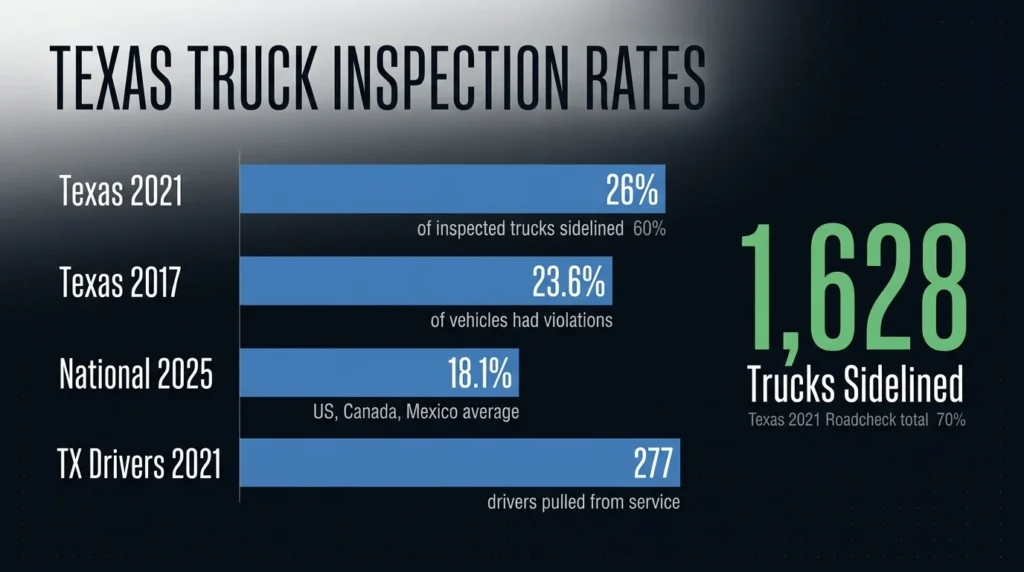
During the 2021 International Roadcheck, Texas DPS inspected 6,288 commercial vehicles and placed 1,628 of them, about 26 percent, out of service, most often for brake and tire defects. DPS also pulled 277 drivers out of service that year.
In the 2017 Roadcheck, roughly 23.6 percent of the 8,355 Texas vehicles inspected had violations serious enough to trigger an out-of-service order.
These figures provide historical snapshots because more recent Texas-specific data is not currently available. Nationally, CVSA’s 2025 International Roadcheck recorded an 18.1 percent vehicle out-of-service rate across the United States, Canada, and Mexico, with brakes and tires again the leading violation categories.
Out-of-Service Violations as Evidence in a Truck Accident Case
When a carrier or driver operates a truck after it has been placed out of service, or certifies a repair that was never made, that is a direct violation of federal safety law. Those violations can become central evidence in a Texas truck accident case.
Texas recognizes a legal doctrine called negligence per se. An unexcused violation of a safety regulation may support a negligence claim when the regulation was intended to protect people like you from the type of harm you suffered. Texas courts use a multi-factor test to determine whether the doctrine applies.
That test comes from Perry v. S.N., 973 S.W.2d 301 (Tex. 1998), a Texas Supreme Court case that did not itself involve trucking. The case sets out the general framework that Texas courts use to determine whether any regulatory violation, including a federal trucking safety violation, supports a negligence-per-se claim. It does not guarantee any particular outcome, and every case depends on its own facts.
Building this kind of case often requires the roadside inspection report, the carrier’s repair certifications and DVIR records, and its out-of-service history from FMCSA’s SAFER Company Snapshot and Safety Measurement System. These records can show whether the defect was repaired before the crash or remained unresolved.
Talk to Angel Reyes & Associates About an Out-of-Service Truck Accident
If you were hurt by a commercial truck that had an out-of-service violation, a history of prior violations, or a defect that was never properly repaired, you don’t have to track down these records alone.
Angel Reyes & Associates has guided injured Texans through truck accident claims for over 30 years, and our team knows how to obtain and evaluate inspection reports, out-of-service histories, and repair certification records. Get a free consultation to talk through what happened and your options.
Every case is different. Past results do not guarantee future outcomes.
Out-of-Service Truck FAQs
How long does a carrier have to certify that an out-of-service defect was repaired?
A motor carrier has 15 days under federal law to file its certification that a cited defect has been repaired. That certification follows the earlier requirement that the carrier fix any defect likely to affect safety before dispatching the truck again, and the inspection and certification records must then be kept for 12 months.
The records tied to this 15-day window and 12-month retention requirement are often the first documents requested when investigating whether a truck’s defect was fixed before it returned to the road.
Can a driver be placed out of service even if the truck itself passes inspection?
Yes. Out-of-service orders apply separately to the vehicle, its equipment, and the driver. An inspector can sideline a driver for a missing medical certificate or an hours-of-service violation even when the truck has no mechanical defect.
During Texas’s 2021 International Roadcheck, DPS placed 277 drivers out of service separately from the vehicles it removed from service. A Level III inspection follows this approach by reviewing the driver’s license, medical certificate, and hours-of-service records without conducting a mechanical inspection.
What is the difference between passing a Level I inspection with a CVSA decal and simply not being placed out of service?
A CVSA decal is a higher bar. Only Levels I, V, and VI can result in a decal, since those are the only inspections that include a full mechanical review of the vehicle. Even then, the vehicle earns a decal only if no defect meeting the out-of-service criteria turns up.
Simply not being placed out of service is a lower bar, since a truck can clear a roadside stop at a more limited level, such as Level II or Level III, without ever undergoing the full mechanical check a Level I inspection requires. A truck can avoid an out-of-service order without ever having examined the systems where a defect might be hiding.
How can I check whether the truck involved in my accident has a history of out-of-service violations?
FMCSA’s SAFER Company Snapshot is a free, public lookup by DOT number, MC/MX number, or company name that returns a summary of a carrier’s roadside inspection results, including out-of-service findings, along with its crash history.
FMCSA’s Safety Measurement System goes further by compiling 24 months of roadside inspection and crash data across several safety categories, including vehicle maintenance, to show whether a carrier or a specific truck has a pattern of out-of-service violations rather than a single isolated defect.
Does an out-of-service violation automatically prove the trucking company was negligent?
No. Texas recognizes a doctrine called negligence per se, under which the unexcused violation of a safety regulation designed to protect people like the injured party can support a negligence claim. Texas courts apply a multi-factor test to decide whether the doctrine applies to a given regulation, rather than treating any violation as automatic proof.
That framework comes from the Texas Supreme Court’s decision in Perry v. S.N., which is not itself a trucking case. It does not guarantee a particular outcome, and how it applies depends on the specific facts, the regulation violated, and the harm that resulted.
About the Authors

Angel Reyes
Writer
Angel L. Reyes, III is the Founder and Managing Partner of Angel Reyes & Associates. A nationally recognized trial attorney and business leader, Angel has helped over 70,000 injury victims recover more than $1 billion since founding the firm in 1993. Named to the Texas Super Lawyers list annually since 2008, Angel brings Wall Street experience, Ivy League education, and a deep commitment to client advocacy. He is a frequent legal commentator and published author with extensive contributions to legal scholarship, trial strategy, and consumer protection.

Kyle Nicolas
Editor
Kyle Nicolas is the Web Content & SEO Manager at Angel Reyes & Associates. He has more than 10 years of experience as a marketing co...

Alex Ivanov
Reviewer
Alex Ivanov is a personal injury attorney at Angel Reyes & Associates, focused on car, truck, and motorcycle accident cases. Licensed in...