Can Parents File a Wrongful Death Claim for a Child in Texas?


Every article on this site is researched by our internal team, reviewed for legal accuracy against current Texas law, and held to State Bar of Texas advertising standards before publication. We do not publish content that overstates outcomes or makes promises about results.
Learn more about our
editorial standards .
Key Takeaways
- Texas parents have two years from a child's death to file a wrongful death claim.
- Divorce does not remove a Texas parent's standing to bring a wrongful death claim.
- A minor's death often makes non-economic losses the largest part of recovery.

The call came while you were driving home on I-35W, and nothing since has felt real. Your child is gone, taken in a crash near Burleson that someone else caused. Between the grief and the paperwork, one question keeps surfacing: do you even have the right to hold that person accountable?
Wrongful Death Claim Rights for Parents
Yes. Texas law gives surviving parents the right to bring a wrongful death claim after a child dies. The Texas Civil Practice and Remedies Code (CPRC) § 71.004 names parents among the family members who can file or benefit from that action.
A Texas wrongful death claim lets close family members recover for what a death takes from them. As a parent, you sit squarely inside the group the statute protects.
The law does not pause for grief, though. You have two years from the date of your child’s death to file, under CPRC § 16.003.
Waiting past that window almost always ends a claim before it starts. Our guide to the wrongful death filing deadline walks through the few narrow exceptions.
Many of these claims begin with a fatal car accident. That is often the event that brings a parent to this question at all. You can read how fatal crashes become wrongful death claims and what recovery looks like.
Divorced Parents Filing a Wrongful Death Claim
Divorce does not erase your right to file. A divorced or separated parent keeps the same standing under CPRC § 71.004 as any other parent, whether you file with your co-parent or on your own.
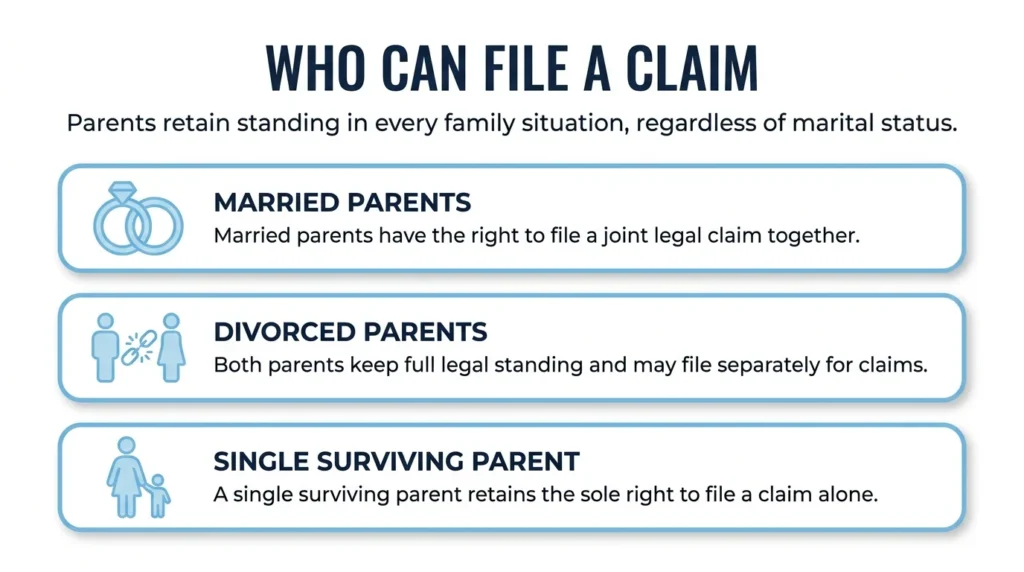
You and the other parent can bring one claim together. You can also file separately if you disagree about how to proceed.
When parents file separately or clash over the case, § 71.010 also controls how a jury divides any recovery. A jury apportions the award by each parent’s share of the loss, not evenly by default.
If you are weighing whether to proceed jointly or alone, our overview of how to file a wrongful death lawsuit lays out the steps involved.
When Only One Parent Survives
If you are the only surviving parent, your right to file does not disappear. Whether the other parent has died, cannot be found, or had their parental rights terminated under the Texas Family Code Chapter 161, you still hold standing to bring the claim.
The other parent’s status can shape how the case moves forward. A terminated parental relationship, for example, may affect who shares in any recovery.
But the core right stays with you. A parent handling this alone has the same ability to seek justice for a child, and you can see how we guide families through these claims when you are ready.
Damages Parents Can Recover
Parents can recover two kinds of losses after a child’s death: economic and non-economic. Because a child rarely earned an income, the non-economic side usually carries the most weight.
Economic Damages for a Child’s Death
Economic damages cover the tangible costs tied to your child’s death. These are the losses you can add up with receipts and bills.
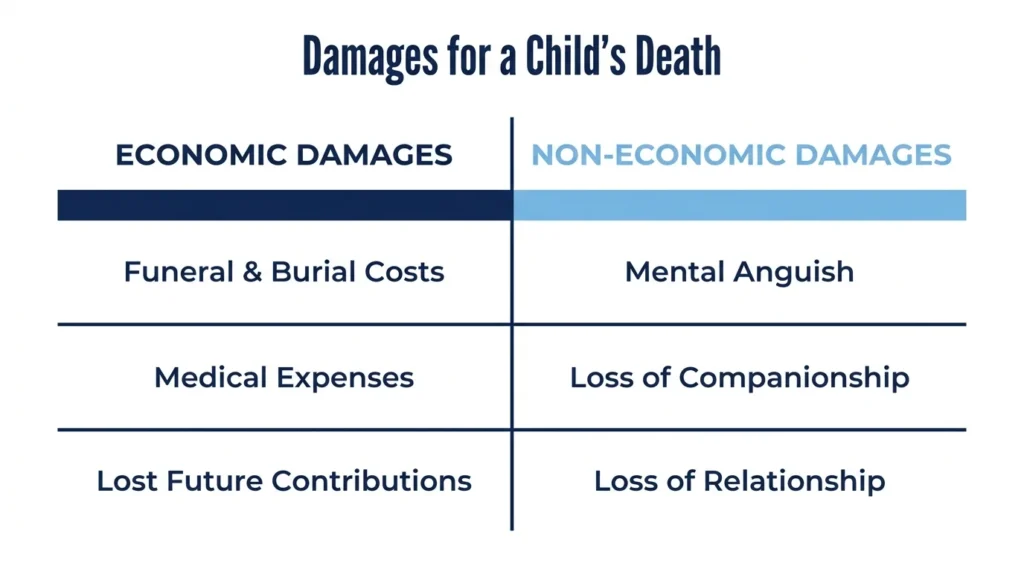
- Funeral and burial expenses: the direct costs of laying your child to rest
- Medical expenses: care connected to the fatal injury before your child passed
- Lost future contributions: in limited cases, the earnings or support your child might have provided the family
Damage amounts in these cases are hard to predict. Knowing the limits and caps on wrongful death recovery can help you set realistic expectations.
Non-Economic Damages for a Child’s Death
Non-economic damages address the emotional weight of losing a child. In most child cases, these losses make up the largest part of any recovery.
They include your mental anguish, the loss of your child’s companionship and society, and the loss of the parent-child relationship itself. No amount restores what you lost. The law lets you hold the responsible party accountable for it, and our breakdown of damages in a Texas wrongful death lawsuit shows the full range.
These harder-to-quantify losses take real experience to prove. That is where working with an attorney who has handled wrongful death claims makes a difference.
Work with a Texas Wrongful Death Attorney
No claim can undo the loss of a child. It can, though, hold the responsible party accountable and lift a financial weight your family should never have to carry.
Angel Reyes & Associates has guided grieving Texas families for over 30 years. We work on a contingency fee, so you owe no attorney’s fee unless we win your case, and we can handle most of your case remotely while you focus on your family. When you are ready, reach out for a free consultation.
Past results do not guarantee future outcomes.
Frequently Asked Questions
Can stepparents or grandparents file a wrongful death claim for a child in Texas?
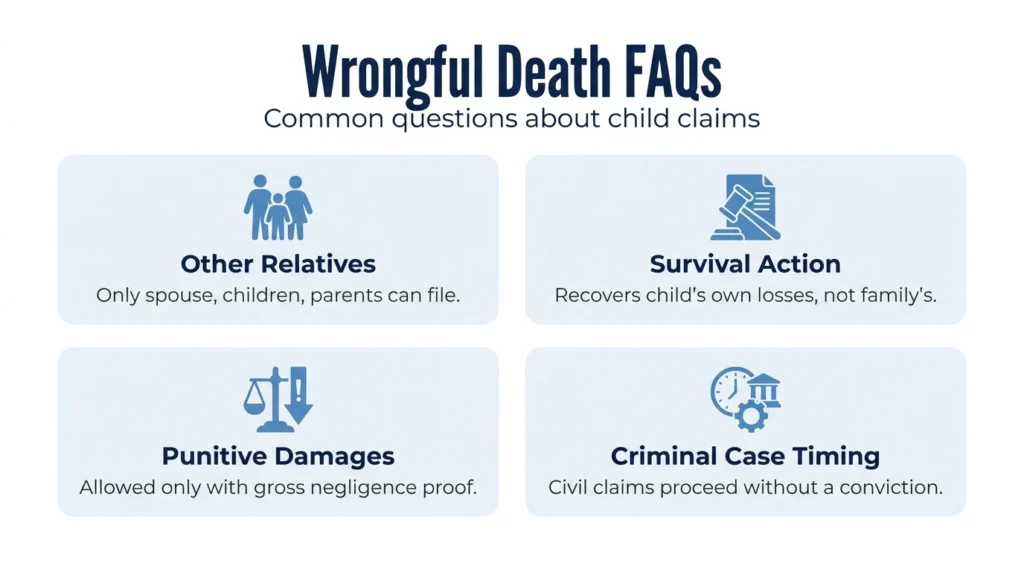
No, Texas limits wrongful death claims to the child’s surviving spouse, children, and parents, so grandparents and stepparents cannot file unless they legally adopted the child.
What is the difference between a wrongful death claim and a survival action in Texas?
A wrongful death claim compensates the family for their own losses, such as grief and lost companionship. A survival action recovers what the child could have claimed, like pain and medical costs, and that money goes to the child’s estate.
Can parents recover punitive damages in a Texas wrongful death claim?
Yes, but only if the parents prove the death resulted from gross negligence, malice, or fraud. Texas law caps most punitive awards at the greater of two times economic damages plus noneconomic damages, up to $750,000.
Do parents have to wait for a criminal case to end before filing a wrongful death lawsuit in Texas?
No. Civil wrongful death claims proceed separately from any criminal case against the driver, and parents do not need a conviction to pursue compensation in civil court.
About the Authors

Angel Reyes
Writer
Angel L. Reyes, III is the Founder and Managing Partner of Angel Reyes & Associates. A nationally recognized trial attorney and business leader, Angel has helped over 70,000 injury victims recover more than $1 billion since founding the firm in 1993. Named to the Texas Super Lawyers list annually since 2008, Angel brings Wall Street experience, Ivy League education, and a deep commitment to client advocacy. He is a frequent legal commentator and published author with extensive contributions to legal scholarship, trial strategy, and consumer protection.

Kyle Nicolas
Editor
Kyle Nicolas is the Web Content & SEO Manager at Angel Reyes & Associates. He has more than 10 years of experience as a marketing co...

Angel Reyes
Reviewer
Angel L. Reyes, III is the Founder and Managing Partner of Angel Reyes & Associates. A nationally recognized trial attorney and business...