Is Wrongful Death Civil or Criminal?


Every article on this site is researched by our internal team, reviewed for legal accuracy against current Texas law, and held to State Bar of Texas advertising standards before publication. We do not publish content that overstates outcomes or makes promises about results.
Learn more about our
editorial standards .
Key Takeaways
- A wrongful death claim is a civil case, fully separate from criminal charges.
- A civil wrongful death case can win money damages but cannot send anyone to jail.
- You have two years to file, even if the criminal case ends without a conviction.

The driver who caused the crash that killed your husband on I-35W near Burleson walked out of court without a conviction. The police report pointed to him, but the jury did not agree, and it feels like no one will answer for what happened. Now you are left wondering whether your family has any path left to hold him responsible.
Wrongful Death vs. Criminal Charges
A wrongful death case is a civil matter, completely separate from any criminal charges the state may bring against the person responsible. The two run on different tracks, with different goals and different people in control.
Understanding that split is the first step toward knowing what your family can actually do.
Civil Wrongful Death Claims
A wrongful death claim is a civil lawsuit that surviving family members file to recover compensation. These Texas wrongful death claims are a type of tort, not a criminal charge against anyone.
Texas law gives certain family members this right under the Texas Civil Practice and Remedies Code (CPRC) § 71.004, which names the surviving spouse, children, and parents as the people who may bring the claim. It stands on its own, apart from anything that happens in criminal court.
If your loss came from a fatal crash, you may be facing a civil claim and a criminal investigation at the same time. Our look at fatal car accidents and wrongful death claims shows how the two usually overlap.
Criminal Prosecution for the Same Death
The criminal side works differently, and you do not control it. Only a prosecutor or a grand jury decides whether to charge the person responsible.
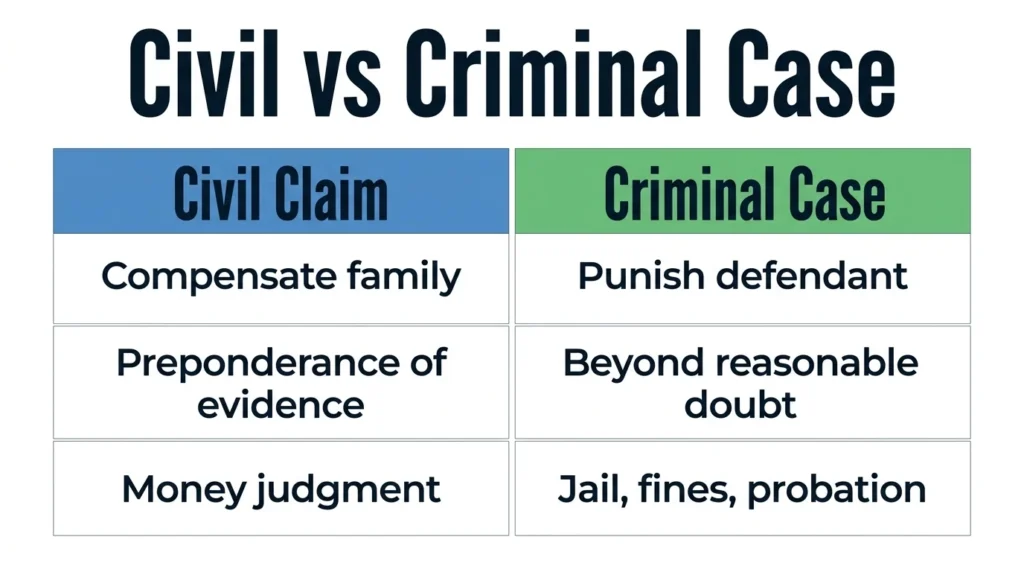
A criminal case exists to punish that person with jail, fines, or probation on behalf of the state. Your civil claim exists to compensate your family for what you lost.
That is why a family can feel powerless watching the criminal process while still holding a separate right of their own.
Can You Go to Jail for Wrongful Death?
No. A civil wrongful death lawsuit cannot send anyone to jail, no matter how strong your evidence is. Jail time comes only from a criminal conviction, which runs as a separate case.
People often confuse the two because both can follow the same death. The difference is in what each one delivers.
When your civil claim succeeds, the result is a money judgment against the responsible party, not a prison sentence. That judgment is meant to cover your family’s losses, and our guide to average wrongful death settlements explains how these amounts get calculated.
If the death came from a car accident, the driver may still face criminal charges like intoxication manslaughter. Even then, that criminal case stays separate from your family’s civil claim.
Wrongful Death Claims After a Criminal Acquittal
An acquittal in the criminal case does not close the door on your civil claim. Double jeopardy stops the state from prosecuting a person twice for the same crime, but it does not touch civil lawsuits.
That protection comes from the Fifth Amendment, and it applies to criminal prosecution only.
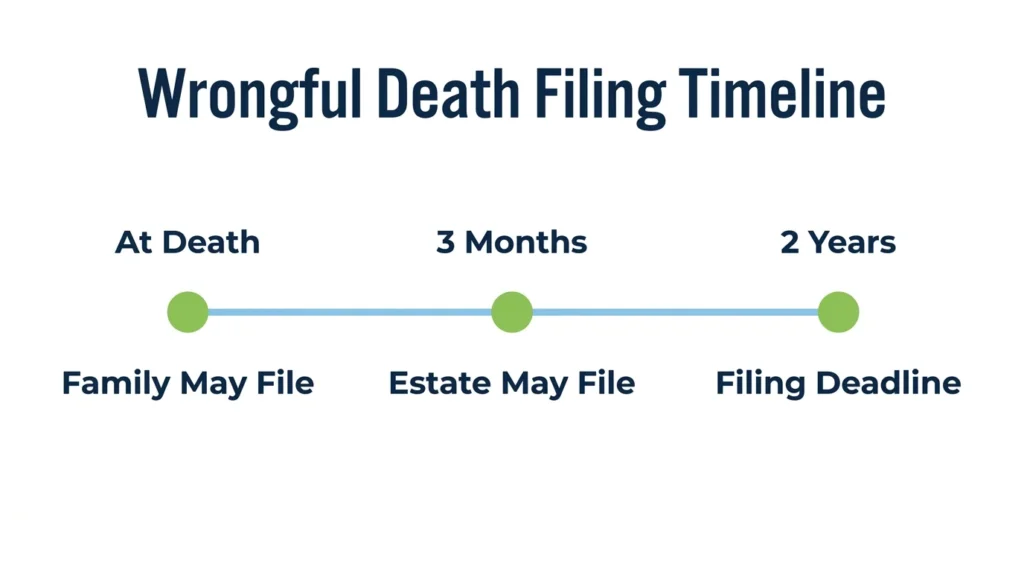
Your civil case also runs on its own clock. Under the Texas Civil Practice and Remedies Code § 16.003, you generally have two years from the date of death to file.
A pending or finished criminal case does not pause that deadline, and only a few narrow exceptions extend it. Our guide to the wrongful death filing deadline in Texas explains what those exceptions are.
Even when the criminal case ends without a conviction, your family may still recover compensation for a wrongful death loss.
Wrongful Death Burden of Proof
A wrongful death claim only has to meet the preponderance of the evidence standard. That means showing it is more likely than not that the defendant caused the death.
A criminal conviction requires proof beyond a reasonable doubt, a much higher bar. That gap is why a jury can acquit while your family still wins a civil claim.
A person found not guilty in criminal court can still be held responsible for the same death in a civil court. The evidence simply has to clear a lower line.
If you are weighing whether to move forward, you can review who we are and how we work before deciding your next step.
Work with a Texas Wrongful Death Attorney

Losing someone because of another person’s actions leaves your family with impossible questions. You should not have to face them alone.
Angel Reyes & Associates has guided Texas families through wrongful death claims for more than 30 years. We serve clients across the entire state of Texas, and we work on contingency, so you pay no fee unless we win.
We also have a track record of more than $1 billion recovered for clients. You can schedule a free consultation to understand your options, with no cost and no pressure.
Past results do not guarantee future outcomes.
Frequently Asked Questions
Who can file a wrongful death claim in Texas?
Only the surviving spouse, children, and parents of the deceased can bring a wrongful death claim under Texas law. If none of them files within three months of the death, the estate’s representative may be able to file on their behalf.
What is a survival action, and how is it different from a wrongful death claim?
A survival action lets the deceased person’s estate recover for the pain, medical bills, and lost income the victim suffered before dying. It is separate from the wrongful death claim, which compensates surviving family members for their own losses, like lost support and companionship.
Can a criminal conviction be used as evidence in a wrongful death lawsuit?
Yes, in many cases. A criminal conviction can sometimes be used as evidence in the civil case to help show the defendant caused the death.
Are wrongful death settlements taxable?
Most of a wrongful death settlement is not taxed, since federal law treats compensation for a death as tax-free. Portions tied to lost wages, previously deducted medical costs, or interest on the award can still be taxable.
About the Authors

Angel Reyes
Writer
Angel L. Reyes, III is the Founder and Managing Partner of Angel Reyes & Associates. A nationally recognized trial attorney and business leader, Angel has helped over 70,000 injury victims recover more than $1 billion since founding the firm in 1993. Named to the Texas Super Lawyers list annually since 2008, Angel brings Wall Street experience, Ivy League education, and a deep commitment to client advocacy. He is a frequent legal commentator and published author with extensive contributions to legal scholarship, trial strategy, and consumer protection.

Kyle Nicolas
Editor
Kyle Nicolas is the Web Content & SEO Manager at Angel Reyes & Associates. He has more than 10 years of experience as a marketing co...

Angel Reyes
Reviewer
Angel L. Reyes, III is the Founder and Managing Partner of Angel Reyes & Associates. A nationally recognized trial attorney and business...