Can You Ride an Electric Dirt Bike on the Road?


Every article on this site is researched by our internal team, reviewed for legal accuracy against current Texas law, and held to State Bar of Texas advertising standards before publication. We do not publish content that overstates outcomes or makes promises about results.
Learn more about our
editorial standards .
Key Takeaways
- Texas bans pocket bikes and electric dirt bikes from public roads, sidewalks, and bike paths under Transportation Code § 551.353.
- Dallas, Houston, and Austin each have different local rules for where Class 1, 2, and 3 e-bikes can ride on sidewalks.
- Riding in a prohibited location when a crash happens can reduce your recovery under Texas proportionate responsibility law.
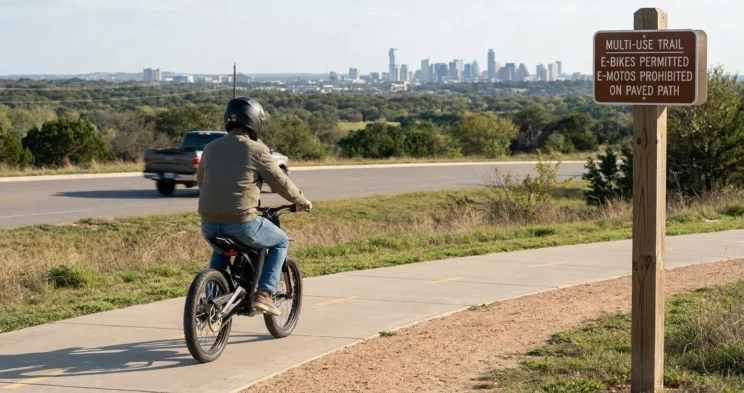
You bought what the retailer called an “electric bike,” and now you’re wondering whether you can take it on the street. The answer depends entirely on which type of electric two-wheeled vehicle you have. Texas draws sharp legal lines between categories, and those lines determine where you can ride, whether you need a license, and what happens to your legal rights if you get hurt.
Texas Law Sorts Electric Bikes into Three Buckets
Texas does not treat all electric two-wheeled vehicles the same way. Where you can legally ride depends on how your vehicle is classified under state law, not on how the retailer marketed it.
The first category is the standard electric bicycle.
Texas Transportation Code § 664.001 defines three classes of standard electric bikes based on motor type and top assisted speed.
- Class 1 bikes have pedal-assist motors capped at 20 mph.
- Class 2 bikes have throttle-assist motors that are also capped at 20 mph.
- Class 3 bikes are pedal-assist with a top assisted speed of more than 20 mph but less than 28 mph.
All three must have fully functioning pedals. Under Texas law, none of these are motor vehicles.
The second category is the off-highway electric dirt bike.
Vehicles like the Sur-Ron Light Bee and Ultra Bee exceed the wattage and speed limits that define a legal e-bike. Since they have no pedals, Texas Transportation Code § 551.351 classifies them as pocket bikes or minimotorbikes.
The third category is the street-legal electric motorcycle.
These are purpose-built, factory-certified motorcycles that happen to run on electricity. They require a title, registration, insurance, and a motorcycle endorsement on your license. They belong on public roads and are subject to all the same traffic laws as any other motorcycle.
E-Bike Sidewalk Rules Vary by City
Class 1, 2, and 3 e-bikes may ride on Texas roads as a matter of state law; however, sidewalk access is a different question and depends on where you are.
Texas state law does not ban e-bikes from sidewalks statewide, but it allows cities to restrict or prohibit sidewalk riding by local ordinance. The rules in Dallas, Houston, and Austin are all different.
- Dallas permits sidewalk riding outside the Central Business District, but if you are in or near downtown Dallas, sidewalk riding is off-limits.
- Houston bans bicycle and e-bike sidewalk riding within business districts, but riders outside those zones can use sidewalks under Houston law.
- Austin allows sidewalk riding in a reasonable and prudent manner, but certain downtown areas and city-posted signs can limit access.
Class 3 e-bikes face additional scrutiny in many Texas municipalities. At speeds approaching 28 mph, they move faster than most pedestrians expect from a sidewalk-eligible vehicle. Check your city’s ordinances before riding a Class 3 bike on shared paths.
Understanding the rules about where you can legally ride also matters for a reason beyond the ticket. If you are ever hurt in a crash, where you were riding at the time plays into how fault is calculated. Texas rules on illegal driving near motorcycles reflect the same principle: the law looks at what both parties were doing.
Off-Road Electric Dirt Bikes Are Banned from Public Roads
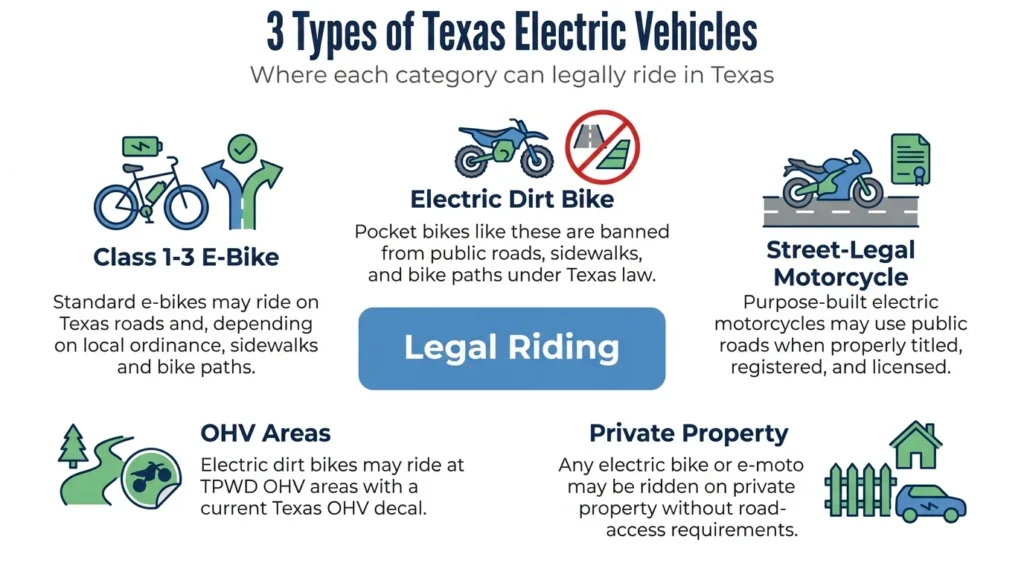
Most electric dirt bikes sold today fall into the pocket bike or minimotorbike category under Texas law. Texas Transportation Code § 551.353 prohibits these vehicles from operating on streets, roads, sidewalks, and bike paths. The only legal riding locations are private property and designated off-highway vehicle areas.
The Sur-Ron Light Bee and Ultra Bee are popular examples, and both exceed Class 2 e-bike thresholds in motor power and top speed. They do not qualify for the road or sidewalk access that Class 1, 2, and 3 e-bikes receive under state law. Riding either model on a public road without proper registration violates both the pocket bike statute and Texas motor vehicle registration requirements.
Some riders attempt to title and register high-powered electric bikes as motorcycles to gain road access. This path requires the vehicle to meet all Texas motorcycle equipment standards, including:
- headlights
- tail lights
- brake lights
- turn signals
- mirrors
- a horn
- a valid VIN
The process is complex and not guaranteed without factory compliance documentation. If the vehicle was never built for road use, getting it legally on the road takes more than just a registration fee.
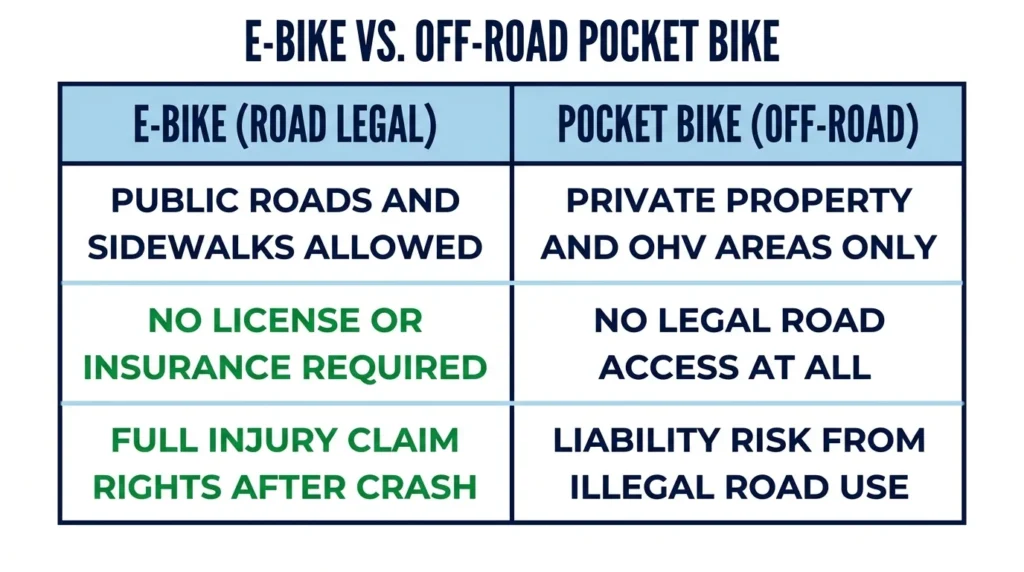
If you own an electric dirt bike in this category, your legal riding locations are Off-Highway Vehicle (OHV) parks and private property. Riding it on a public street, sidewalk, or bike trail is a violation under Texas law. Texas e-scooter and micromobility laws follow a similar structure, as explained in the firm’s coverage of Texas e-scooter laws and liability.
Road-Legal Electric Motorcycles Follow a Different Set of Rules
Street-legal electric motorcycles are in a category of their own. They operate on public roads, they follow motorcycle traffic laws, and they are entirely legal when properly titled and licensed.
To operate a street-legal electric motorcycle in Texas, you need a valid Texas driver’s license with a motorcycle endorsement, the bike must be titled and registered with TxDMV, and you must carry Texas minimum liability insurance. The bike itself must have all required equipment:
- headlight
- tail light
- brake lights
- turn signals
- mirrors
- horn
- license plate light
Brands like Zero Motorcycles are purpose-built to meet federal motor vehicle safety standards from the factory, which makes the registration process straightforward.
Riders injured while operating a street-legal electric motorcycle on Texas roads have the same legal rights as any other motorcycle accident victim. The Texas motorcycle accident practice area page explains what those rights look like when a crash occurs.
Where You Ride Affects Your Legal Rights After a Crash
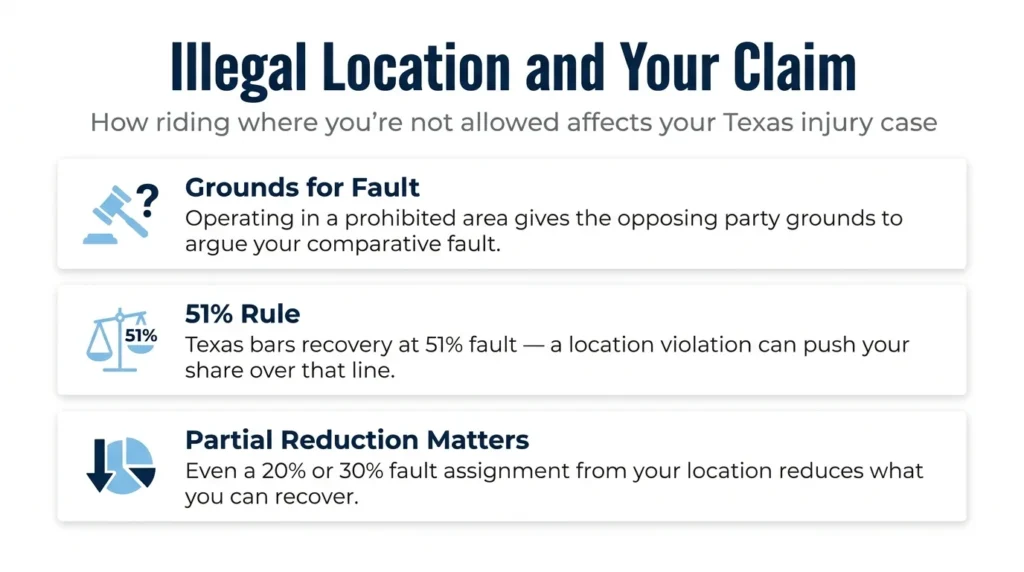
Texas uses a comparative fault system for personal injury claims. Texas Civil Practice and Remedies Code (CPRC) § 33.001 says that a claimant who is 51% or more responsible for the incident cannot recover damages at all. Below that threshold, recovery is reduced by the claimant’s percentage of fault.
Operating your vehicle in a location where it is legally prohibited gives the opposing party grounds to argue you were at fault for being there. An off-road-only electric dirt bike on a public street, or an e-bike ridden on a sidewalk banned by city ordinance, creates a direct argument that you contributed to the conditions of your own accident. That argument does not have to entirely succeed to cost you, as even a 20% or 30% fault assignment reduces what you can recover.
This works in both directions. If another party’s negligence caused the crash, that remains the dominant fact, but your location at the time is a separate element that the fact-finder weighs. The strength of that element depends on which category your bike falls into and whether you were in a legally authorized location.
Understanding how Texas motorcycle accident settlements work gives you a clearer picture of how fault percentages translate into real dollar impacts on your claim. If you were hurt in a crash while riding any type of electric bike or electric motorcycle, how and where the accident happened matters to the value of your claim.
Get Help After an Electric Bike or Motorcycle Accident
The rules that govern where you can ride and the fault implications when something goes wrong are exactly the kind of details that matter after an accident. A wrong assumption about your vehicle’s classification can cost you in two ways: first with a ticket, and then again in a personal injury claim.
Angel Reyes & Associates has guided injured Texans through personal injury claims for over 30 years. We have a team of more than 600 dedicated professionals available across more than 20 offices statewide to handle your claim in both English and Spanish.
Our attorneys can review the facts of your situation and walk you through your options at no upfront cost. We work on a contingency, meaning no fee unless we win, and free consultations are available 24/7. Contact us today for a free consultation.
Past results do not guarantee future outcomes.
Riding an Electric Dirt Bike FAQs
Do you need a helmet to ride an electric bike in Texas?
Texas state law does not require helmets for adult e-bike riders. Riders under 18 must wear helmets in most major Texas cities, and Class 3 e-bikes require riders to be at least 15 years old to operate.
Can I ride my electric dirt bike at a Texas state park OHV area?
Yes, but you must display a current Texas OHV decal issued by the Texas Parks and Wildlife Department. You also need to complete, or be supervised by someone who has completed an approved off-highway vehicle safety course before riding on public OHV lands.
Does Texas require insurance for a Class 1 or Class 2 electric bike?
No. Class 1 and Class 2 e-bikes are not motor vehicles under Texas law, so state-mandated liability insurance is not required. Street-legal electric motorcycles are a separate category and do require Texas minimum liability coverage.
What is the difference between a Sur-Ron and a street-legal electric motorcycle?
A Sur-Ron is an off-road-only electric vehicle that does not meet Texas e-bike classification standards for power output or speed, and it is not factory-certified to motorcycle safety standards. A street-legal electric motorcycle, like those made by Zero Motorcycles, is purpose-built to federal vehicle standards and can be titled, registered, and ridden on public roads with a motorcycle endorsement.
About the Authors

Angel Reyes
Writer
Angel L. Reyes, III is the Founder and Managing Partner of Angel Reyes & Associates. A nationally recognized trial attorney and business leader, Angel has helped over 70,000 injury victims recover more than $1 billion since founding the firm in 1993. Named to the Texas Super Lawyers list annually since 2008, Angel brings Wall Street experience, Ivy League education, and a deep commitment to client advocacy. He is a frequent legal commentator and published author with extensive contributions to legal scholarship, trial strategy, and consumer protection.

Kyle Nicolas
Editor
Kyle Nicolas is the Web Content & SEO Manager at Angel Reyes & Associates. He has more than 10 years of experience as a marketing co...

Spencer Browne
Reviewer
Spencer Browne is a partner at Angel Reyes & Associates and a Board Certified personal injury trial lawyer with nearly 100 jury trials a...