Church Bus Accident Liability in Texas


Every article on this site is researched by our internal team, reviewed for legal accuracy against current Texas law, and held to State Bar of Texas advertising standards before publication. We do not publish content that overstates outcomes or makes promises about results.
Learn more about our
editorial standards .
Key Takeaways
- You can sue a Texas church after a bus crash; religious status is no shield.
- Texas caps church injury damages at $500,000 per person and $1 million per crash.
- A volunteer church bus driver can be held personally liable for negligent driving.

Can You Sue a Church for a Bus Accident?
Yes, you can sue a church in Texas after a bus crash, and the religious nature of the organization does not protect it from a lawsuit. A church is a private entity, and the same negligence rules that govern any bus operator apply to a church-operated vehicle.
Texas treats church buses as commercial passenger vehicles for liability purposes. That means the same legal theories used against commercial carriers apply here. If the church puts an unfit driver behind the wheel, you can hold it responsible.
Many people assume a religious nonprofit is shielded from these claims. It is not. The Texas Charitable Immunity and Liability Act limits how much you can recover from the organization, but it does not erase the claim itself.
This is a damages cap, or limit, not a wall. Your case can still proceed, and you can still recover money for the accident.
Liability Limits Under Texas Charitable Immunity Law
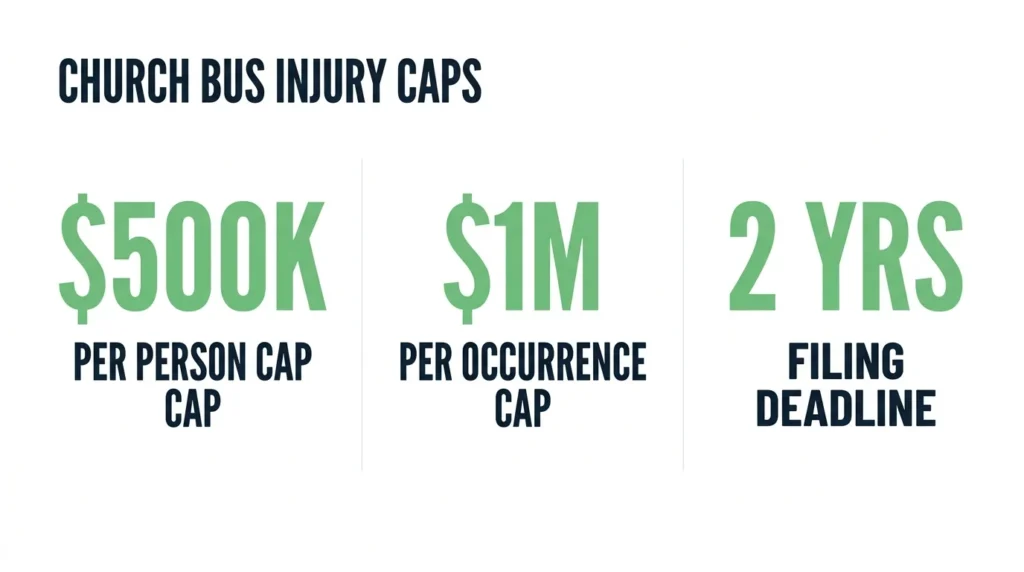
The cap is real, but it is far from immunity. Under Texas Civil Practice and Remedies Code (CPRC) § 84.006, damages against a nonhospital charitable organization are capped at $500,000 per person and $1,000,000 per occurrence for bodily injury or death.
That cap only applies when the church carries at least the minimum required liability insurance. If the church was uninsured or underinsured when the crash happened, different rules can open the door to more money.
There is also a major exception. Under Texas Civil Practice and Remedies Code (CPRC) § 84.007, the cap disappears entirely when the conduct was intentional, willfully negligent, or done with reckless disregard for safety. A poorly maintained bus or a knowingly unlicensed driver can trigger this exception.
Your own conduct matters too. Texas uses a proportionate responsibility system under the Texas Civil Practice and Remedies Code Chapter 33. If you are found more than 50 percent responsible for the crash, you cannot recover any money.
Sorting out whether the gross negligence exception applies takes a close look at the facts, which is something an attorney handling Texas bus accident claims can evaluate for you.
Volunteer Driver Liability & the CDL Gap
A volunteer driver is not automatically protected, and the size of the bus often decides whether a commercial license was even required. These two questions get tangled together, so they need separate answers.
Volunteer Immunity & the Motor Vehicle Exception
A volunteer church bus driver can be held personally liable for negligent driving. Under Texas Civil Practice and Remedies Code (CPRC) § 84.004, volunteers of charitable organizations get conditional immunity, but subsection (d) removes that immunity when the volunteer was operating a motor vehicle.
This means the driver does not get a free pass simply because they were not paid. The protection that covers other volunteer work does not cover driving.
You can name both the volunteer driver and the church in the same lawsuit. The driver is liable for how they drove, and the church can be liable for putting them behind the wheel.
That second path is called negligent entrustment. It applies when a church hands a vehicle to an unlicensed, inexperienced, or unqualified driver. The same idea applies to everyday situations, like letting an unlicensed driver use your car.
CDL Requirements for Church Buses
A volunteer driving a bus built to carry 16 or more people, including themselves, must hold a commercial driver’s license. Texas Transportation Code Chapter 522 sets that 16-passenger threshold, and nonprofit or religious status does not change it.
Smaller vehicles fall below the line. A van designed for 15 or fewer total occupants, including the driver, does not require a CDL. This is the common gap that catches church vans.
Federal carrier rules add another layer. FMCSA oversight applies mainly to interstate or for-hire operations, and most intrastate church transportation is exempt from full federal regulation. The CDL requirement still applies on its own, separate from that exemption.
A driver without the required CDL on a CDL-mandated vehicle is strong evidence of negligent entrustment against the church. It shows the organization let someone drive who was never legally qualified to do it.
Insurance Gaps & Recovery Options
Your compensation often depends on the policies in play, and church bus crashes carry a coverage problem most people never see coming. Texas requires minimum liability insurance on all registered vehicles, and churches are not exempt under Texas Transportation Code § 601.072. Many churches carry only those minimum limits.
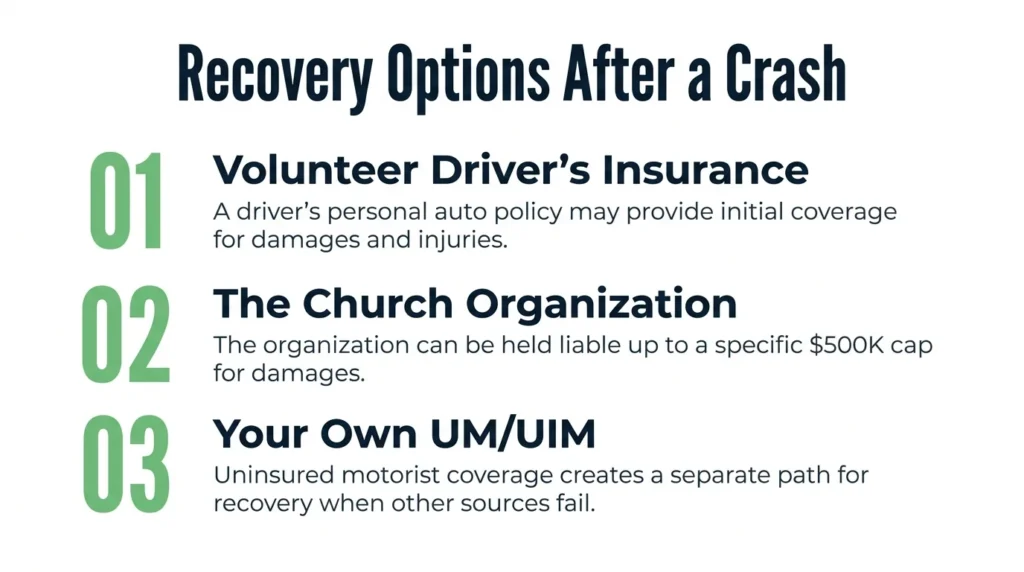
When the policy limits cannot cover your losses, you may still have several places to look:
- Volunteer driver’s personal auto insurance: If the driver used their own vehicle, their personal policy may apply.
- The organization itself: You can pursue the church up to the § 84.006 cap when the cap applies.
- Your own UM/UIM coverage: Uninsured or underinsured motorist coverage on your personal auto policy can create an independent recovery path through your own insurer.
If the church carried no valid insurance at the time of the crash, the charitable immunity cap may fall away, and organizational liability can become unlimited under the Act’s conditions.
An attorney can review every applicable policy and identify each source of compensation, including the steps in how to file a bus accident claim, before any deadline runs out.
Filing a Claim: Deadlines & Next Steps
You have two years from the crash date to file a personal injury lawsuit. Texas Civil Practice and Remedies Code § 16.003 sets that deadline, and missing it almost always ends your right to recover money.
When a church bus crash takes a life, surviving family members can bring a wrongful death claim. Texas Civil Practice and Remedies Code Chapter 71 governs these claims, and the same two-year deadline applies.
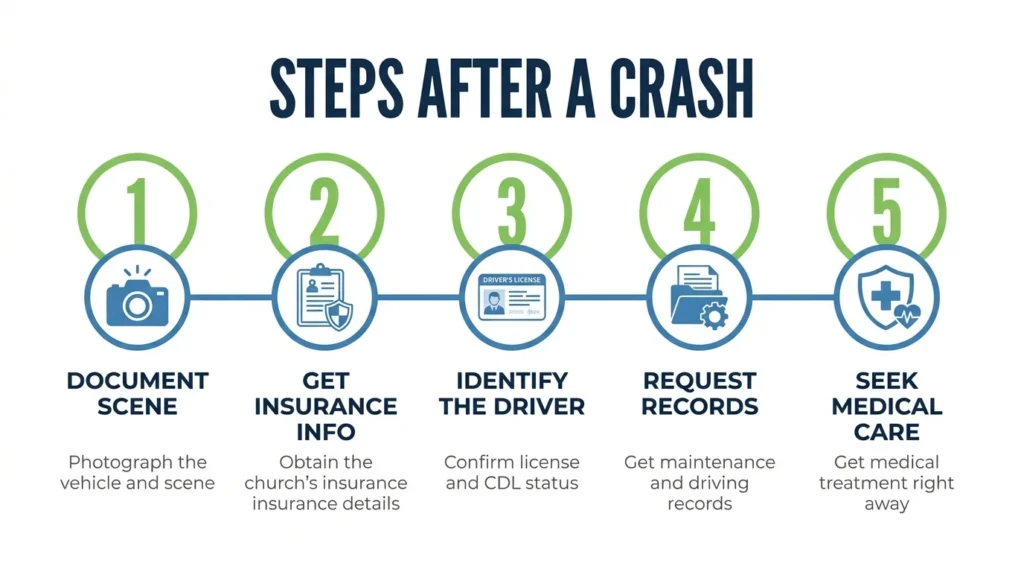
The early days after a crash decide how strong your claim will be. Document the scene and the vehicle, obtain the church’s insurance information, and identify the driver and whether they held the required license. Request the church’s maintenance and driving records, and seek medical care right away.
Certain evidence carries the most weight. The vehicle inspection records, the driver’s license history and CDL status, any prior complaints about the driver or bus, and witness statements from passengers can make or break your case.
Injured in a Church Bus Crash? Get Legal Help
Angel Reyes & Associates has represented bus accident victims across Texas for over 30 years. Our team of Texas personal injury attorneys handles the layers of liability law that most people cannot work through alone, from the charitable immunity cap to volunteer driver statutes and coverage disputes.
We offer free initial consultations, and we charge no fee unless we win. We have more than $1 billion recovered for clients across the state.
You do not have to face your own congregation’s insurer by yourself. Reach out for a free consultation, and let us review your options and the deadlines that apply to your case.
Past results do not guarantee future outcomes.
Church Bus Accident Liability FAQs
Can a child injured on a church bus still file a claim after the two-year deadline?
Yes. Under Texas Civil Practice and Remedies Code § 16.001, the two-year deadline does not begin until the injured minor turns 18. A child hurt on a church bus at age 10 would typically have until age 20 to file.
Does signing a liability waiver before a church trip stop you from suing?
Not necessarily. In Texas, a waiver must specifically name negligence in clear terms and must be easy to read and find in the document. Waivers that fail those tests can be set aside, and courts have generally held that waivers cannot block claims involving gross negligence.
Is the church still responsible if it rented the bus instead of owning it?
Yes. The church’s liability for how the bus was operated does not depend on who owns the vehicle. Federal law protects rental companies from liability as vehicle owners, but the organization that rented and operated the bus remains responsible for negligent driving and driver selection.
What types of damages can you recover in a Texas church bus accident claim?
You can seek economic damages such as medical bills, lost wages, and future care costs, as well as non-economic damages such as pain and suffering, mental anguish, and physical impairment. The charitable immunity cap limits how much the church organization must pay, but it does not restrict the categories of harm you can claim.
About the Authors

Angel Reyes
Writer
Angel L. Reyes, III is the Founder and Managing Partner of Angel Reyes & Associates. A nationally recognized trial attorney and business leader, Angel has helped over 70,000 injury victims recover more than $1 billion since founding the firm in 1993. Named to the Texas Super Lawyers list annually since 2008, Angel brings Wall Street experience, Ivy League education, and a deep commitment to client advocacy. He is a frequent legal commentator and published author with extensive contributions to legal scholarship, trial strategy, and consumer protection.

Graham Griffin
Editor
Graham Griffin is the Web & Content Manager at Angel Reyes & Associates, where he oversees content strategy, AI-powered workflows, a...

Angel Reyes
Reviewer
Angel L. Reyes, III is the Founder and Managing Partner of Angel Reyes & Associates. A nationally recognized trial attorney and business...