Construction Zone Motorcycle Accidents in Texas


Every article on this site is researched by our internal team, reviewed for legal accuracy against current Texas law, and held to State Bar of Texas advertising standards before publication. We do not publish content that overstates outcomes or makes promises about results.
Learn more about our
editorial standards .
Key Takeaways
- Texas work zone claims against TxDOT require written notice within six months of the crash.
- Liability can fall on the contractor, TxDOT, another driver, or all three parties at once.
- Milled pavement, loose gravel, and missing signs are grounds for a contractor negligence claim.
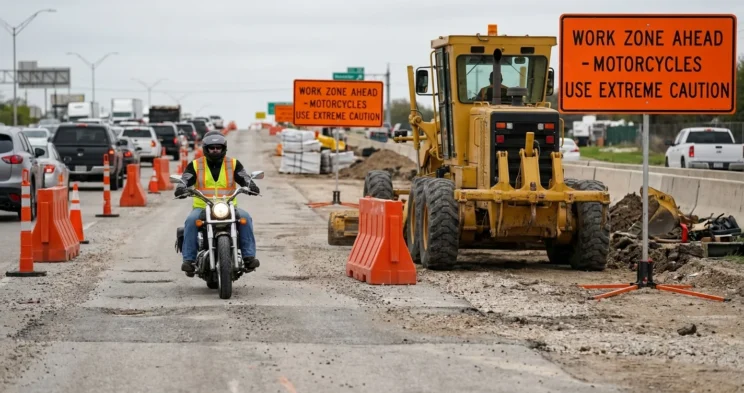
You were riding through a stretch of I-35 near Waco when the lane suddenly dropped 2 inches without warning. No signage. No cones marking the edge. Your front wheel caught the lip and the bike went down. Now you have medical bills, a wrecked motorcycle, and a growing question: who is responsible for that road?
Construction zone crashes are not like ordinary collisions. The at-fault parties may include a private contractor, a state agency, another driver, or all three at once. And some of the deadlines for these claims are much shorter than most riders expect.
Why Construction Zones Are More Dangerous for Riders
A construction zone that poses minor discomfort to a car can be genuinely dangerous to a motorcycle. Cars absorb road irregularities through suspension and four points of contact.
Motorcycles do not.
Milled pavement leaves grooves that can pull a front wheel sideways. Loose gravel scattered across a lane reduces traction dramatically. Steel plates, even when secured, create slick surfaces in wet weather.
Vertical asphalt edges between a milled lane and an adjacent untouched lane create what engineers call an edge trap. A tire dropping into that gap at speed is enough to destabilize the entire bike.
Texas saw nearly 28,000 crashes in work zones in 2024, including 215 fatalities. Motorcyclists face a disproportionate share of that risk because the surface conditions that a car drives over easily can throw a rider entirely.
According to TxDOT’s Roadway Design Manual, contractors working on Texas roads are expected to account for motorcycle safety in every traffic control plan. When they do not, that failure is the foundation of a negligence claim.
Sudden lane shifts, missing signs, and unmarked detours compound the hazard. Riders need more time and distance to process a lane change than drivers do.
A missing warning sign that a car driver handles with a quick turn of the wheel may leave a motorcyclist no room to respond. Texas motorcycle accident statistics confirm that construction zones are among the most dangerous environments riders face.
Three Parties Who May Be Liable
Liability, or blame, in a Texas construction zone crash does not always belong to a single party. A careful analysis of the facts will often point to the contractor, the government agency overseeing the project, or the driver who caused the collision. Sometimes all three share responsibility.
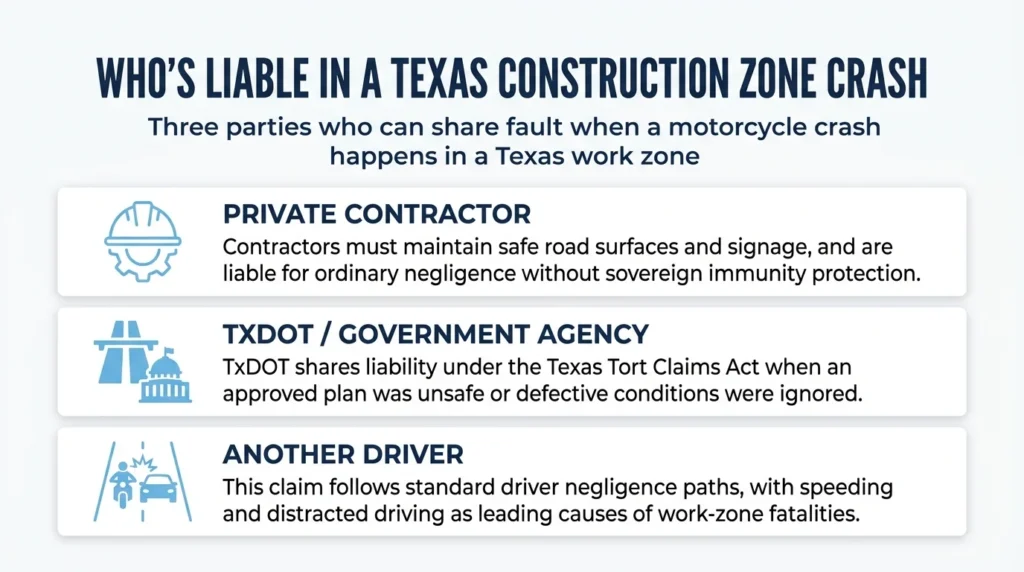
The private contractor is typically the first party to examine. Contractors hired to manage a work zone must set up proper signage, maintain lane markings, keep the road surface reasonably safe, and place barriers correctly. They are not shielded by sovereign immunity.
If the contractor failed to install a required warning sign or left loose gravel across the travel lane, they face the same negligence standard as any private party. Understanding how fault is determined in Texas injury cases helps clarify how that liability is assigned when multiple parties are involved.
When TxDOT or a Government Agency Shares Fault
TxDOT owns the roads and approves the traffic control plans that contractors must follow. When the approved plan itself was unsafe, or when TxDOT knew about a defective road condition and failed to address it, the agency can share liability under the Texas Civil Practice and Remedies Code (CPRC) Chapter 101, which is commonly called the Texas Tort Claims Act (TTCA).
The TTCA waives sovereign immunity for injuries caused by a condition of real property when the governmental unit would be liable as a private person under Texas law. A road with missing warning signs or a dangerous surface condition can qualify as that type of premises defect. Damage caps apply to these claims: a claim against the state of Texas is limited to $250,000 per claimant.
When Another Driver Causes the Crash
Other drivers in construction zones create their own dangers. Speeding, distracted driving, and unsafe lane changes are the leading contributors to work zone fatalities in Texas. When another driver’s negligence caused your crash, you pursue that claim through their insurance the same way you would in any other collision.
Multiple parties can share fault in the same crash. Texas uses proportionate responsibility rules under CPRC Chapter 33, which allow a jury to assign a fault percentage to each party. As long as your own fault stays at 50% or below, you can still receive compensation.
Your payout is then reduced by your own percentage. You can read about working through Texas motorcycle accident claims involving multiple defendants for a better understanding of what to expect.
The Six-Month Deadline You Cannot Miss
Most personal injury claims in Texas carry a two-year filing deadline. But if any part of your construction zone claim involves a government entity, a much shorter clock starts running the moment the crash happens.
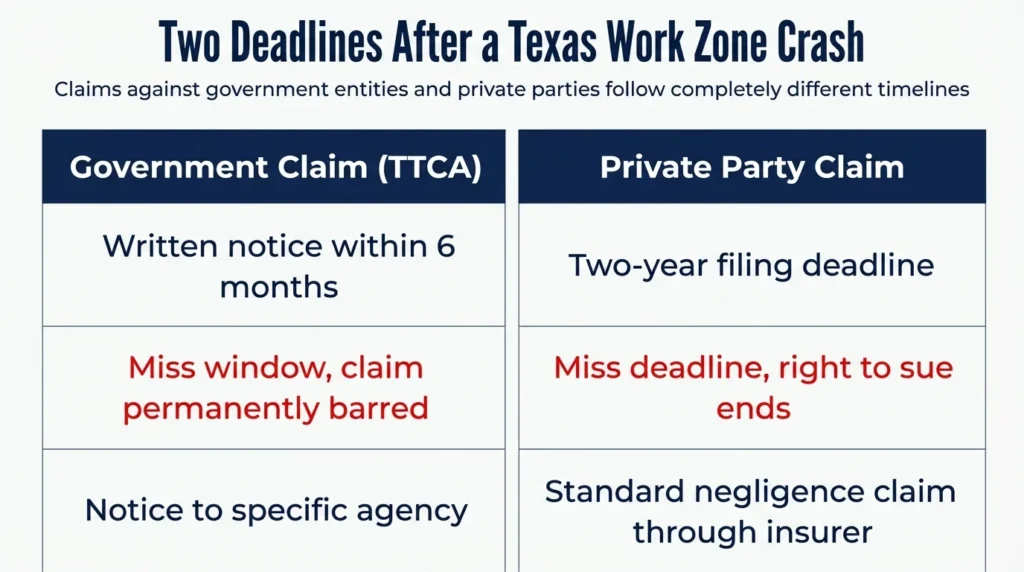
Under CPRC Section 101.101, you must give written notice to the governmental unit within six months of the incident. Miss that window and your claim against the government entity is barred. No exceptions apply based on how serious your injuries are or how long your recovery takes.
The notice must include a description of your injury, the time and place of the crash, and a brief explanation of what happened. It must go to the specific governmental unit involved: TxDOT, a county, a city, or another agency depending on who manages that road.
Your claims against the private contractor and any other drivers still follow the standard two-year deadline under Texas Civil Practice and Remedies Code Section 16.003. When your crash involves both a government entity and a private party, you are managing two different clocks simultaneously.
How to Protect Your Claim After the Crash
Evidence in construction zones disappears fast. Contractors resurface roads, barriers get moved, and lane markings change within days of an incident. Acting quickly is the difference between a provable claim and one that cannot be reconstructed.
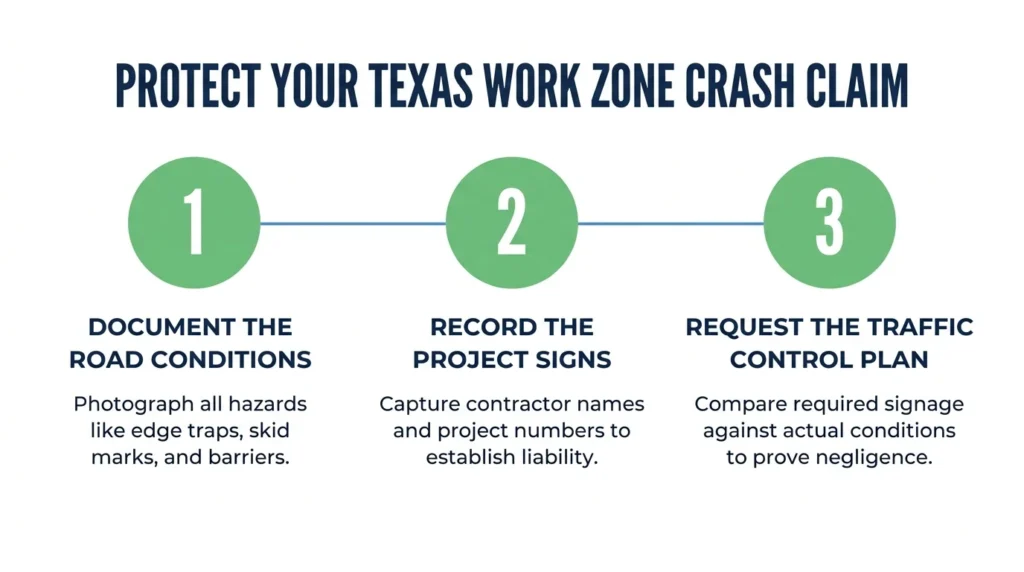
Step 1: Document the scene before you leave. Take photos of the road surface, any edge traps or pavement drops, missing or damaged signs, misplaced barriers, and skid marks from your crash. Capture the entire scene, not just the point of impact.
Step 2: Record every sign you can see. Construction zone signs typically display the project name, a contract number, and a contractor name. Photograph all posted information. That contract number connects your crash to a specific contractor and a specific government agency.
Step 3: Request the traffic control plan. This document specifies what signage, lighting, and lane markings were required at the crash location. You can request it from TxDOT or the applicable agency. If the plan required a warning sign that was not there, the gap is direct evidence of negligence.
Step 4: Gather witness information. Other drivers who were behind you or in adjacent lanes may have seen the road conditions before the crash. Their statements can support your account of what the zone looked like.
These steps serve a purpose beyond documentation. They establish that the condition was present before your crash, not created by it. For a broader look at post-crash legal strategy, review legal strategies for Texas motorcycle accidents.
What Compensation May Cover
Construction zone crashes often produce serious injuries: fractures, road rash, head trauma, spinal injuries. The compensation available spans economic and non-economic categories, and pursuing all three liable parties fully is worth the effort.
Economic damages cover your medical bills from the emergency room through ongoing treatment, lost wages during recovery, estimated future medical costs if your injuries are permanent, and the cost to repair or replace your motorcycle. Non-economic damages address pain and suffering, emotional distress, and the loss of activities your injuries prevent you from doing.
Your total recovery reflects how fault is divided. If the jury assigns 60% of fault to the contractor, 30% to TxDOT, and 10% to you, your compensation is reduced by that 10% across each defendant.
Identifying and pursuing all liable parties helps you potentially receive more compensation than pursuing only one.
You can review how Texas motorcycle accident settlements are calculated to learn how insurers and courts value these claims.
Get Legal Help Before the Deadlines Pass
Construction zone claims require fast action. The six-month TTCA notice clock starts the day of your crash, and every day you wait is a day of evidence lost to repaving or barrier relocation.
Angel Reyes & Associates has spent over 30 years helping injured Texans pursue claims against contractors, government agencies, and negligent drivers. We handle cases involving the full range of TTCA requirements, multi-party liability, and the evidence steps that keep construction zone claims viable.
Our consultations are free, and we have more than 20 office locations across Texas and can handle most, if not all, of your case remotely.
Review our case results to see the outcomes we have achieved for clients in serious injury cases. When you are ready to talk, contact us to speak with a member of our team.
Past results do not guarantee future outcomes.
Construction Zone Motorcycle Accident FAQs
Does not wearing a helmet affect my construction zone crash claim in Texas?
Texas allows riders 21 and older to ride without a helmet if they completed an approved safety course or carry qualifying health insurance. If you were riding without a helmet and the other side argues your head injury would have been less severe with one, a jury could reduce your recovery by the percentage of fault assigned to you, but it does not bar your claim entirely.
What if the contractor followed TxDOT's approved traffic control plan exactly?
If a contractor fully complies with TxDOT’s approved plan, the government contractor defense may limit the contractor’s liability. Liability for poor conditions would then shift more heavily to TxDOT, whose plan failed to adequately protect riders.
Does actual notice to TxDOT replace the formal six-month written notice requirement?
Texas courts interpret actual notice very narrowly. A police report or agency investigation of the crash is generally not enough; the governmental unit must have had specific knowledge of its own potential fault. Filing formal written notice within six months is the only reliable way to preserve your government claim.
How do I find out which contractor was responsible for the work zone where I crashed?
Look for signs posted at the entrance to the work zone; Texas construction projects are required to display the contractor name and project information. You can also request contract records from TxDOT or the relevant county or city agency to identify who held the contract at the time of your crash.
About the Authors

Angel Reyes
Writer
Angel L. Reyes, III is the Founder and Managing Partner of Angel Reyes & Associates. A nationally recognized trial attorney and business leader, Angel has helped over 70,000 injury victims recover more than $1 billion since founding the firm in 1993. Named to the Texas Super Lawyers list annually since 2008, Angel brings Wall Street experience, Ivy League education, and a deep commitment to client advocacy. He is a frequent legal commentator and published author with extensive contributions to legal scholarship, trial strategy, and consumer protection.

Kyle Nicolas
Editor
Kyle Nicolas is the Web Content & SEO Manager at Angel Reyes & Associates. He has more than 10 years of experience as a marketing co...

Angel Reyes
Reviewer
Angel L. Reyes, III is the Founder and Managing Partner of Angel Reyes & Associates. A nationally recognized trial attorney and business...