Did a Navigation App Cause Your Uber Crash?


Every article on this site is researched by our internal team, reviewed for legal accuracy against current Texas law, and held to State Bar of Texas advertising standards before publication. We do not publish content that overstates outcomes or makes promises about results.
Learn more about our
editorial standards .
Key Takeaways
- A faulty route can justify investigating the app provider, but it does not prove liability.
- Texas drivers must still obey signs and one-way rules, even when an app says to turn.
- Preserve route screenshots, closure records, and driver accounts as soon as possible.
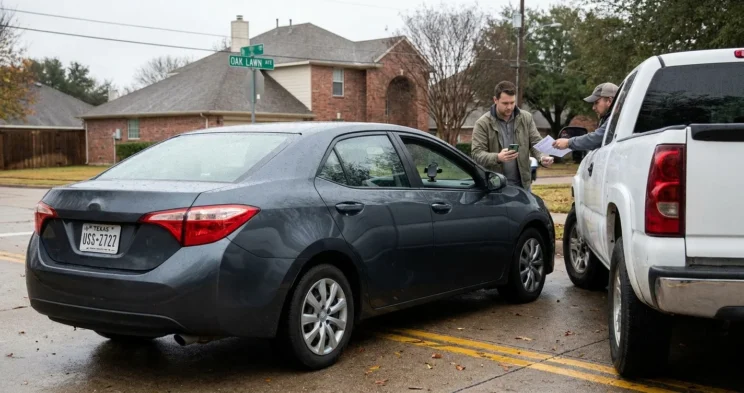
If your Uber driver followed a navigation app onto a closed or flooded road, or turned the wrong way down a one-way street, the company behind the app may be part of the crash investigation. A wrong turn alone does not make the app company liable. A Texas claim involving Google Maps liability for an accident depends on the instructions delivered, a legally recognized duty or actionable defect, and a connection to your injuries.
Start with the directions the app gave at the time, any available map or road closure records, and what the driver saw and did.
Can a Faulty Route Make the Navigation Provider Part of an Uber Crash Claim?
Yes, a faulty route can bring the navigation provider into the investigation. Showing that a route was involved is different from proving that the provider’s fault helped cause the crash.
The driver, Uber, and the navigation company may each have played a different role. For a claim against the navigation company, you’d need evidence of a defect or a failure to meet a legal duty. You’d also need to show how that failure contributed to your injuries.
How Does Texas Law Treat a Navigation Software Claim?
Texas products liability law does not automatically make a navigation provider responsible for an unsafe route. Product classification, an actionable defect, and any negligence duty require separate analysis.
When Texas Product Liability Law May Apply
Texas Civil Practice and Remedies Code § 82.001 defines a products liability action. It covers claims against manufacturers or sellers for injury, death, or property damage allegedly caused by a defective product. Those claims can be based on negligence, strict liability, or other legal grounds.
The definition does not say whether navigation software qualifies as a product. If Texas design defect law applies, § 82.005 requires you to show that a safer design was available and that the defect helped cause your injury.
The alternative design must have been feasible with the technology available at the time and economically feasible when the product left the manufacturer’s or seller’s control. It also must have reduced the risk of injury without substantially reducing the product’s usefulness. One wrong route alone does not show that a safer design met those requirements.
What Courts Have Said About Software

In Hou-Tex, Inc. v. Landmark Graphics, a Houston appeals court treated software used to analyze seismic data as a product for that appeal. The court limited its conclusion to the software in that case, which involved financial losses from drilling a dry well.
In Rosenberg v. Harwood, a Utah court dismissed negligence claims involving Google’s walking directions because Google did not owe the duties the plaintiff claimed it did. The plaintiff agreed to drop the product liability claims, so the court did not decide whether navigation software was a product.
Either case establishes when a navigation company can be held liable for an Uber crash in Texas.
What Should You Check if a Navigation App Gives Unsafe Directions?
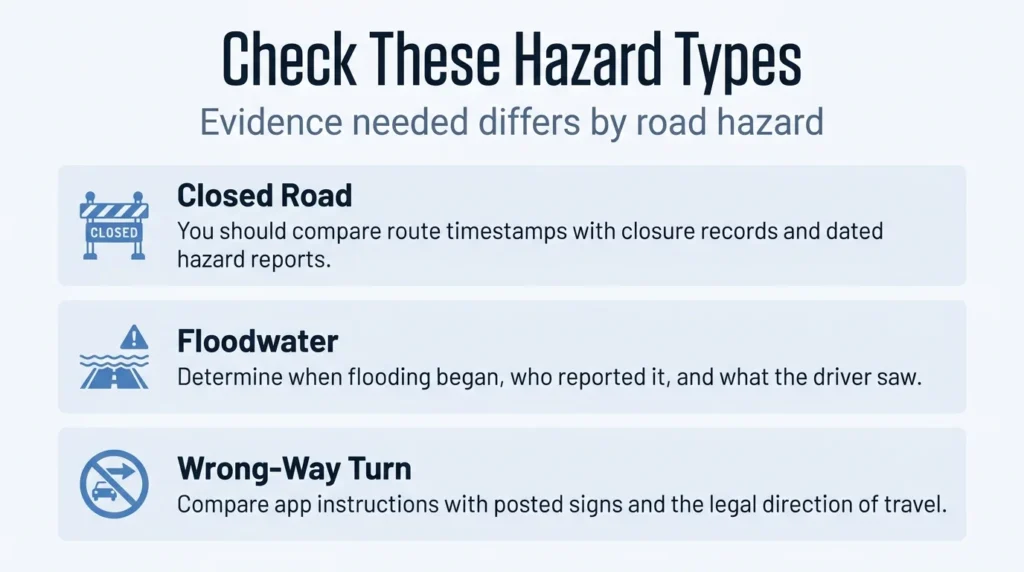
Check what the app told the driver to do, what the navigation company knew before the trip, and how the driver responded. The evidence to look for depends on the road hazard.
A Route Onto a Closed Road
Compare the route’s timestamp with official closure records and dated reports to the provider. The North Carolina Paxson complaint alleges that Google kept directing drivers across a collapsed bridge after people reported the hazard. The complaint includes emails confirming those reports.
The allegations do not establish liability. The emails show how dated records can help show when a hazard was reported and whether the company acknowledged it before the trip.
A Route Into Floodwater
Investigators need to establish when the flooding began, when someone reported it, what information reached the provider, and what the driver could see. Floodwater on the road alone does not show that the company knew about the hazard or had a duty to detect it as it developed.
A Wrong-Way Instruction
Compare the turn the app told the driver to make with the posted signs, the legal direction of travel, and map records from the time of the crash. Then check whether the driver followed the instruction or misread it.
How Google Maps Uses Road Reports
Google Maps uses user reports and partner data to update roads and maps, with phone-derived and partner information contributing to traffic and routing. These sources can guide an investigation, but they do not prove that any particular report was received, reviewed, or incorporated.
How the Driver’s Choices Can Affect Your Claim
Texas drivers must follow traffic signs and signals even when an app tells them to do something different.
Texas Transportation Code § 544.004 generally requires drivers to obey official traffic signs and signals that apply to them. Under § 545.059(b), drivers must travel in the posted direction on streets marked as one-way.
To prove negligence, you need to show that the driver owed you a duty, failed to meet it, and caused your injuries. In Bustamante v. Ponte, the Texas Supreme Court explained that the conduct must help cause the injury and that the harm must have been reasonably foreseeable. An injury can have more than one cause.
In a car accident claim, investigators can look at both the app’s directions and the driver’s choices. They may check what signs, barriers, or floodwater the driver could see and whether the driver chose a different route.
What Records Should You Save After a Navigation-Related Crash?
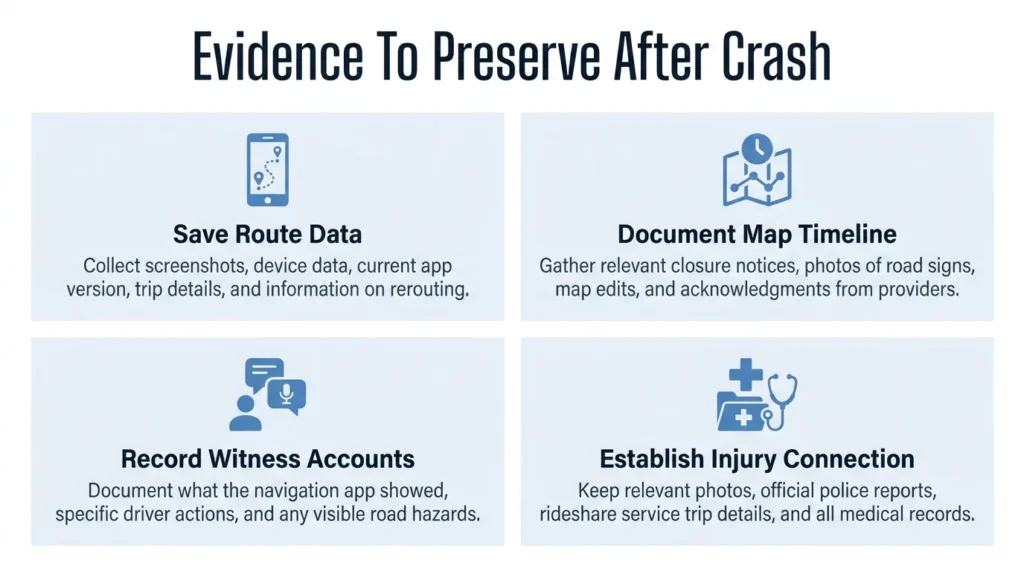
1. Preserve the route. Save available screenshots, original device data, navigation audio or video, the app name and version, destination, trip time and location, and any rerouting. A route generated after the crash may differ from the one delivered earlier.
2. Build the road and map timeline. Gather official closure notices, road designations, photographs of signs, map edits, incident reports, and provider acknowledgments. Compare timestamps rather than assuming a report preceded the trip.
3. Write down what the driver and witnesses saw. Note which app gave the directions, what it showed or said, whether the driver followed it, and what hazards were visible. Passenger and witness accounts can help fill in gaps.
4. Connect the crash to your injuries. Keep photographs, police and incident reports, Uber trip details, and relevant medical records
A lawyer can send an evidence preservation letter asking the navigation company to keep any records it has of the route or rerouting.
Discuss a Possible Navigation-Related Uber Crash Claim
Angel Reyes & Associates has guided injured Texans for over 30 years. Our team can review the route, road conditions, driver conduct, and available evidence to help you understand your options. Contact us for a free consultation.
Past results do not guarantee future outcomes.
Navigation App Crash FAQs
Can an Uber passenger sue a navigation app company without suing the driver?
A passenger may pursue a claim against a navigation provider if there is a valid legal basis for holding that company responsible. Whether the driver or other parties must also be included depends on the claims and circumstances.
Does Uber's insurance cover accidents caused by GPS navigation errors?
Uber’s insurance coverage generally depends on the driver’s status in the app when the accident occurred, rather than whether GPS directions contributed to the crash. Under Texas Insurance Code § 1954.052, specific liability insurance requirements apply when a driver is transporting a passenger on a prearranged ride.
Can a navigation company be held responsible for outdated road information?
Outdated road information may be relevant to a negligence claim, but it does not automatically establish liability. Under Texas law, the injured person must establish an applicable legal duty, a breach of that duty, and a legally sufficient connection to the injuries.
How long do I have to file a lawsuit after an Uber accident involving faulty GPS directions in Texas?
Texas Civil Practice and Remedies Code § 16.003 generally provides a two-year deadline for filing a personal injury lawsuit. Certain exceptions may affect that deadline, so the applicable filing period depends on the circumstances.
Can multiple companies share responsibility for an Uber accident caused by incorrect directions?
Yes. Under Texas Civil Practice and Remedies Code Chapter 33, a court may allocate percentages of responsibility among parties whose conduct contributed to an injury, subject to the statute’s requirements. This can include a driver and a navigation provider if the evidence supports legally recognized claims against them.
About the Authors

Angel Reyes
Writer
Angel L. Reyes, III is the Founder and Managing Partner of Angel Reyes & Associates. A nationally recognized trial attorney and business leader, Angel founded the firm in 1993, which has gone on to help over 70,000 injury victims recover more than $1 billion. Named to the Texas Super Lawyers list annually since 2008, Angel brings Wall Street experience, Ivy League education, and a deep commitment to client advocacy. He is a frequent legal commentator and published author with extensive contributions to legal scholarship, trial strategy, and consumer protection.

Kyle Nicolas
Editor
Kyle Nicolas is the Web Content & SEO Manager at Angel Reyes & Associates. He has more than 10 years of experience as a marketing co...

Angel Reyes
Reviewer
Angel L. Reyes, III is the Founder and Managing Partner of Angel Reyes & Associates. A nationally recognized trial attorney and business...