The Difference Between an E-Bike and an E-Moto in Texas


Every article on this site is researched by our internal team, reviewed for legal accuracy against current Texas law, and held to State Bar of Texas advertising standards before publication. We do not publish content that overstates outcomes or makes promises about results.
Learn more about our
editorial standards .
Key Takeaways
- Texas law excludes compliant e-bikes from the motor vehicle definition, so no license or insurance is required.
- E-motos are classified as motorcycles under Texas law and require a Class M license, registration, and insurance.
- When an injury occurs, the vehicle's legal classification determines what coverage applies and who can be sued.
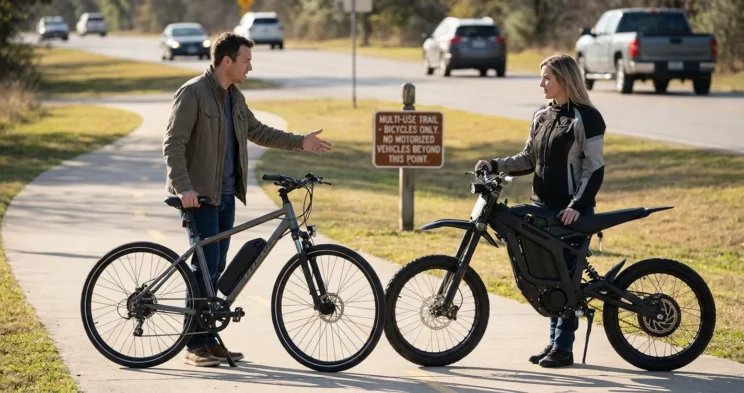
You bought an electric two-wheeled vehicle and you want to know where you stand legally in Texas. Or maybe you were hit by one and you’re not sure what insurance applies, who is responsible, or what your options are. The vehicle’s classification under Texas law determines all of that. Whether what you’re dealing with is an e-bike or an e-moto is not just a matter of what it looks like. It is a legal question with real consequences.
How E-Bikes & E-Motos Work Differently
The mechanical difference between an e-bike and an e-moto is also the legal one. An e-bike has fully operable pedals. The motor on an e-bike assists the rider’s pedaling or, in some configurations, can propel the bike up to a capped speed without pedaling. Either way, pedals are present and functional.
An e-moto has no pedals. The motor is the only means of propulsion. It can reach speeds well beyond what an e-bike is designed for, and its motor output typically far exceeds an e-bike’s.
This is not just a design choice. Texas law uses these mechanical differences to sort each vehicle into a legal category, and those categories carry different rules. Texas Transportation Code Chapter 664 is the law that governs e-bikes, and it is built entirely around the presence of pedals, motor wattage, and speed limits.
How the Law Defines E-Bikes & E-Motos in Texas
Texas law is precise about what separates an e-bike from an e-moto. The definitions come from the Texas Transportation Code, and they are not ambiguous.
What Texas Law Says About E-Bikes
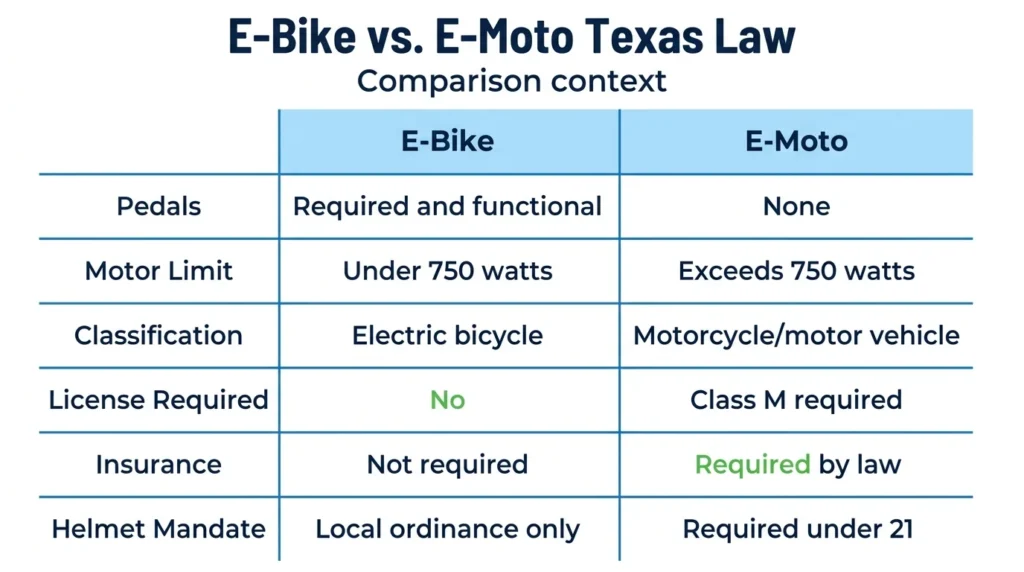
Under Texas Transportation Code Section 664.001, an electric bicycle is a bicycle with fully operable pedals, a motor under 750 watts, and a top assisted speed of 28 mph or less. Texas law creates three classes within that definition:
- Class 1: Motor assists only when the rider is pedaling; top assisted speed of 20 mph or less.
- Class 2: Motor may propel the bicycle without pedaling; top assisted speed of 20 mph or less.
- Class 3: Motor assists only when the rider is pedaling; top assisted speed of more than 20 mph but less than 28 mph.
The legal significance of meeting this definition goes beyond a label. Texas Transportation Code Section 541.201 defines “motor vehicle” under Texas law and expressly excludes electric bicycles from that definition. A compliant e-bike is not a motor vehicle in Texas. That exclusion is what drives the differences in licensing, insurance, and liability.
What Texas Law Says About E-Motos
E-motos do not have their own separate code chapter. Instead, they fall under the motorcycle definition in Texas Transportation Code Section 541.201: a motor vehicle equipped with a rider’s saddle, designed to have no more than three wheels on the ground when moving.
Because e-motos have no pedals and their motors exceed the Chapter 664 thresholds, they cannot qualify as electric bicycles. They are motor vehicles under Texas law. Any electric two-wheeled vehicle that exceeds 750 watts of motor power or a 28 mph top assisted speed is reclassified as a motor vehicle, regardless of how the manufacturer markets it.
Licensing, Insurance & Age Requirements
The legal classification creates two very different sets of obligations for Texas riders.
A rider on a compliant e-bike needs no driver’s license, no vehicle registration, and no liability insurance. State law sets no minimum age for Class 1 and Class 2 e-bikes. Class 3 riders must be at least 15. These rules reflect the fact that a compliant e-bike is treated more like a bicycle than a motor vehicle under Texas law. For context on how similar the regulatory approach is to other low-speed electric vehicles, the Texas e-scooter liability framework follows a comparable structure.
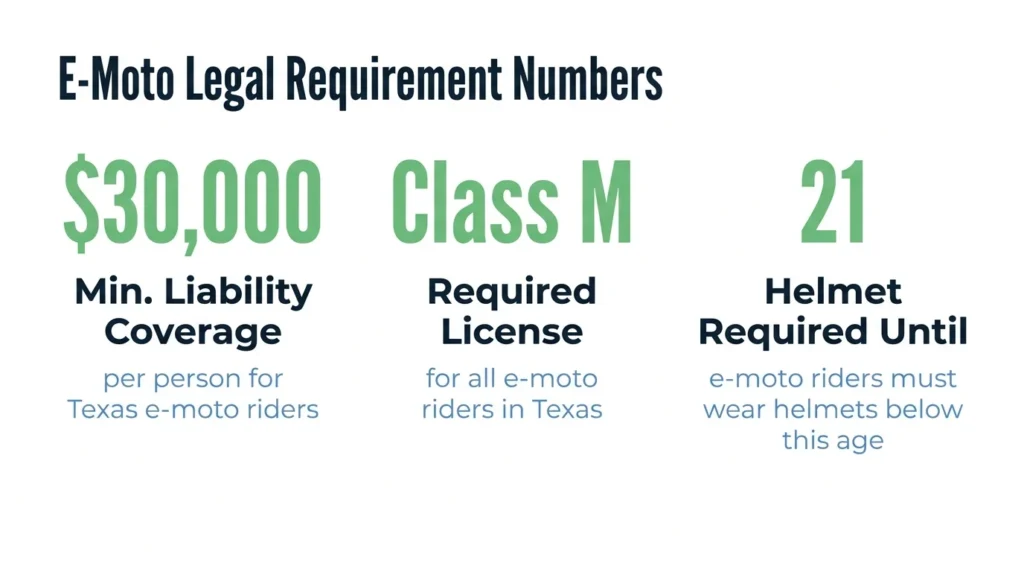
An e-moto rider faces a completely different set of requirements. Riders must hold a valid Class M driver’s license under Texas Transportation Code Section 521.084. The vehicle must be registered with TxDMV and carry a valid license plate. Texas requires liability insurance meeting the state’s minimum limits: $30,000 per injured person, $60,000 per accident, and $25,000 for property damage. The Texas Department of Insurance outlines these requirements for motorcycle and moped operators. The minimum rider age is 16.
Helmet rules add another layer of difference. E-moto riders under 21 must wear a helmet under Texas motorcycle law. E-bike helmet requirements vary by local ordinance and are not uniformly imposed at the state level. If you have questions about what motorcycle accident claims in Texas typically involve, the injury risks for e-moto riders track closely with those of traditional motorcycle riders.
How Classification Affects Injury Claims
When an e-bike or an e-moto is involved in an injury incident, the vehicle’s classification directly shapes what coverage is available and what legal options exist.
If you are riding an e-bike and another driver causes an accident that injures you, you typically pursue the at-fault driver’s liability policy. Because e-bikes are not motor vehicles, e-bike riders carry no required insurance of their own. If the at-fault driver is uninsured, your recovery options depend on whether you carry uninsured motorist coverage on a personal auto policy. That coverage can extend to bicycle accidents in some circumstances, but it is not guaranteed. How motorcycle accident settlements work in Texas gives a useful frame for understanding how fault and coverage interact in these situations.
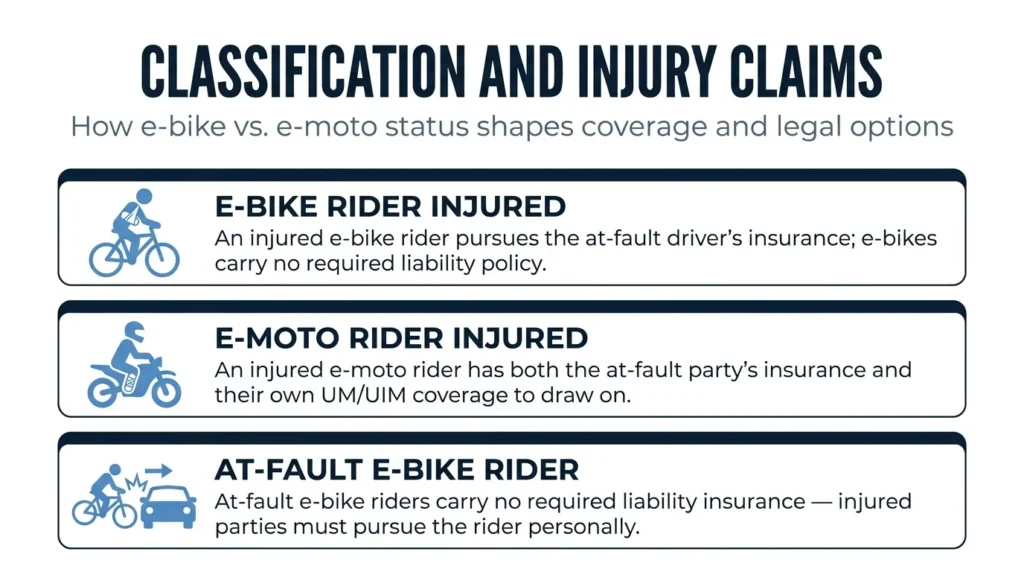
If you are riding an e-moto, you are in the same position as a motorcycle rider for purposes of an injury claim. You carry required liability insurance. The at-fault party’s policy is the first source of recovery. Your own UM/UIM coverage may supplement that if the at-fault driver is uninsured or underinsured. The injuries common in motorcycle accidents are broadly applicable to e-moto riders, who face similar exposure without the protection of an enclosed vehicle.
When the e-bike or e-moto rider is the at-fault party, the situation reverses. An injured person pursuing an at-fault e-bike rider will find no required liability policy to collect against. That does not end the claim, but it does complicate recovery. An at-fault e-moto rider, by contrast, must carry liability insurance, so there is a policy in place for an injured party to pursue. Our attorneys can help evaluate which claims apply to your specific situation and what recovery options are realistically available.
One more scenario deserves attention. If a vehicle is sold or marketed as an e-bike but actually exceeds the 750W or 28 mph thresholds, Texas law classifies it as a motor vehicle. If that vehicle causes an injury and the rider lacks the required Class M license and insurance, it creates serious complications for anyone trying to recover damages. Misclassified vehicles blur the lines that the legal framework depends on.
Get Legal Help After an E-Bike or E-Moto Accident
The legal distinctions between e-bikes and e-motos matter most when something goes wrong. Whether you were hit while riding an e-bike with no liability policy on the other side, or you were injured by an e-moto rider operating without the required license or insurance, the path to fair compensation depends on understanding exactly what vehicle was involved and how Texas law classifies it.
Angel Reyes & Associates has helped injured Texans work through complex personal injury situations for over 30 years, including cases involving motorcycles and other electric vehicles. We offer free consultations and handle cases on a contingency basis, which means you pay nothing unless we recover for you. We serve clients across the entire state of Texas from more than 20 office locations. Contact us to review your situation with no upfront cost.
Past results do not guarantee future outcomes.
E-Bike vs. E-Moto FAQs
Can an e-bike be reclassified as a motor vehicle in Texas?
Yes. If your e-bike exceeds 750 watts of motor power or a 28 mph top assisted speed, Texas law treats it as a motor vehicle, not an e-bike. At that point, you need a Class M license, registration, and liability insurance to ride it legally.
Where can e-bikes legally ride in Texas?
Compliant e-bikes may use public roads, bike lanes, and multi-use paths where regular bicycles are allowed. They are not permitted on controlled-access highways. Local ordinances can restrict where specific classes of e-bikes may ride, so the rules vary by city.
Does Texas require helmets for e-bike riders?
Texas has no statewide helmet law for e-bike riders. However, local ordinances in cities like Dallas, Houston, and Austin require helmets for riders under 18, so the rule depends on where you ride.
If an e-bike rider with no insurance injures me, what are my options?
You can still file a personal injury claim against the at-fault rider directly. Because e-bikes do not require liability insurance in Texas, there may be no policy to collect against, but a civil judgment is still an option. Your own uninsured motorist coverage under a personal auto policy may also apply depending on your policy terms.
Do e-moto riders have to follow the same rules as traditional motorcycle riders in Texas?
Yes. Texas classifies e-motos as motorcycles under the Transportation Code. E-moto riders must hold a Class M license, register the vehicle, carry minimum liability insurance, and follow the same helmet and age requirements that apply to traditional motorcycle operators.
About the Authors

Angel Reyes
Writer
Angel L. Reyes, III is the Founder and Managing Partner of Angel Reyes & Associates. A nationally recognized trial attorney and business leader, Angel has helped over 70,000 injury victims recover more than $1 billion since founding the firm in 1993. Named to the Texas Super Lawyers list annually since 2008, Angel brings Wall Street experience, Ivy League education, and a deep commitment to client advocacy. He is a frequent legal commentator and published author with extensive contributions to legal scholarship, trial strategy, and consumer protection.

Graham Griffin
Editor
Graham Griffin is the Web & Content Manager at Angel Reyes & Associates, where he oversees content strategy, AI-powered workflows, a...

Angel Reyes
Reviewer
Angel L. Reyes, III is the Founder and Managing Partner of Angel Reyes & Associates. A nationally recognized trial attorney and business...