What Is the Difference Between Wrongful Death and a Survival Action in Texas?


Every article on this site is researched by our internal team, reviewed for legal accuracy against current Texas law, and held to State Bar of Texas advertising standards before publication. We do not publish content that overstates outcomes or makes promises about results.
Learn more about our
editorial standards .
Key Takeaways
- Wrongful death compensates the surviving spouse, children, and parents directly.
- A survival action belongs to the estate and covers the decedent's losses suffered before their death.
- Texas generally gives families two years to file a claim, so confirm your exact deadline before taking legal action.

The funeral home director hands you paperwork across their desk, and a phrase appears that you have never heard before: survival action. You knew about wrongful death, but you have no idea how to file a survival action claim, or even what the difference is.
Here is the short answer: Under Texas law, a wrongful death claim and a survival action are two separate legal actions that can arise from the same fatal injury. In some cases involving a wrongful death, the surviving family has grounds to pursue both.
The difference is as follows:
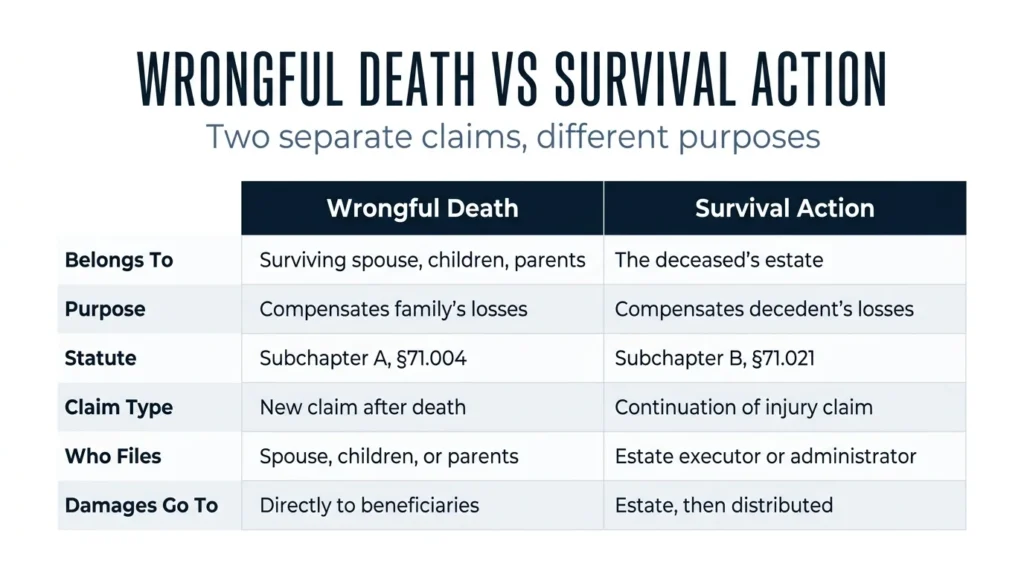
- A wrongful death claim belongs to the surviving spouse, children, and parents, and it compensates them for their own losses.
- A survival action belongs to the deceased. It is pursued by their estate and recovers compensation for what the victim personally suffered before their death.
Understanding what each claim covers will strengthen your position for both.
Separate Claims With Different Purposes
The clearest way to differentiate these two claims is determining their purpose:
- A wrongful death claim pays for the family’s loss.
- A survival action pays for the decedent’s loss.
Texas places both claims in Chapter 71 of the Civil Practice and Remedies Code, but in different subchapters:
- Subchapter A covers wrongful death. §71.004 states that a wrongful death action is for the exclusive benefit of the surviving spouse, children, and parents of the deceased.
- Subchapter B covers survival action. Under §71.021, a personal injury claim is not dismissed because the injured person died. It continues to be pursued through the decedent’s estate or legal representatives on behalf of their heirs.
Therefore, the difference is as follows:
- A survival action is not a new claim resulting from your loved one’s death. It is their existing injury claim that continues to be pursued through their estate after their death.
- Wrongful death is a new claim that is opened after the death occurs.
Although both claims are a result of the same incident, they are two separate legal actions.
Texas Law Behind Each Claim
Each claim is based on a different Texas law, which is why Texas courts treat them as separate legal claims entirely, rather than just different paths to the same legal claim.
The Texas laws are organized as follows:
- §71.002 allows a wrongful death claim to be filed when an injury that causes a death is a result of someone else’s wrongful act, negligence, carelessness, lack of skill, or other wrongful conduct.
- §71.003 limits wrongful death claims to injuries that the deceased would have been entitled to sue over if they had lived, and it includes specific exceptions.
- §71.004 identifies who can benefit from the wrongful death action, and who is permitted to file the claim.
- §71.021 establishes that a personal injury claim is not dismissed just because the injured party has died; instead, the claim passes to the heirs, legal representatives, and estate of the deceased.
To clarify, the Texas wrongful death laws above do not list every type of damages that can be recovered. The specific losses that Texas juries award in these cases have been developed through Texas court decisions and long-established jury instructions, not from the text of the laws themselves.
Who Has the Right to File?
One of the biggest differences between these two claims is who is allowed to file them. This is one area that causes the most confusion for families.
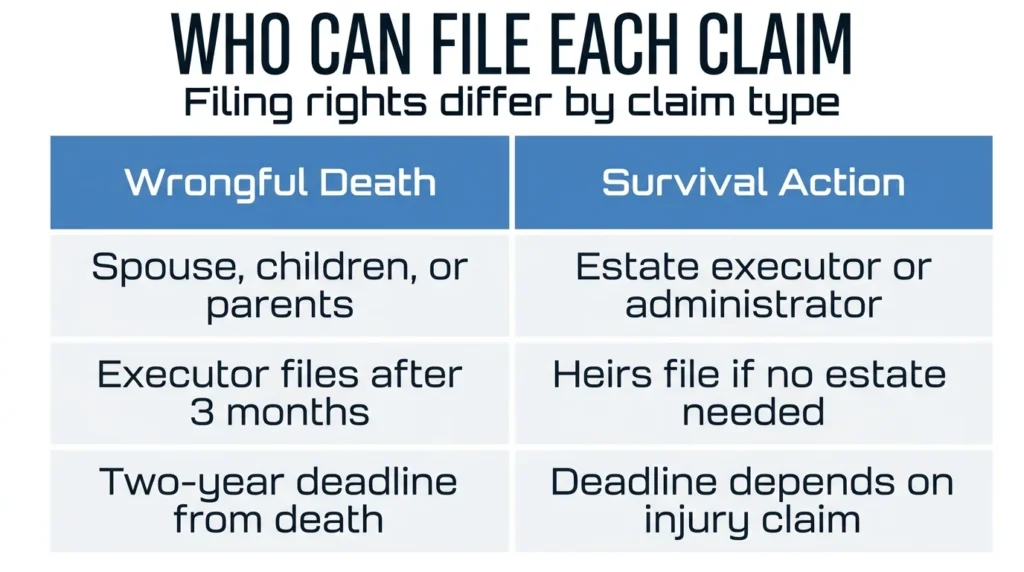
For wrongful death claims, the surviving spouse, children, or parents of the deceased may file the claim under §71.004(b). One party may file the claim individually or on behalf of all parties.
If none of these parties file the claim within three calendar months after the death, then §71.004(c) requires the executor or administrator of the decedent’s estate to file the claim on their behalf, unless all the beneficiaries ask the representative not to.
A survival action is usually filed by the person who represents the decedent’s estate, typically the executor named in the decedent’s will or an administrator appointed by the probate court.
Not every family opens a probate case, and Texas law recognizes that. In Shepherd v. Ledford, 962 S.W.2d 28 (Tex. 1998), the Texas Supreme Court allowed heirs to file a survival action directly if they prove that no estate administration is pending or needed.
Note the difference in vocabulary:
- The wrongful death statute refers to an refers to an “executor” or “administrator.”
- The survival statute refers to “heirs,” “legal representatives,” and “the estate.”
Those phrases may be used interchangeably in everyday conversation, but they have different legal meanings. Using the wrong term in a lawsuit may cause delays or other problems with your family’s claim.
Compensation Available Under Each Claim
Each claim seeks compensation for different types of losses, which is why pursuing both is not considered double recovery.
Wrongful Death Damages
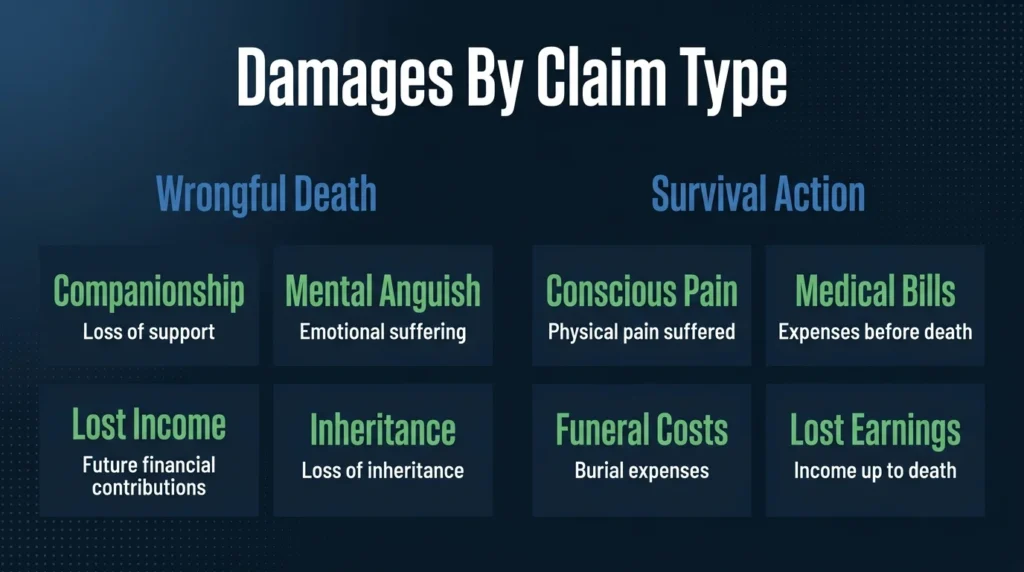
Wrongful death damages compensate the surviving spouse, children, and parents for the losses they experience after their loved one’s death. Texas courts have recognized several types of “actual damages” as stated in §71.002, including:
- Loss of companionship and support
- Mental anguish and emotional suffering
- The income and financial contributions that the deceased would have provided over the course of their lifetime
- Loss of inheritance
The Texas Supreme Court defined “loss of inheritance” in [Moore v. Lillebo, 722 S.W.2d 683 Tex. 1986 as the value of what the deceased would have reasonably added to the estate and left to their beneficiaries if they had not died prematurely. The same decision confirmed that mental anguish and loss of companionship are separate types of damages, rather than two ways of describing the same kind of loss.
Survival Damages
Survival damages focus on what your loved one endured between their injury and their death.
According to case law and established Texas jury practices, these damages generally include:
- Conscious physical pain and mental anguish suffered before death
- Reasonable medical and hospital expenses incurred before death
- Funeral and burial expenses
- Lost earnings up to the time of death
Compensation for pain and suffering experienced before death usually depends on evidence that your loved one was conscious and experienced pain after their injury and before their death. Medical records, first responder documentation, and witness accounts can prove what they went through during that time.
There is also a difference in who the money goes to:
- Wrongful death damages pass directly to the statutory beneficiaries.
- Survival action damages go to the estate first and are then distributed according to the decedent’s will or Texas inheritance rules.
This difference explains why the two types of compensation are not considered duplicates of each other, even if the same relatives ultimately benefit from both claims.
Why Families Pursue Both Claims & the Filing Deadline
Texas attorneys routinely file both claims in a single lawsuit because they involve different claimants and cover different types of losses. Failing to include one claim could mean losing the opportunity to recover further compensation.
Consider a fatal collision on I-35 during rush hour. The driver survives at the scene, is transported to the hospital, and dies hours later. The surviving spouse and children can file a wrongful death claim for their own loss, and the decedent’s estate can file a survival claim for the final hours of conscious pain, emergency care bills, and burial costs. Cases arising from fatal car accidents often involve this exact combination.
Both claims are generally subject to the two-year deadline in §16.003. Subsection (b) addresses wrongful death cases directly, stating that a lawsuit must be filed within two years of the date of death.
However, the deadline for a survival claim can be more complicated because a survival claim is a continuation of the personal injury claim that was pending before the victim’s death. Therefore, the deadline may depend on the specific facts of the underlying injury.
It’s important to have a Texas attorney confirm the exact deadline that applies to your family’s situation as soon as possible, because evidence in fatal injury cases can quickly disappear.
Talk to an Attorney About Your Wrongful Death Claim or Survival Action in Texas
Whether your family has a wrongful death claim, a survival action, or both depends on facts that only a careful legal review can determine, such as who survived, what happened between the injury and the death, whether an estate has been opened, and who holds the legal right to file a claim.
Angel Reyes & Associates has guided Texans through situations like this for over 30 years. Our firm reviews fatal injury cases at no upfront cost to your family, and you pay no fees unless we win your case. Contact us for a free, no-obligation consultation to understand what your family is entitled to pursue.
Past results do not guarantee future outcomes.
Wrongful Death vs. Survival Action FAQs
Can siblings or grandparents file a wrongful death lawsuit in Texas?
No. Siblings and grandparents are not wrongful death beneficiaries. However, they may receive compensation through a survival action if they inherit from the deceased’s estate.
Can estate creditors receive money from a Texas survival action?
Yes. Survival action compensation belongs to the estate, so valid debts and estate expenses may have to be paid before the remaining funds can be distributed to heirs or beneficiaries.
Are punitive damages available in Texas wrongful death and survival cases?
Sometimes. Texas law permits exemplary (punitive) damages in a wrongful death case only if it involves a purposefully reckless act or gross negligence. A survival action may also include a claim for exemplary (punitive) damages if the deceased would have been entitled to pursue them based on the facts of the case and applicable law.
Do different deadlines apply when a government entity causes the death?
Sometimes. The Texas Tort Claims Act generally requires notice to be sent to the governmental unit within six months after the incident, and additional procedural restrictions may apply before a claim can proceed.
Does opening a probate estate extend the deadline for a survival action?
Not automatically. Texas has limited circumstances in which the filing deadline may be paused after the claimant’s death, but the deadline depends on when the underlying injury claim began, and when an executor or administrator was appointed to the estate.
About the Authors

Angel Reyes
Writer
Angel L. Reyes, III is the Founder and Managing Partner of Angel Reyes & Associates. A nationally recognized trial attorney and business leader, Angel has helped over 70,000 injury victims recover more than $1 billion since founding the firm in 1993. Named to the Texas Super Lawyers list annually since 2008, Angel brings Wall Street experience, Ivy League education, and a deep commitment to client advocacy. He is a frequent legal commentator and published author with extensive contributions to legal scholarship, trial strategy, and consumer protection.

Kyle Nicolas
Editor
Kyle Nicolas is the Web Content & SEO Manager at Angel Reyes & Associates. He has more than 10 years of experience as a marketing co...

Angel Reyes
Reviewer
Angel L. Reyes, III is the Founder and Managing Partner of Angel Reyes & Associates. A nationally recognized trial attorney and business...