What’s the Difference Between Umbrella and Excess Coverage?


Every article on this site is researched by our internal team, reviewed for legal accuracy against current Texas law, and held to State Bar of Texas advertising standards before publication. We do not publish content that overstates outcomes or makes promises about results.
Learn more about our
editorial standards .
Key Takeaways
- Follow-form excess adopts underlying terms with exceptions; an umbrella may cover more.
- A primary insurer's denial is not exhaustion and does not by itself trigger upper layers.
- Check every declarations page, insuring agreement, and underlying-limits schedule.
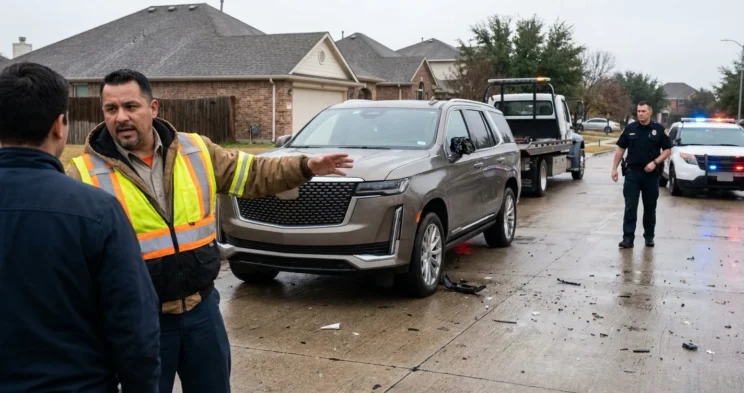
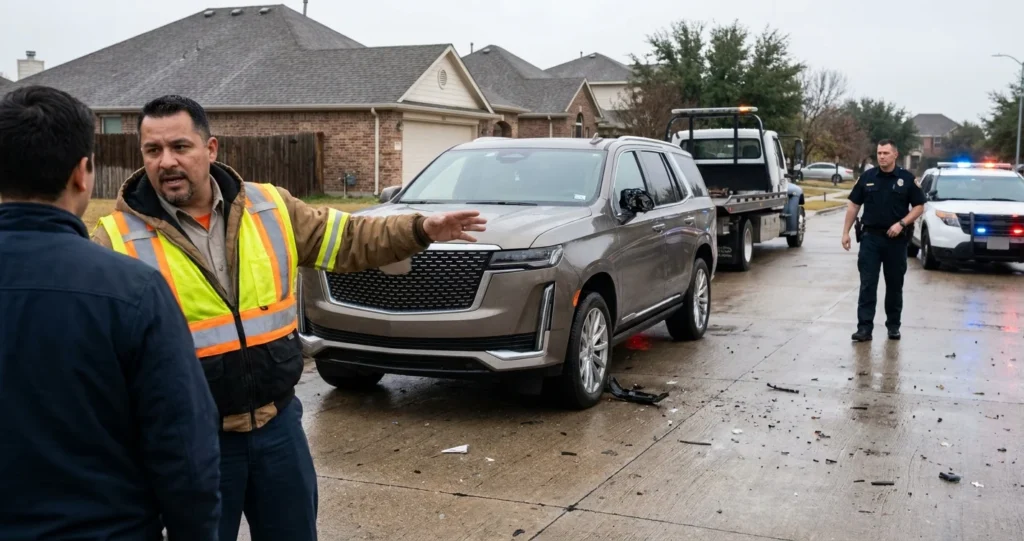
After a serious crash with a commercial truck or company vehicle, the primary insurance limit may fall short of your losses. The difference between umbrella and excess liability is how each policy grants coverage.
Follow-form excess generally adds limits using the underlying policy’s terms, subject to exceptions; an umbrella has its own coverage grant and may cover some claims the underlying policy excludes.
For an injured person in Texas, that distinction counts when identifying the defendant’s available insurance. The policy wording determines whether an upper layer covers the crash and when it must respond.
How Do Umbrella & Excess Policies Grant Coverage?
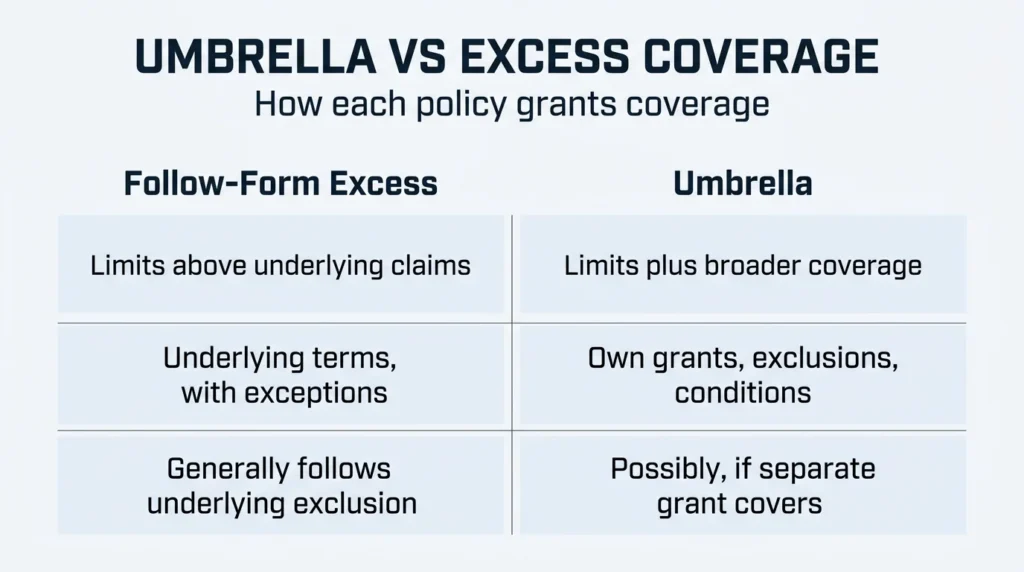
A follow-form excess policy generally adds limits above coverage that already exists. An umbrella can add limits and provide a separate coverage grant for certain risks outside the underlying policy.
The Texas Department of Insurance explains that an umbrella can insure exposures outside the primary commercial general liability policy, provided the umbrella does not exclude them:
| Coverage question | Follow-form excess | Umbrella |
| What does it add? | Limits above covered underlying claims | Limits and potentially broader coverage |
| Which terms apply? | Designated underlying terms, subject to the excess policy’s exceptions | The umbrella’s grants, conditions, exclusions, and any incorporated terms |
| Can it cover an excluded underlying risk? | Generally follows the underlying exclusion, subject to its own wording | Possibly, if its separate grant covers the risk |
“Follow form” does not mean a perfect copy. Chubb’s product descriptions identify limited exceptions in its follow-form excess coverage and illustrate an umbrella with separate excess and umbrella grants. Those descriptions show why reviewing the actual contract matters.
When an umbrella’s separate grant covers a claim the primary policy excludes, the umbrella may “drop down” to respond. The umbrella label alone never proves broader protection. Its insured definition, exclusions, and payment conditions still control.
That separate grant may require a self-insured retention, an amount that must be satisfied before the applicable umbrella coverage pays. It is an insured-side obligation, not money you owe as the injured person. Retentions are not universal; some umbrella products have no retention for their separate coverage.
Why Does the Difference Matter After a Serious Commercial Crash?
The defendant’s primary limit may be only one part of the available insurance. Travelers describes excess liability coverage above primary and umbrella limits, including coverage for auto liability exposures.
After an I-35 crash involving a company vehicle, two different questions may arise. If the primary policy covers the crash but its limit is too low, additional limits may matter. If it excludes the risk, an umbrella’s separate grant may count instead.
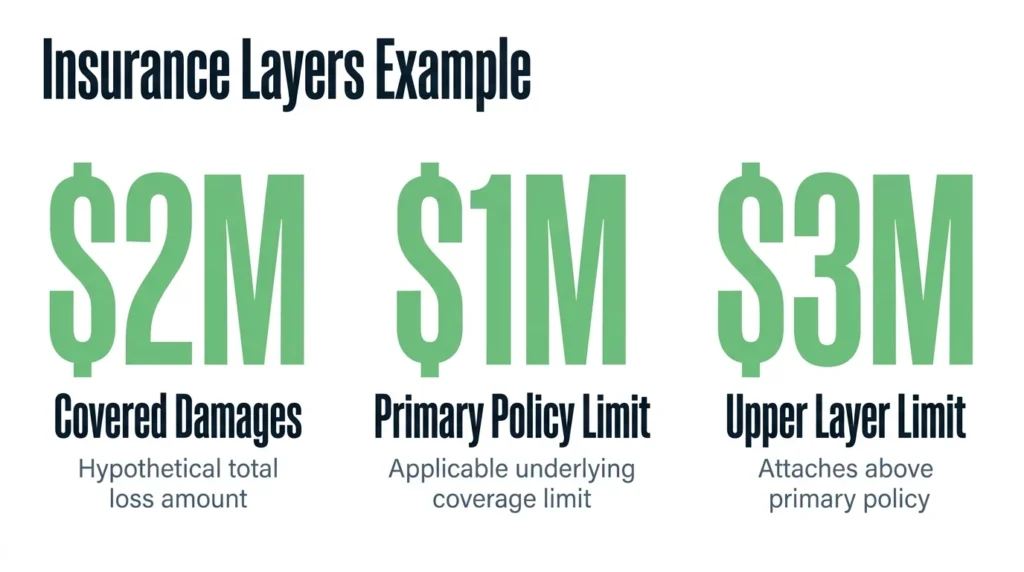
As a hypothetical example, assume covered damages of $2 million, an applicable $1 million primary policy, and a $3 million upper layer attaching above it. If the upper layer’s terms are met and its limits remain available, it could cover the additional $1 million. These figures illustrate the layers; they are not Texas minimums, typical limits, or a settlement prediction.
Neither route promises payment. Liability, damages, insured status, coverage, and remaining limits each require their own proof.
How Can You Read the Defendant’s Insurance Tower?
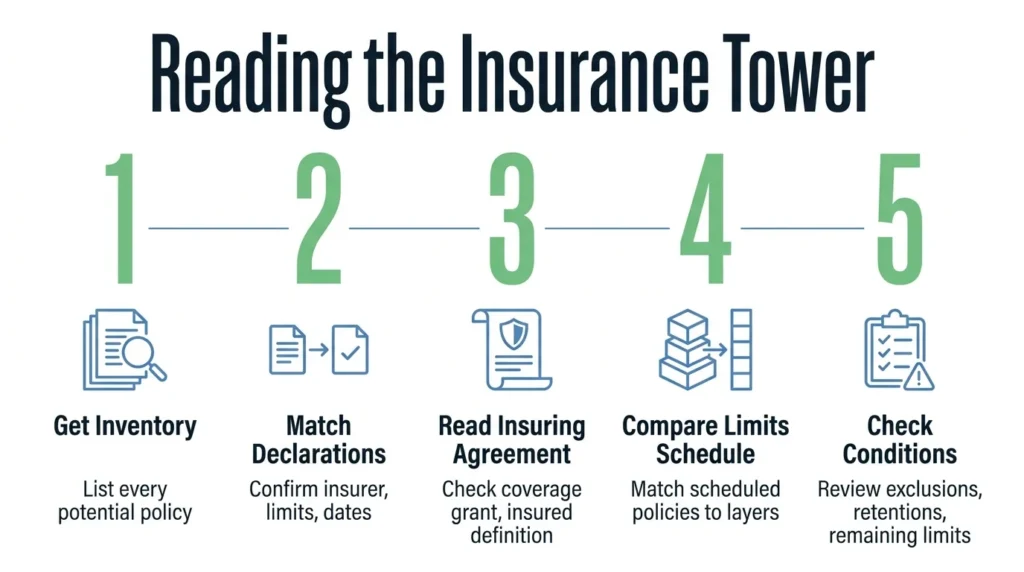
Start with a limits disclosure identifying every potentially applicable layer, then verify the list against complete policies. An insurance “tower” means the arrangement of primary and upper layers, including where each begins to provide coverage.
The declarations page, insuring agreement, and underlying-insurance schedule are the starting documents. Read them with the exclusions, endorsements, and payment conditions:
- Get the inventory. Identify every potentially applicable primary, umbrella, and excess policy. Treat the disclosure as a list to verify.
- Match each declarations page. Confirm the insurer, named insured, policy dates, limits, and listed endorsements.
- Read each insuring agreement. Check the coverage grant and insured definition to determine whether the policy covers this defendant and crash.
- Compare the underlying-limits schedule. Match the scheduled policies to the layers below. Identify the controlling form and required underlying limits.
- Check conditions and remaining limits. Review exclusions, endorsements, retentions, attachment and exhaustion language, defense-cost treatment, and payments that may have reduced available limits.
A tower may run from primary insurance to a lead umbrella to higher excess layers. That is an illustration, not a required order. Simply adding the declarations-page limits can mislead you: exclusions may bar coverage, while prior payments may reduce the limits available.
Texas litigation rules help parties obtain the documents. Rule of Civil Procedure 192.3(f) generally allows discovery of insurance agreements that may satisfy or reimburse a judgment. Rule 194.2(b)(7) includes those agreements in initial disclosures in covered civil suits, subject to Rule 194.1’s exceptions and provisions for agreement or court order.
These rules support seeking every potentially responsive layer in an ordinary injury lawsuit. They do not establish a universal pre-suit duty to provide an insurance-layer chart, and disclosure does not prove coverage.
In ExxonMobil v. National Union, the Texas Supreme Court required the analysis to start with the policy. Other documents become part of that analysis only as the policy authorizes. The decision also shows that an umbrella can limit an additional insured to the risks.
This document review fits into the broader process of proving losses and identifying responsible parties after a crash.
What Happens If the Primary Insurer Denies the Claim or Exhausts Its Limits?
A denial does not by itself trigger an excess layer. Denial and exhaustion are different events, and the next policy’s wording determines their effect:
| Issue | Primary insurer denies | Underlying limit is exhausted |
| What happened? | The insurer refuses payment | Covered payments have used up an applicable limit |
| What needs checking? | The reason for denial and the upper policy’s coverage | Whether the payments satisfy the upper policy’s attachment terms |
| What may respond? | A separate umbrella grant, if its coverage and conditions apply | The next applicable layer, if its coverage and conditions apply |
For a denial, identify the reason. An excluded risk, a dispute over insured status, and an unmet payment condition require different analysis. An umbrella’s separate grant provides a possible route only if it covers the insured and loss and its conditions are satisfied.
For exhaustion, confirm actual payments and read the next layer’s requirements. Pay particular attention to who must pay, which payments count, and any settlement or gap provisions.
In Martin Resource Management v. AXIS, the Fifth Circuit applied Texas law to wording requiring exhaustion by actual payment under the primary policy. A below-limit settlement with the primary insurer, plus the insured’s proposed gap payment, did not trigger that excess policy.
The case concerned defense expenses in a stock-dilution suit, not a crash. Its narrow lesson is that the actual exhaustion language matters. It does not mean every Texas policy requires the same payment arrangement.
A denied, missing, uncollectible, or insolvent primary policy is not automatically equivalent to paid exhaustion. Review the upper contract before drawing conclusions about coverage.
Talk With Angel Reyes & Associates About Umbrella and Excess Coverage
After a serious commercial vehicle crash, the first disclosed policy limit may not show all potentially available coverage. Identifying every layer and reviewing its terms can help you understand your options while you recover.
Contact Angel Reyes & Associates for a free consultation about the crash and the defendant’s potentially applicable insurance. Our attorneys are here to help.
Past results do not guarantee future outcomes.
Umbrella vs Excess Coverage FAQs
How long does it take to determine whether umbrella or excess insurance applies after a Texas truck accident?
The timeline depends on how quickly the relevant policies and endorsements can be obtained, whether insurers dispute coverage, and whether questions arise about liability or exhaustion of underlying limits. Complex insurance towers may require additional document review and litigation before the available coverage becomes clear.
Does a commercial vehicle's excess insurance cover multiple injured people in the same crash?
Potentially, but the amount available to each injured person depends on the policy’s per-occurrence and aggregate limits, applicable coverage terms, and payments made on other claims.
Can a trucking company be covered by an umbrella policy if the driver was not listed by name?
Possibly, because coverage may extend to qualifying employees or permissive drivers under the policy’s insured definition and endorsements. The driver’s relationship to the company, vehicle use, and applicable exclusions must be reviewed.
About the Authors

Angel Reyes
Writer
Angel L. Reyes, III is the Founder and Managing Partner of Angel Reyes & Associates. A nationally recognized trial attorney and business leader, Angel has helped over 70,000 injury victims recover more than $1 billion since founding the firm in 1993. Named to the Texas Super Lawyers list annually since 2008, Angel brings Wall Street experience, Ivy League education, and a deep commitment to client advocacy. He is a frequent legal commentator and published author with extensive contributions to legal scholarship, trial strategy, and consumer protection.

Kyle Nicolas
Editor
Kyle Nicolas is the Web Content & SEO Manager at Angel Reyes & Associates. He has more than 10 years of experience as a marketing co...

Angel Reyes
Reviewer
Angel L. Reyes, III is the Founder and Managing Partner of Angel Reyes & Associates. A nationally recognized trial attorney and business...