Does Insurance Cover Custom Car Parts?


Every article on this site is researched by our internal team, reviewed for legal accuracy against current Texas law, and held to State Bar of Texas advertising standards before publication. We do not publish content that overstates outcomes or makes promises about results.
Learn more about our
editorial standards .
Key Takeaways
- Your own policy pays for upgrades only within its custom equipment terms and limits.
- A third-party claim turns on proven repair cost or pre-crash value, not your policy cap.
- Keep receipts, work orders, and photos of each upgrade, and request a payment breakdown.
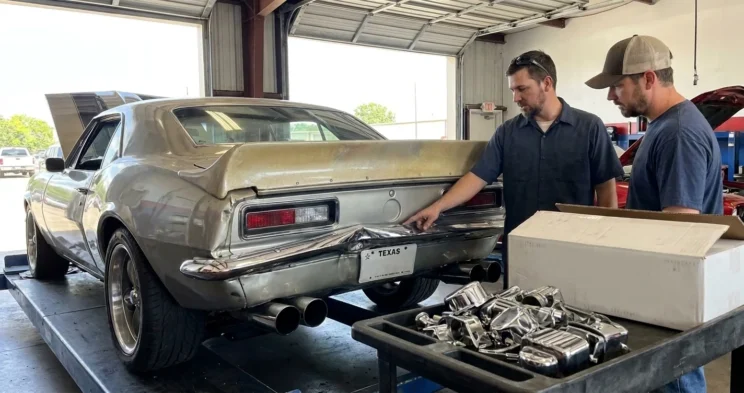
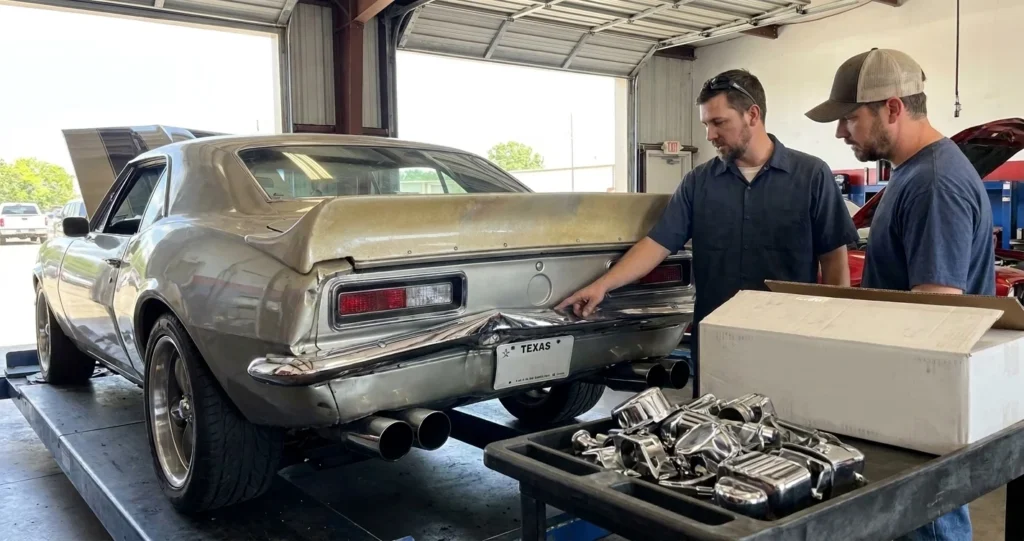
Insurance can cover custom car parts after a Texas crash, but the outcome depends on what you claim. If an estimate leaves out your lift kit, custom wheels, audio system, or wrap, compare it with your equipment records before accepting the valuation.
Your own policy pays according to its custom equipment coverage terms and limits. A claim against the at-fault driver depends on the loss the crash caused, as proven by your records. In both cases, what you paid for an upgrade is not automatically what an insurer will pay.
Can Insurance Pay for Custom Parts Damaged in a Texas Crash?
Yes, insurance can pay for damaged custom parts. How much it pays depends on the claim route, policy terms, fault, and the proof you provide.
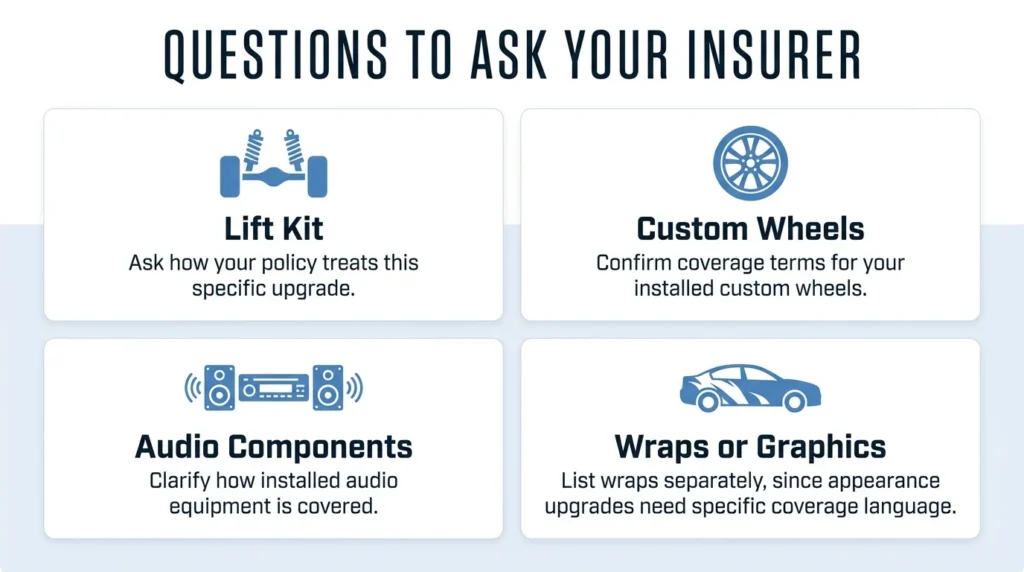
Custom parts here refer to owner-added equipment or appearance upgrades, including lift kits, custom wheels, installed audio systems, wraps, body kits, and custom paint.
After a crash, two claim routes may be available. The Texas Department of Insurance explains that collision coverage pays for crash damage to your own vehicle, while liability coverage pays for damage a driver causes to others. Your own claim follows your policy terms. A claim against the at-fault driver follows Texas property-damage rules and remains subject to the available liability coverage.
The phrase “full coverage” does not establish that every modification is covered. The Texas Office of Public Insurance Counsel advises drivers to ask insurers about custom sound equipment, rims, and tool boxes, and explains that endorsements change coverage.
What Does Your Own Policy Cover for Upgrades?
If you purchased collision coverage, a crash claim under your own policy generally runs through that coverage. Payment for owner-added equipment depends on your policy’s definitions, exclusions, endorsements, equipment schedule, deductible, and limits.
Start with your declarations page and endorsements. Compare them with the damaged equipment. Disclosure and scheduling requirements vary by policy, so your lift kit answer may differ from a friend’s.
Custom Equipment Limits
Progressive’s explanation of aftermarket coverage says its comprehensive and collision coverage includes the first $1,000 of damage to aftermarket parts or modifications. It also describes added custom parts and equipment coverage that may pay up to $5,000.
Those figures describe one insurer’s offering and depend on the issued policy and state availability. These are not standard Texas limits and should not be added together to reach an assumed $6,000 benefit.
Questions to Ask Your Carrier
Ask your insurer how it treats each upgrade. Name the lift kit, custom wheels, and installed audio components. List a wrap specifically as a wrap or graphics, since appearance upgrades can fall under custom equipment language.
The answer for each item depends on your policy. Your collision deductible also applies to a collision claim under your own coverage.
Why Can the At-Fault Driver’s Insurer Value Upgrades Differently?
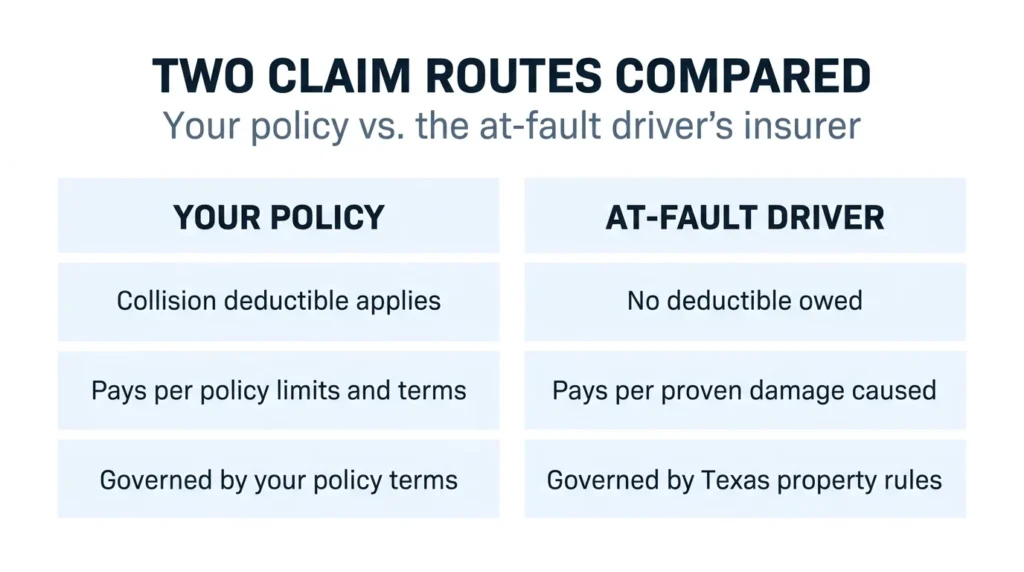
Your policy’s custom equipment limit does not control the value of a property-damage claim against the at-fault driver. A third-party claim is measured by the damage the crash caused, using Texas property-damage rules.
In J&D Towing, LLC v. American Alternative Insurance Corp., the Texas Supreme Court described the general measures of direct property damage. For repairable damage, the measure is generally the difference in market value before and after the loss, with reasonable restoration costs available when repair is economical and reasonable. For a total loss, the measure is the property’s market value immediately before the loss at its location.
That case did not decide a custom-parts dispute. Applied to a modified vehicle, the general rule means supported repair costs for a damaged upgrade can be considered in a repairable claim. In a total loss, the vehicle’s pre-crash market value as equipped includes any proven value added by the upgrades.
TDI’s total-loss valuation guidance tells owners to identify custom parts that increased the vehicle’s value and provide comparable vehicles from their area. Receipts help prove what you bought and installed, but they don’t establish the same amount of added market value. Fault, causation, available liability coverage, and your evidence can affect how much you can recover.
You do not pay a deductible on a claim against the other driver’s insurer. A collision claim under your own policy carries the applicable deductible. If you were also hurt, Texas car accident lawyers can help you review the property claim alongside your injury claim.
How Do You Prove an Upgrade Was Missed or Undervalued?
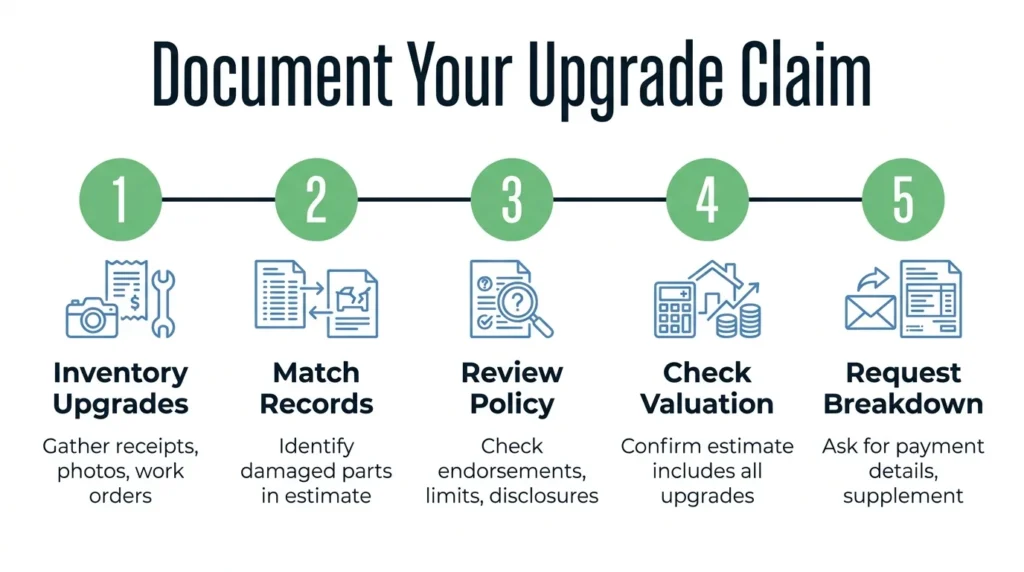
Document the installed upgrades, then compare them with the policy terms, repair estimate, total-loss valuation, and the insurer’s payment breakdown. Ask for a specific explanation when something is missing.
- Inventory each upgrade. Gather its brand and model, purchase and installation dates, receipts, shop work orders, pre-crash photos, and any existing appraisal. Allstate’s modified-car guidance recommends these records for valuation and claims.
- Match the records to the damage. Ask the shop to name the installed lift kit or custom wheel in its estimate. Identify the audio components and whether they were permanently installed. For a wrap, keep the installer’s invoice and photos showing its finish and condition.
- Review your policy for a claim with your insurer. Gather the declarations, custom equipment endorsement, equipment schedule, and any earlier written disclosure. Ask which provision and limit the adjuster is applying.
- Check the estimate or valuation. Confirm the repair estimate identifies the damaged upgrades. For a total loss, check the vehicle’s condition and equipment, and submit relevant local comparable vehicles or appraisal evidence to support disputed added value.
- Request a written payment breakdown. Ask the insurer to show the accepted loss amount, equipment limits, deductible, and any salvage adjustment. Request an explanation for omitted upgrades and the policy provision behind any contractual cap.
- Ask for a supplement if damage was missed. TDI says estimates can be revisited when additional damage is found, so ask the shop to submit a supported supplement.
The TDI auto insurance guide also explains the limits of dispute tools. Your policy’s appraisal process addresses certain valuation disputes with your insurer, not disputes with the other driver’s insurer. TDI cannot decide fault or set damage amounts.
Talk with Angel Reyes & Associates About Your Crash Claim
If you were injured in the crash, questions about your vehicle’s upgrades can add to the strain of medical bills and missed work. Bring your upgrade records, policy, repair estimate or total-loss valuation, and any payment breakdown to your free consultation.
Angel Reyes & Associates has guided injured Texans for over 30 years, and you can reach us 24/7. Contact Angel Reyes & Associates to review your situation and walk through your options.
Past results do not guarantee future outcomes.
Custom Car Parts FAQs
Does Texas Require Drivers to Report Vehicle Modifications to Their Insurance Company?
Texas law does not require you to report every vehicle modification to your insurer. However, your policy may require disclosure of certain upgrades, and failing to provide required information can create coverage disputes.
Can Aftermarket Parts Affect a Vehicle's Factory Warranty After an Accident?
Installing aftermarket parts does not automatically void a vehicle’s factory warranty. However, a manufacturer may deny warranty coverage for damage caused by a modification, even when unrelated warranty protections remain in effect.
Will Insurance Cover Custom Car Parts if Someone Hits My Parked Car?
If another driver damages your parked vehicle, their property damage liability insurance may cover the resulting damage to custom parts, subject to fault and coverage limits. Your own collision coverage may also apply, depending on your policy.
Can You Keep Custom Wheels or Other Upgrades After Your Car Is Totaled?
You may be able to retain certain removable upgrades from a totaled vehicle, but you should obtain the insurer’s approval before removing anything. Removing equipment included in the vehicle’s valuation may affect the settlement amount.
Can You Sue an At-Fault Driver for Custom Car Parts That Insurance Won't Fully Cover?
Under Texas law, you may sue the at-fault driver for proven property damage that exceeds available insurance coverage. Recovering additional compensation depends on establishing liability, the amount of damage, and the driver’s ability to pay.
About the Authors

Angel Reyes
Writer
Angel L. Reyes, III is the Founder and Managing Partner of Angel Reyes & Associates. A nationally recognized trial attorney and business leader, Angel has helped over 70,000 injury victims recover more than $1 billion since founding the firm in 1993. Named to the Texas Super Lawyers list annually since 2008, Angel brings Wall Street experience, Ivy League education, and a deep commitment to client advocacy. He is a frequent legal commentator and published author with extensive contributions to legal scholarship, trial strategy, and consumer protection.

Kyle Nicolas
Editor
Kyle Nicolas is the Web Content & SEO Manager at Angel Reyes & Associates. He has more than 10 years of experience as a marketing co...

Angel Reyes
Reviewer
Angel L. Reyes, III is the Founder and Managing Partner of Angel Reyes & Associates. A nationally recognized trial attorney and business...