What Happens When You Sue for UIM Benefits?


Every article on this site is researched by our internal team, reviewed for legal accuracy against current Texas law, and held to State Bar of Texas advertising standards before publication. We do not publish content that overstates outcomes or makes promises about results.
Learn more about our
editorial standards .
Key Takeaways
- A Texas UIM lawsuit can establish the other driver's liability and your right to benefits.
- Dependent bad-faith claims may wait while the court decides the UIM benefits dispute.
- Liability insurance credit is subtracted from your damages, not from your UIM policy limit.
When you sue your own insurance company for underinsured motorist (UIM) benefits in Texas, the lawsuit can establish the other driver’s liability, your damages, and what your policy owes. Bad-faith claims may have to wait while the benefits case proceeds. The payment calculation accounts for the other driver’s insurance, and a court may award attorney’s fees in an appropriate case.
If you’re facing medical bills after a crash and your own insurer disputes your claim, suing over coverage you bought can feel frustrating. Understanding what the lawsuit must prove helps you see why the driver’s settlement may not end the dispute.
Why Would You Sue Your Own Insurance Company for UIM Benefits?
You may need to sue because your UIM insurer’s contractual duty to pay does not arise until a judgment establishes the other driver’s liability and underinsured status. In Brainard v. Trinity Universal Insurance Co., the Texas Supreme Court held that asking for benefits or filing suit does not, by itself, trigger that duty.
The same goes for the at-fault driver’s settlement or admission of fault. Neither one establishes your UIM entitlement, because your insurer can still dispute fault or the size of your damages.
Not every UIM claim ends up in court. Claims can be resolved by agreement. When they don’t, the lawsuit enforces coverage you bought, and you still have to prove what happened in the underlying crash.
That is why evaluating collision evidence with Texas car accident lawyers can help identify what remains disputed. A UIM case involves the underlying collision’s liability and damages questions.
You don’t have to win a judgment against the at-fault driver first. Brainard allows a direct action against your own insurer to resolve those questions.
In Allstate Insurance Co. v. Irwin, the court approved a declaratory judgment action to establish your rights under the policy before any breach of contract has occurred. The petition, which starts the lawsuit, identifies which questions are in dispute: coverage, causation, the amount of damages, or some combination.
Your policy, declarations page, and UIM endorsement help identify coverage issues. Collision evidence, medical records, and wage-loss records help establish fault and damages. In Irwin, the parties agreed on coverage and the settlement credit, while causation and damages went to trial.
What Happens to the At-Fault Driver’s Settlement & Your Insurer’s Consent?
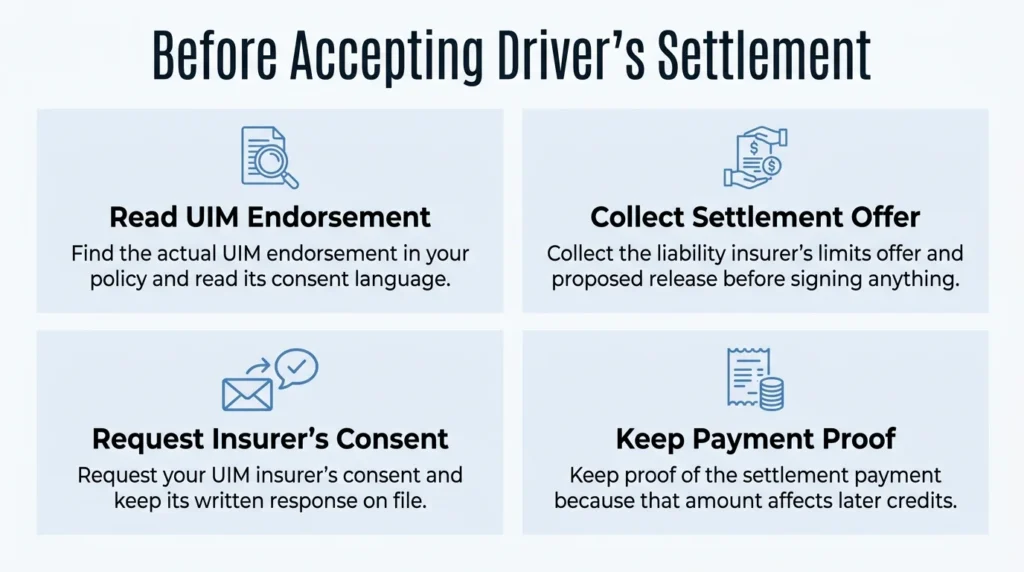
Before accepting the at-fault driver’s settlement, review your policy’s consent-to-settle clause and obtain your UIM insurer’s consent as required by that clause. Consent to settle does not establish fault, damages, or UIM entitlement. As Brainard explains, the driver’s settlement does not establish what your UIM coverage owes.
These steps help preserve the documents needed for that review:
- Find the actual UIM endorsement in your policy and read its consent language.
- Collect the liability insurer’s limits offer and proposed release before you sign anything.
- Request your UIM insurer’s consent and keep its written response.
- Keep proof of the settlement payment, because that amount matters later when the court applies credits.
What if you settled without consent? In Hernandez v. Gulf Group Lloyds, the court held that a settlement-without-consent exclusion defeats coverage only when the settlement actually prejudices the insurer.
Prejudice can come from releasing valuable subrogation rights, which let your insurer pursue the at-fault driver for what it pays you. Missing consent does not always destroy coverage, but it can put coverage at risk. Have the consent clause and proposed release reviewed before signing.
Why Might the Court Separate Bad-Faith & Insurance Code Claims?
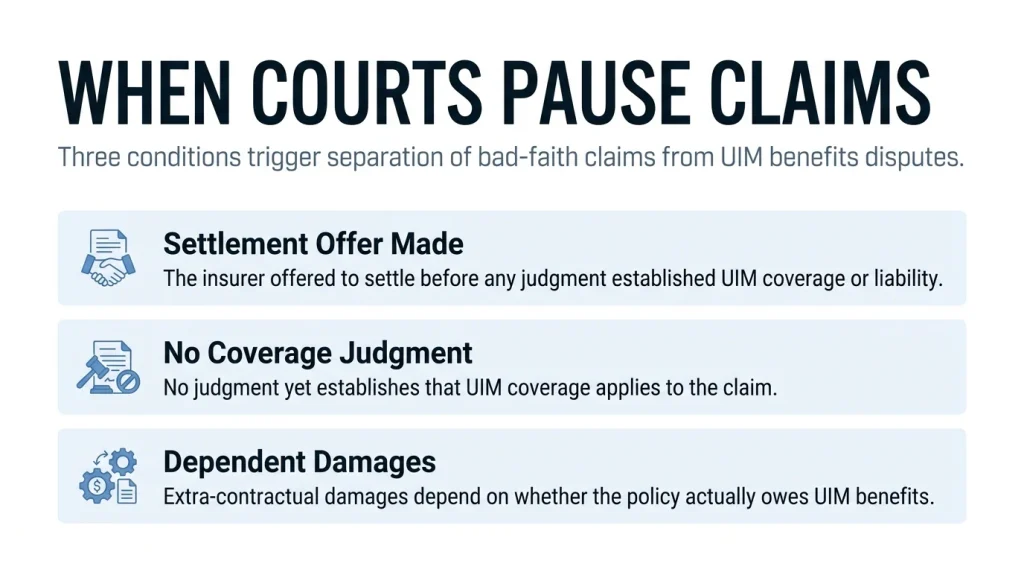
Courts may separate misconduct claims that depend on whether the policy owes UIM benefits. In In re State Farm Mutual Automobile Insurance Co. and Lindsey Nicole Dessart, decided in April 2025, the Texas Supreme Court applied a rule requiring separation and abatement when three conditions are present:
- The insurer offered to settle.
- No judgment yet establishes UIM coverage.
- The extra-contractual damages depend on the policy benefits.
Extra-contractual claims seek recovery for alleged misconduct beyond payment of the policy benefits. People often call separating the proceedings UIM bifurcation, but courts can do this in different ways.
Severance splits the claims into separate lawsuits. Separate trials keep one lawsuit but try the claims separately. Abatement pauses the dependent claims, including discovery on them, while the benefits case moves forward.
Separation does not necessarily mean one jury hears two back-to-back phases. It also does not mean your bad-faith claims are dismissed.
The reasoning is practical. Evidence of settlement offers can unfairly influence a jury deciding damages, and a benefits ruling may eliminate the basis for dependent misconduct claims. Pausing those claims can avoid unnecessary litigation expenses.
To see which claims are moving now and which are on hold, check the petition and any severance, separate-trial, or abatement order.
The 2025 decision continued to apply Brainard and declined to overrule it. It left open questions about injuries independent of lost benefits and whether statutory settlement duties can arise before judgment. It did not hold that insurers owe no good-faith duties before judgment, and filing a benefits lawsuit does not itself prove bad faith.
How Does the Judgment Determine the UIM Payment?
The damages finding and the UIM payment can be different amounts. Under Texas Insurance Code § 1952.106, recovery depends on your damages, your UIM policy limit, and amounts recovered or recoverable from the at-fault driver’s liability insurer.
The Texas Department of Insurance personal automobile checklist explains that the liability-insurance credit comes off actual damages, not the UIM policy limit. To understand the calculation:
- Start with the damages you are legally entitled to recover.
- Subtract the applicable liability-insurance credit from those damages.
- Compare the remaining covered damages with your UIM limit, which caps the benefits.
- Verify whether any other credits apply and how they affect payment under your policy.
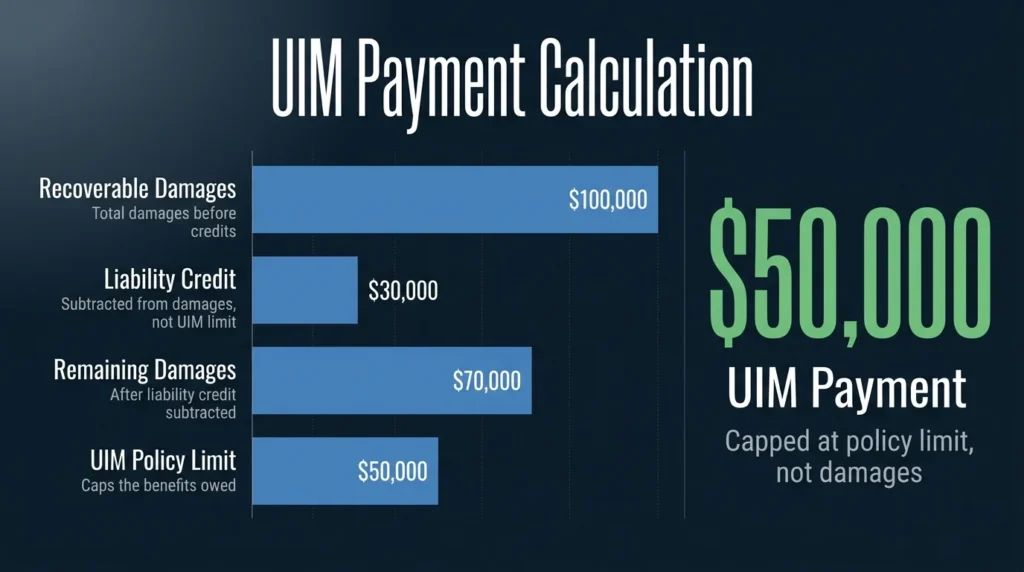
For a hypothetical calculation, assume $100,000 in recoverable damages, a $30,000 liability-insurance credit, $50,000 in UIM limits, and no other reductions. Subtracting the credit leaves $70,000 in uncovered damages, so the UIM payment is capped at $50,000. Subtracting $30,000 from the $50,000 limit would be the wrong method.
You cannot decide whether a driver was underinsured just by comparing the face amounts of the two policies. Damages drive the analysis.
When reviewing a judgment, examine the damages findings, liability-insurance credit, any other credits, and UIM cap separately. Verify policy-specific offsets against your own coverage rather than copying them from another case.
Can You Recover Attorney’s Fees in a Texas UIM Lawsuit?
A court may award attorney’s fees in an appropriate UIM declaratory judgment action, even before a contract breach, under Irwin. Texas Civil Practice and Remedies Code § 37.009, part of the Uniform Declaratory Judgments Act, permits costs and reasonable and necessary attorney’s fees when equitable and just.
That award is discretionary. Filing suit, winning, or receiving benefits does not automatically make the insurer pay your legal expenses.
Brainard rejected a Chapter 38 fee request in that case’s particular posture; it did not impose a blanket ban on UIM attorney’s fees. Irwin later confirmed the declaratory judgment route.
Keep three amounts separate: the UIM benefits, any fees a court awards, and what you owe under your own fee agreement with your lawyer. They are different amounts governed by different rules.
Talk With Angel Reyes & Associates About Your UIM Claim
Before a consultation, gather your policy and UIM endorsement, the at-fault driver’s limits settlement, your insurer’s consent, and any petition, court order, judgment, or proposed offset. Those documents help show what remains disputed and which claims can proceed.
Contact Angel Reyes & Associates for a free consultation to review your policy and your options. Our attorneys are here to help.
Past results do not guarantee future outcomes.
Suing For UIM Benefits FAQs
Can you sue your UIM insurance company if the at-fault driver has no assets?
Yes. Your UIM claim generally focuses on the at-fault driver’s liability, your damages, and the coverage available under your own policy, rather than whether the driver has personal assets to pay a judgment.
Can a UIM insurance company require an independent medical examination?
Depending on the policy and applicable procedural rules, an insurer may seek a medical examination to evaluate the injuries claimed, and a court may order one during litigation. Review the request carefully because the circumstances and rules governing an examination can affect your obligations.
How long does a UIM lawsuit take in Texas?
The timeline depends on disputed issues, medical treatment, evidence gathering, court scheduling, settlement negotiations, and whether additional claims are paused while the benefits dispute proceeds. Cases involving contested causation, extensive damages evidence, or appeals may take longer than those resolved through an earlier agreement.
About the Authors

Angel Reyes
Writer
Angel L. Reyes, III is the Founder and Managing Partner of Angel Reyes & Associates. A nationally recognized trial attorney and business leader, Angel has helped over 70,000 injury victims recover more than $1 billion since founding the firm in 1993. Named to the Texas Super Lawyers list annually since 2008, Angel brings Wall Street experience, Ivy League education, and a deep commitment to client advocacy. He is a frequent legal commentator and published author with extensive contributions to legal scholarship, trial strategy, and consumer protection.

Kyle Nicolas
Editor
Kyle Nicolas is the Web Content & SEO Manager at Angel Reyes & Associates. He has more than 10 years of experience as a marketing co...

Angel Reyes
Reviewer
Angel L. Reyes, III is the Founder and Managing Partner of Angel Reyes & Associates. A nationally recognized trial attorney and business...