Do More People Die in Car or Motorcycle Crashes?


Every article on this site is researched by our internal team, reviewed for legal accuracy against current Texas law, and held to State Bar of Texas advertising standards before publication. We do not publish content that overstates outcomes or makes promises about results.
Learn more about our
editorial standards .
Key Takeaways
- Motorcyclists die at roughly 22 times the rate of car occupants per 100 million miles driven.
- Motorcycles are 3% of registered vehicles but account for 15% of all U.S. traffic fatalities.
- Texas riders have two years from the crash date to file a personal injury or wrongful death claim.
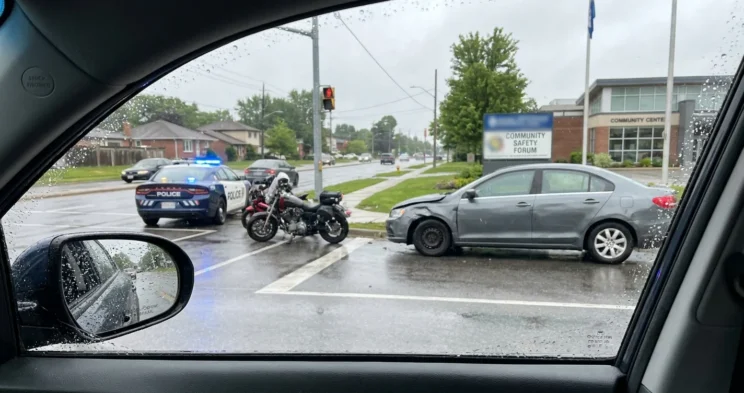
Drivers walk away from most car accidents. Riders often do not. The crash that leaves a car driver shaken and sore can send a motorcyclist to a trauma center for weeks, and the numbers from federal and state safety agencies explain exactly why.
The gap between motorcycle and car fatality rates is not subtle. It is one of the most dramatic safety disparities in American transportation, and it shapes everything about how a serious motorcycle accident claim is evaluated under Texas law.
How Much More Often Do Riders Die Per Mile?
Motorcyclists die at roughly 27 times the rate of passenger car occupants when you account for how much each vehicle type is actually driven. According to NHTSA’s current motorcycle safety data, motorcyclists were almost 27 times more likely than passenger car occupants to die in a crash, and almost 5 times more likely to be injured, per mile traveled in 2024.
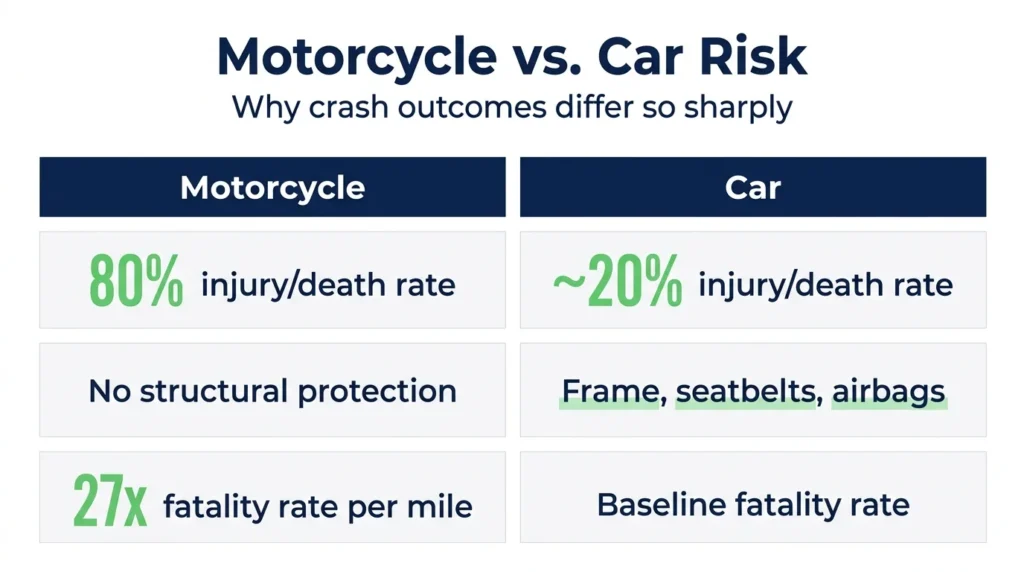
Vehicle miles traveled, or VMT, is the standard way to compare crash risk fairly. It controls for the fact that cars are driven billions more miles each year than motorcycles. Without that control, raw death counts would be misleading. With it, the disparity becomes clear.
In 2024, 6,228 motorcyclists were killed on U.S. roads, one of the highest totals since federal recordkeeping began in 1975. Motorcycles make up about 3% of all registered vehicles in the United States. Yet motorcyclists accounted for 16% of all traffic deaths that year. That overrepresentation reflects what happens when riders have no structural protection between them and the road.
Texas Motorcycle Fatalities by the Numbers
In many ways, Texas mirrors the national pattern when it comes to motorcycle accidents. According to the Texas Department of Transportation, 557 motorcyclists were killed on Texas roads in 2025, with another 2,468 riders sustaining serious injuries.
In 2023, the most recent year with detailed breakdowns available:
- 55% of Texas motorcycle fatalities occurred on urban roads
- Nearly 30% of fatal motorcycle crashes happened at intersections
- 40% of motorcyclists killed were not wearing helmets at the time of their crash
Breaking these numbers down by county shows the risk is not limited to any one part of the state. Harris, Bexar, Dallas, and Tarrant counties consistently lead in crash volume, but serious and fatal crashes occur across every region.
Why Motorcycle Crashes Cause More Severe Injuries
The fatality gap is not a mystery. It is the direct result of what riders do not have: car occupants are surrounded by a reinforced steel frame. Seatbelts spread crash forces across the body. Airbags deploy in milliseconds to cushion the head and chest. Motorcyclists have none of that.
When a crash happens on a motorcycle, the rider either stays with the bike and absorbs the full impact, or is thrown free and hits the road or another vehicle. Neither outcome is gentle. The injuries that result are among the most serious seen in any civilian trauma setting.
The most common catastrophic results include traumatic brain injury, spinal cord damage, severe road rash requiring skin grafts, and multiple bone fractures from a single collision. For a full picture of what these injuries involve, see what the data shows about common injuries in motorcycle accidents.
Roughly 80% of all motorcycle crashes result in injury or death. For passenger vehicle crashes, that number is closer to 20%. Even a relatively low-speed motorcycle collision can produce injuries that require surgery, extended rehabilitation, and months of recovery.
What Higher Severity Means for Your Claim
Injury severity drives claim value. When injuries are more severe, documented damages are higher: larger medical bills, longer recovery periods, more lost income, and greater pain and suffering. A motorcycle crash that produces a traumatic brain injury or spinal cord damage creates a fundamentally different legal situation than a rear-end collision that causes whiplash.
Insurance adjusters know this. Some use it in reverse. They may argue that the rider contributed to the crash, assumed the risks of riding, or failed to wear a helmet in a way that affected the outcome. These arguments are built to reduce what they pay out. Understanding how a Texas motorcycle accident settlement is calculated is the first step to pushing back against those arguments effectively.
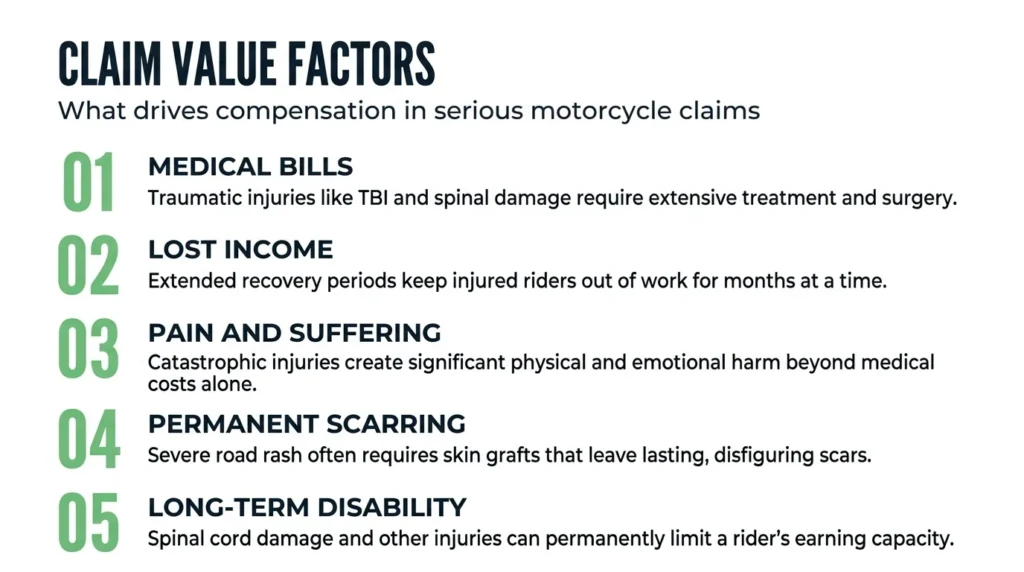
Serious motorcycle crashes frequently trigger categories of damages that do not come up in minor car accidents. Permanent scarring, loss of earning capacity, and long-term disability all affect the value of a claim. These categories require documentation and expert support to establish fully.
When a crash is fatal, the legal situation shifts. Surviving family members may bring a wrongful death action under the Texas Wrongful Death Act (Texas Civil Practice and Remedies Code Chapter 71), which allows them to recover for their own losses resulting from the death. For families facing that situation, the process for fatal car and motorcycle accident claims in Texas explains how these cases work.
Whether the claim is for an injured rider or a surviving family member, the filing deadline applies. The Texas Civil Practice and Remedies Code (CPRC) § 16.003 gives you two years from the date of the crash to file a personal injury or wrongful death lawsuit. Miss that deadline and the right to sue is almost certainly gone.
Talk to a Motorcycle Accident Attorney
The data is clear. Motorcycle crashes produce more severe injuries, higher damages, and more complex legal claims than the average car accident. Riders and their families deserve legal representation that understands what those numbers mean in practice.
Angel Reyes & Associates has handled serious injuries across Texas for over 30 years, including motorcycle accident cases. We work on contingency, meaning there is no fee unless we win. Whether you are an injured rider dealing with medical bills and lost income, or a family that has lost someone on the road, we can review your situation and walk you through your legal options.
Contact us at our free consultation page or call us 24/7. Our team serves the entire state of Texas, with more than 20 office locations across the state and has recovered more than $1 billion for clients.
Past results do not guarantee future outcomes.
Car vs. Motorcycle Accident FAQs
Does Texas require motorcycle riders to wear a helmet?
Texas requires helmets for all riders under 21. Riders 21 and older can ride without a helmet only if they have completed an approved motorcycle safety course or carry at least $10,000 in health insurance coverage for crash-related injuries.
Can a motorcycle passenger file a separate injury claim in Texas?
Yes. A passenger injured on a motorcycle has the same right to file a personal injury claim as any other crash victim. They can pursue compensation from the at-fault driver, from the motorcycle operator if that person caused the crash, or from both if more than one party shares fault.
What if the other driver who hit me had no insurance?
If you carry uninsured/underinsured motorist (UM/UIM) coverage on your motorcycle policy, you can file a claim through your own insurer. Texas does not require UM/UIM coverage, but it is one of the most valuable protections a rider can carry given how often serious crashes involve underinsured drivers.
Does helmet use actually reduce fatality risk in a motorcycle crash?
NHTSA data shows helmet use reduces the risk of a fatal head injury by approximately 37% and the risk of head injury overall by approximately 69%. The protection is real, but helmets do not eliminate the risk created by the fundamental lack of structural protection that makes motorcycle crashes so severe.
Are motorcycle accident claims handled the same way as car accident claims?
The basic legal framework is the same, but motorcycle claims are often more contested. Insurance adjusters sometimes argue that a rider’s choice to ride contributed to the severity of injuries, or that the rider was more at fault for the crash. These arguments are not automatic legal defenses, but they make experienced legal representation more important in serious motorcycle cases.
About the Authors

Angel Reyes
Writer
Angel L. Reyes, III is the Founder and Managing Partner of Angel Reyes & Associates. A nationally recognized trial attorney and business leader, Angel has helped over 55,000 injury victims recover more than $1 billion since founding the firm in 1993. Named to the Texas Super Lawyers list annually since 2008, Angel brings Wall Street experience, Ivy League education, and a deep commitment to client advocacy. He is a frequent legal commentator and published author with extensive contributions to legal scholarship, trial strategy, and consumer protection.

Kyle Nicolas
Editor
Kyle Nicolas is the Web Content & SEO Manager at Angel Reyes & Associates. He has more than 10 years of experience as a marketing co...

Angel Reyes
Reviewer
Angel L. Reyes, III is the Founder and Managing Partner of Angel Reyes & Associates. A nationally recognized trial attorney and business...