Organ Damage Injuries from Motorcycle Accidents in Texas


Every article on this site is researched by our internal team, reviewed for legal accuracy against current Texas law, and held to State Bar of Texas advertising standards before publication. We do not publish content that overstates outcomes or makes promises about results.
Learn more about our
editorial standards .
Key Takeaways
- The spleen, liver, and kidneys are the organs most often injured in a motorcycle crash.
- Organ injuries may not cause visible symptoms for hours or days after a motorcycle crash.
- Texas gives you two years to file a personal injury claim after a motorcycle crash.
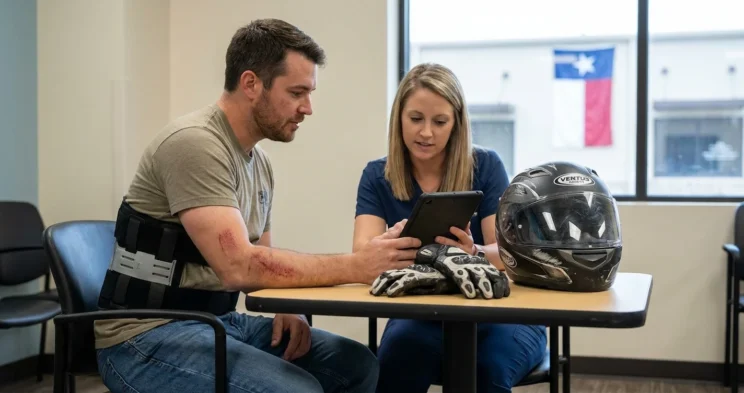
You walked away from the crash on I-10 near Katy feeling sore but stable. You declined the ambulance and drove home. Two days later, you collapsed with severe abdominal pain, and a CT scan showed a splenic laceration that had been bleeding slowly since impact. What seemed minor at the scene was never minor at all.
Organs Most Often Injured in a Motorcycle Crash
The spleen, liver, and kidneys sit at the center of the body with limited structural protection, and are the most frequently damaged internal organs in motorcycle crashes.
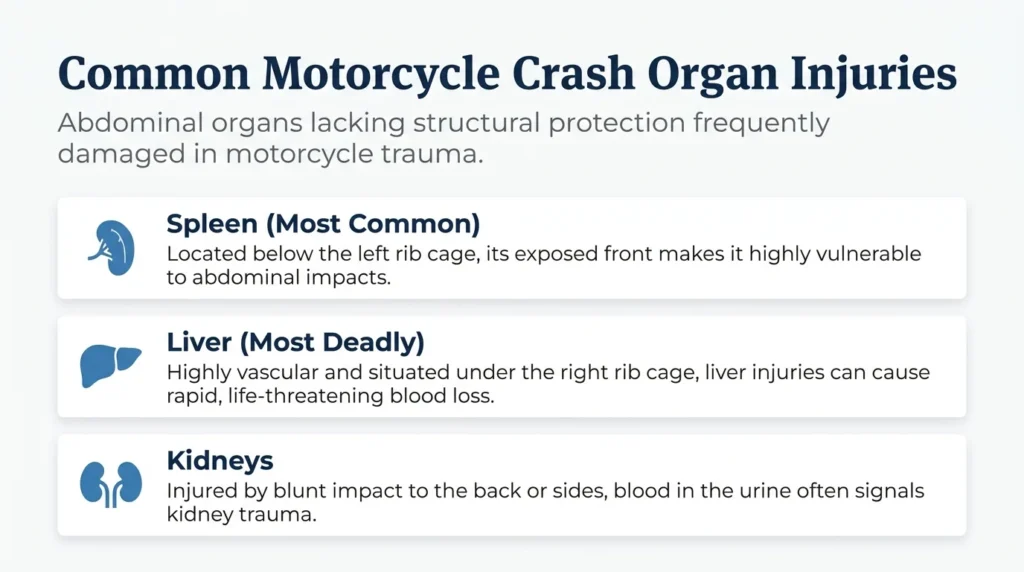
Motorcycle crashes can damage internal organs in three main ways:
- Blunt force trauma occurs when the abdomen makes direct contact with the pavement, the motorcycle frame, or another vehicle.
- Deceleration trauma occurs when the body stops suddenly but organs continue moving forward, tearing tissue where they are attached.
- Penetrating trauma occurs when road debris or components break through the skin.
The spleen is the most commonly injured abdominal organ in motor vehicle crashes, according to clinical research on splenic trauma. It sits below the left rib cage with no bone-related protection. The liver is the second most commonly injured organ and the leading cause of death when abdominal trauma is severe. Kidney injuries typically result from blunt impact to the back or sides of the body.
A single crash can damage more than one organ at once. Texas crash data shows that motorcyclists face severe injuries at rates far above car occupants, and Texas motorcycle accident statistics show why organ damage is consistently among the most serious injuries for riders.
Why Organ Damage Goes Undetected After a Crash
Organ injuries from motorcycle crashes frequently go undiagnosed for hours or days, which can be life-threatening. Adrenaline released during and after a crash reduces pain so effectively that riders with serious internal injuries often feel only mild soreness at the scene.
Internal bleeding from a liver laceration or splenic tear does not create visible injuries on the body. A bruise may appear across the torso over the following hours, but many riders dismiss it. Some splenic injuries fully rupture days or even weeks after the impact.
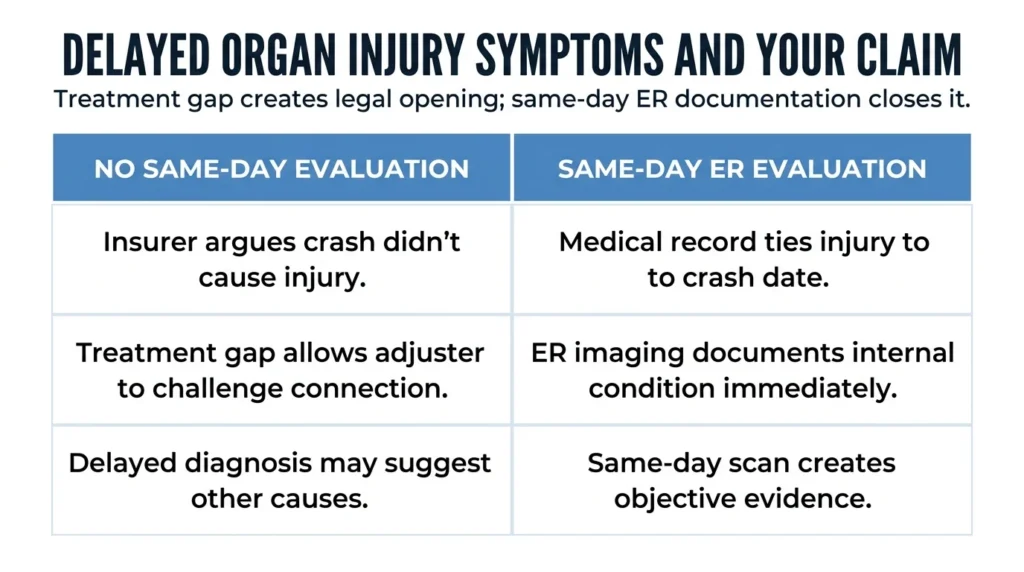
A delayed diagnosis also creates a legal problem. An insurer may argue that a rider who waited two days to seek treatment was not seriously injured at the time of the crash. That argument attacks causation, or the link between the crash and the injury, even when the injury is severe.
If you are a rider who suspects an internal injury, go to an emergency room the same day as the crash. The resulting evaluation from a medical professional protects both your health and your ability to pursue a claim.
When an organ injury proves fatal, surviving family members may have a claim under Texas wrongful death law in addition to any personal injury claim. Reading about common injuries in motorcycle crashes can help you and your family recognize what you may be facing.
Symptoms of Organ Damage to Watch For
Go to an emergency room, not an urgent care clinic, if you notice any of the following after a crash. Urgent care facilities do not provide imaging procedures that identify internal injuries.
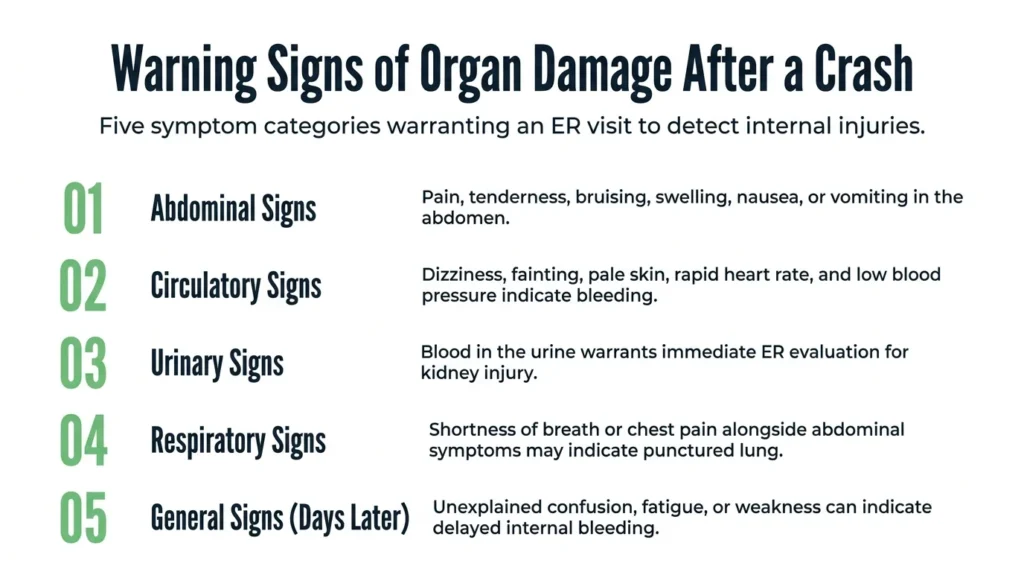
- Abdominal signs: Pain or tenderness anywhere in the abdomen or sides; visible bruising across the torso; swelling; nausea or vomiting without an obvious cause.
- Circulatory signs: Dizziness or fainting; pale, clammy skin; a rapid heartbeat; low blood pressure. These signs together point to active internal bleeding.
- Urinary signs: Blood in the urine, which may appear pink, red, or brown. This symptom alone calls for immediate emergency evaluation for kidney injury.
- Respiratory signs: Shortness of breath or chest pain. Rib fractures that accompany abdominal trauma sometimes puncture a lung, so respiratory symptoms alongside abdominal pain require urgent attention.
- General signs: Confusion, extreme fatigue, or unexplained weakness in the days after a crash, even without pain in specific areas.
How Organ Injuries Affect Your Texas Damages Claim
Organ injuries are among the most expensive injuries following a motorcycle crash, and their full cost often does not become clear for weeks. Texas allows injured riders to recover two categories of damages, or monetary compensation, from the at-fault driver.
Economic Damages
Economic damages refer to considerable financial losses. Emergency surgery, ICU care, blood transfusions, and hospitalization for a splenic laceration or liver repair are among the services resulting in six-figure medical bills.
Future costs can be equally large. A rider who loses a spleen faces lifelong immune vulnerability and specific vaccination requirements. Kidney damage that progresses to reduced function may require dialysis, which carries lifetime costs well into the hundreds of thousands of dollars. These future costs are fully recoverable under Texas law.
Lost income during recovery adds to the total. Serious organ injuries typically keep a rider out of work for weeks to months, and permanent injury-related health issues may affect the ability to work at all.
How fault for an accident is determined under Texas Civil Practice and Remedies Code (CPRC) Chapter 33 directly affects your compensation. Your damages are reduced by your percentage of fault for the accident; if you are found more than 50 percent at fault, you cannot recover damages. Understanding how motorcycle accident settlements work in Texas can help you evaluate any compensation offer before you accept it.
Non-Economic Damages
Non-economic damages compensate for losses that do not result in medical bills. Physical pain from surgery and recovery qualifies. Permanent impairment from a splenectomy or reduced kidney function is another type of non-economic damage.
Mental anguish, such as the fear of future organ failure and the psychological impact of life-altering surgery, also qualifies. The severity of the organ injury typically increases non-economic damages compared to less severe injuries.
Texas sets a strict filing deadline. Under CPRC § 16.003, you have two years from the date of the crash to file a personal injury lawsuit. Missing that deadline ends your right to sue regardless of how severe your injuries are.
You can review outcomes from past cases we have handled to understand how these claims have worked out for other riders.
Work with a Texas Motorcycle Attorney
Organ injuries require aggressive legal representation because their full cost is not visible for months, and insurers challenge causation and damages whenever they can.
Angel Reyes & Associates has spent more than 30 years representing motorcycle accident victims across Texas. We have recovered more than $1 billion for our clients. We offer free initial consultations and take cases on a no-fee-unless-you-win basis.
Learn more about our motorcycle accident services and cases to see how we handle these claims. To talk through your situation, contact us for a free consultation.
Past results do not guarantee future outcomes.
Motorcycle Accident Injury FAQs
Does the two-year filing deadline change if my organ injury was diagnosed weeks after the crash?
Texas generally starts the two-year clock on the date of the crash, not the date of diagnosis. Riders who discover internal organ damage late should contact an attorney right away, because the filing window may be shorter than it appears.
Will the at-fault driver's insurance pay my hospital bills directly while my claim is ongoing?
Texas liability insurance does not pay medical bills directly during the claim process. You will need to cover costs through your own health insurance or out of pocket, then recover those amounts as part of your settlement or judgment.
Can I still pursue a motorcycle injury claim if I have no health insurance?
Yes. Not having health insurance does not prevent you from filing a personal injury claim in Texas. Some medical providers accept attorney-referred cases on a lien basis, meaning treatment is provided and the provider is paid from the claim proceeds once it resolves.
Can a motorcycle passenger file a claim for organ injuries caused by the crash?
Yes. A passenger has the same right to file a personal injury claim as a rider does. The passenger can pursue the at-fault driver, and depending on the facts, both the other driver and the motorcycle operator may be liable.
How is a wrongful death claim different from a personal injury claim when organ injuries are fatal?
A personal injury claim belongs to the injured person; a wrongful death claim belongs to surviving family members after the person dies. Texas wrongful death claims can recover for lost financial support, loss of companionship, and lost inheritance, which are not available in a personal injury claim.
About the Authors

Angel Reyes
Writer
Angel L. Reyes, III is the Founder and Managing Partner of Angel Reyes & Associates. A nationally recognized trial attorney and business leader, Angel has helped over 55,000 injury victims recover more than $1 billion since founding the firm in 1993. Named to the Texas Super Lawyers list annually since 2008, Angel brings Wall Street experience, Ivy League education, and a deep commitment to client advocacy. He is a frequent legal commentator and published author with extensive contributions to legal scholarship, trial strategy, and consumer protection.

Kyle Nicolas
Editor
Kyle Nicolas is the Web Content & SEO Manager at Angel Reyes & Associates. He has more than 10 years of experience as a marketing co...

Angel Reyes
Reviewer
Angel L. Reyes, III is the Founder and Managing Partner of Angel Reyes & Associates. A nationally recognized trial attorney and business...