Do Motorcycle Accident Settlement Calculators Work?


Every article on this site is researched by our internal team, reviewed for legal accuracy against current Texas law, and held to State Bar of Texas advertising standards before publication. We do not publish content that overstates outcomes or makes promises about results.
Learn more about our
editorial standards .
Key Takeaways
- Texas comparative fault can reduce or eliminate your recovery, and no calculator can predict that.
- Insurers use proprietary software and local jury data that no public tool can access.
- Settling before maximum medical improvement means accepting a number that may not cover future costs.

You were riding home on the I-35 corridor through San Marcos when a driver cut across your lane and sent you down. The crash wasn’t your fault, but you’ve got medical bills coming in, and you haven’t been back to work in two weeks. You found an online settlement calculator, entered your expenses, and got a number back.
Now you’re wondering whether that number means anything. The short answer: it might, but its accuracy is often limited. Every case is unique, and case calculators often can’t consider all of the small details that influence your specific situation.
What Settlement Calculators Actually Do
Online motorcycle accident settlement calculators take the numbers you type in and run them through a simple formula. You enter your medical bills, lost wages, property damage, and a severity rating for your pain and suffering. The tool multiplies your economic losses by a factor and returns a settlement range.
Our case calculator can do this for you as well! We have specifically designed our calculator using real-world data from other cases we have handled to provide a more accurate estimate based on actual case outcomes. However, it’s important to note that our calculator can only produce exactly that: an estimate.
If an insurance adjuster is pressuring you into accepting an offer that falls well below what our calculator says your case might be worth, then you should absolutely have an attorney review your case before signing anything.
However, the output that our calculator puts out is a product of what you entered. Even when each question is answered as honestly as possible, the calculator cannot factor in specific details about your actual case, the people involved, or the legal terrain ahead of you.
These details could substantially influence the actual outcome in a real-world scenario. Motorcycle accidents require professional legal assistance for fair settlements.
Why Calculators Can’t Estimate Texas Claims
Texas motorcycle cases are shaped by five variables that no formula can reach. Each one can move your settlement value by tens of thousands of dollars in either direction.
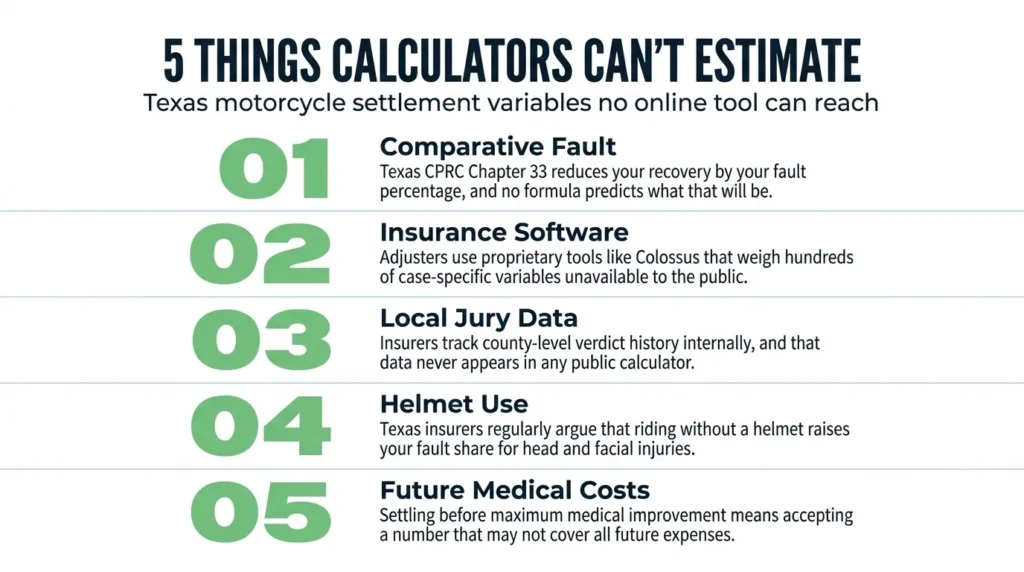
Texas comparative fault is the first and largest gap. Under Texas Civil Practice and Remedies Code (CPRC) Chapter 33, your recovery is reduced by your percentage of fault. A 30% fault finding cuts your payout by 30%. At 51% or higher, you recover nothing. Our calculator doesn’t have a field for fault allocation because there is no formula that predicts what percentage an insurer or jury will assign to you.
The second variable is adjuster calculations. Insurance adjusters do not use the same calculation methods that calculators mimic. Instead, they run your claim through proprietary software, such as Colossus or ClaimIQ, that weights hundreds of case-specific variables: gaps in your treatment history, how well your injuries are documented, the adjuster’s internal authority limit, and the company’s regional claims reserve. None of these appear on any public tool.
Local jury verdict data is the third variable calculators cannot see. Insurers maintain internal databases of verdicts by county and court. A case in a county known for conservative verdicts will be valued differently than the same facts in a county with higher historical awards. That data is not public and changes constantly.
Helmet use is the fourth variable, and it comes up more often than riders expect. Texas insurers routinely argue that a rider who was not wearing a helmet assumed extra risk for head and facial injuries. That argument appears at the claims negotiation stage, not just in court, and it increases the comparative fault percentage.
A calculator has no field for whether you were wearing a helmet and no way to estimate how it affects your number.
The fifth gap is future medical costs. Motorcycle accidents frequently involve injuries that require ongoing treatment. If you settle before you have reached maximum medical improvement, you are accepting a number that may not cover what your injuries will ultimately cost. Understanding when to accept an offer requires knowing whether your treatment is complete.
What Actually Drives Settlement Value in Texas?
Once you understand why calculators fall short, the question becomes: what actually determines what your claim is worth?
Economic Damages
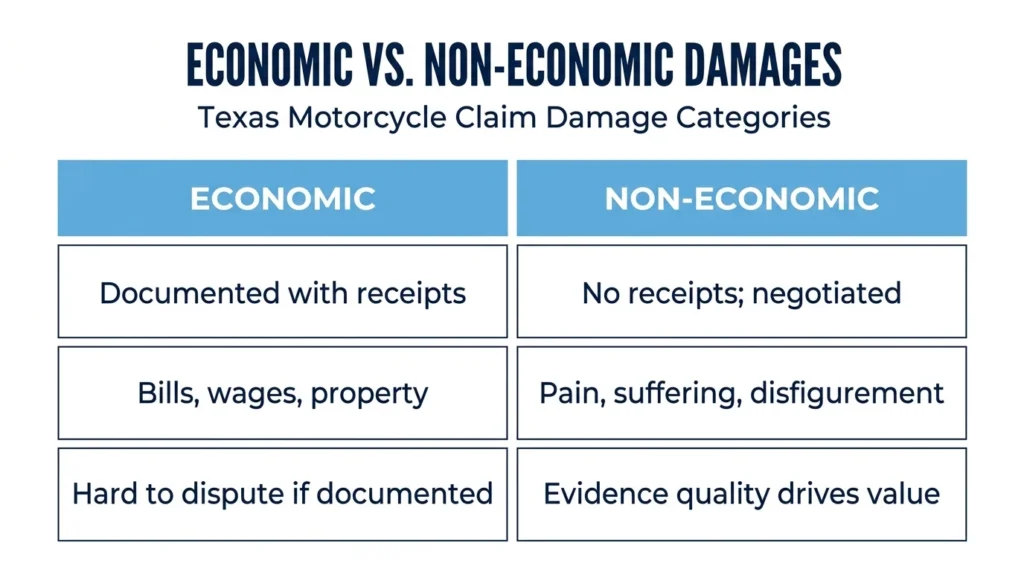
Economic damages are your documented, calculable losses. They include your past medical bills, projected future medical expenses and rehabilitation costs, wages you have already lost, and your reduced earning capacity if your injuries prevent you from returning to your previous work. Property damage to your motorcycle and gear is included too.
These losses form the base of any settlement figure. The more completely they are documented, the harder they are for an insurer to dispute.
Non-Economic Damages
Non-economic damages cover losses that do not come with receipts: pain and suffering, emotional distress, disfigurement, and loss of enjoyment of life. These are real losses. They are also negotiated, not calculated. No multiplier produces an accurate number for them.
What drives non-economic values in actual negotiations is the quality of evidence. Medical records documenting the progression of your pain, photos of your injuries over time, and statements about how your daily life has changed all affect how this portion of your claim is valued. The stronger your documentation, the less room the insurer has to argue the number down.
The Insurer’s Side of the Negotiation
While you are trying to estimate your claim on a public calculator, the insurer’s adjuster is working from an entirely different set of information. You are not operating on a level playing field.
Insurers open with low offers. The first number an adjuster puts in front of you is a business decision, not a fair evaluation. Accepting it closes your claim permanently. You lose the right to ask for more, even if your medical bills grow, even if a surgery turns out to be necessary. Once it is signed, it is final.
Policy limits create a ceiling you cannot see from the outside. The at-fault driver’s insurance coverage defines the maximum you can recover through their policy, regardless of how severe your injuries are. A calculator does not know those limits. It does not know whether the driver carried minimum coverage or a commercial policy with higher limits.
That gap alone makes any estimate unreliable.
Adjusters are trained negotiators who handle claims daily. You are likely managing a motorcycle injury for the first time. The information gap between you and the adjuster is wide, and the insurer’s goal is to resolve your claim for the least amount the evidence will support. Knowing how Texas motorcycle accident claims are handled can help you prepare.
Get a Real Assessment of Your Claim
A calculator can tell you a number. It cannot tell you whether that number reflects the fault allocation a Texas insurer will argue, the county where your case may be litigated, or the full scope of your medical recovery.
Angel Reyes & Associates has spent over 30 years helping injured Texans understand what their claims are actually worth. We offer free consultations, handle cases on a contingency basis so there is no fee unless we win, and have recovered more than $1 billion for clients across Texas.
If you were injured in a motorcycle accident and you want an evaluation that reflects the real variables in your case, reach out to schedule your consultation.
Past results do not guarantee future outcomes.
Motorcycle Accident Settlement Calculator FAQs
How long do I have to file a motorcycle accident claim in Texas?
Texas gives you two years from the date of the crash to file a personal injury lawsuit under Texas Civil Practice and Remedies Code Section 16.003. Missing that deadline will almost certainly end your ability to recover compensation, regardless of how strong your case is.
What if the at-fault driver has no insurance?
If the driver who hit you is uninsured or underinsured, your own uninsured/underinsured motorist (UM/UIM) coverage may cover the gap. Texas law requires insurers to offer UM/UIM coverage, so check your policy to see if you have it before assuming you have no options.
How long does a Texas motorcycle accident settlement typically take?
Simple claims with clear liability can settle in a few weeks, but cases involving serious injuries often take several months to a year or longer. Insurers are required to respond to your claim within 15 days under Texas law, but that does not mean a fair offer follows.
Does it matter if I don't have health insurance when filing a motorcycle accident claim?
Not having health insurance does not prevent you from pursuing a claim. Your attorney can often arrange a medical lien with your providers, allowing you to get treatment now and repay those costs from your settlement after the case resolves.
Can I still recover compensation if I was partially at fault for the crash?
Yes, as long as your share of the fault is 50% or less. Texas uses a modified comparative fault rule that reduces your recovery by your fault percentage, so a 20% fault finding reduces a $100,000 claim to $80,000. At 51% or more, you cannot recover anything.
About the Authors

Angel Reyes
Writer
Angel L. Reyes, III is the Founder and Managing Partner of Angel Reyes & Associates. A nationally recognized trial attorney and business leader, Angel has helped over 70,000 injury victims recover more than $1 billion since founding the firm in 1993. Named to the Texas Super Lawyers list annually since 2008, Angel brings Wall Street experience, Ivy League education, and a deep commitment to client advocacy. He is a frequent legal commentator and published author with extensive contributions to legal scholarship, trial strategy, and consumer protection.

Kyle Nicolas
Editor
Kyle Nicolas is the Web Content & SEO Manager at Angel Reyes & Associates. He has more than 10 years of experience as a marketing co...

Angel Reyes
Reviewer
Angel L. Reyes, III is the Founder and Managing Partner of Angel Reyes & Associates. A nationally recognized trial attorney and business...